This entry explains what 5W1H is and how to use it in the context of problem solving with critical thinking. Since 5W1H is a handy tool you can use at every stage of problem solving, learn the basics here.
Let’s begin.
toc
What Is 5W1H?
First, let’s check what “5W1H” means. 5W1H refers to the six question words Who, What, When, Where, Why, and How. In English, they’re better known as “the five Ws and one H” (or simply “the five Ws”), long taught in journalism as the elements of a complete news story.
Using these six question words lets you describe things accurately. You can treat “accurately” here as meaning “concretely.”
This is the key point. People may know what 5W1H consists of, but they tend to forget what it’s for. Make sure you understand this.
5W1H is used to describe things concretely
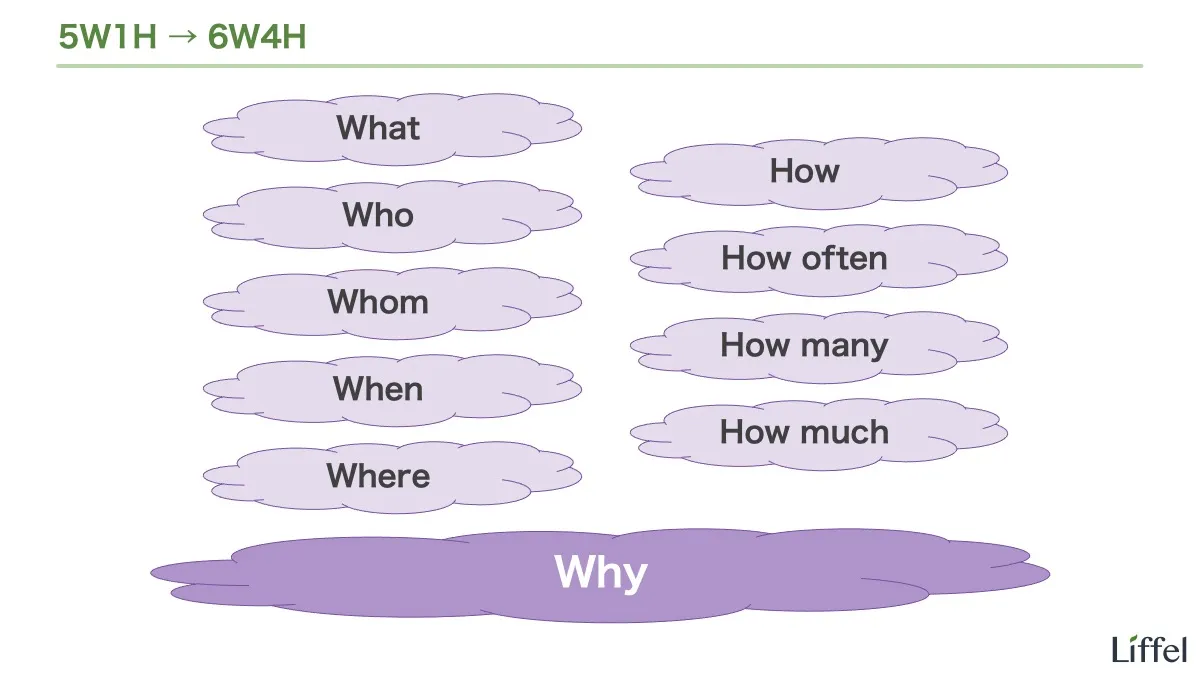
Extending It to 6W4H
Now, let’s extend 5W1H to 6W4H.
5W1H is generally introduced as a tool for describing news (what happened) concretely, and it’s certainly enough for that.
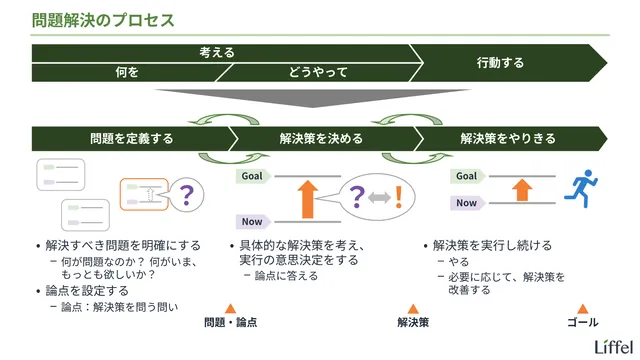
But unless you’re a journalist, you don’t write news. We actually use 5W1H in the context of problem solving with critical thinking. And what we want to make concrete in problem solving isn’t news but solutions (actions).
And 5W1H is often not enough to make solutions concrete.
If this doesn’t click, read the link below first. It explains what problem solving is.

So let’s extend it to 6W4H as follows:
- What exactly is the solution?
- What: What will you do?
- Who: Who will do it?
- Whom: For or to whom?
- When: When?
- Where: Where?
- Why: Why should it be done that way?
- Note: Treat Why as a separate question (explained later)
- How: How will you do it?
- How often: How often?
- How many: How many times / how much?1
- How much: How much will it cost?
You may think ten items are too many to remember. Don’t worry. In the end, you can’t act unless these elements are concrete. If you always keep the perspective of “Can I see this solution through?”, you’ll end up thinking about these ten question words whether you like it or not. Also, you don’t answer all ten every time. You pick and choose as needed.
Example
Let’s look at an example.

I’m going on a diet.

That’s not good enough. You need to make your solution concrete. Use the 6W4H.
Let’s use the 6W4H in this situation.
Making the Goal Concrete
First, make the goal concrete before making the solution concrete. “Going on a diet” is far too vague.
You can use the 6W4H to make the goal concrete too. While we’re at it, let’s use it.
- What do I want to achieve through dieting?
- What: What will I do? → No need to think about it
- Who: Who will do it? → I will (obvious, so it can be cut)
- Whom: For or to whom? → No need to think about it
- When: When? → Within six months
- Where: Where? → No need to think about it
- How: How will I do it? → No need to think about it
- How often: How often? → No need to think about it
- How many: How many times / how much? → Lose 8 kg
- How much: How much will it cost? → No need to think about it
- Why: Why? → Losing 8 kg will bring me to a healthy weight, and this pace won’t strain my body
For goals, it’s more like “the 6W4H can be used, more or less.” In most cases, knowing the “deadline” and the “numerical target” is enough for a goal. Using the 6W4H doesn’t offer much benefit.
So let’s say you’ve set the goal “lose 8 kg within six months.”
Making the Solution Concrete
Next, let’s make the solution concrete. This is the real thing. Since the correctness of the content isn’t the point here, treat it as a rough guide.
- What exactly will I do to lose 8 kg within six months?
- What: What will I do? → Restrict my diet and keep my daily calorie intake to 2,000 kcal or less
- Based on my age, weight, activity level, and so on, keeping my daily intake to 2,000 kcal or less should achieve the goal
- It’s not realistic to keep my current eating habits and exercise enough to burn off the calories and still lose weight
- Who: Who will do it? → I will (obvious, so it can be cut)
- Whom: For or to whom? → No need to think about it
- When: When? → Eat only breakfast and dinner, and skip lunch. Finish dinner by 7 p.m. if possible. Also, stop snacking entirely
- Eating three meals a day while keeping my intake to 2,000 kcal or less isn’t realistic for me. Also, as far as I could find, there’s no convincing reason to eat three meals a day
- As for which meal to skip, since I can control what I eat for breakfast, I shouldn’t skip it. So I’ll skip lunch or dinner. I chose lunch, considering the downside of getting sleepy after lunch, but skipping dinner would also be fine
- Where: Where? → No need to think about it
- Where I eat doesn’t matter
- How: How will I do it? → Breakfast is always a protein smoothie, and I can eat whatever I like for dinner. However, I’ll avoid carbohydrates as much as possible and choose a menu that keeps my daily total under 2,000 kcal
- Since breakfast is the easiest meal to control, I’ll fix the menu to secure the necessary nutrients such as protein, fat, and vitamins. Considering effort, how filling it is, and so on, I chose a protein smoothie
- Since strict menu control for dinner too isn’t realistic, I’ll loosen the restrictions there and manage by results (whether my weight goes down)
- How often: How often? → Every day. However, once every two weeks, I can eat as much as I like for dinner
- Unless I eat as much as I like once in a while, it won’t last
- How many: How many times / how much? → No need to think about it
- In this case, When and How cover what’s needed
- How much: How much will it cost? → No need to think about it
- Restricting my diet normally reduces food costs
- What: What will I do? → Restrict my diet and keep my daily calorie intake to 2,000 kcal or less
Confirm that using the 6W4H has made what to do more concrete than when you were just saying “I’m going on a diet.”
Tips for Using It
Here are some tips for using 5W1H (6W4H):
- Why is special
- You don’t need to be strict about which question word gets what
- Think while acting
Let me explain each in turn.
Tip 1: Why Is Special
First, when using 5W1H (6W4H) in the context of problem solving or critical thinking, Why is special. Specifically, Why isn’t treated on a par with the other question words. It’s used to mean “why the answer to each question word is what it is.”
Generally, Why in 5W1H means “why you’re doing it / why it happened” and applies to the whole. In this example, the answer to the question “Why should I diet?” would correspond to Why in the general sense.
But there’s no point in thinking about that question, is there? In this setting, you’ve already answered “Why should I diet?”2, which led to the decision “I’ll diet,” and now you’re thinking about how to do it concretely.
In other words, at the solution stage, there’s no point in thinking about “Why should I diet?” What matters more is whether the answer to each question word is right. So Why is used to mean “why the answer to each question word is what it is.” Confirm that the indented parts are the Whys and that they accompany every question word.
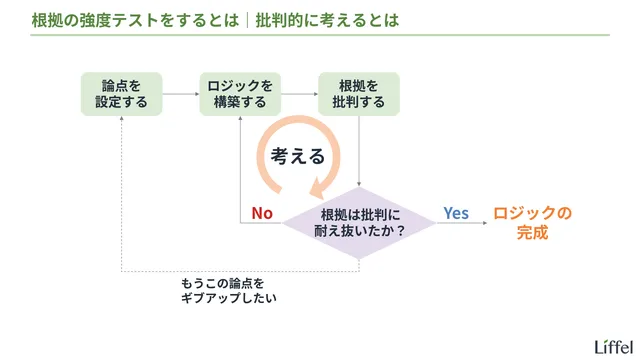
That’s what “Why is special” means. Get a picture of it from the image below.
The reason for this is that Why is thinking itself. This is explained in the entry below.
Tip 2: You Don’t Need to Be Strict About Which Question Word Gets What
Second, you don’t need to be strict about what you write under which question word, since all that matters is that what to do becomes concrete. In this example too, it’s hard to say what belongs under What, How, or How many, but as long as what to eat and how is clear, that’s fine.
You can check whether what to do has become concrete by asking yourself, after writing everything out, “Can I start acting right now without hesitation?” Rather than worrying about what to write under each question word, focus on whether you can answer “yes” to this question.
Focus on “Can I start acting right now without hesitation?”
In this example, the How part isn’t fully worked out. Since I don’t really want to discuss dieting, I kept it brief. To work it out fully, you’d also need a protein smoothie recipe and a list of the carbohydrate content and calories of the main foods. Guidelines on drinking are missing too3.
However, in my experience, if you make things too rigidly concrete, they become empty formalities. That’s the interesting thing about humans. I think the key is to make things concrete enough to act on without tying yourself down too much.
Tip 3: Think While Acting
The last tip is to think while acting.
Once you can answer “yes” to “Can I start acting right now without hesitation?”, just act. Unless your life or a large sum of money is at stake, acting won’t cost you much. You’ll reach your goal faster by improving your 6W4H while testing in practice whether your thinking was right.
In the diet example above too, I can write like that because I’ve actually thought that way and dieted. There’s no way I could write something that concrete through desk research alone without ever having dieted.
Acting without thinking may be less likely to produce results, but unless you act, you’re 100 percent certain to get no results. There’s no point in overthinking, so act boldly.
Exercise
Choose one of the following topics and make it concrete using the 6W4H (there are no sample answers).
- Study English
- Start strength training
- Learn programming
- Become more stylish
- Become better-looking
Try writing your answer in the box below.
That covers how to use 5W1H (6W4H) in problem solving with critical thinking. There are probably quite a few cases where “you vaguely know what to do but haven’t acted on it,” so in those cases, try using this framework.
If You Want to Keep Learning
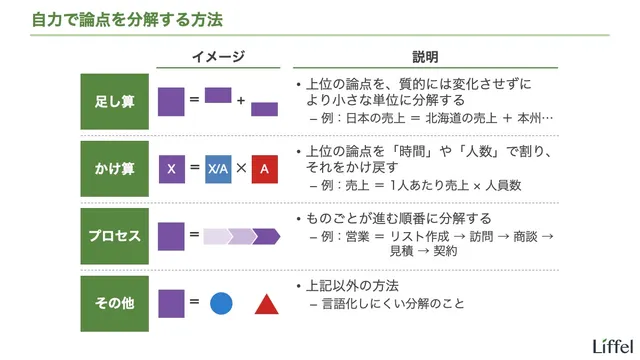
Thank you very much for reading this far. If you’d like to keep learning critical thinking, continue to the entry below. From the next entry, let’s learn how to break down questions on your own.
If you want to learn frameworks you can use in business, go to the link below.
Entries related to critical thinking are collected on the page below. Feel free to use them as a reference.
Footnotes
-
“How much” in the sense of quantity would also be “how much” in English, but since “How much” is used for “How much will it cost?”, I’ve organized it this way. ↩
-
If anything, what’s implied by the Why written when making the goal concrete (I’m not currently at a healthy weight) is the reason to diet. ↩
-
I don’t drink, so I’m not an expert, but it’s generally said that “not drinking is best, but if you do drink, you should avoid brewed drinks (such as beer) and choose distilled spirits (such as shochu).” ↩