
In this entry, you’ll learn specific ways to critique. Along the way, the origin of critical thinking will also become clear.
This entry is a sequel to the one below. If you’re not confident about what “critique” means, read it first.

Let’s begin.
toc
What It Means to Critique
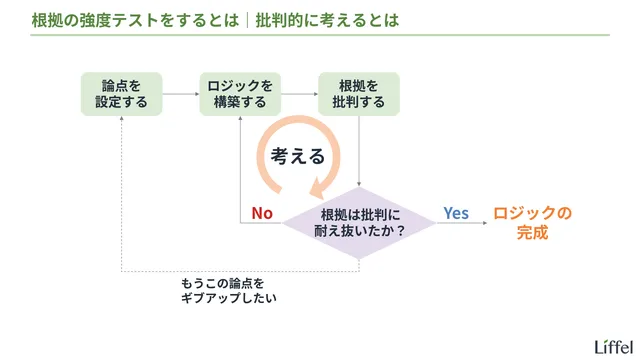
First, here’s the process of critique. Take a look.
As shown, thinking critically means critiquing the premises after building an argument, and rebuilding the argument as many times as it takes until the premises withstand critique.
So what exactly do you do to critique?
You doubt. To critique is to doubt.
Critique = doubt
An Example of Critique
First, look at an example.

Should I buy a house or rent one?

I think you should rent.
Why?
There are three reasons. First, buying property in Japan right now means you’re likely overpaying. Japan’s population will keep declining, so there will only be more and more surplus housing. In other words, as rents are likely to fall, it makes more sense to keep switching rentals to match.
Second… (omitted)
“Japan’s population will keep declining.” Is that really right?
Yes, it is.
Why?
The National Institute of Population and Social Security Research publishes population projections. The source is here (in Japanese).
I see. It seems safe to treat “Japan’s population will keep declining” as right. Next… (omitted)
Notice that Bear doubts Panda’s argument step by step. In this way, to critique is to doubt the argument presented by asking, “Is that really right?”
The Basic Tool of Critique: “Why?”
The basic method of critique is to keep asking “Why?” As long as you ask “Why?”, you’ve critiqued (= doubted). That’s all you need to remember.
To critique, just keep asking “Why?”
Why does asking “Why?” count as critiquing (= doubting)?
As you know, “Why?” asks for the reason a statement is right. Conversely, we don’t ask “Why?” about things that are obviously right. For example, if someone says “Humans die,” you normally wouldn’t ask “Why?” It’s obvious that humans die.
In other words, the very act of asking “Why?” is a declaration that “I don’t yet accept that statement as right (= I still doubt it).” That’s critique in its purest form.
In this way, “Why?” is just another way of saying “Is that really right?” Although I mixed in “Is that really right?” for variety in the example above, “Why?” is basically all you need (“Is that really right?” = “Why can you say it’s right?”). Pick up this hammer and start tapping away at the premises.
How Far Should You Critique?
Now, you may have had this thought about the example above: “It’s common knowledge that Japan’s population will keep declining, so is there really any need to doubt it?”
Fair point. If you start doubting the obvious, it takes a long time to reach the point you actually want to discuss.
On the other hand, you may have thought: “Just because some institution publishes data, should we accept it as right? Shouldn’t we doubt that too?”
That’s a fair point as well. As mentioned, to critique is to doubt. If you accept whatever an authoritative institution says as unconditionally right, you’ll never learn to think for yourself. You should doubt first.
So from here, let’s think about the question “How far should you critique?” Unless you think this through carefully, you can’t have constructive discussions with others.
Critiquing to the Limit
First, let’s have Bear critique as far as it can possibly go. What happens?
Should I buy a house or rent one?
I think you should rent.
Why?
There are three reasons. First, buying property in Japan right now means you’re likely overpaying. Japan’s population will keep declining, so there will only be more and more surplus housing. In other words, as rents are likely to fall, it makes more sense to keep switching rentals to match.
Second… (omitted)
“Japan’s population will keep declining.” Is that really right?
Yes, it is.
Why?
The National Institute of Population and Social Security Research publishes population projections. The source is here (in Japanese).
Are those projections really right?
I think we should treat them as right.
Why?
Birth rates are unlikely to change rapidly, and there’s plenty of historical data on mortality rates by generation. Unless there’s some major human-caused shock to the population structure, like a war or large-scale immigration, the chances of these projections being wrong are low.
I see. But isn’t it possible that birth rates could surge in the future? And given the rapid advances in modern medicine, isn’t it questionable whether historical mortality data by generation is still reliable? Is what Panda is saying really right?
Wait a moment. We’ve been talking on the assumption that there are no calculation errors in these projections. But is that assumption really right?
Bear… please stop…
Come to think of it, are we even observing the same things in the same way?
Come to think of it, do I really exist?
Why?
Is that really right?
Aaaaargh!
Bear!

(Rumble rumble…)
I think, therefore I am.
Pleased to meet you. Formerly Bear, now Descartes.
Oh, come on.
Believe it or not, after relentless critique, Bear turned into Descartes. What on earth happened?
Descartes’ “I Think, Therefore I Am”
You’ve likely heard the phrase “I think, therefore I am” at least once. And many people know it comes from the philosopher Descartes.
Yet what it actually means isn’t widely understood.
Here’s a simple way to express its meaning:
“In this moment when I’m thinking, I exist. This, and this alone, is an undeniable truth.”Having come to doubt the rightness of everything he had been taught, Descartes critiqued everything relentlessly. He questioned every single thing, asking “Is that really right?” In the end, he arrived at the one absolute truth that he couldn’t doubt no matter how hard he tried.
That’s “I think, therefore I am.” In the moment when I’m doubting something, a consciousness called “I” certainly exists. Even Descartes had no choice but to accept this as right. In other words, “I think, therefore I am” is the one thing that can’t be critiqued no matter how hard you try, or, to put it the other way, it’s absolutely right1. He called this the “first principle of philosophy.”
I think, therefore I am: the undeniable truth discovered by Descartes
Let me quote Descartes’ own words here.
But immediately upon this I observed that, whilst I thus wished to think that all was false, it was absolutely necessary that I, who thus thought, should be somewhat; and as I observed that this truth, I think, therefore I am (COGITO ERGO SUM), was so certain and of such evidence that no ground of doubt, however extravagant, could be alleged by the sceptics capable of shaking it, I concluded that I might, without scruple, accept it as the first principle of the philosophy of which I was in search.
In other words, the founder of critical thinking is Descartes2.
Descartes discovered methodic doubt (“in order to think, doubt; treat anything even slightly doubtful as false”) and paved the way for humanity to think. Philosophy is often mocked as a “useless discipline,” but critical thinking, the very model of a “useful discipline,” has its roots in philosophy.
I’ll stop here since going further would be a digression. That said, if philosophy has caught your interest, I recommend reading Descartes’ Discourse on the Method. In my view, this book is simply a genius named Descartes saying, “Here’s how I think about things.” While it contains some difficult passages, the book as a whole is quite readable. Don’t let the title put you off. Give it a try.
What No One Doubts: Assumptions and Common Sense
Let’s get back to the question “How far should you critique?” What the Descartes story makes clear is this:
If you critique relentlessly, every discussion falls apart.
If you doubted everything every time and started from “Right, I do exist. That much is true,” you’d never get as far as deciding whether a claim is right.
In other words, to discuss constructively, you mustn’t critique too much. No discussion can work unless the people discussing share an understanding that “we’ll treat these things as right and not doubt them.”
To think constructively, you need a shared understanding of what not to doubt (= what’s obviously right)
Take a look at the slide below.
As shown, every argument needs something at its base whose rightness isn’t doubted. Think of it as the foundation of a building. Without it, the “Why?” drill bores deeper and deeper into the ground, and the discussion becomes pointless.
This is what’s generally called (or rather, the role played by) “assumptions” or “common sense.” Thanks to assumptions and common sense, we can stop critiquing at a certain point, which makes discussion constructive.
When Assumptions and Common Sense Matter
Assumptions and common sense matter when two or more people discuss something (as I’ll explain later, you don’t need to worry about them when thinking alone). If the participants’ assumptions and common sense don’t line up, there’s no discussion.
For example, in the conversation above, Bear doubted the statement “Japan’s population will keep declining.” But do that in a real discussion, and people will just think, “This person isn’t a suitable discussion partner.” That Japan’s population will keep declining is common knowledge, and doubting it only shows you haven’t done your homework.
In this way, for a discussion to work, the participants’ assumptions and common sense need to line up.
Assumptions and Common Sense Differ from Person to Person
The problem is that assumptions and common sense differ from person to person. There’s no telling whether what you consider an assumption or common sense is also one for someone else.
For example, I said earlier that “Japan’s population will keep declining” is common knowledge. But even at the most generous estimate, it only counts as common knowledge for Japanese people of middle-school age and up. Expecting it to be common knowledge for anyone else, foreigners for example, is unreasonable.
In other words, when you discuss something, you need to gauge the other person’s assumptions and common sense and adjust yours to match. If this goes well, you can have a constructive discussion. If it fails, there’s no discussion. Always pay attention to what, and how much, your discussion partner accepts as “right.”
Assumptions and Common Sense as Etiquette
If I stopped here, I’d only have said “it depends,” which isn’t practical. So let me go a step further and introduce what seems safe to accept as “right” at a minimum. Note, however, that this is just my opinion, not a universal rule.
If you want to have a constructive discussion with someone, I recommend accepting at least the following as “right”:
- What your discussion partner observed actually happened
- There’s nothing wrong with their perception
- They aren’t lying
- The information in the argument contains no falsehoods or errors
- There are no data entry or calculation errors
- The sources referenced (someone’s statements or media reports) contain no lies or errors
The reason you shouldn’t doubt these is that the person doubted has no way to disprove them. You can’t prove that you’re not lying or that you’ve made no mistakes. If you’re critiqued on these points, there’s nothing you can do.
Also, in practice, doubting things at this level makes discussion impossible. So in real discussions, people almost never doubt this far. Discussions proceed on the assumption that there are no lies and no calculation errors. In short, you trust that your discussion partner is honest and not the kind of person who makes mistakes.
The minimum assumption: your discussion partner is honest and as capable as you are
If you can’t accept even this as “right” about someone, it’s better not to discuss things with them at all. There’s no way you could answer a difficult question together.
The Pitfall of “Common Sense”
Beyond this, how much to treat as assumptions or common sense really does depend on the case. You have no choice but to adjust the line for common sense to the person you’re dealing with.
However, be careful about one thing: don’t set the line for assumptions and common sense too high. If you call everything “common sense” or “obvious,” you’ll never get any better at critical thinking.
The defining trait of people who are bad at critical thinking is that they don’t doubt. They accept things as “right” at a shallow level and can’t deepen their thinking on their own.
Such people tend to fall back on phrases like:
- “It is what it is.”
- “That goes without saying.”
- “Everyone knows that.”
If you rely on these phrases too quickly, you’ll never get better at critical thinking. When you feel these words about to come out, swallow them and ask “Why?” instead. Maybe it isn’t just what it is. Maybe it does need saying. Maybe not everyone knows that.
In other words, when you practice critical thinking, doubting one level deeper than usual is just about right. It’s a good idea to let your discussion partner know: “I want to find the right answer, so I’m going to critique fairly hard.”
This is also why I said earlier that “you don’t need to worry about assumptions and common sense when thinking alone.” Most people should work on doubting one level deeper than usual, not worry about doubting too much.
You’ve probably never had the thought, “Do I really exist?” If you can come up with a question like that without ever having studied philosophy, you’re a natural at critical thinking. Such exceptional people do run the risk of turning into Descartes every time they think, but for most people, that’s nothing to worry about. For now, just doubt.
When thinking alone, just doubt
Summary
To sum up, there’s no simple answer to the question “How far should you critique?” To discuss constructively, you have no choice but to adjust what you accept as “obviously right” to the person you’re dealing with.
But start by doubting everything thoroughly. That’s the shortcut to getting better at critical thinking.
That covers specific ways to critique. Since it’s no exaggeration to say that “thinking = doubting,” try doubting all sorts of things from a fair perspective. Doubting what you consider “obvious,” in particular, is good training, so give it a try.
If You Want to Keep Learning
Thank you very much for reading this far. If you’d like to keep learning critical thinking, continue to the entry below. Let’s learn what valid premises look like.
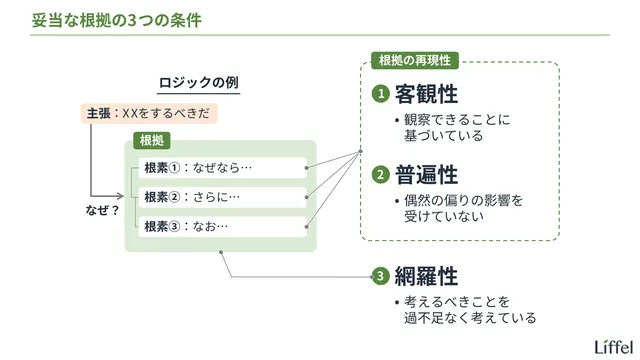
Entries related to critical thinking are collected on the page below. Feel free to use them as a reference.
Footnotes
-
Note that there are recent challenges to this first principle of philosophy. Descartes is thought to have regarded consciousness as prior to the body (though this itself is debatable), but according to the latest findings in neuroscience, consciousness is also a product of the body. In other words, instead of “I think, therefore I am,” the right formulation might be “I think ⇔ I am.” ↩
-
That said, the founders of this way of thinking as a business skill (known in Japan as “logical thinking”) are generally said to be Barbara Minto, author of The Pyramid Principle, and Hanako Teruya and Keiko Okada, authors of the Japanese bestseller Logical Thinking (in Japanese). ↩