
In this entry and the next, you’ll learn what the impact of a question is and how to evaluate it.
When evaluating a question, you should start with impact. There’s no point in solving a question that yields little or no impact. This time, let’s dig into the impact on you.
This entry is part of a series on evaluating questions. Read the series in order, starting from the entry below.

Let’s begin.
toc
What Is the Impact of a Question?
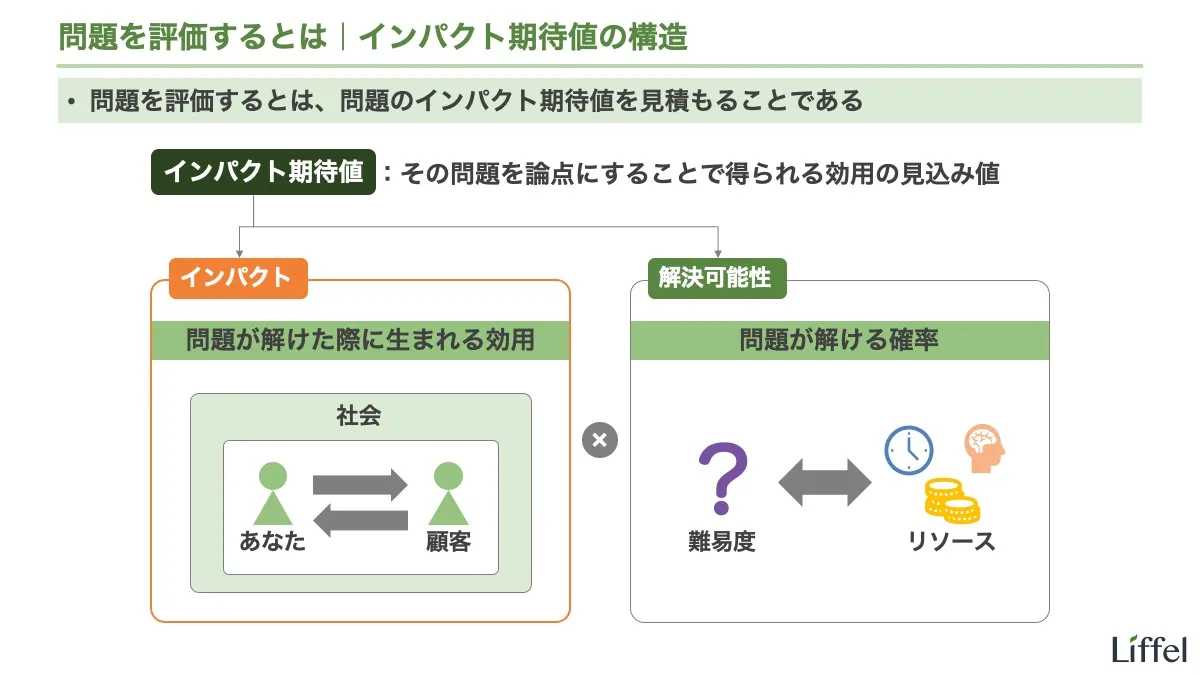
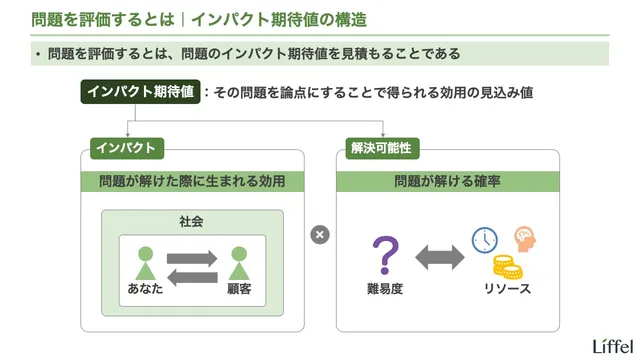
As already explained, the impact of a question is the totality of the benefits gained when it’s solved.
Impact: the benefit (as a whole) gained when a question is solved
Depending on the context, if “impact” doesn’t feel quite right, I’ll substitute words like “value” or “benefit.” Think of them all as meaning the same thing.
Impact You Gain Even Without Solving the Question
First, let’s confirm an important premise. As the definition says, “impact” here is what you gain when a question is solved. Conversely, what you gain even without solving the question isn’t included in impact.
The reason I spell this out is that some impact can be gained even without solving the question. Specifically, there are two kinds:
- The joy of thinking itself
- Training effects
First, if thinking itself is the goal, you get joy whether or not you solve the question. And if it’s for training, you’ll gain the training effect of “improving your thinking skills” even if you can’t reach an answer (although reaching one is better). These are legitimate forms of impact.
In this way, some impact can be gained regardless of whether the question is solved.
I won’t include such impact in the “impact” used to think about expected impact, because we’re thinking about expected impact as a tool for sifting through questions.
If you include what you gain even without solving the question, it becomes hard to differentiate impact, and you tend to conclude that “every question has impact (= every question is worth thinking about).”
That way of thinking only makes expected impact less useful as a sifting tool. So the impact used in expected impact is limited to what you gain when the question is solved.
What you gain even without solving the question isn’t included in impact
The Broad Categories of Impact
Now that we’re ready, let’s dig into “impact.” First, let’s divide it into broad groups.
Look at the slide again. As shown, when you think about some question, the stakeholders fall broadly into three groups:
- You
- Clients
- Society
Here, “society” means “everything other than you and your clients.” That covers every human in the world, and even animals and plants.
Society: everything other than you and your clients
In other words, impact falls broadly into three types:
- Impact on you (yourself)
- Impact on clients
- Impact on society
Let me explain each in turn.
Impact 1: Impact on You
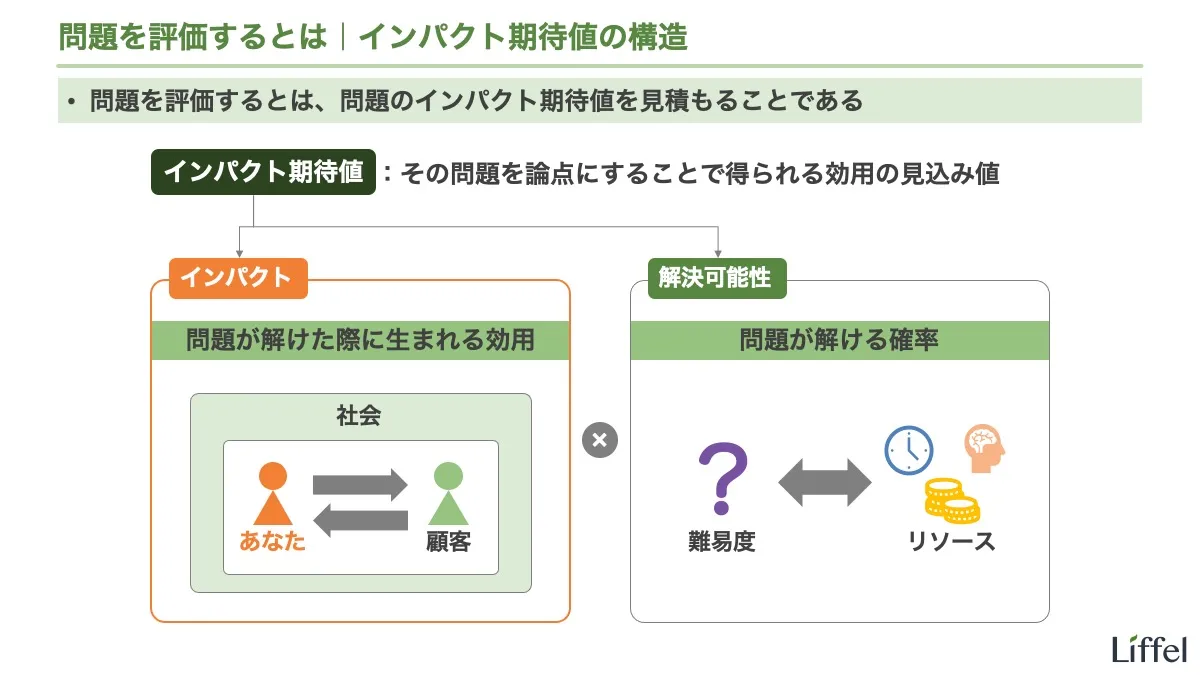
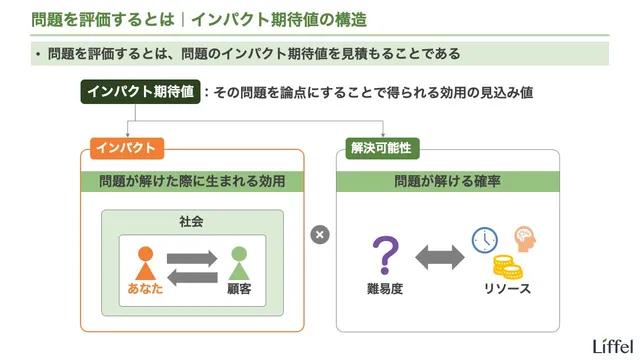
First, there’s “(1) impact on you (yourself).” Since you’re the one using your head to think, it’s obvious that the impact on you matters.
Simply put, the impact on you is whatever satisfies your desires. This is obvious if you think about it the other way around. Something that satisfies none of your desires, that is, something you don’t want, can’t be an impact on you.
The impact on you is whatever satisfies your desires
That means if you pick out the human desires that seem closely related to answering questions, you can capture the impact on you in broad terms.
Jumping to the conclusion, human desires and their corresponding impacts can be classified as follows:
- Intellectual curiosity → satisfying intellectual curiosity
- Desire for money → financial reward
- Other
In other words, I’ve singled out (1) intellectual curiosity and (2) desire for money as special desires and thrown the rest into the “other” box. If a desire you value is missing, pick it out of the “other” box.
Satisfying these desires is the impact on you. Let’s look at each in turn.
Impact on You 1: Satisfying Intellectual Curiosity
The first impact on you is satisfying intellectual curiosity. Put simply, it’s the joy of “I get it! I solved it!”
Why a picture of a naked old man here? This picture is actually a symbol of satisfied intellectual curiosity. This man (Archimedes) is said to have solved a difficult problem while taking a bath and, overjoyed, run through the streets stark naked. A true legend.

Eureka!
How to Evaluate Intellectual Curiosity
How should you evaluate how much a question stimulates your intellectual curiosity (= how much solving it will satisfy your intellectual curiosity)?
At first glance, this seems hardly worth asking. Anyone can tell instantly whether they’re interested in a question. It seems fine to treat that as the measure of intellectual curiosity.
Strictly speaking, however, a gut sense of “interested / not interested” isn’t a reliable measure of intellectual curiosity.
For example, look at the following question:
- How can I be more attractive to others?
Most people would want to know the answer to this question. In other words, they’re “interested” in it.
But the reason this question is intriguing is probably that satisfying the sexual desire and need for approval that lie beyond the answer is appealing. Anyone who claims to want the answer out of pure intellectual curiosity is either simply lying or doesn’t know themselves.
Thinking about it this way, you can see that the concept of “intellectual curiosity” is hard to apply to questions that offer the thinker some impact other than “knowing the answer.” There’s no way to separate whether you purely want the answer or are after what lies beyond it.
In other words, intellectual curiosity is only clearly an impact when no other impact exists. For example, I’m currently curious about the question “What does ‘physicality’ mean in basketball?” It seems safe to say I’m curious about this out of intellectual curiosity. Answering it won’t earn me a cent, and no one will praise me for it.
To sum up, evaluating intellectual curiosity rigorously requires answering the following two questions:
- If you could answer the question, would it bring you any impact other than “knowing the answer”?
- If the answer to the above is “no,” would you still want to know the answer?
First, questions for which the answer to (1) is “yes” can’t be evaluated purely from the angle of intellectual curiosity. There’s no way to neatly separate your own desires. Give up and evaluate it together with the other impacts. That’s perfectly fine.
For questions with impact beyond “knowing the answer,” the impact of satisfying intellectual curiosity can’t be evaluated purely
If the answer to (1) is “no” and the answer to (2) is “yes,” the question definitely stimulates your intellectual curiosity.
Exercise
Write down three or more questions that currently stimulate your intellectual curiosity.
As mentioned, ideally write questions that offer you no benefit other than knowing the answer.
Try writing your answer in the box below.
Besides the question above, I’m currently curious about “Is it rational to run libraries with public money in today’s society?” It seems like a heavy question if you think about it seriously. This one, too, offers me no benefit even if I find the answer.
If you’re the type who isn’t curious about things that offer no concrete benefit, this exercise may have been hard. In that case, don’t worry and move on.
Impact on You 2: Financial Reward
The second impact on you is financial reward. This means just what it says: how much money you’ll get for thinking about the question.
How to Evaluate Financial Reward
So how should you evaluate financial reward?
Since it’s a financial reward, what you naturally want to know is the amount. In the simplest terms, you’d just answer the following question:
- If I could answer the question, how much money would I get?
But you probably can’t answer this. In the real world, a single question rarely ties directly to a financial reward. When evaluating financial reward, you need to take a broader view of it and consider together the pay and stability of the industry or company where you’ll think about the question, such as:
- Industry level
- Average pay, future market growth, hiring trends, stability
- Company / organization level
- Current pay, future growth prospects, open positions, stability
Considering all of this, you’ll want to roughly answer at least these three points:
- Will I get paid or not?
- Roughly how much will I get?
- Can I live comfortably on that amount?
In short, it’s the same thing you think about when job hunting. Most people don’t choose an industry or company while ignoring pay.
If you discovered the question yourself, evaluating financial reward gets a bit more complicated. I’ll explain that in the section on impact on clients.
Impact on You 3: Satisfying Other Desires
Finally, if thinking about the question might satisfy desires other than intellectual curiosity and the desire for money, you should count them as impact. Examples include:
- Sexual desire and the need for approval: already explained
- Desire for honor: “Solving this question would guarantee a Nobel Prize,” for example
Add others as needed.
Think About Your Values
Once you’ve listed the impacts on you, all that’s left is to think about which impacts you want to prioritize. Even if you can evaluate each element, you can’t calculate the total without weights. These are what we call values. This entry doesn’t go into values, so think about them as homework.
Since this entry is getting long, let’s stop here. The continuation is the entry below.
Entries related to critical thinking are collected on the page below. Feel free to use them as a reference.
References
Websites