In this entry, let’s study breaking down a question by multiplication. Following breaking down by addition, this is another basic breakdown used in all sorts of situations.
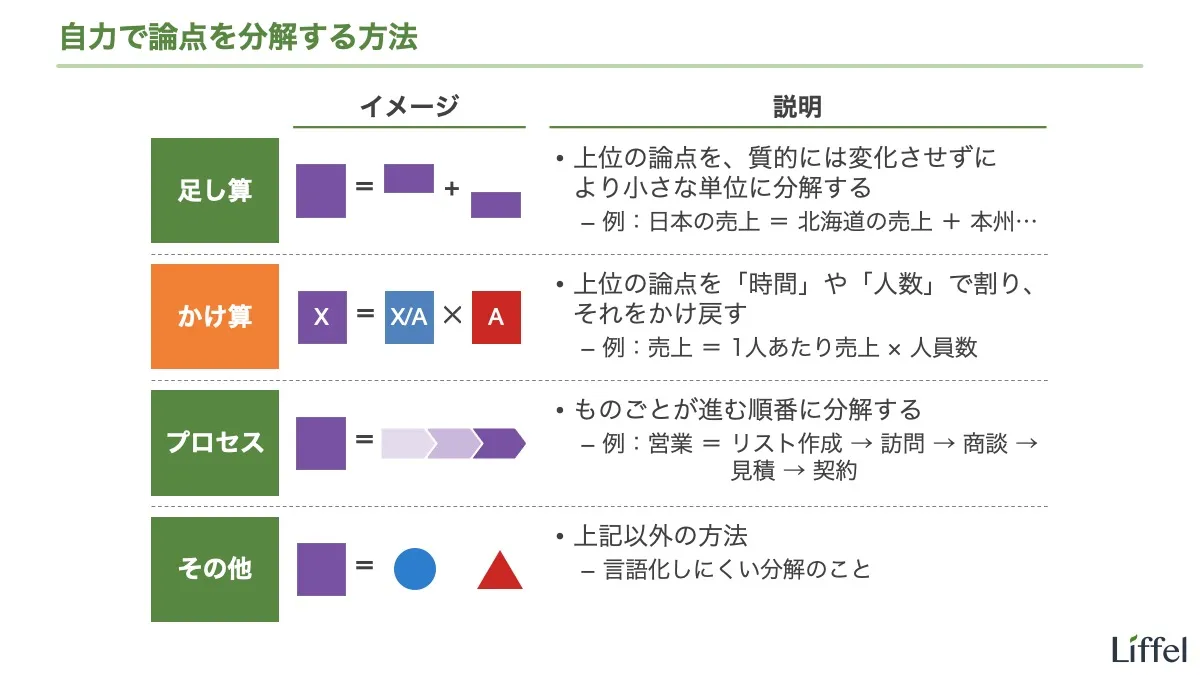
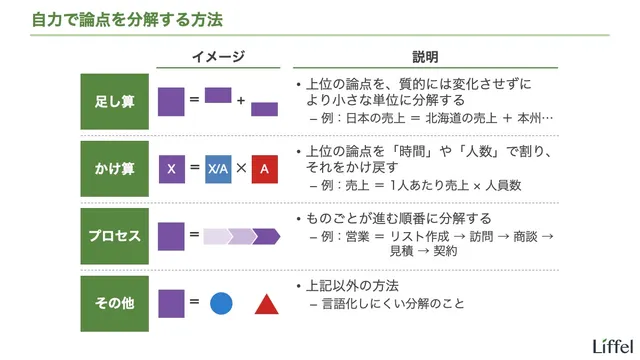
Before reading this entry, read the one below. It gives an overview of how to break down a question on your own.

Let’s begin.
toc
What Is Breaking Down by Multiplication?
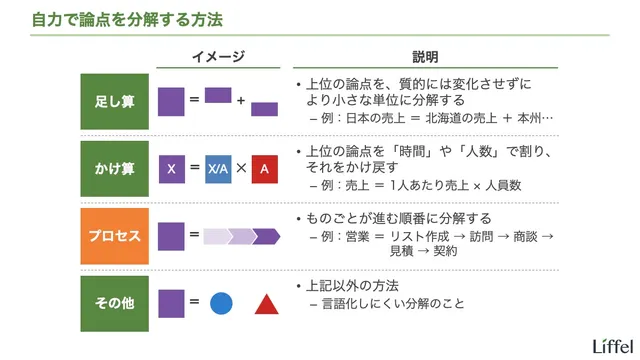
Breaking down by multiplication means dividing by some factor and then multiplying that factor back.
Dividing by some factor and then multiplying that factor back
First, look at an example.
- How can we increase GDP?
- How can we increase GDP per capita (the productivity of the population)?
- How can we increase the population?
In this breakdown, the concept of “GDP” is divided by “population,” and then “population” is multiplied back. “GDP per capita” means “GDP / population,” after all.
In abstract terms, “concept X is divided by A, and then A is multiplied back.” As a formula:
X = X/A × A
A breakdown like this is a multiplication breakdown.
If done correctly, a multiplication breakdown is guaranteed to be mathematically equal. In other words, a multiplication breakdown is always exhaustive (MECE). Since there’s no “other” as with addition, it’s a technique you can use with confidence.
Angles for Multiplication
The angle for multiplication (what corresponds to A in the formula above) is a concept that can be expressed in numbers. Since it’s processed mathematically, concepts that can’t be expressed in numbers can’t be used.
The two main angles are the following. Be sure to remember both:
- Time
- “Per hour,” “per day,” etc.
- Number of people / groups
- “Per person,” “per team,” “per store,” etc.
Of course, any concept that becomes a number works, so use “number of items,” “price,” “weight,” and so on as needed.
Exercise
Let’s check what you’ve learned with an exercise.
Break down the following questions by multiplication. Use the angle specified in parentheses.
How can I increase my income from my part-time job? (Time)
Try writing your answer in the box below.
- How can I increase my income from my part-time job?
- How can I raise my hourly wage?
- Note: in many cases, raising the hourly wage at your current job isn’t realistic, so the solution becomes “find a part-time job with a better hourly wage”
- How can I increase the hours I work?
- Note: here, you need to consider both “the time you can devote to the job” and “the time when shifts are open (when you can work)“
- How can I raise my hourly wage?
This is a question I actually agonized over as a college student. Even if you want to increase your part-time income, it’s hard to increase both of these at once. For example, well-paid part-time jobs like tutoring don’t offer many hours, so the total monthly income doesn’t get big.
Looking back now, the fact that I was thinking so hard about this question in the first place probably means I was getting something wrong as a college student… A failure of question setting, you might say.
You’re an executive of an organization that runs fundraising campaigns nationwide. How can you increase the amount donated? (Number of people)
- How can we increase the amount donated?
- How can we increase the amount donated per person?
- How can we increase the number of people who donate?
Increasing the amount donated per person is a challenging question. Think about what methods there might be.
How Breaking Down by Addition and by Multiplication Differ
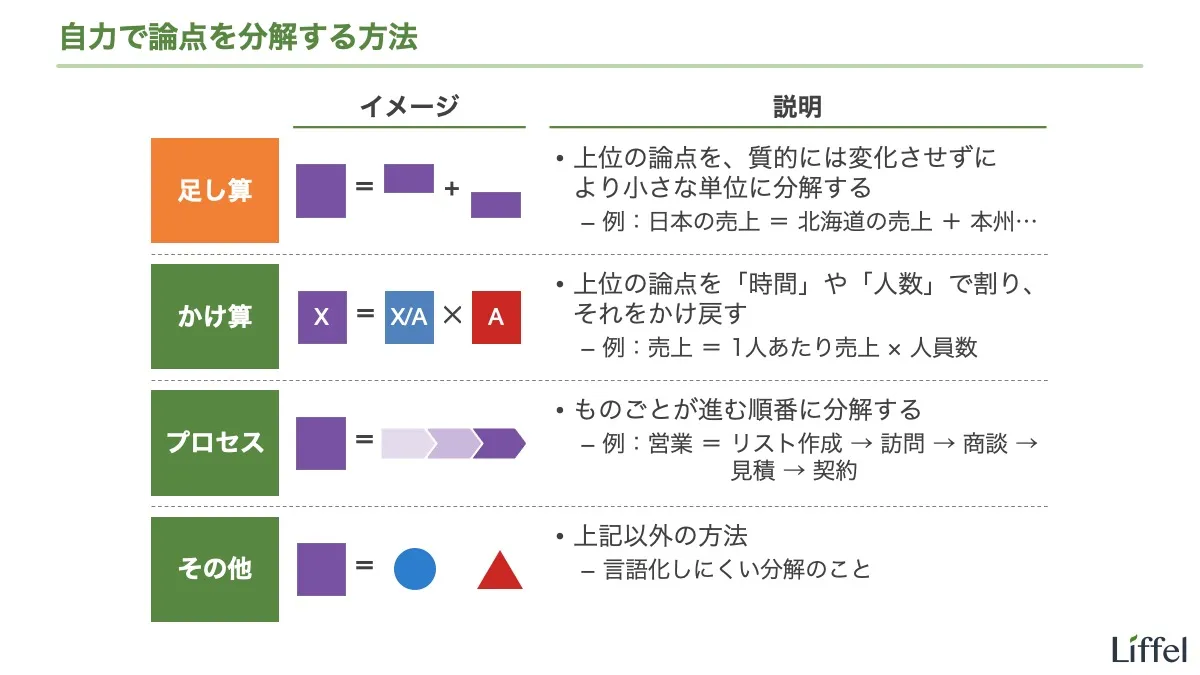
Since breaking down by addition and by multiplication are often used together, let’s sort out the characteristics of each here.
As an example, let’s use the question from the exercise above: “How can we increase the amount donated?” As stated in the exercise, we’ll assume the organization “runs fundraising campaigns nationwide,” so keep that in mind.
Breaking It Down by Addition
First, let’s break this question down by addition. The angle is “region” (using the four US Census regions). The result is as follows:
- How can we increase the amount donated (nationwide)?
- How can we increase the amount donated in the Northeast?
- How can we increase the amount donated in the Midwest?
- How can we increase the amount donated in the South?
- How can we increase the amount donated in the West?
Since this is an addition breakdown, confirm that the nature of the question doesn’t change between the higher-level and lower-level questions. Both deal with the concept of “the amount donated.”
Herein lies the weakness of addition. Since the concept doesn’t change in an addition breakdown, no matter how much you break things down by addition, it won’t give you hints for coming up with solutions.
As the breakdown makes clear, it only shrinks “the scope of what you’re thinking about.” “What you’re thinking about” (“How can we increase the amount donated?”) itself doesn’t change. So breaking the question down this way gives you no hints that make solutions easier to come up with.
Since the concept doesn’t change in an addition breakdown, it doesn’t give you hints for solutions
This explanation alone probably doesn’t click. Let’s compare it with multiplication.
Breaking It Down by Multiplication
Now let’s look at the same question broken down by multiplication. It’s the sample answer from earlier.
- How can we increase the amount donated?
- How can we increase the amount donated per person?
- How can we increase the number of people who donate?
In this breakdown, the concept of “the amount donated” changes into qualitatively different concepts: “the amount donated per person” and “the number of donors.”
And this breakdown gives you hints for thinking. For example, to boost “the amount donated per person,” ideas like these come to mind right away:
- When asking for donations, add, “Please give generously!”
- Give a thank-you gift for donations above a certain amount
- Target areas where many wealthy people seem to live
Since these are all ideas, don’t worry about feasibility.
On the other hand, to do something about “the number of donors,” ideas like these come to mind:
- Advertise on a large scale
- Make members (those asking for donations) dress flashily / use attractive people
- Target areas with lots of people
What I want you to notice here is that converting one concept into different concepts makes ideas like these easier to come up with.
In this example, converting the concept of “the amount donated” into the qualitatively different concepts of “the amount donated per person” and “the number of donors” served as a hint and generated ideas. Of course, you can come up with ideas from “the amount donated” as is, but thinking about “the amount donated per person” and “the number of donors” separately yields more concrete and varied ideas. That’s what “gives you hints for thinking” means.
Since the concept changes in a multiplication breakdown, it gives you hints for solutions
How to Choose Between Them
So does breaking down by addition have no advantage, and should you always use multiplication? Of course not.
In fact, the addition breakdown above wasn’t smart. I did it badly on purpose to highlight its weakness. Breaking it down as follows brings out the strength of addition:
- How can we increase the amount donated (nationwide)?
- Which region should we focus on?
- The Northeast?
- The Midwest?
- The South?
- The West?
- (In the region we should focus on) how should we increase the amount donated?
- How can we increase the amount donated per person?
- How can we increase the number of people who donate?
- Which region should we focus on?
Used this way, to identify “the region to focus on” first, breaking down by addition becomes meaningful, unlike before. Then you use multiplication to think about concrete actions.
Thinking this way, it seems you could use resources more efficiently than approaching the whole country evenly.
What Breaking Down by Addition Is For
In this way, breaking down by addition helps you find “the parts that matter most.” Breaking down by “region,” as above, tells you “the important regions,” and breaking down by “time” tells you “the important timing.”
Although “focus on what matters” may sound too obvious to be worth saying, it’s important. Breaking down by addition helps you think about it.
Use breaking down by addition to find “the parts that matter most”
Conversely, that’s as far as breaking down by addition takes you. Once you’ve identified what seems important, addition is no further help. You need other breakdowns, such as multiplication or the process breakdown introduced next.
The basic pattern I recommend is trying addition and then multiplication. Use addition to pinpoint “where,” and multiplication to dig into “why / how.” This is the basic one-two punch, so if you’re a beginner, keep this pattern in mind.
That covers breaking down by multiplication. Next, let’s study breaking down by process.
Entries related to critical thinking are collected on the page below. Feel free to use them as a reference.