This entry explains the differences between the following words:
- Reason
- Premises
- Data
- Fact
- Evidence
You hear all of these words in discussions. Some, like “reason” and “premises,” have similar meanings and are easy to confuse, while others, like “evidence,” mean different things to different people. Let’s sort them out.
Note that this entry focuses on how these words are generally used and how to use them so you won’t be misunderstood. I won’t cover their usage in special settings (such as formal debate), and the meanings given here are only my interpretation.
Let’s begin.
toc
Reason vs. Premises
Let’s start with the difference between “reason” and “premises.” Take a look at the slide below.
I recommend starting from “reason,” which has the broadest meaning.
Since there’s no simpler word to explain “reason,” grasp it as an image rather than in words. As the slide shows, a “reason” is an arrow. If I had to put it into words: when there’s some main event (A), “reason” refers to what lies behind it (B).
Specifically, the following count as “B”:
- Background or motive: why A came to be done
- Cause: why A is happening
- Premises: why A can be said to be “right”
As you may have noticed, one of these is “premises.” In other words, “premises” are one use of “reason.”
Let’s go through each use of “reason” and check whether it can be replaced with “premises.”
Use 1: Background or Motive
First, when “reason” means “how something came about” or “the motive for doing something,” only “reason” works. Let’s look at an example.


What’s the reason?
This “reason” can’t be replaced with “premises.”
Use 2: Cause
Next, when “reason” means “the cause of something,” again only “reason” works.
I wonder what the reason is.
This “reason” can’t be replaced with “premises” either.
Use 3: Premises
Finally, when it means “what supports a claim’s rightness,” both “reason” and “premises” work.
What’s your reason for saying that?
This “reason” can be replaced with “premises,” can’t it?
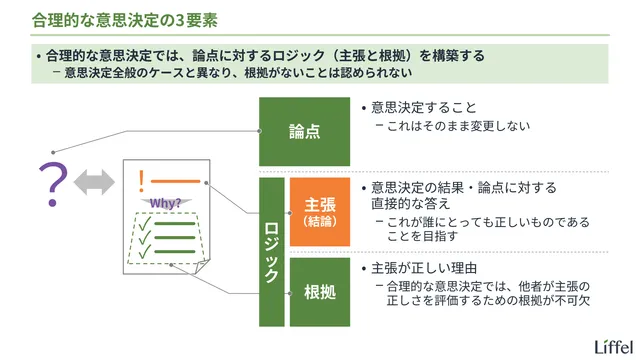
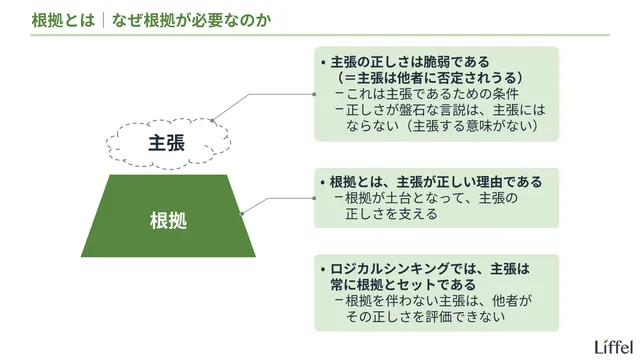
In this way, statements that support the rightness of something debatable (a claim) can be called either “reasons” or “premises.” Claims and premises are each explained in separate entries. See the links below.

Which to Use
As for which to use, when you mean “what supports a claim’s rightness,” you should use “premises” rather than “reason.” “Premises” sounds more formal, and because its meaning is narrower, it makes clear that you’re talking about what supports the claim’s rightness. Let’s check with the earlier example.
What are your premises for saying that?
It somehow feels more like a proper discussion, doesn’t it? (In casual English conversation, “What’s your reason?” or “Why do you say that?” is more natural. But when you analyze an argument, use “premises.”) From here on, this entry also uses “premises.”
Data, Fact, and Evidence
Let’s move on. Next, let’s think about the differences between these words:
- Data
- Fact
- Evidence
Although there are subtle differences, roughly speaking, they all mean “facts that have actually been observed,” and are used in the sense of “valid premises (premises that can support a claim’s rightness).” First, take a look at the slide below.
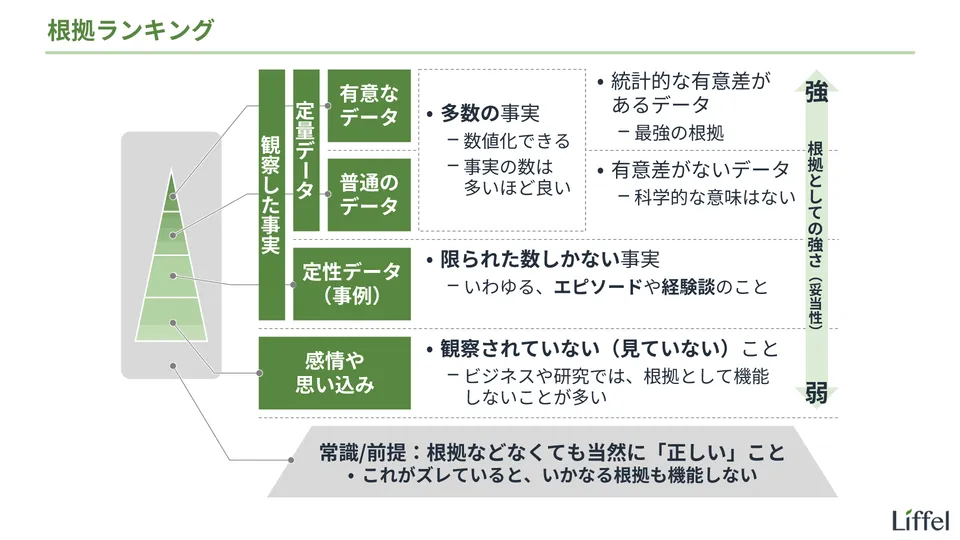
As shown, the statements you give as premises have a hierarchy of validity. That’s what this premise ranking shows.
Since “premise ranking” is my own name for it, don’t use it elsewhere. It’s based on the “levels of evidence” used in medical research, a term you can use anywhere without embarrassment, but since I’ve simplified and extended the concept, I’ve avoided using the same name.
Since explaining the premise ranking in detail would never end, just understand this point:
Observed facts are more valid as premises than things that aren’t observed (emotions and assumptions).
That’s because the rightness of observed facts can be shared with others. Since this entry focuses on the meaning of words, if you want to learn more, read the link below.
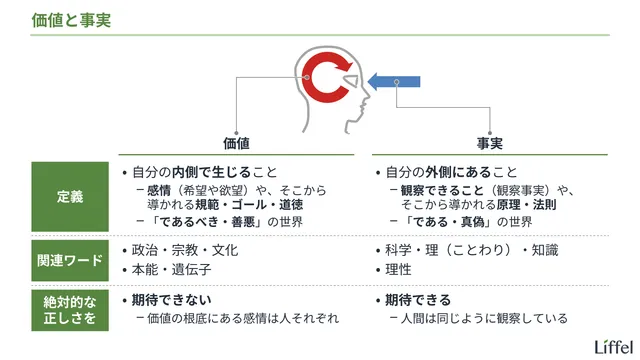
Back to the point: since observed facts are desirable as premises, examining premises always comes with the question “Is that an observed fact?” All the words above are just other ways of saying “observed facts.”
Let’s look at them one by one.
Data
First, you can interpret “data” as simply meaning “observed facts.” It’s also a word that appears in the premise ranking above.
Let’s look at an example.
What are your premises for saying that?
Is there any data on that?
The data is made up.
Quantitative and Qualitative Data
Data can be classified into “quantitative data” and “qualitative data.” Think of them like this:
- Quantitative data: facts expressed as numbers
- Example: 95 out of 100 people said, “This cake is delicious”
- Qualitative data: facts that are limited in number and hard to express numerically (facts described in text)
- Example: “This cake is delicious” (the comment itself)
When people say “data,” they generally picture quantitative data organized in tables and graphs. In the academic sense, however, even a single fact is “data” (qualitative data). Don’t get this wrong.
Fact
Next, let’s think about “fact.”
First, in contexts like “fact-based thinking,” “fact” means the same as “data” above. The idea is to think based on observed facts, not emotions or assumptions.
It’s also used in questions like “Is that a fact?” This simply means “Is that true? (Can I trust that information?)” Personally, I think a plain “Is that true?” works just as well.
Evidence
Finally, let’s think about “evidence.”
In discussions, think of “evidence” as “solid premises.” In other words, the image of “evidence” is “premises that force you to accept the claim as right (premises that are valid beyond dispute).”
Evidence (the image): premises that force you to accept the claim as right
So what kind of premises force you to accept a claim as right?
I recommend thinking of it as “many observed facts, not emotions, assumptions, or rules of thumb.” Check the premise ranking.
As you can see, emotions and assumptions are at the bottom of the ranking. Your own experience is second from the bottom. Claims derived from these premises are unlikely to be considered right.
Yet in government and medicine, that way of thinking long held sway. In reaction to this, the idea of “evidence-based XXX” began to spread.
So for now, it’s fine to interpret “evidence = quantitative data (in reasonable quantity).”
“Evidence” One Step Further
My impression, however, is that “evidence” often goes one step further and is used to mean “academic papers and the data published in them.”
As mentioned, the premise ranking is based on the “levels of evidence” used in medicine. Skipping the details, think of levels of evidence as dividing the “significant data” part of the slide more finely by experimental method and so on.
In other words, even within evidence (quantitative data), there’s a hierarchy of validity. Just because data is presented in a nice graph doesn’t mean you should unconditionally believe the claims derived from it.
Obviously, when you’re thinking about something, you want to know the more valid premises. And such premises are often found in academic papers. Against this backdrop, at some point more people began using “evidence” to mean “information in academic papers (= premises and information at the top of the ranking that should be accepted as right).”
Does Evidence Make Something Right? The Deification of “Evidence”
So does having evidence make something right?
In principle, yes. Thinking based on evidence (quantitative data) is more likely to be right than thinking based on emotions and assumptions. Since denying evidence is unscientific in itself, it’s better not to1.
However, be aware that more and more people exploit this idea, using the words “evidence” and “studies” as a trump card. Let’s look at an example.
What are your premises for saying that?
There’s evidence for it.
Although Bear seems at first glance to be saying something plausible, this is the same as saying nothing.
Needless to say, the words “evidence” or “studies” have no meaning in themselves. What matters is the content. At the very least, examine the content.
And even if there is content, you can’t trust it unconditionally. Look at the example below.
What are your premises for saying that?
Is there any evidence for that?
Although it seems fair to accept Bear’s point this time, you should be aware of risks like the following. Since understanding them requires some knowledge of statistics, skip ahead if they don’t make sense.
- Limits of scientific (statistical) methods
- There’s no telling whether what happened to others in an experimental setting will happen to you
- Humans aren’t industrial products
- In general, experimental settings differ greatly from real life
- Even fairly conducted research can produce wrong results (false positives)
- There’s no telling whether what happened to others in an experimental setting will happen to you
- Risks arising from the paper itself
- The sample size may be small
- The sample may have different characteristics from you
- Example: there’s no telling whether an experiment conducted on white or Black participants applies to Japanese people
- Risks arising from the person citing the paper
- They may have simplified the claim and left out the caveats and qualifications written in the paper
- They may have selected only papers convenient to their own claim (cherry-picking)
Of course, if you doubted all of this in every case, you’d have to become an expert yourself. Since that isn’t realistic, you have no choice but to trust things at some point2.
But people who use words like “evidence,” “studies,” and “scientific” excessively tend not to explain these limits of academic papers and instead use the words simply as authority. They also seem to make sweeping assertions and attack others who make different claims.
Put simply, their attitude is: “What I, an expert on evidence, say is the absolute truth.” I won’t name specific examples, though you’ll find plenty of books like that in any bookstore.
This way of thinking is authoritarianism, the very opposite of the scientism and rationalism that underlie the emphasis on evidence. It’s a shame to see people become the very thing they set out to fight, but I see it often. Be careful.
That covers the meanings of words related to premises. If you’d like to keep learning critical thinking, continue to the entry below. Next, let’s learn about universal premises.
Entries related to critical thinking are collected on the page below. Feel free to use them as a reference.
Footnotes
-
However, when it comes to study methods or health practices, if there’s something you believe is right from your own experience, you should prioritize that over evidence. All evidence is other people’s data, and there’s no telling whether it applies to you. ↩
-
In this example, rather than thinking about whether Bear can be trusted, I recommend varying your own workout frequency. If you build muscle working out once a week, great. If not, increase the frequency. ↩