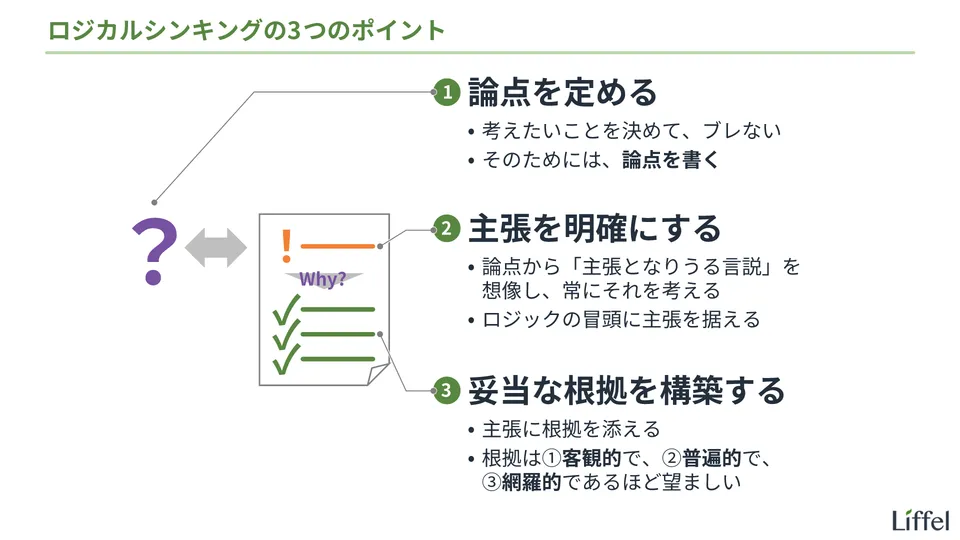
This entry introduces a training for understanding the key terms of critical thinking: “the question,” “claim,” and “premises.” Since it doesn’t explain critical thinking itself, if you get lost along the way, work through the entries in order starting from the page below.
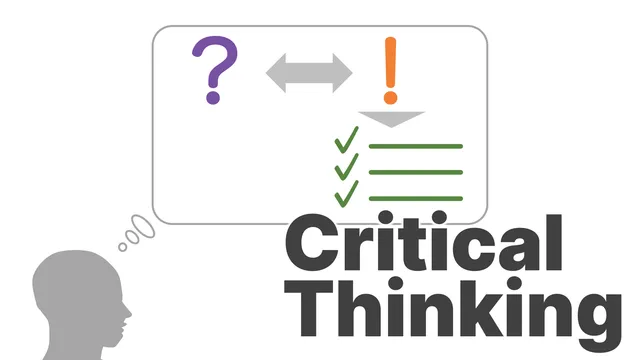

This training also doubles as practice for writing catchy headlines. I’ve added some playful elements. Have fun with it.
Let’s begin.
toc
- What the Training Involves and Its Key Points
- Example and Sample Answer
- If You Want to Keep Learning
What the Training Involves and Its Key Points
In this training, you create three versions of a book title from a single question. Proceed in the following order:
- Set a question people would be interested in → use that question as the title
- Come up with a claim on the question (it doesn’t have to be right) → turn that claim into a title
- Make a title that hints at the premises
Let me explain each in turn.
Step 1: Set a Question People Would Be Interested In
First, set a question people would be interested in. Prepare one interrogative sentence that would make people think, “Oh? I’d like to hear the answer to that.”
Even though it’s the first step, this is the hardest part of the training. Since setting a question belongs to the realm of ideas, you may struggle to come up with an interesting one. But since you can’t do the training without a question, do your best.
If you’re stuck, I recommend thinking about money, romance, or health. Hardly anyone is uninterested in these three. Since it’d be a shame to get stuck on the question and never do the training, get this part over with quickly.
As an example, let’s set the question “How can I become more attractive to others?” Although it sounds highly dubious, you don’t need to worry about that in this training.
This is the first version of the title. While we’re at it, let’s make a cover.
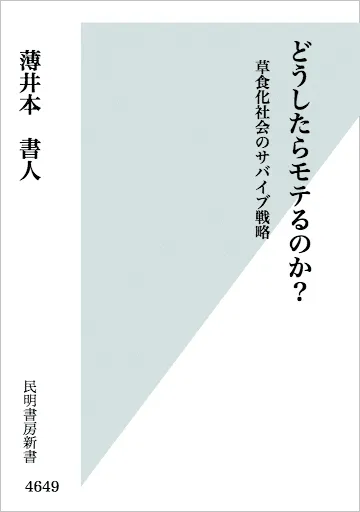
Making a cover helps you judge whether you’d want to buy the book (= whether the question has value). It’s fun as a game, too. Give it a try. You can easily make one with the link below.
Paperback Maker (in Japanese)Note that this tool has a strict character limit for titles. Treat it as practice in stating the question or claim sharply, and see how much you can fit. If you can’t make it fit, it’s fine to give up and move on.
Step 2: Come Up with a Claim on the Question
Next, come up with a claim on the question.
Here, try to come up with a claim that’s as outlandish as possible. That makes for a more attractive book title. Since this is training, you don’t need to consider whether the claim is right.
In this example, for the question “How can I become more attractive to others?”, let’s go with the claim “You should get rejected 100 times.”
Let’s make this claim sound like a book title. Here, I’ve gone with “Want to Be Irresistible? Get Rejected 100 Times.”

It sounds more like a book title than simply writing the claim “You should get rejected 100 times,” doesn’t it?
There are two key points: (1) work in the question, and (2) make it a command. As a basic pattern, keep the form “Want to X (question)? Do Y (claim)” in mind. Bookstores are full of books with titles like this.
Step 3: Make a Title That Hints at the Premises
Finally, change the previous title into one that hints at the premises.
This time, the claim is “You should get rejected 100 times.” So the premises for this claim can be rephrased as “the reasons you should get rejected 100 times.” Let’s make that the title.

There are two basic patterns for this style. Choose whichever you like:
- “Why you should / Why they…”: Why you should do X (claim) (the example in the image above)
- Take the claim as given and ask for the premises: Why do people who can X (question) do Y? (Why do irresistible people get rejected 100 times?)
A variation on (1) is to include the number of reasons, as in “3 Reasons You Should Get Rejected 100 Times.” Come up with various titles and think about which one you’d want to pick up.
You don’t need to actually come up with these reasons. Going that far would mean seriously building an argument on the question, which goes beyond this training. Here, it’s enough to understand the differences between the question, the claim, and the premises by coming up with titles.
Example and Sample Answer
Finally, here’s one more example with a sample answer.
The question: How can I earn $100 million a year?
Claim-type title: Want to Earn $100 Million a Year? Pick Up Litter Every Day
Premise-type title: 3 Reasons Anyone Who Wants to Earn $100 Million a Year Should Pick Up Litter Every Day
That covers the training for understanding how the question, claim, and premises relate. From here, try starting from your own questions. I also recommend competing with friends to see who can come up with the book title people would most want to buy.
If You Want to Keep Learning
Thank you very much for reading this far. If you’d like to keep learning critical thinking, continue to the entry below.
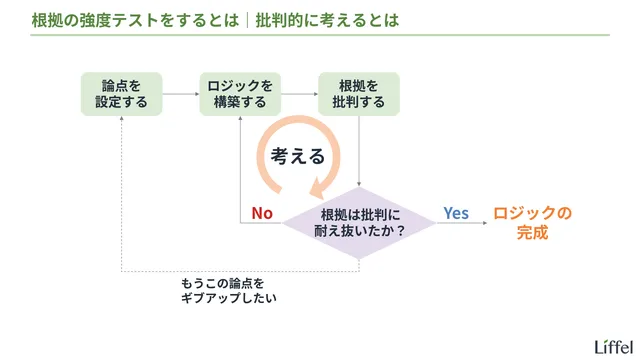
Entries related to critical thinking are collected on the page below. Feel free to use them as a reference.