This entry explains the three conditions for valid premises. Since this is the most basic concept for judging whether a claim is right, make sure you understand it well.
This entry assumes basic knowledge of critical thinking (at least an understanding of how claims and premises relate). If you get lost along the way, use the link below to learn from the basics.

Also note that this entry is a simplified version for the website.
Let’s begin.
toc
- The Overall Picture of Valid Premises
- Condition 1: Objectivity
- Condition 2: Universality
- Condition 3: Exhaustiveness
The Overall Picture of Valid Premises
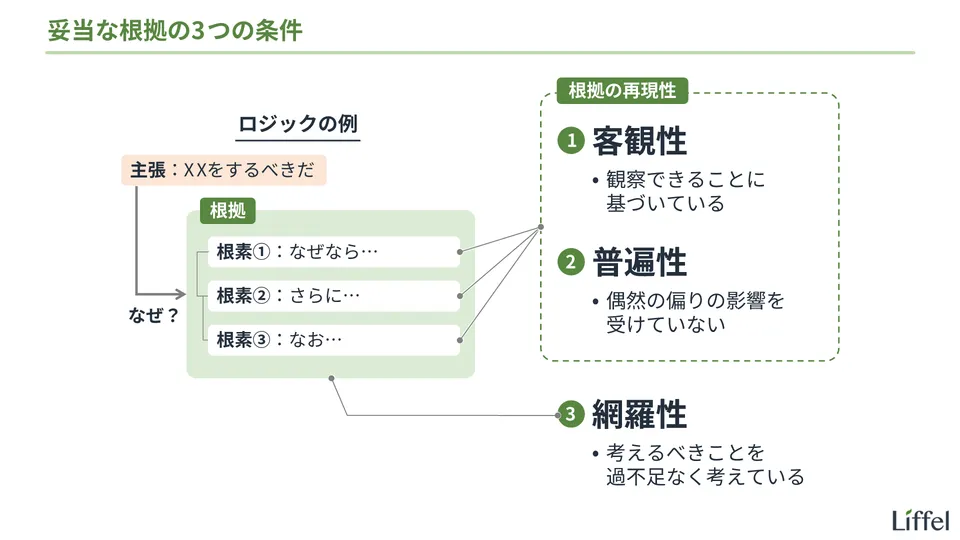
First, take a look at the conclusion. The slide below sums it up.
As shown, for premises to be valid, they must meet the following three conditions:
- Objective: based on what can be observed
- Universal: not affected by chance bias
- Exhaustive: considering everything that needs to be considered, no more and no less
Let’s go through them in order.
Since the goal of this entry is to grasp the overall picture, I won’t explain each condition in detail. I’ll do that in later entries. Don’t worry if some parts aren’t clear yet.
Condition 1: Objectivity
The first condition is the objectivity of the premises. In short, it means basing your premises on what can be observed.
Since what can be observed can be shared directly with others, it makes for solid premises. Conversely, since what can’t be observed can’t be shared directly with others, it makes for weak premises and becomes a target for critique.
Let’s look at an example.

Should we have Company X or Company Y design our poster?

Company X. I think Company X’s designs are better.
”Company X’s designs are better” is just your subjective opinion. Other people might say Company Y’s are better.
You can’t observe that a design is “better.” “Better” is a value judgment, and you can’t see it. That’s what Bear critiqued. Let’s change it to objective premises.
Should we have Company X or Company Y design our poster?
Company X. I surveyed five people around me, and three said they preferred Company X’s designs.
You’re right. Let’s go with Company X.
Unlike before, “I surveyed five people, and three said they preferred Company X’s designs” can be observed. You just have to look at the survey forms.
In this way, making premises objective increases their validity. Confirm that the difference between the two lies in whether they can be observed.
Condition 2: Universality
The second condition is the universality of the premises. This means ensuring that what you observed didn’t happen by chance.
Objective premises (= what you observed) can’t support just any claim, because what you observed may have happened by chance. Let’s have Bear tear down the earlier argument.
Should we have Company X or Company Y design our poster?
Company X. I surveyed five people around me, and three said they preferred Company X’s designs.
But if just one person changed their mind, the conclusion would flip. Didn’t that just happen by chance?
Although the argument worked before, this time Bear critiqued its lack of universality (= the possibility that chance affected it). Winning by just one vote certainly isn’t very convincing.
So how can you increase the universality of premises? I’ll explain in detail in later entries. The quickest way is to increase the amount of data (the number of observations). Let’s have Panda survey many more people.
Should we have Company X or Company Y design our poster?
Company X. I surveyed 1,000 people around me, and 600 said they preferred Company X’s designs.
I see. Let’s go with Company X.
Although Company X’s support rate is still 60%, this time one person changing their mind wouldn’t budge the result at all. By increasing the amount of data, Panda increased the universality of the premises.
Strictly speaking, increasing the amount of data isn’t enough. The data also needs to accurately reflect the population. For example, if the poster will be seen by the entire nation, the gender ratio and age makeup of the data should match those of the whole country.
As some of you may have noticed, the universality of premises is about statistics. If you want to master the universality of premises, you need to study statistics, not critical thinking.
How Far to Pursue Universality
Note that not every situation requires universal premises. Although universal premises are certainly valid, in practice there are many cases where you can’t pursue universality. For example, the example above had Panda survey 1,000 people, but in reality, it’s rare to be able to survey that many. Most of the time, you can’t spare that much effort or money.
In practice, you decide how far to pursue universality by considering the size of the question (how many people are involved and how serious it is), the availability of data, the resources available for building premises (effort and budget), and urgency (whether you need to answer and act right now).
The same applies when you critique. With a little study of universality, it’s easy to fire off critiques like “Do you have data?”, “Is that data statistically significant?”, or “What’s the evidence?” (I’ll explain what these critiques mean in later entries).
But repeatedly firing off such critiques without considering whether such rigorous premises are really needed, or even possible, just makes you a discussion wrecker. Be careful not to get too theoretical.
Condition 3: Exhaustiveness
The third condition is the exhaustiveness of the premises. This means considering everything that needs to be considered, no more and no less.
An example makes this easier to understand. Let’s have Bear tear down the earlier argument from the angle of exhaustiveness.
Should we have Company X or Company Y design our poster?
Company X. I surveyed 1,000 people around me, and 600 said they preferred Company X’s designs.
I see. Company X’s designs are no doubt better. But which company to hire has to be decided by weighing price, not just design quality.
By observing many facts, Panda prepared the premise “Company X’s designs are better.” Since this premise is both objective and universal, it can withstand any critique1.
The problem is that relying on the single premise “Company X’s designs are better” can’t fully support the claim “We should have Company X design it.”
As Bear points out, at the very least you need to consider price. For example, if Company X charged five times as much as Company Y, you’d hardly want to hire Company X. Design support of 60:40 isn’t enough to justify a fivefold price difference.
In this way, when you think about a question, there may be more than one thing to consider as premises. In that case, if anything is left out, that’s where you’ll be critiqued. Conversely, discussing things that don’t need to be considered becomes noise.
The exhaustiveness of premises means covering everything that needs to be considered as premises, with nothing missing and nothing extra.
Let’s have Panda build exhaustive premises.
Should we have Company X or Company Y design our poster?
Company X.
I compared the two companies on two points, design quality and price, because we should hire the company that offers the best overall value for money.
First, Company X has better design quality. I surveyed 1,000 people around me, and 600 said they preferred Company X’s designs.
Next, price. Both companies charge $10,000, so there’s no difference. There doesn’t seem to be room for a discount, either.
In conclusion, we should choose Company X, which offers better value for money.
Good job!
In this way, by increasing the exhaustiveness of the premises, Panda fended off Bear’s critique.
What Determines Exhaustiveness
Although I treated “design quality” and “price” as exhaustive in this example to keep things simple, strictly speaking, there’s no telling whether that’s exhaustive. Just off the top of my head, you could add perspectives like these:
- Turnaround time
- Whether they handle minor revisions / whether revisions cost extra
- Their track record as a design firm
- Their history of business with your company
Conversely, if you want to pursue design quality regardless of price, information about price could become noise.
In this way, what counts as “exhaustive” is decided subjectively. Be careful, since trying to apply it mechanically won’t work.
That covers the three conditions for valid premises. When you build an argument, check your premises from these three angles. You’ll be able to build premises that won’t budge under any ordinary critique.
Next, let’s dig deeper into objectivity, the first condition for valid premises.
Entries related to critical thinking are collected on the page below. Feel free to use them as a reference.
Footnotes
-
Strictly speaking, a statistical critique (checking whether the sample is valid) is possible, but let’s let it slide this time. ↩