This article explains the categories of AI.
It is no exaggeration to say that not a day goes by without hearing the word “AI.” Almost every day brings news of a new AI service, or of yet another way to boost productivity by using AI.
In this environment, “AI” has become a catch-all term — a word that means different things to different people. Let’s get on the same page.
Specifically, this article addresses the following questions.
- What is “AI”?
- What kinds of AI are there?
- Which AI should you start with?
This article begins from the absolute basics, so feel free to skip the parts you already know.
Let’s begin.
toc
- What Is AI?
- Categories of AI
- Categories of AI #1: Horizontal AI / LLMs
- Categories of AI #2: Vertical AI
What Is AI?
By dictionary definition, “AI” stands for “Artificial Intelligence.” Think of it as a general term for the technology that reproduces human intelligence on a computer.
AI / artificial intelligence (dictionary definition): A general term for the technology that reproduces human intelligence on a computer.
That said, as of 2026, defining “AI” simply as services (apps and software) built on generative AI technology, such as ChatGPT or Gemini, is sufficient in nearly all situations.
Let me explain.
What Is “Generative AI”?
“Generative AI,” as the name suggests, refers to AI that can generate something — text, images, and so on.
What we now call “generative AI” has existed for a long time, but its earlier performance was nowhere near human intelligence. It was once mocked as “artificial idiocy.” For that reason, conventional AI focused on tasks like classification and prediction, and generation received little attention.
In the 2010s, however, several technical breakthroughs took place — Deep Learning, the Transformer architecture, and others — and the performance of generative AI began to improve dramatically. Those advances came to fruition in the 2020s, symbolized by the release of ChatGPT in 2022. The AI boom that followed needs no introduction. Services built on generative AI technology are appearing almost daily.
As a result, when we now use the word “AI,” we usually mean a specific service built on generative AI technology. With that in mind, let’s adopt the following as the practical definition of AI.
AI (practical definition): A service built on generative AI technology (e.g., ChatGPT, Gemini).
Unless you are an AI researcher, this definition is more useful, and it is the one this site will use.
Categories of AI
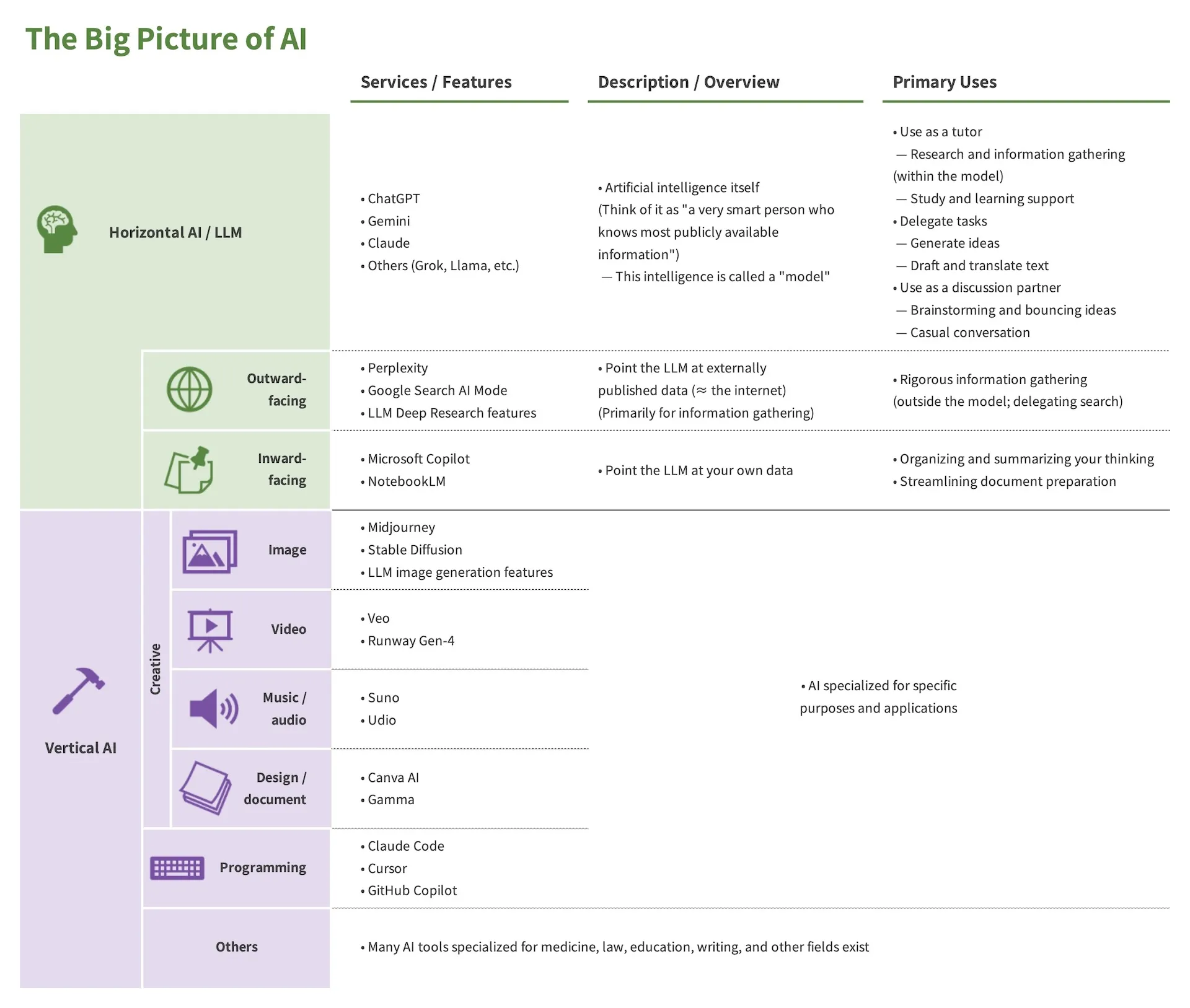
What kinds of AI are there? Here is the overall picture.
For clarity, specific service names are kept to a minimum. AI can list them endlessly, so focus here on the framework of categories. Once that framework is in your head, you will be able to choose which AI to invest your time in.
The framework used here is as follows.
- Horizontal AI / LLMs
- LLMs (the brain itself)
- LLMs (the brain) directed at a specific purpose
- Outward (toward the internet)
- Inward (toward your own data)
- Vertical AI
- Creative
- Image generation
- Video generation
- Music and audio generation
- Design and document creation
- Programming
- Other
- Creative
A note on terminology: treat all of these labels as ad hoc. Although they follow the most widely used conventions where possible, the vocabulary in this area is still far from settled.
Let’s go through them in order.
Categories of AI #1: Horizontal AI / LLMs
The first and largest distinction is whether an AI is general-purpose or specialized for a particular purpose or domain. Let’s call the general-purpose kind — the AI you can use for many different tasks — Horizontal AI, the standard industry term. The three best-known examples are these.
You interact with these AIs through text-based chat. If you have never tried any of them, open one of the links above and try it now.
After a few minutes of use, you will notice the strange sensation that there is another person on the other side of the screen. This, truly, is “artificial intelligence.”
Horizontal AI: AI that can be used for many different tasks.
LLMs
All horizontal AIs are built on a technology called the Large Language Model, so they are also commonly referred to as LLMs (from the initials). Learn this term alongside “horizontal AI.”
LLM (Large Language Model): The AI technology behind horizontal AI. For practical purposes, it can be treated as a synonym for “horizontal AI.”
In technical contexts, “LLM” is the more appropriate term, and using “AI” too often makes the writing harder to follow. From here on, this article will mainly use “LLM” to refer to horizontal AI.
What LLMs Can Do
A useful mental image for an LLM is a very smart person (or brain) who knows almost everything that is publicly available on the internet. This person supports you tirelessly. In abstract terms, almost every concrete use case falls into one of these three categories.
- Use it as a teacher
- Gathering information and looking things up (handled inside the model)
- Supporting your studies and learning
- Editing your writing
- Have it do work for you
- Generating ideas
- Drafting and translating text
- Use it as a sparring partner or companion
- Bouncing ideas around or brainstorming
- Casual conversation
It is hard to imagine someone for whom none of these is useful. Once you try it, you are likely to find some kind of value, so starting with LLMs is the recommended approach.
The difference between the free and paid plans comes down to the intelligence of the model and how many requests you can make (free plans cap your access to the top-tier models). Starting with the free plan is fine.
Problems with LLMs in Their Default Mode
When you use an LLM in its default mode, it produces answers from inside its own model — that is, from inside its (artificial) brain. If the answer comes back instantly, you can assume the brain handled it.
Although this setup has the merit of fast and frictionless back-and-forth, it has two problems as of 2026.
- When the goal is gathering information, the reliability is questionable.
- When you make it reference data you have prepared, accuracy drops.
Let’s go through them in order.
Problem #1: Reliability of Information Is Questionable
Gathering information and looking things up is one of the basic uses of LLMs. Currently, however, the information you gather is not yet at a level where you can confidently pass it on to others.
As is widely known, LLMs have a tendency called “hallucination” — confidently asserting things that are wrong. As of 2026 this tendency has improved considerably, but there is no doubt that LLMs still occasionally say strange things.
In addition, we have not yet reached a world where “the LLM said so” counts as justification, and when reporting the results of your research to others, the responsibility for accuracy still falls on the human.
The implication is that even when an LLM gathers information for you, a human needs to fact-check afterwards, and the ultimate source should be a human (a piece of writing or a statement) rather than an AI. This is not debatable.
In short, when the accuracy of the information matters, relying entirely on the inside of an LLM’s brain is still risky.
Solution #1: Direct It Outward (to the Internet)
This problem is solved by having the LLM do internet research, in the following way.
- The source of the answer becomes “information made by humans (specific URLs)” rather than “the inside of the AI’s brain”
- The risk of hallucination drops sharply
- You can show your sources, explain them to others, and take responsibility for them
Of course, information made by humans can also be wrong, but that argument leads nowhere. The point is that, at least for now, this approach is the more honest one.
The major LLMs all include this feature, often under names like Deep Research (in some cases only on paid plans). The following two functions are usually bundled together.
- The LLM does not stay inside its own model; it researches the internet.
- It takes its time, reasons through to a conclusion, and produces a report.
It is worth trying once (ask the AI how to use it).
There is also Perplexity, an AI specialized for this purpose. At first glance it looks like the major LLMs, but its distinguishing feature is that the LLM is pointed outward at the internet from the start. People who do research often as part of their work should check it out as well.
Problem #2: Accuracy Drops When Referencing External Data
Next, LLMs have a problem in which accuracy drops when you make them reference materials or data you have prepared.
To set the context: when you want to have an in-depth discussion in a work setting, or study for an exam with a defined scope, you naturally want to interact with the LLM based on materials and data you have prepared yourself, such as the following.
- A document you are writing or have written
- Data you are analyzing
- Specific reference materials
- e.g.: “The exam covers up to page 100 of this textbook” — and you want the LLM to refer to it strictly.
This kind of use case is, of course, anticipated, and every LLM offers a file upload feature.
Yet for some reason, LLMs do not read uploaded files correctly. In my experience, they either fail to read the file at all, or read things that are not actually there (as of March 2026; Claude feels relatively stable).
This phenomenon is also broadly called “hallucination” (or “lack of grounding”). For now, just take the following point: when you make an LLM reference data outside its model, it often becomes unreliable.
When you make an LLM reference data outside its model, it often behaves strangely.
Solution #2: Direct It Inward (to Your Own Data)
To summarize.
- When interacting with AI, you often want it to refer to materials or data you have prepared.
- As of now, LLMs in their default mode cannot handle this well (Claude is relatively stable).
A natural idea, then, is an LLM specialized in reading user-provided data correctly. The leading example is NotebookLM. It is easiest to think of this as “a Gemini specialized for inward use.” It is especially useful when you want to study from a specific textbook (you do need to load the textbook into it).
Microsoft 365 Copilot also fits in this category. It is “an LLM that runs inside the Microsoft Office UI (with ChatGPT under the hood),” so the product itself does not particularly emphasize “inward” use. However, when we work in apps like Word or Excel, there are always materials and data we are working on. Copilot is therefore inherently an inward-facing AI.
That covers a brief overview of LLMs. The differences among the major LLMs are explored in the next article (linked below).
Categories of AI #2: Vertical AI
Next, let’s call AI specialized for a specific purpose or domain Vertical AI, the standard industry term. The label is straightforward enough.
Vertical AI: AI specialized for a specific purpose or domain.
Vertical AI is most active in the following areas.
- Creative
- Image generation
- Video generation
- Music and audio generation
- Design and document creation
- Programming
- Other: Many vertical AIs exist for medicine, law, education, writing, and more.
For vertical AI, the term “powerful tool” fits better than “artificial intelligence.” With image-generation or video-generation AI, anyone can now produce respectable images and videos.
Try Vertical AI Too
Because vertical AI is, by definition, specialized, the answer to “which one should you try” is “it depends on the person.” In fact, I myself mostly stick to LLMs and have barely touched vertical AI.
That said — partly as a note to myself — trying everything at least once is probably the better mindset.
The reason: vertical AI flips “I cannot do this” into “I can”, immediately. Concretely, things like the following actually happen.
- You become an illustrator overnight.
- You become a video creator overnight.
- You become a programmer overnight (strictly speaking, someone who builds apps without understanding the code).
None of this means “instant professional level,” of course. Yet it is undeniable that you can now produce results at a pace that was unimaginable until recently.
In this environment, the line “that does not concern me, so I will skip it” no longer holds. If you can become capable quickly, decide whether you need it after you become capable.
For my part, I plan to use Claude Code to build what is called an “AI agent” — an app with an LLM running behind it (I am not a programming novice, to be clear). After that, I think I will try becoming a musician. What an extraordinary time to be alive.
That covers what AI is and the categories of AI. Next, let’s compare the major LLMs. The discussion is in the article below.


A full list of AI-related articles is available here.