In this entry, you’ll learn the overall picture of the routes to identifying questions.
Identifying questions is truly the very first step of thinking. How does thinking begin?
Let’s begin.
toc
- The Overall Picture of Identifying Questions
- Route 1: Discover a Question
- Route 2: Receive a Question from a Client
The Overall Picture of Identifying Questions
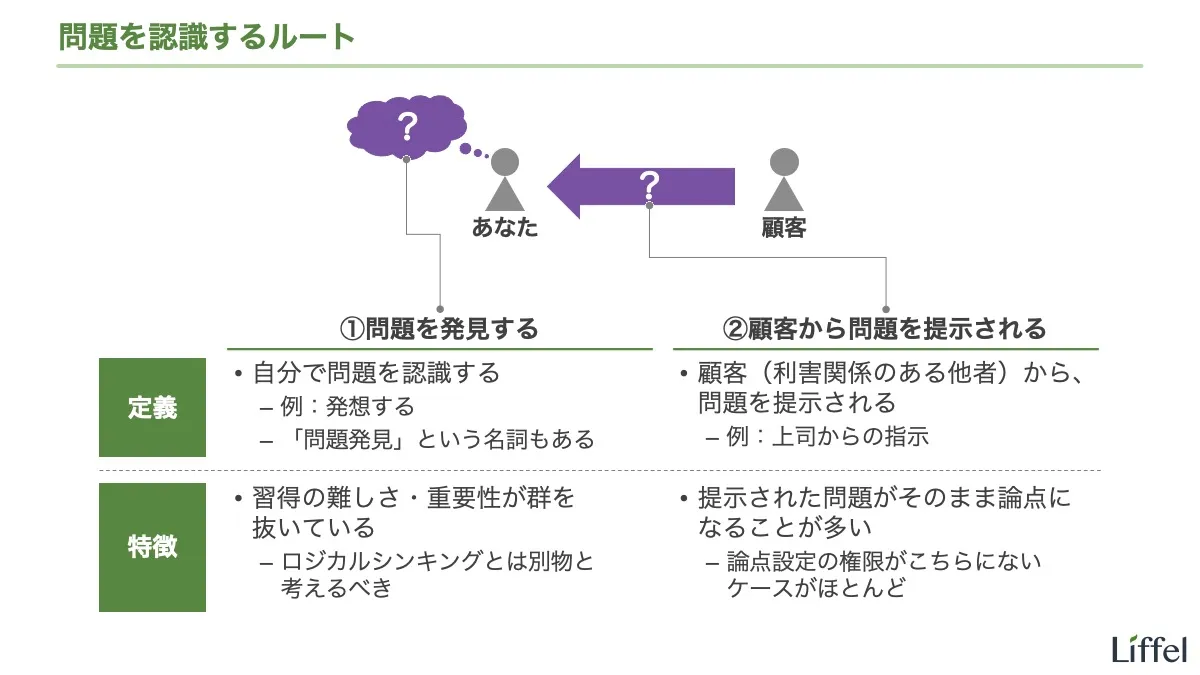
Let’s start by looking at the routes to identifying questions. The slide below summarizes them.
As shown, there are two main routes to identifying questions:
- Discover a question (identify it yourself)
- Receive a question from a client
If you identify a question, it’s either because you found it yourself or because someone presented it to you. That’s all there is to it. In principle, there’s no other way, is there?
Let’s look at each in turn.
Route 1: Discover a Question
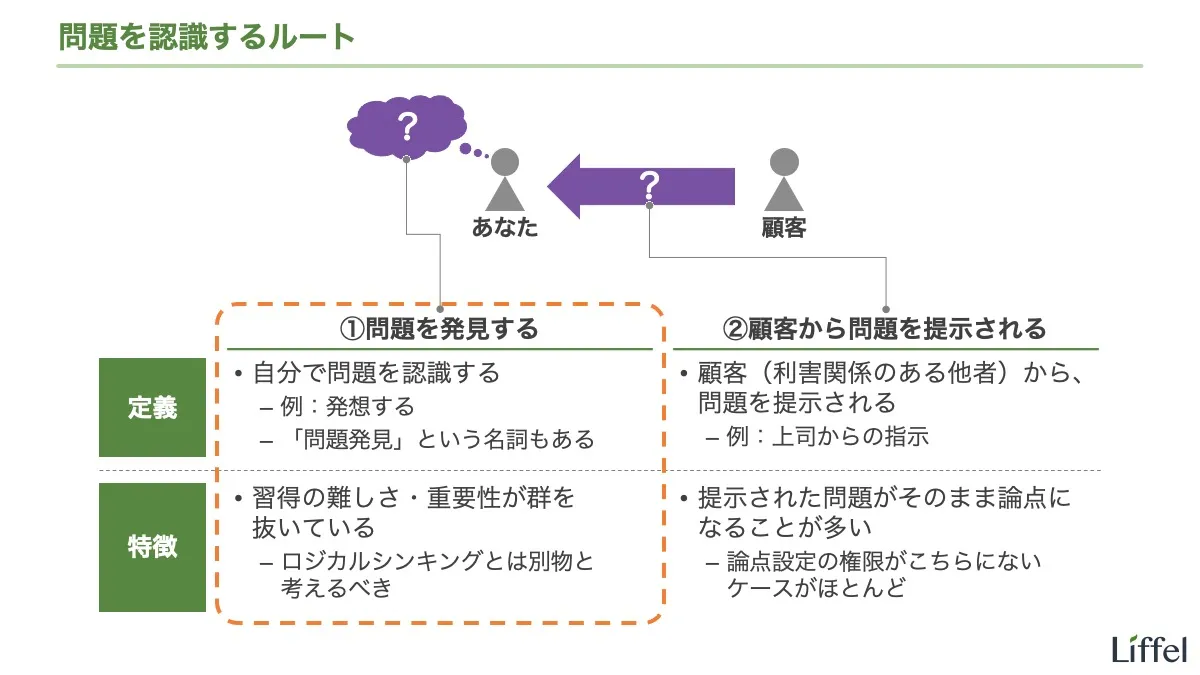
The first route to identifying questions is discovering a question. Something prompts a question to arise within you.
The easiest way to see this is to recall your childhood. For a child, it’s no exaggeration to say that the whole world is a question. Children don’t even know the names of things. You, too, probably kept asking the people around you questions.
Discovering questions has its own name, “problem finding,” and forms a skill area all its own.
In its difficulty and importance, problem finding is a skill in a class of its own. Although I introduce it as part of critical thinking for convenience, you should think of it as something separate.
Since I don’t fully understand this area myself yet, let me stop here for now. Let’s move on.
Route 2: Receive a Question from a Client
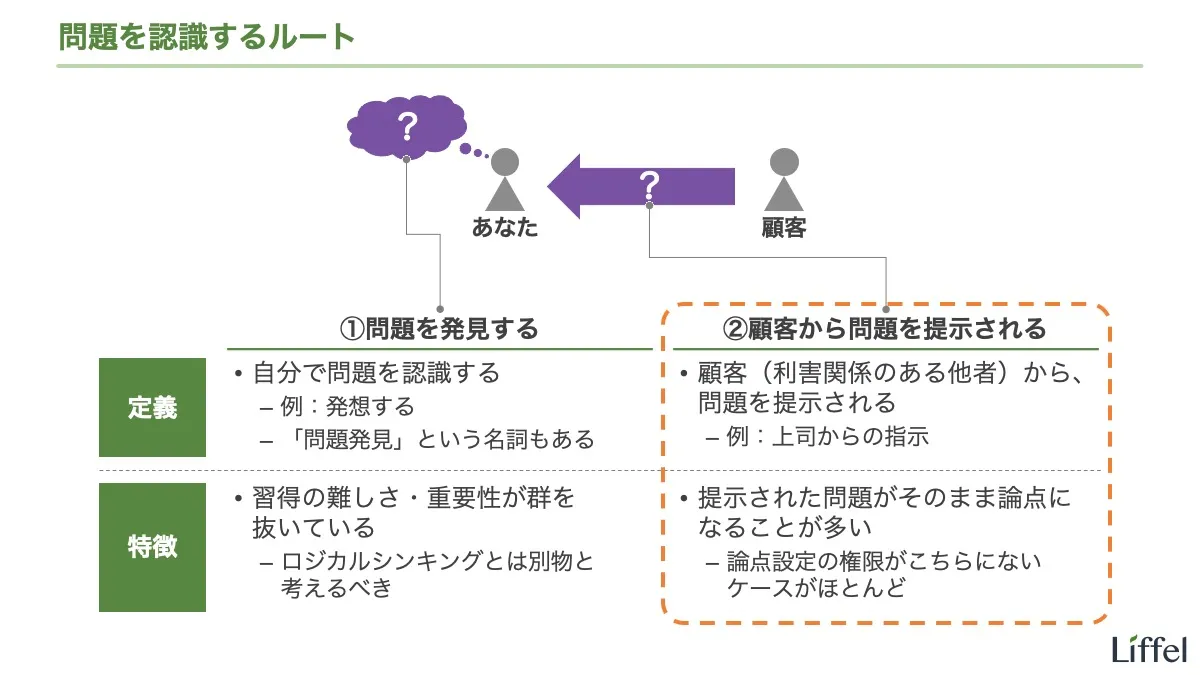
The second route to identifying questions is receiving a question from a client.
First, look at some concrete examples. Situations like these are what it means to identify a question presented by a client:
- Tests
- Essays and reports
- Your manager telling you, “Think about X”
Let me explain why step by step.
What Is a Client?
First, a client is someone who has a stake in your interests. Note that I’m using the word in an unusual sense.
Client: someone who has a stake in your interests
Here, “having a stake” means “a relationship in which doing what they say gets you what you want.” Put bluntly, a relationship in which money or grades change hands. For working adults, it’s money. For students, it’s grades (including marks and credits). Strictly speaking, there are other things too, but if you remember money and grades, you won’t go wrong.
In other words, your clients are people like these:
- Working adults: customers (clients in the narrow sense), managers
- Students: professors, teachers
These people ask you to “think about this question.” “Receiving a question from a client” refers to this route to identifying questions. Confirm that all the examples above follow this route.
Conversely, identifying a question presented by someone with no stake in your interests doesn’t count as this route. For example, identifying a question written in a book is ordinary problem finding. Keep in mind that what matters is whether the person presenting the question is your client (= whether you have a stake in each other’s interests).
Question Setting When You Think About a Client’s Question
As a rule, when you think about a client’s question, you have no authority over question setting. In exchange for thinking about the question your client has decided on, you get what you want (money or grades). Sorry to put it so crassly, but there’s no point in pretending otherwise.
When a client presents the question, you have no authority over question setting
As a result, when you identify a question through this route, you rarely evaluate or refine it. Since thinking about the assigned question gets you what you want, this is no time to evaluate whether the question is worth thinking about.
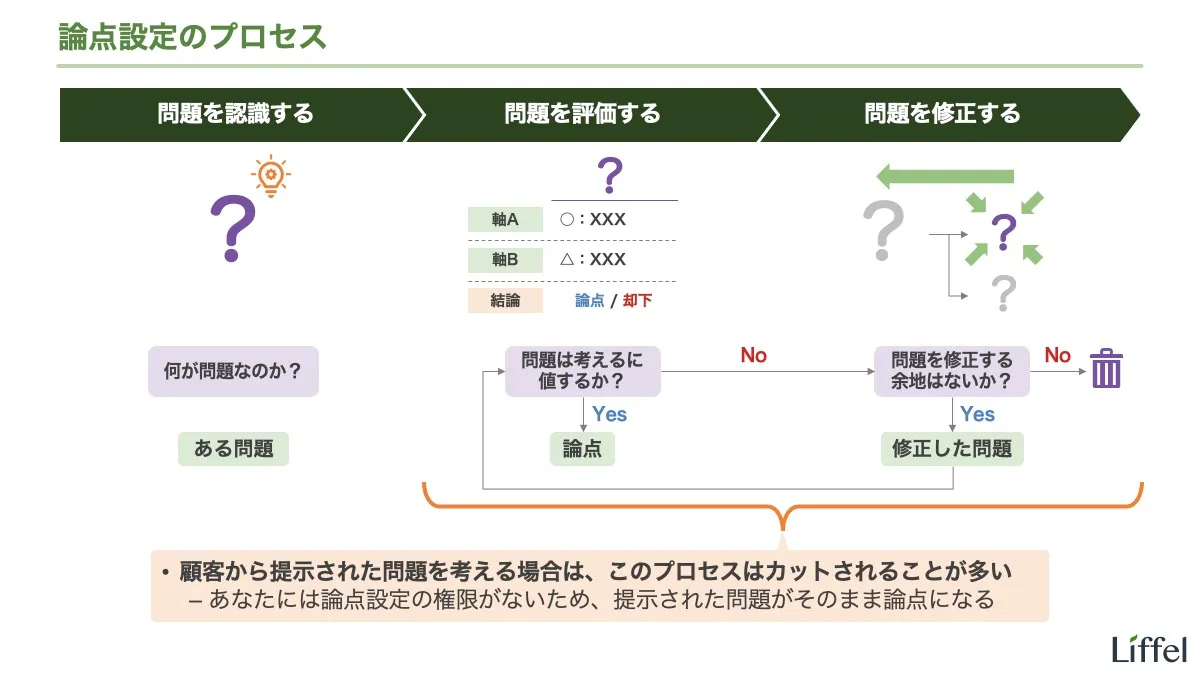
Don’t get me wrong. I’m not saying, “Don’t evaluate or refine questions presented by clients.” I’m just describing the reality that those steps are often skipped.
For example, have you ever wondered during a test, “Is there any point in thinking about this question?” And do you think it would be wise to?
Normally, the answer to both is no. What you want is a good score, and to get a good score, you need to answer the questions. Questioning the value of the questions themselves won’t get you what you want.
When a client presents the question, the value of the question itself is rarely questioned
The Risk of Not Evaluating Questions
While you’re a student or new to the workforce, there’s no big problem with the approach of “not questioning the value of the question you’re given and simply answering it.”
In fact, realistically, this is the only approach possible. For students, it goes without saying (master’s and doctoral students aside). And at work, no one but senior management is allowed to set questions from scratch. Your department and position determine the range of questions you’re allowed to work on, and that range is normally set by your managers (in the form of your assignment or role).
Beyond a certain level, however, this approach stops working. There are two main reasons:
- As you rise in position, you have to discover problems yourself
- For this approach to work, the assumption “the question you’re given is right” has to hold, but in the real world, it doesn’t
The first reason is simple. To be given questions, you need someone to give them to you. Sooner or later, there will be no one left to do that. You’ll have to become the one who discovers problems and gives questions to others. If you want to make thinking your job at the forefront of society, you can’t wait for questions to be handed to you.
The second reason is decisive: in the real world, the questions you’re given aren’t necessarily worth thinking about.
Working hard on a question you’re given is only worthwhile if the question is worth thinking about. For example, you shouldn’t think about a question that certainly won’t yield an answer no matter how much you think1.
And clients are human too, not gods. Of course they may give you the wrong question. Even so, if your attitude is “I won’t doubt the question I’m given and will do my best to solve it,” you’ve already got it completely wrong.
What to Do
So what should you do?
It’s easy to jump straight to saying, “This is no time to be thinking about questions you’re given. From now on, it’s all about problem finding.” In fact, claims like that are everywhere, and the trend will only grow stronger. That kind of claim is easy on the ears, after all.
Personally, though, I think this advice is unlikely to work in practice.
Because, let’s face it, you need money (no sugarcoating).
Since most people think within relationships of mutual interest, they can’t claim the right to set questions for themselves. Even if they find a problem, it won’t become the question.
That being the case, taking a lofty stance of “I must find the problems” will probably only sour your relationship with your client. Sorry to be blunt again, but your relationship with your client means money to you. It’s not something to neglect.
So it’s more realistic to take actions like these:
- Don’t compromise on communication about the question
- Communicate until you understand, with no discrepancy, what question your client is asking you to think about
- Ideally, evaluate and refine the question together with your client
- However, you need to communicate skillfully, and it’s also important to give in at the right point
- Communicate until you understand, with no discrepancy, what question your client is asking you to think about
- Always evaluate the question you’re given
- Even if the question becomes the question no matter what, always evaluate it for yourself
- If you’re repeatedly made to work on questions not worth thinking about (from your point of view), it may be worth considering a job change or transfer
- If your evaluation is right, that company or department will soon be in trouble (since it’s spending resources on meaningless things)
Through actions like these, the standard path is probably to earn money and survive within your organization while steadily building your ability to set questions and find problems.
Roughly speaking, it’s “rather than finding problems yourself, find a manager or leadership team that can find problems.” Although this has turned into a murky story, this area really is murky (for example, some problems are taboo and can’t even be raised), so I think anyone who works will understand.
Of course, if you have the authority to set questions, build your problem-finding ability, no questions asked. There’s no debate that this is the essential part.
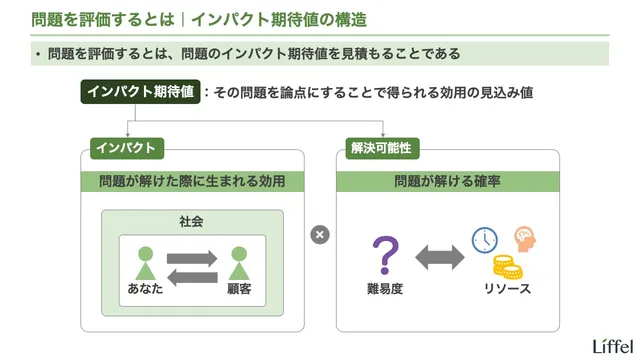
That covers the two routes to identifying questions. Next time, I’d like to think about the main event, problem finding… but since this topic will take some time, please bear with me. The entry on the next step of question setting, “evaluating questions,” is below.

Entries related to critical thinking are collected on the page below. Feel free to use them as a reference.
Footnotes
-
However, judging correctly before thinking about a question whether it will yield an answer is difficult (or rather, impossible). Although there’s no point in thinking about a question with no answer, you can’t create new value without taking on questions that seem unlikely to yield answers. Herein lies the difficulty of question setting. ↩