In this entry, you’ll learn about the universality of premises. It’s a very important condition for building valid premises, and it has been drawing more and more attention lately.
If you’d like to study logical thinking from the basics, see the link below.

Let’s begin.
toc
What Does “Universal” Mean?
First, let’s clarify what the word “universal” means. Dictionaries typically define it as something like “applying to all cases” or “existing everywhere.”
Although that may be correct, it’s too vague to be practical for logical thinking. So this site adopts a narrower definition.
Universal means not affected by chance bias. From here on, treat this as the meaning of “universal.”
Universal: not affected by chance bias
What “Not Affected by Chance Bias” Means, Part 1
So what exactly does “not affected by chance bias” mean?
Let’s start with a concrete example. First, look at this claim.
Claim: This die is rigged to always land on 1.
Here are some candidate premises for this claim:
- Because when I rolled this die, it landed on 1.
- Because when I rolled this die, it landed on 1 twice in a row.
- Because when I rolled this die, it landed on 1 three times in a row.
- Because when I rolled this die, it landed on 1 four times in a row.
- Because when I rolled this die, it landed on 1 ten times in a row.
Here’s a question for you. Which of these premises would you consider valid? In other words, how many 1s in a row would it take for you to accept that the die is rigged?
First, (1) is out of the question. Even a normal die lands on 1 once every six rolls. Premises like this can’t support the claim that the die is rigged.
(2) and (3) would also have a hard time carrying the claim. With a normal die, the probability of rolling 1 twice in a row is 1/36 (about 3%), and three times in a row is 1/216 (about 0.5%). These are probabilities that can easily happen.
But by (5), it becomes hard not to suspect the die is rigged. The probability of rolling 1 ten times in a row with a normal die is (1/6) to the 10th power, about 0.00000165%. That’s practically zero. With this, it seems fine to claim “This die is rigged to always land on 1.”
What “Not Affected by Chance Bias” Means, Part 2
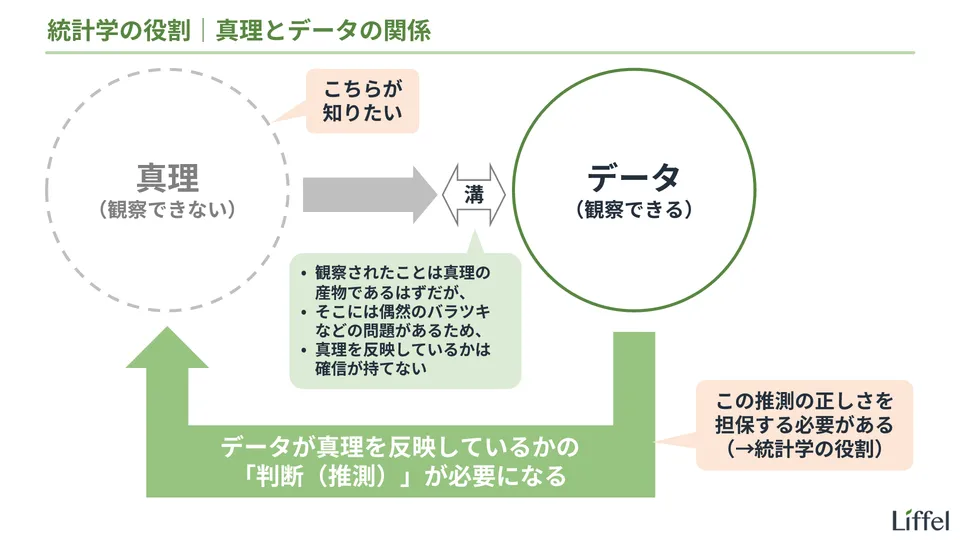
Let’s step back and explain what we’ve covered. Take a look at the slide below.
First, let’s call the die’s actual state (rigged or not) its “truth.”
No matter how many times you roll the die, you can never state its truth with 100 percent certainty. Even with a normal die, the probability of 1 coming up again and again never reaches zero. Whether 100 times or 100 million times, a normal die could keep landing on 1.
You might be thinking, “Just take the die apart.” It’s true that with a die, you could learn the truth by taking it apart. But as the next example shows, in most cases in the world, there’s no way to learn the truth directly. So for now, let’s say the die can’t be taken apart.
That means we have no choice but to infer the truth from what we can observe (= objective facts). Let’s call this “what we can observe” data. In this example, we infer the die’s truth from the results of rolling it (the data).
Here, however, a problem arises: data has random variation. You can never know with 100 percent certainty whether data “reflects the truth” or “just happened by chance.”
As mentioned, even a normal die can keep landing on 1. In other words, there’s an unbridgeable gap between the “data” (1 came up X times in a row) and the “truth” (the die is rigged or not). Check the slide.
So what should we do? What bridges this gap is our judgment. We have no choice but to judge: “No, this is just chance,” or “This can’t possibly be chance.”
Earlier, I asked, “How many 1s in a row would it take for you to accept that the die is rigged?” In other words, “After how many 1s in a row would you judge that it’s ‘not chance’?” What’s being asked is your judgment about whether it’s chance.
In this way, we leap over the unbridgeable gap between “data” and “truth” with a jump called judgment.
We infer the truth by judging whether the data is due to chance
A More General Case
Let’s check this with a more general case than dice.

Whose designs are better, Company X’s or Company Y’s?

Company X’s. I surveyed five people around me, and three said they liked Company X’s designs.
But then if just one person changed their mind, the conclusion would flip. That’s not reliable.
Confirm the following three points:
- You can’t directly observe whose designs are better (you can’t learn the truth directly)
- So Panda surveyed people on which designs they liked and inferred (claimed) the truth using that data as premises
- But Bear judged that Panda’s data was affected by chance bias and rejected Panda’s claim
In other words, Bear judged that “Panda’s premises are objective but lack universality (they’re affected by chance bias).” As a result, Panda’s claim (Company X’s designs are better) was rejected.
So how can Panda convince Bear? The answer is obvious: prepare premises that will be judged “not affected by chance bias.”
In this case, increasing the number of respondents will do it. Skipping the detailed explanation, with more respondents it becomes hard to think the result is affected by chance bias (= universality increases). Strictly speaking, this alone isn’t enough (you also need to consider things like the makeup of the sample), but let’s skip the hard part and just increase the number of respondents.
Whose designs are better, Company X’s or Company Y’s?
Company X’s. I surveyed 1,000 people around me, and 600 said they liked Company X’s designs.
In that case, it does seem fair to say Company X’s designs are better.
Confirm that this time, the conclusion doesn’t change even if one person changes their mind. The universality of the premises has increased. As a result, Panda got the claim accepted.
What changed from before?
Of course, on the surface, what changed was the number of respondents. But what really changed was the judgment about universality. Because the number of respondents changed, Bear’s judgment about the universality of Panda’s premises changed. Make sure you understand this.
Statistics
So how should you judge the universality of premises (= whether the premises presented are affected by chance bias)?
The discipline that teaches how to make this judgment is statistics. Although many people picture statistics as juggling difficult formulas, if I had to put it most simply, I’d describe it as “how to judge whether data is due to chance”1.
Statistics: how to judge whether data is due to chance
To sum up so far, universal premises are a set of objective premises judged to be “not affected by chance bias.” And judging whether they’re affected by chance bias requires knowledge of statistics.
Why Are Universal Premises Valid?
Let’s move on. Why are universal premises valid? In other words, why can premises that aren’t affected by chance bias withstand critique?
The answer is that that’s the rule we’ve agreed on. The general rule in the world is to accept as valid “premises judged, through statistical calculation, to be not affected by chance bias.”
That doesn’t mean it’s some outrageous rule that clever people made up on their own. As far as I know, it’s the fairest way of thinking there is.
Why Is Relying on Statistics for Judgment Fair?
As mentioned, inferring the “truth” from “data” inevitably requires our judgment about whether something is due to chance.
If we each made this judgment however we liked on various questions, thinking as a group would become impossible. Everyone could simply change their criteria to suit themselves.
”The Probability Isn’t Zero”
The clearest example of this is the nitpick “the probability isn’t zero.” It’s a typical, meaningless rebuttal used when universal premises supporting an inconvenient claim come up.
Let’s think about the earlier dice example. If you’re determined not to admit that the die is rigged, you can insist, after 100 ones in a row, that “the probability of a normal die landing on 1 a hundred times in a row isn’t zero.”
And in fact, the probability isn’t zero. A normal die will land on 1 a hundred times in a row with a probability of roughly 1 in 1078.
But no matter how mathematically correct “the probability isn’t zero” may be, you wouldn’t want to think together with someone who judges like this. This probability is so close to zero that it wouldn’t happen even once if you’d been rolling dice since humans evolved from apes (a rough guess). If you accept arguments like this, you’ll never get at the truth.
Let’s look at some examples other than dice.
The probability of winning the lottery jackpot isn’t zero. You should put everything you own into lottery tickets right now.
No one has ever died of this disease, but the probability that you’ll be the first isn’t zero. Take this medicine to prevent it.
The probability of being killed by a meteorite while walking outside isn’t zero. So you shouldn’t set foot outside your house.
Confirm that in every case, the part “the probability isn’t zero” is correct. Even so, none of the claims that follow are right.
That’s because “the probability isn’t zero” can be said of almost every probabilistic event. In other words, since this statement applies to everything, it’s correct but meaningless. Naturally, as a premise, it contributes nothing to supporting the claim’s rightness.
There are two main countermeasures against this tactic:
- Calculate the actual probability
- Point out that “the probability isn’t zero” for the opposite or other events too
For reference, here are sample rebuttals to the examples above.
The probability of winning the lottery jackpot isn’t zero. You should put everything you own into lottery tickets right now.
The odds of winning the jackpot are published. Try calculating the expected value.
No one has ever died of this disease, but the probability that you’ll be the first isn’t zero. Take this medicine to prevent it.
The probability of dying from taking that medicine isn’t zero either. Why can you say for sure that taking it is better?
The probability of being killed by a meteorite while walking outside isn’t zero. So you shouldn’t set foot outside your house.
The probability of something wonderful happening while walking outside isn’t zero either. I’ll take that one.
In my experience, though, by the time someone says “the probability isn’t zero,” they’re already emotional, and no real discussion is possible. Gambling is the classic case. I used to think like this all the time:
The probability of a big comeback on the next round isn’t zero. Double or nothing!
What to Do
So how can we prevent such arbitrary judgments about probability and think constructively?
The answer is to agree on the criteria for judgment in advance. If you agree beforehand that “up to here is chance, and beyond here we won’t consider it chance,” you can prevent people from conveniently changing their judgment about chance depending on the result. That’s fair, isn’t it?
Why Study Statistics
This is why it’s worth studying statistics. What you learn in statistics is exactly the “criteria for judgment” described above. In other words, studying statistics lets you take part in judging whether something is due to chance.
So to critique and build universal premises, you have no choice but to study statistics.
If you want to be able to critique and build universal premises, you have to study statistics
And statistics can’t be understood overnight. Unless you learn the theory and actually work with data and run tests, you won’t know what set of facts you need to gather to make premises that can fend off the critique “Didn’t that just happen by chance?”
In other words, you can’t learn to critique and build universal premises overnight. Since this site currently has no plans to go deep into statistics, please study it separately on your own.
If You Want to Keep Learning
Thank you very much for reading this far. If you’d like to keep learning logical thinking, continue to the entry below. It explains exhaustive premises.

Entries related to logical thinking are collected on the page below. Feel free to use them as a reference.
Footnotes
-
Statistics is divided into “descriptive statistics,” which teaches how to clarify the characteristics of data (such as means and variance), and “inferential statistics,” which teaches how to judge whether data is due to chance, as described in the text. Strictly speaking, what I’m describing here is inferential statistics. ↩