

I can’t say whether conversations like this are still happening somewhere out there. What I can say is that Panda is hard to follow. And there’s a problem with the content, too. A banana diet probably won’t help anyone lose weight1.
Critical thinking is now firmly established as an essential skill for working adults. If you’re a college student starting your job search or someone new to the workforce, you’ll hear the term “critical thinking” sooner or later.
How did it come to this? In other words, why should you learn critical thinking? This entry answers that question.
If you’ve already decided to study critical thinking, I hope this entry boosts your motivation. If you’re still on the fence, I’d be glad if it nudges you a little closer to starting.
Let’s begin.
toc
- What Is Critical Thinking?
- The Benefits of Critical Thinking
- How Critical Thinking Helps at Work
- Summary
- References
What Is Critical Thinking?
First, a quick overview of critical thinking.
On this site, “critical thinking” means the ways of thinking, explaining, and discussing that lead to absolute rightness. Since this entry focuses on why you should learn critical thinking, if you’d like to learn what it is first, read the entry below.

As an example, let’s use critical thinking to improve the conversation above.
The content is still questionable, but at least it’s easier to follow than before. And of course, once you learn critical thinking, you’ll be able to improve the content as well.
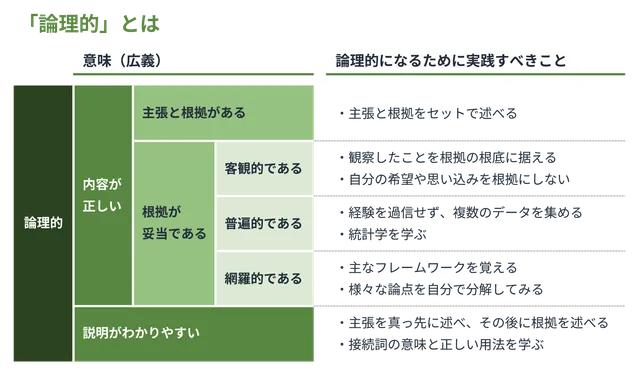
The main elements of critical thinking are summarized in the table below.
For details, see the link above.
The Benefits of Critical Thinking
As Ulrich Boser argues in Learn Better, what turns fleeting motivation into deep, lasting motivation is value: the sense that something is worth doing.
Let’s get to the point. Ultimately, the reason to learn critical thinking is simply the benefit of mastering it. If studying something brings no benefit, you’d be better off spending the time having fun2.
More than that, it’s impossible to learn critical thinking without understanding its benefits. That’s because benefits are what drive your motivation to learn.
Whether it’s critical thinking or anything else, nothing matters more for learning than motivation. Unless you’re a small child, nobody’s going to tell you to study. You have to push yourself. And if you force yourself to study something you don’t want to learn, it probably won’t stick.
You can study with motivation because you see benefits (value) in learning
When it comes to critical thinking, seeing its value is especially important, because critical thinking can’t be mastered overnight.
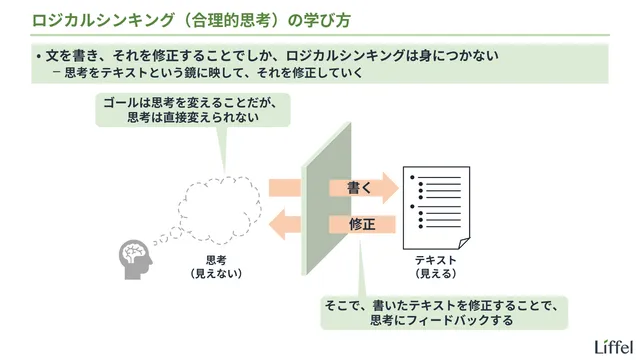
As the word “thinking” suggests, this skill changes the way you think. How long it takes varies from person to person, but expect it to take at least several months (not to study the material, but to put the skills into practice). That’s not a period you can get through while dragging your feet.
So understanding the benefits of critical thinking is a prerequisite for mastering it.
The Answer
So, what’s the benefit of learning critical thinking, that is, of mastering the basic ways of thinking, explaining, and discussing?
You probably already have a vague idea. Otherwise, the term “critical thinking” wouldn’t have caught your attention.
The answer is: it makes you money.
Of course, I’m putting it bluntly on purpose. Usually, people say it in more grown-up (more roundabout) ways, such as:
- Critical thinking is a basic skill for working adults, and something everyone is naturally expected to have
- Mastering critical thinking makes it easier to land a job or change careers
- Mastering critical thinking lets you deliver more value at work. As a result, your reputation improves, and you get more chances for promotion
Maybe you came across claims like these somewhere, got curious about critical thinking, and ended up on this page.
So what do these claims mean? In short, it makes you money.
Of course, I know work isn’t just about money. But it’s also true that you can’t live without it. Not just critical thinking, but every skill popular among working adults, including English and programming, is popular because it makes money (that is, it leads to jobs and promotions). There’s no point in pretending otherwise.
So here’s the point:
The benefit of critical thinking: it makes you money
How Critical Thinking Helps at Work
Simply declaring “it makes you money” without any reasons sounds pretty suspicious, doesn’t it? From here, I’ll explain why critical thinking makes money.
As I said, critical thinking makes money because it’s useful at work. So how exactly does critical thinking help at work?
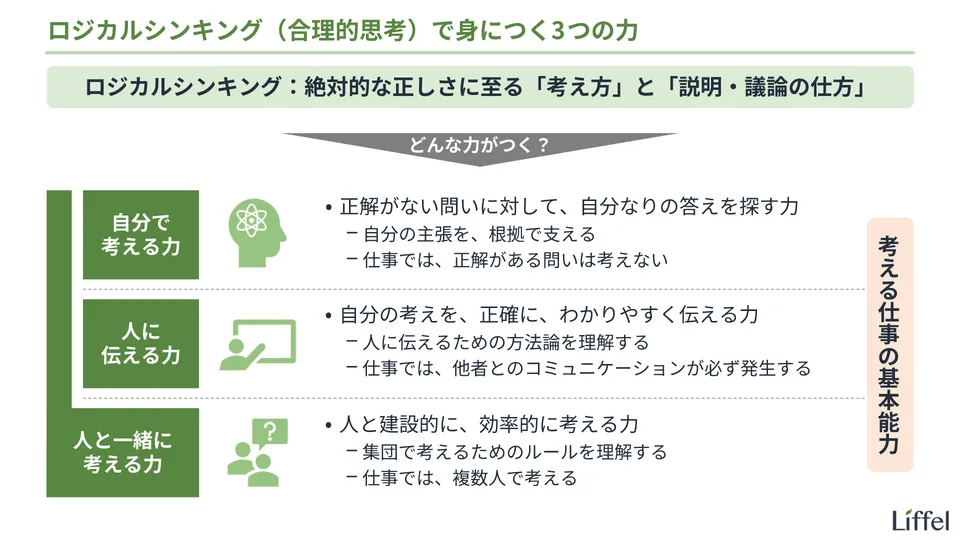
Broadly speaking, mastering critical thinking gives you the following three abilities:
- The ability to think for yourself: finding your own answers to questions that have no correct answer
- The ability to communicate: conveying your ideas accurately and clearly
- The ability to think with others: thinking together with others constructively and efficiently
These are all fundamental abilities for any job that requires “thinking.”
Let’s look at them one by one.
Ability 1: Thinking for Yourself
First, mastering critical thinking enables you to think for yourself.
You may be thinking, “Come on, I already think for myself!” And in the sense that your brain is working, that’s true. But critical thinking uses the word “think” in a narrower sense.
Here, “thinking” means finding your own answers to questions that have no correct answer. You also back up those answers with reasons. “Because I think so” doesn’t count. The emphasis is always on what has been observed (what the facts are).
Defined this way, you’ll realize that we hardly ever think in daily life. Learning critical thinking teaches you to think in this sense.
Why is this ability useful at work?
Because at work, the only questions you need to think about are those without a correct answer. Questions with a correct answer can be settled with a quick search or by asking AI.
In other words, in any job that requires thinking, if you can’t find answers to questions without a correct answer on your own, you’re out of the game. It’s not a matter of being “useful.”
In “thinking” jobs, people who can’t find answers to questions without a correct answer on their own have no reason to be there
Incidentally, AI will eventually answer questions with correct answers almost perfectly, and we’ll come to take that for granted. At that point, it won’t just be that thinking jobs are pointless if you can’t answer such questions. More likely, there’ll be no point in humans using their heads at all unless they’re thinking about questions without a correct answer.
Ability 2: Communicating
Second, mastering critical thinking enables you to convey your ideas accurately and clearly.
As in the opening example, when we speak (or write) whatever comes to mind, our words become surprisingly hard to follow. Critical thinking teaches you methods for conveying your ideas accurately and clearly, improving your ability to communicate.
Why is this ability useful at work?
Because work is about contributing to others. Whatever the job, it counts as work because someone benefits from what you do.
In other words, work inevitably involves other people, and that means communicating with them (though how much varies greatly from job to job). The more accurate and clear that communication is, the better.
Since work requires communicating with others, the ability to convey your ideas accurately and clearly is useful
Ability 3: Thinking with Others
Once you can think for yourself and communicate your ideas, you’ll be able to think together with others. This is the third ability critical thinking gives you.
Learning critical thinking helps you understand the rules for thinking together with others. Only once you understand these rules can you truly think with others.
A sports analogy makes this easier to see. If you want to play soccer, every player needs to understand the rules of soccer (not just what’s written in the rulebook, but all the norms players are expected to follow). For example, “no one but the goalkeeper may touch the ball with their hands.” If even one player doesn’t understand these things, it isn’t soccer anymore.
Thinking as a group works the same way. For a group to think together, everyone needs to understand the rules of group thinking. Those rules are exactly what critical thinking is.
For example, for a group to think together, everyone needs to bring their own ideas. Someone with no ideas of their own can’t contribute anything. In soccer terms, they’re like a player who never moves and never touches the ball.
You also need to convey your ideas clearly. If someone rattles on about their ideas without trying to be understood, the group can’t reach an answer efficiently. In soccer terms, that’s a player who never passes. With a player like that, you can’t win.
There are several other rules for discussing constructively and efficiently. I won’t go into detail here, but the point is that unless everyone understands them, the group can’t think together. The ability to think with others means understanding these rules.
Why is this ability useful at work?
Because at work, people think in teams. Until college, you rarely get a chance to think as a group. In the working world, however, it’s actually rare to think alone. If you don’t know how to think and discuss as a group, you can’t deliver value at work.
Since people think in teams at work, the ability to think with others is useful
Review
Let’s check what you’ve learned with an exercise.
Name the three abilities you gain by learning critical thinking.
Try writing your answer in the box below. You’ll learn much more effectively if you write it yourself. If you get stuck, reread the entry. Note that what you write here can’t be saved, so if you’d like to keep your answer, use your own notes app or something similar.
- The ability to think for yourself: finding your own answers to questions that have no correct answer
- The ability to communicate: conveying your ideas accurately and clearly
- The ability to think with others: thinking together with others constructively and efficiently
Summary
Finally, let me sum up.
Mastering critical thinking makes you money, because critical thinking is an essential skill for any job that requires thinking (answering questions without a correct answer). Learning critical thinking gives you three abilities: (1) thinking for yourself, (2) communicating, and (3) thinking with others. With these three abilities, it’ll be easier to land a thinking job and to deliver results once you’re there.
That’s about it. Strictly speaking, I’ve skipped explaining why thinking jobs make money, but I think that’s self-evident, so I’ll leave it out.
The Real Reason You Need Critical Thinking
Now, are the three abilities above really something you should acquire just because they make money?
(1) Thinking for yourself, (2) communicating, and (3) thinking with others are all basic human abilities, not something you pick up because they pay.
For example, the very existence of the term “literacy rate” shows that people can live without being able to read. Still, if someone in a developed country today couldn’t read, you’d think it was a serious problem, wouldn’t you? To me, these three abilities are as important as reading. What do you think?
In fact, in Europe and North America, the basics of critical thinking are taught in schools, in subjects such as “language arts”3.
Language arts is a comprehensive system that teaches methods of thinking and expression as concrete skills, and its goal is character formation. What kind of person does it aim to form? Roughly, a person like this:
(1) Someone who can think critically and independently (who has the ability to examine matters logically, analytically, and from multiple perspectives on their own, and to make sound judgments)
(…)
Toward these goals, language arts systematically and concretely teaches skills such as taking in information (reading, viewing, and listening), thinking (critical, logical, analytical, multi-perspective, and creative thinking), and expression (speaking and writing), according to students’ developmental stages, over the twelve years from elementary through high school.
Japanese education from elementary through high school leaves this out entirely, which has created the strange situation in which critical thinking is a huge hit in new-employee training. This is an issue Japanese education should take seriously.
In any case, here’s the conclusion:
The benefit of critical thinking: you gain basic human abilities
That covers the benefits of learning critical thinking. Now, let’s start studying it!
Continue to the next entry:
Entries related to critical thinking are collected at the link below. Feel free to use them as a reference.
References

Footnotes
-
Of course, if you ate nothing but bananas and kept your calorie intake low, you might lose weight. But that would simply be because you kept your calorie intake low. Bananas are actually high in sugar for a fruit, and there’s no evidence of any weight-loss effect unique to them. ↩
-
Some people believe that learning has value in itself, and it’s true that a rare few people treat learning as a form of play. However, this site doesn’t take that view, for two reasons: (1) such people are very rare, and (2) under that view, there’s no way to prioritize what to learn. ↩
-
In Japan, by contrast, this skill is usually called “critical thinking,” and its scope is vague to begin with. At the very least, critical thinking on this site incorporates what’s taught in Western language arts and critical thinking courses. ↩