
This entry explains how debate differs from real-world decision-making.
There is no question that debate trains skills you can use in real-world decision-making. Even so, debate is fundamentally training. If you do not understand how it differs from the real thing, you risk getting tripped up when it actually counts. Let us think this through.
As preparation, please read the following entry first (from the “Critical Thinking” category).

toc
- How Debate Resembles Real-World Decision-Making — and How It Does Not
- Difference #1: At the Question Level
- Difference #2: At the Claim Level
- Difference #3: At the Premises Level
How Debate Resembles Real-World Decision-Making — and How It Does Not
To start with, in the sense of “preparing a claim and premises in response to a question,” debate is modeled on decision-making. Look at the slide below.
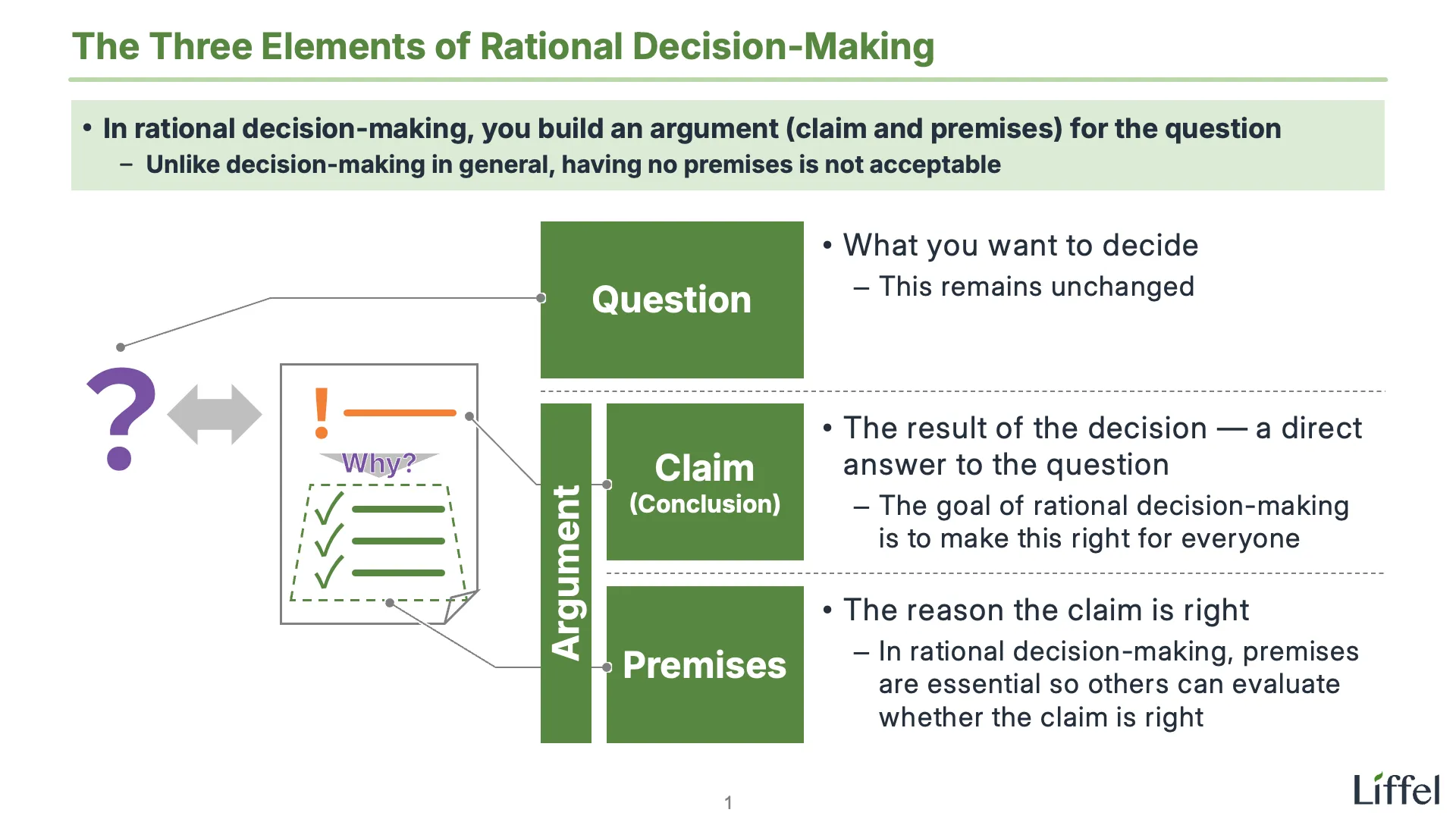
The “question” in debate is the same as the “question” in the slide above. That means the two have exactly the same structure.
In other words, debate is training for becoming able to make rational decisions.
The revolutionary significance of AI debate is that you can now do this on your own. Until now, debate could only be meaningful training with an instructor who understood rationality and decision-making, plus an opponent. All of that is no longer required. You can now repeat this training for becoming rational by yourself1. There is no reason not to do it.
The Fundamental Difference
That said, even if debate models decision-making, it remains training in the end. Look at the table below.
| Real-world decision-making | Debate | |
|---|---|---|
| Fundamental nature | The real thing | Training |
| Goal | Making the right decision | Producing good training |
| Time limit | Anywhere from a few minutes to unlimited | Extremely short (30 minutes to 1 hour) |
As long as it is training, the goal has to be “to be good training” — there is no way around this.
This means a single match (one decision) must finish within an hour at most. This is non-negotiable. If the time burden grows beyond that, it becomes impossible for most people to repeat debate consistently.
The skills debate trains — writing skill and reasoning ability — none of them stick without repetition. Without repetition, debate will never become “good training.”
How much repetition is needed is something I will need to test further. My current view is that anyone whose education has not included this kind of training should aim to do AI debate hundreds of times (such opportunities are rare in many education systems, and the gap is rarely closed elsewhere).
If you have hundreds of repetitions in mind, “one hour per match” is the upper bound. The ideal is probably 30–45 minutes, but for now, let us aim for one hour per match including feedback as a rough target.
For debate to be good training, each match must finish within an hour — let us treat this as non-negotiable
To meet this constraint, debate simplifies decision-making. Below, let us look at how the three elements of rational decision-making (introduced in the linked entry) are handled differently in debate and in real-world decision-making.
Difference #1: At the Question Level
First, let us look at how the question differs between the two contexts. The table below summarizes it.
| Real-world decision-making | Debate | |
|---|---|---|
| The question | Something to find or choose | Something given to you |
| Form | Any kind of question | A yes/no question |
| Whether you can tell if you were right | Yes, eventually (in the medium-to-long run) | Never, by design |
| Importance | Most important (about 80% of the outcome is decided here) | Low (any debatable question will do) |
To put it briefly: in real-world decision-making, the question is the most important element. In debate, it barely matters.
The Question in Real-World Decision-Making
In real-world decision-making, the question is unquestionably the most important point.
Out of countless possible questions, we choose which ones to spend resources answering. If we do not weigh the following carefully, those resources go to waste:
- Will it produce value?
- You need to choose a question whose answer produces value
- Can it be answered?
- No matter the question, no value is produced if it cannot be answered
- Will the answer come in time?
- Even if a question can be answered, many questions are pointless if someone else gets there first
I will not go deeper here because this could fill a whole entry on its own. The single point I want you to take away is this: in real-world decision-making, the question must be chosen carefully.
In real-world decision-making, what to make the question is the most important thing
The Question in Debate
In debate, by contrast, the game does not work unless both sides — affirmative and negative — have a chance to win. Because of this, the questions chosen are ones where you can never tell which side was right. That is, every debate question is one whose answer is ultimately “it depends” or “either way” or “a matter of values.”
There is no reason to agonize over choosing such a question. Just decide on one quickly. The only thing that matters is “can I build an argument on this question?” If the answer is yes, start the debate.
For the same reason, you do not need to agonize over which of the questions the AI proposes in AI debate. A question you do not pick today can simply be the question for tomorrow.
By the way, you can also reuse questions you have already debated before. Especially at first, doing the same question every day is fine (it lets you focus on “completing it as a piece of writing”). I myself debated “Should ambulance services charge a fee?” about three times while writing this series of entries, and I learned something each time2.
In debate, any question that can be debated will do
Difference #2: At the Claim Level
Next, let us look at how the claim differs. The table below summarizes it.
| Real-world decision-making | Debate | |
|---|---|---|
| The claim | Something you put forward and commit to | Determined by your assigned side (affirmative or negative) |
| Mutability | Can be changed | None (the claim is fixed) |
| Accountability | You are accountable | You are not accountable |
| If wrong | You suffer losses, get poor evaluations, etc. | ”Being wrong” does not even apply |
This is a similar story to the question: in real-world decision-making, the claim is the second most important thing after the question. In debate, there is nothing you can do about the claim.
A Claim in Real-World Decision-Making
In real-world decision-making, your claim is effectively your resolution / fixed final decision (assuming you have decision-making authority). You act or announce based on that resolution, and what awaits on the other side is gain or loss, and evaluation.
Nobody would say gains, losses, or evaluations are unimportant. So what you claim in real-world decision-making is extremely important. It is not quite as important as the question (the question determines what you can claim), but it is the second most important thing.
In real-world decision-making, the claim brings gains and losses with it, so what you claim matters
In the real world, you can also change your claim as new information comes in, or even make no claim at all (to wait and see). Nobody is forcing you to take a stand. This is another major difference from debate.
A Claim in Debate
In debate, by contrast, a claim is fixed by your assigned side. It has nothing to do with your actual opinion, and you bear no accountability for the claim. To use a sports analogy, it carries about as much weight as “which goal to attack” — there is nothing in particular to be conscious of.
In debate, there is nothing you can do about the claim
If there is one point, it might be this: state your claim at the beginning of your constructive. This is a basic convention of formal argumentative writing. Let debate train it into you as a default form.
Difference #3: At the Premises Level
Finally, let us look at how the premises differ. The table below summarizes it.
| Real-world decision-making | Debate | |
|---|---|---|
| Core of the premises | Data (ideally) | Reasoning and personal anecdotes (by necessity) |
| Research | Almost always done | Not done (by convention) |
| What ultimately decides truth or victory | Data | Values and delivery (both sides can produce reasoning) |
This is the point that calls for special care. Debate is training in constructing premises, but because of the time constraint, it cannot include “gathering data” — which is essential in real-world decision-making.
What does this mean?
Premises in Real-World Decision-Making
As our starting point, in real-world decision-making, the core of the premises should be data.
The reason is that data (what can be observed) is the only thing whose rightness can be shared by everyone. So premises that are not based on data cannot make a claim right. This is the basic precondition of rationality (modern science). Since the full explanation would be too long for this entry, please refer to the entry below.
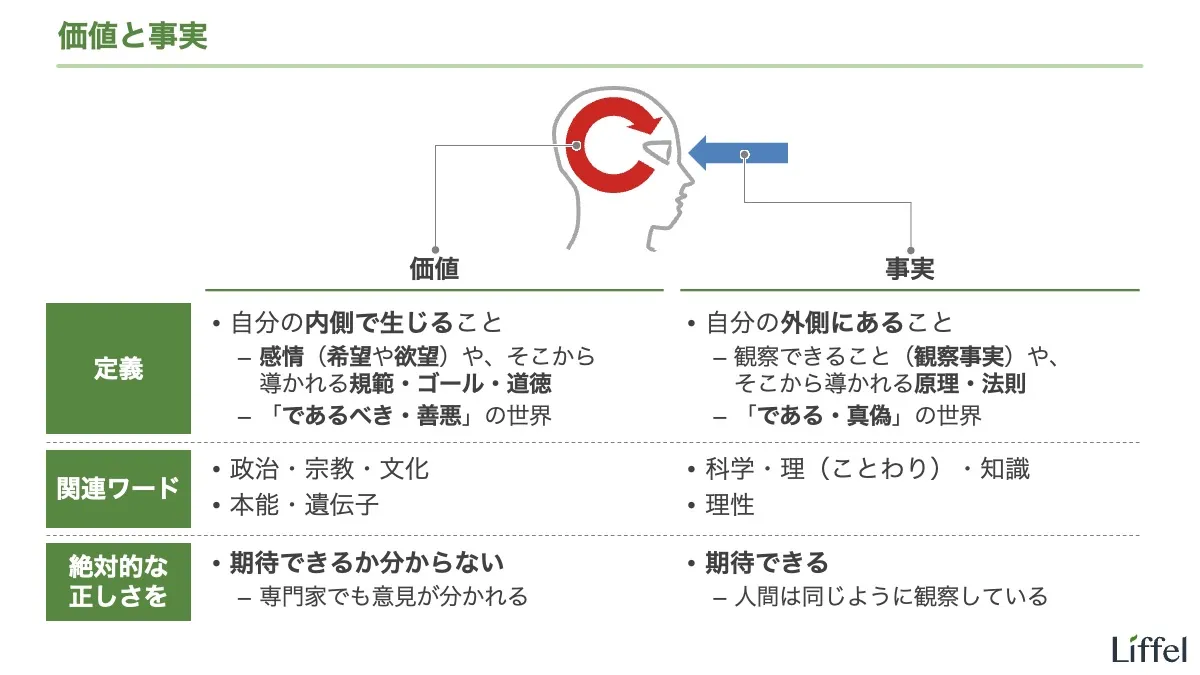
Of course, in actual decision-making, things beyond data also come into play. Who is saying it and whose gains and losses are at stake are two examples. However, none of those have anything to do with rationality, and there is no way to train them. For the purposes of this entry, please accept the framing that “in real-world decision-making, premises are based on data.”
In real-world decision-making, premises are based on data, which support the claim
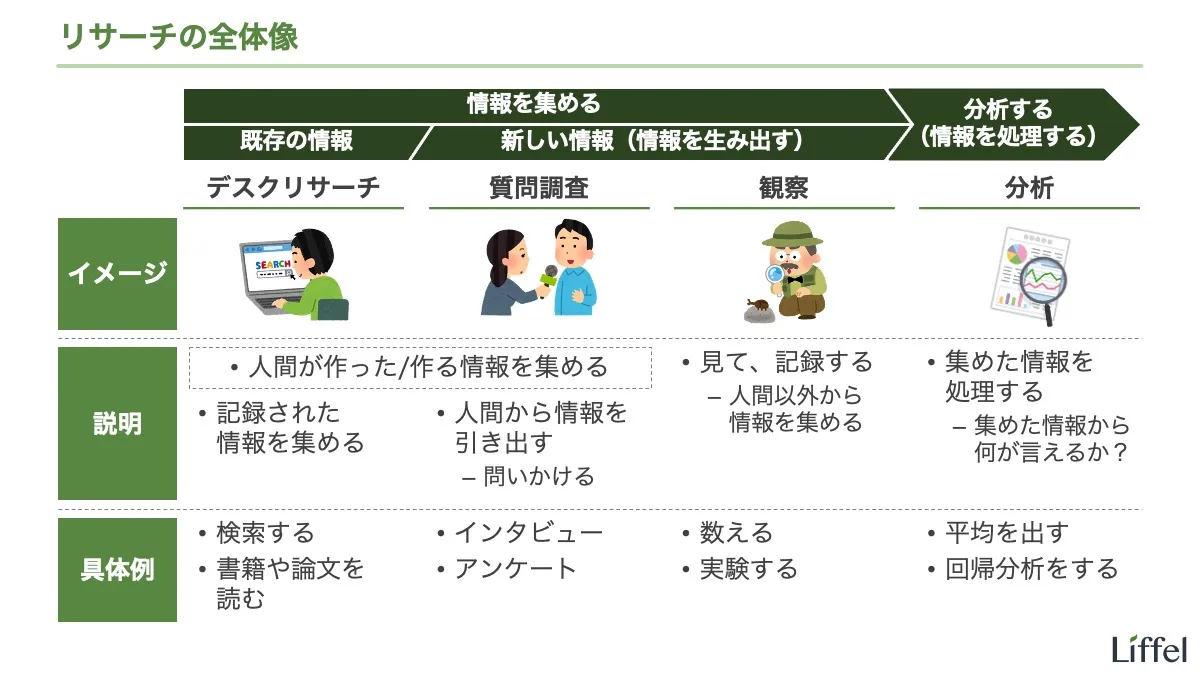
So, in real-world decision-making, research (the act of gathering data) is essential. Without it, you cannot construct sound premises.
I have a separate entry on research. Please give it a look when you have time.
Premises in Debate
The problem is that research takes time. In academic research, it can take years to gather the data. An hour of research, at most, gives you a rough overview — not data strong enough to serve as solid premises.
This collides head-on with our earlier principle: “for debate to be good training, each match must finish within an hour.” The conclusion: we have to accept that debate does not include research.
Whether you go this way is a matter of preference. In competitive debate, the question is sometimes announced in advance and competitors are given time to research before the match.
However, in the context of “doing AI debate on your own,” my view is that you should give up research and put your effort into training writing skill and reasoning ability. On this site, let us treat “no research in debate” as a given.
To repeat debate efficiently, we treat it as not including research
Under this convetion, your premises end up made of the following elements:
- Reasoning (the building blocks of your premises — your contentions): why this holds
- Example: “Requiring uniforms creates an environment where students can focus on learning”
- Values: what we should prioritize
- Example: “In this case, equality should outweigh freedom” or “Lives and health should come before cost efficiency”
- Personal anecdotes (including hearsay): what you have actually experienced or heard (data with a tiny sample size)
- Example: “Personally, I take a long time deciding what regular clothes to wear”
Put unkindly: premises like these may sound plausible but are thin. The values and personal anecdotes propping up the reasoning may not function as sound premises in real-world decision-making, for the following reasons:
- Values: their rightness across people is not as widely shared as data’s
- In real-world decision-making, “I do not share that value” ends the conversation
- Personal anecdotes: the sample size is too small
- In real-world decision-making, “that’s just n=1” ends the conversation
- In debate, treat personal anecdotes as a way of making your reasoning concrete and vivid, nothing more
This is the kind of thing you cannot fully grasp without studying rationality (critical thinking and statistics) rather than debate. For now, please just take this away: what counts as sound premises in (research-free) debate is not as sound in real-world decision-making.
Why Debate Is Still Worth Doing
You might think: “Then is there really any point in working at debate?” There is.
“Decision-making based on data” is, after all, the ideal endpoint. Before that, you need to learn the basic stance of rational decision-making — “judging the rightness of a claim from its premises,” “examining the substance rather than who said it,” and so on. Debate is the best training for this.
In fact, our real-world decision-making is far from the ideal — most people do not even reach the basic stance. Look at the following:
- They do not even know that “judging the rightness of a claim from its premises” is something one should do
- They decide what is right by the mood in the room (groupthink)
- They decide what is right by who said it (argument from authority)
- They cannot have a proper discussion
- They take critique and rebuttal as personal attacks and quickly fly into a rage
- They conflate “critique” with “personal attack”
- They are convinced they are right, with no room for discussion
- They take critique and rebuttal as personal attacks and quickly fly into a rage
In the end, debate is essential precisely so that you can eventually make ideal, data-based decisions. Although it is true that debate is not so universal that you can apply it directly to real-world decision-making, that is no reason not to do debate. Take it up with confidence.
That covers how debate differs from real-world decision-making.
For other AI-related entries, see the following:
Footnotes
-
One more advantage: you can do AI debate in text rather than in speech. In situations where strict rationality is demanded, people rely on text rather than speech. Training your writing skill therefore pays off directly. ↩
-
Any single question has at least five possible contentions. Since you only use two in your argument, a single question can be reused at least two or three times. ↩