This entry introduces “the problem-solving framework (cause and solution).” It’s one of the most frequently used frameworks, applicable to almost any problem solving. Learn it here and try it out in all sorts of situations.
Let’s begin.
toc
The Problem-Solving Framework (Cause and Solution)
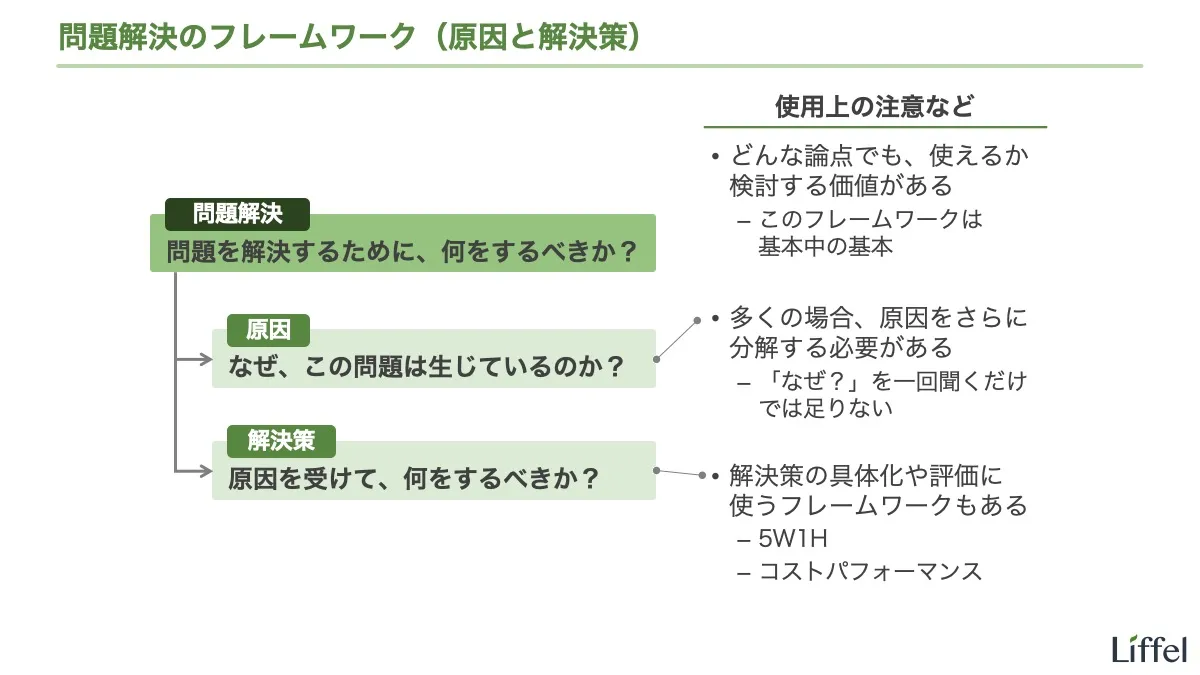
Let’s get right to it. Take a look at the slide below.
As shown, “the problem-solving framework” means that when there’s a problem, you first think about what’s causing it and then think about solutions.
Whenever something undesirable (a problem) is happening and you want to solve it, you can use this framework almost 100 percent of the time. It can be called the most versatile framework in problem solving.
Problem solving = Cause × Solution
As a question structure, this framework looks like this:
- Problem solving: What should we do to solve problem XX?
- Cause: Why is problem XX happening?
- Solution: Given the cause, what should I (we) do?
Exercise
Let’s put this framework to use right away with an exercise.
The following problems exist. Set a question that asks for a solution, and break it down using the problem-solving framework. Adjust the wording as needed.
Problem 1: There are fruit flies in my home
Try writing your answer in the box below.
- What should I do to keep fruit flies out of my home?
- Cause: Why are there fruit flies in my home?
- Solution: Given the cause, what should I do?
This actually happened to me when I started living alone. The cause was “not putting a lid on the trash can with food scraps in it.” I hope this helps anyone who’s just started living alone.
Problem 2: My grades are bad
- What should I do to improve my grades?
- Cause: Why are my grades bad?
- Solution: Given the cause, what should I do?
You can dig deeper into the cause sub-question by using the “Results = Effort × Talent × Luck” framework introduced in another entry.
Problem 3: Sales are declining
- What should we do to recover sales?
- Cause: Why are sales declining?
- Solution: Given the cause, what should we do?
As you can see, this framework applies to everything from private life to business.
Cautions About the Problem-Solving Framework
Finally, let me explain some cautions about using this framework.
Although this framework is highly versatile, it doesn’t dig deep enough. You need to break down the “cause” sub-question further.
A famous story has it that Toyota asks “why” five times. Don’t get this wrong: just setting up the first “why” is far from enough.
That said, start by using this framework thoroughly. Since it’s a classic among classics, whenever you want to solve something undesirable, it’s fine to use it mechanically.
People who don’t know critical thinking rush into solutions without thinking carefully about causes. Although one “why” may not be enough, it’s much better than none.
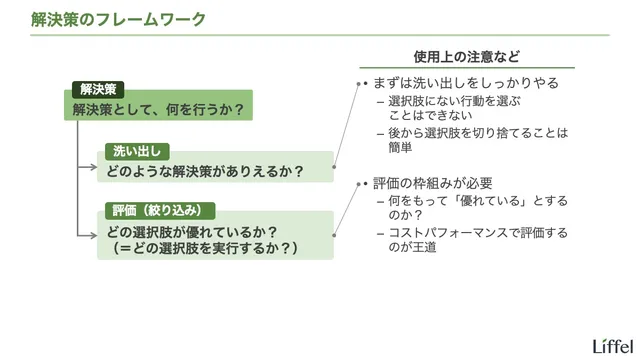
That covers the problem-solving framework. Next, let’s learn the solution framework.

Entries related to critical thinking, and other frameworks, are collected on the page below. Feel free to use them as a reference.