This entry introduces “the solution framework.” Since this is another basic framework, make sure you understand it well.
This entry continues from the one below. Read it first.

Let’s begin.
toc
The Solution Framework
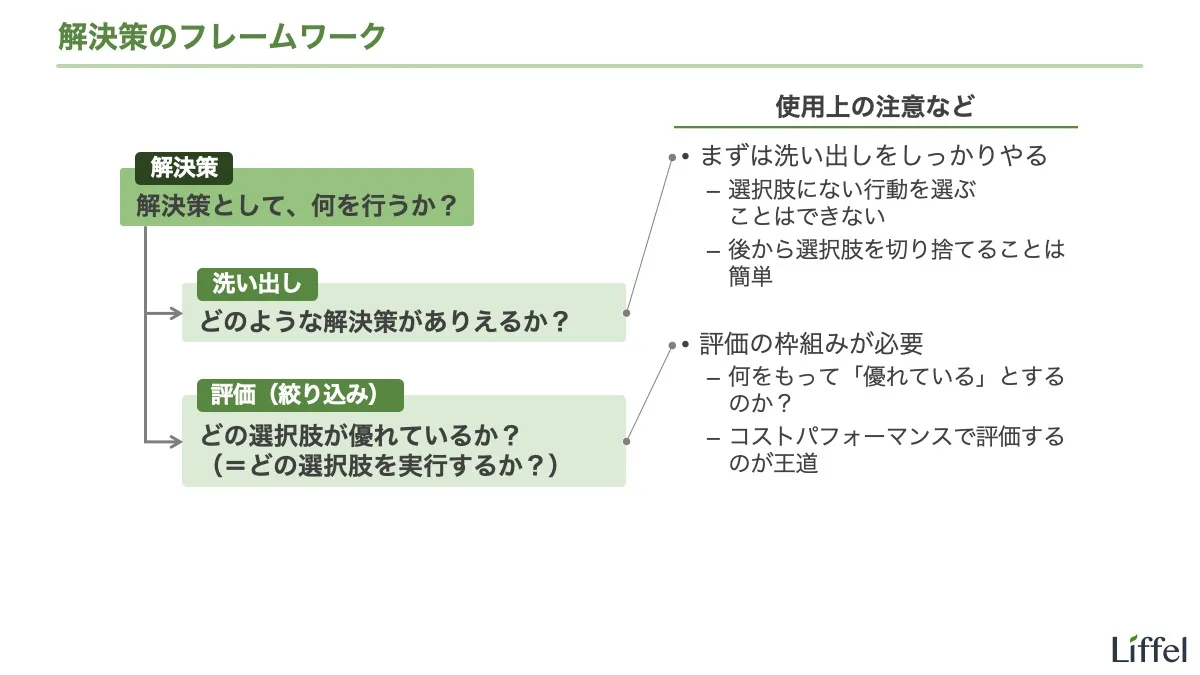
Let’s get right to it. Take a look at the slide below.
As shown, the solution framework means that when deciding on a solution, you first come up with a wide range of solution ideas and then narrow them down.
Solution = Listing solutions × Evaluating options (narrowing down)
As a question structure, this framework looks like this:
- Deciding on a solution: What will we do as a solution?
- Listing solutions: What options are there as solutions?
- Evaluating options (narrowing down): Which option is best? (= Which option will we carry out?)
Incidentally, the “evaluating options” question could also be “How does each option evaluate?” But the reason for evaluating options is to choose and carry out the option considered best. So here I’ve taken a stance and written “Which option is best?”
Example
Let’s look at how to use this framework.
Suppose you’re studying in a library, but the person next to you is so noisy that you can’t concentrate. Let’s use the solution framework in this situation.
- The person next to me is so noisy that I can’t concentrate. What will I do as a solution?
- Listing solutions: What options are there as solutions?
- Evaluating options (narrowing down): Which option is best? (= Which option will I carry out?)
Following the broken-down sub-questions, first list the solutions. What solutions are there? Think about it.
For example, the following solutions are possible:
- Ask the person next to you to be quiet
- Tell a librarian and have them speak to the person
- Move to another seat
- Put in earphones and play music
- Remind yourself why you’re studying and refocus so you’re not distracted by the noise
Although you may think (4) or (5) wouldn’t work, at this stage you should freely put forward any solution that comes to mind. Deciding which to carry out comes later, so focus here on increasing your options.
Once you have options, next evaluate them and decide which to carry out. Although the framework for evaluating them depends on the case, here it makes sense to consider “effort / psychological cost” and “whether you’ll get a quiet environment.” Which would you choose?
Combining It with the Problem-Solving Framework
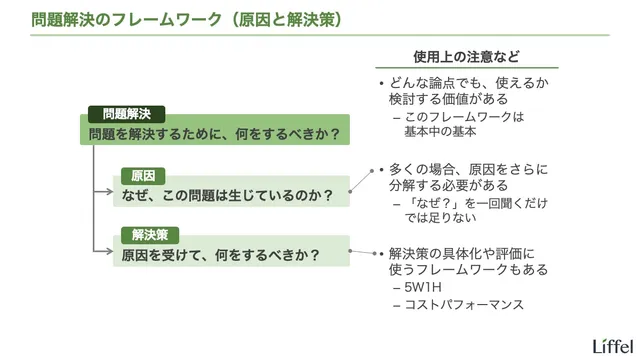
I recommend using this framework together with “the problem-solving framework” introduced in the previous entry. Both are classic frameworks, so feel free to use them mechanically.
Combining the two frameworks gives the following question structure:
- What should we do to solve problem XX?
- Cause: Why is problem XX happening?
- Solution: Given the cause, what should I (we) do?
- Listing solutions: What options are there as solutions?
- Evaluating options (narrowing down): Which option is best? (= Which option will we carry out?)
Identify the cause, list the possible options, evaluate them, and decide on the solution to carry out. This is the basic pattern of problem solving, so remember it.
Exercise
Let’s put this framework to use right away with an exercise. Since the problems are the same as in the previous entry, add the solution framework.
For each of the following problems, set a main question and break it down using the problem-solving framework and the solution framework. Adjust the wording as needed.
Try writing your answer in the box below.
Problem 1: There are fruit flies in my home
- What should I do to keep fruit flies out of my home?
- Cause: Why are there fruit flies in my home?
- Solution: Given the cause, what should I do?
- Listing solutions: What options are there as solutions?
- Evaluating options (narrowing down): Which option is best? (= Which option will I carry out?)
Problem 2: My grades are bad
- What should I do to improve my grades?
- Cause: Why are my grades bad?
- Solution: Given the cause, what should I do?
- Listing solutions: What options are there as solutions?
- Evaluating options (narrowing down): Which option is best? (= Which option will I carry out?)
Problem 3: Sales are declining
- What should we do to recover sales?
- Cause: Why are sales declining?
- Solution: Given the cause, what should we do?
- Listing solutions: What options are there as solutions?
- Evaluating options (narrowing down): Which option is best? (= Which option will we carry out?)
Cautions About the Solution Framework
Finally, let me explain some cautions about using this framework.
First, list solutions thoroughly. The reason is simple: you can’t evaluate or choose an option that isn’t on the list.
Just stopping to think calmly for a moment, or spending some time searching, can turn up unexpected solutions. Conversely, if you rush through the listing and move on to evaluation, you can never choose the options you didn’t find. Since it’s easy to cut options later, start by thinking broadly about solutions.
Next, evaluating options needs an additional framework underneath it. As it stands, you can’t judge what makes an option “best.”
Criteria for evaluating options include:
- Impact (performance): how much effect you can expect
- Cost: how much it costs to carry out the solution (you can further divide this into financial and non-financial costs)
- Speed: whether it takes effect right away
- Feasibility: whether you can really see it through
The combination of (1) and (2) is called “cost-effectiveness,” and it’s the main framework used for evaluation. However, cost-effectiveness isn’t everything. There are also cases where you pursue performance regardless of cost, so evaluate flexibly depending on the situation.
That covers the solution framework. Next time, I’ll introduce a framework you can use to evaluate solutions.
Entries related to critical thinking are collected on the page below. Feel free to use them as a reference.