In this entry, you’ll learn how questions can be classified.
Generally, answering a question requires research (gathering and processing information). If you squeeze an answer out of your own head without research, it’s subjective and can’t be considered right.
However, for certain kinds of questions, research isn’t what matters in answering them. In other words, there are questions whose answers exist only inside you.
Unless you understand this, you’ll end up researching questions whose answers are inside you, that is, looking for answers outside yourself. Since researching is right as a general rule, this is exactly where the pitfall lies.
In this entry, let’s think about what kinds of questions research doesn’t work for and what to do to answer them.
Let’s begin.
toc
Two Types of Questions
Let’s get right to it. Take a look at the slide below.
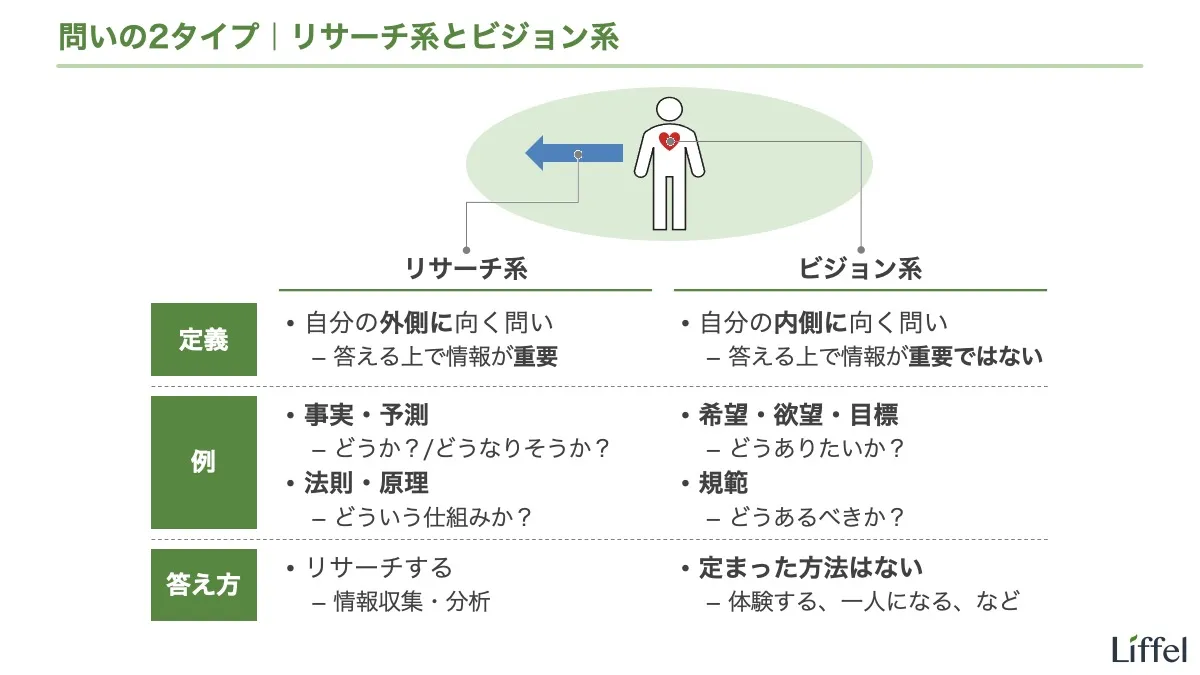
As shown, the questions we try to answer can be classified into research questions and vision questions (both my own coinages). The difference is simple: whether the question points outside yourself or inside. If it points outside, it’s a research question. If inside, a vision question.
As mentioned at the start, the key point is that gathering information isn’t effective for vision questions. While the straightforward approach (= research) works fine for research questions, there are also questions it doesn’t work for.
Let’s look at each in turn.
Research Questions
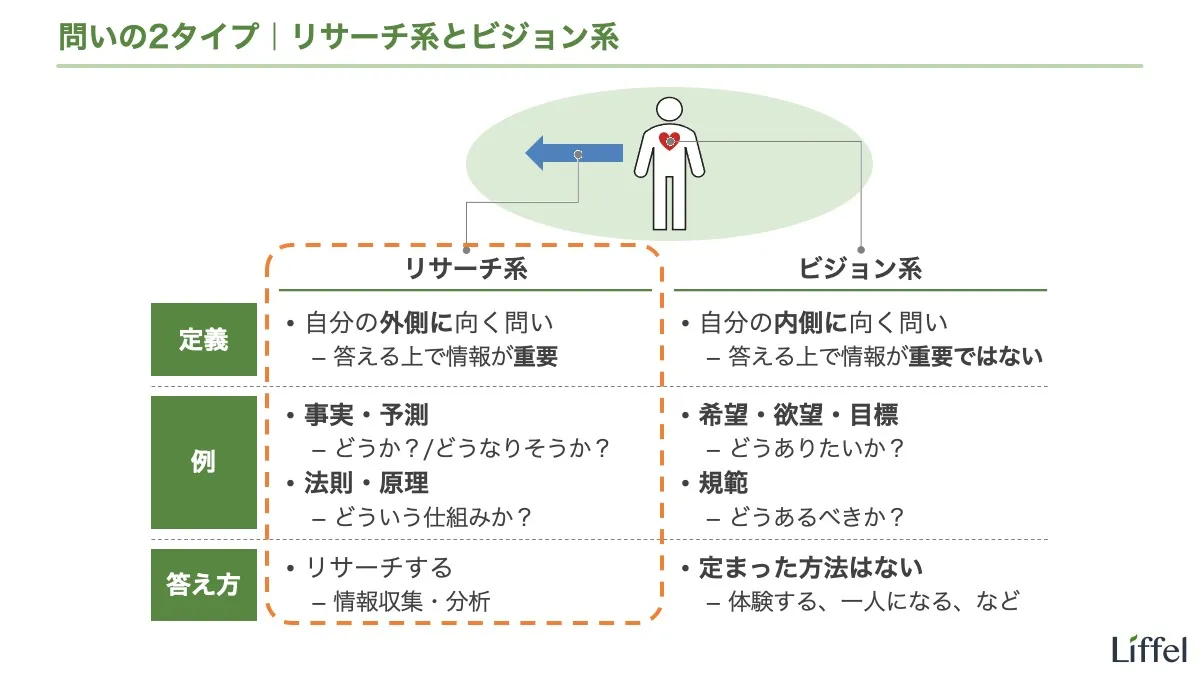
Let’s start with research questions. These are easy to understand.
A research question is a question that points outside yourself.
Research question: a question that points outside yourself
Let’s look at some examples. Research questions are questions like these:
- Who founded the Kamakura shogunate?
- Why are sales of product X declining?
- Which industries are likely to grow rapidly over the next ten years?
The answers to these questions exist outside you. Conversely, you can’t answer these questions inside your own head alone.
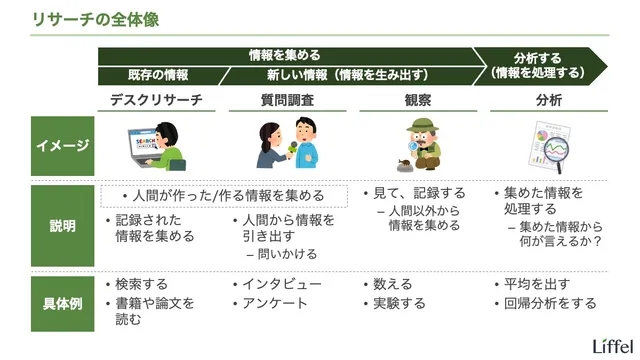
So to answer such questions, you need to gather information that exists in the outside world and process it (= research). The slide below gives an overview of research.
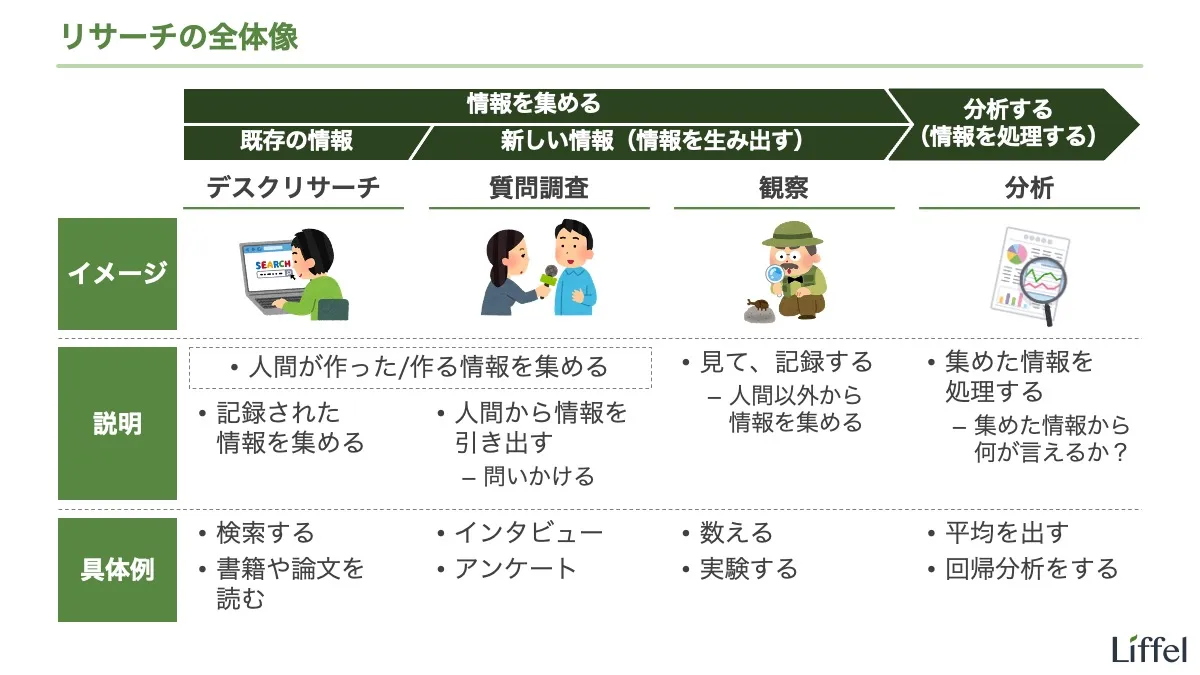
Since I’ll explain this slide in detail in the next entry, for now just understand that “research questions are questions you answer through activities like these.”
Incidentally, you may be able to answer “Who founded the Kamakura shogunate?” without research if you already know the answer. But that’s because you knew it. The source from which you first learned the answer was outside you, such as a class or a textbook.
In this way, when you already know the information needed to answer, you don’t need to rely on gathering it. But since learning the information in the first place requires research1, such questions count as research questions.
What Research Questions Ask
Research questions ask about facts and predictions or principles and laws.
- Facts
- How was it? (past)
- How is it? (present)
- Predictions
- How is it likely to be?
- Principles and laws
- How does it work?
Confirm that the examples above all fall into these categories.
Facts and principles exist outside us2. That’s why answering these questions requires research.
Most of the questions we solve are research questions. Almost 100 percent of the questions dealt with in school are research questions3, and even in business, cases that deal with the vision questions described below aren’t common.
Vision Questions
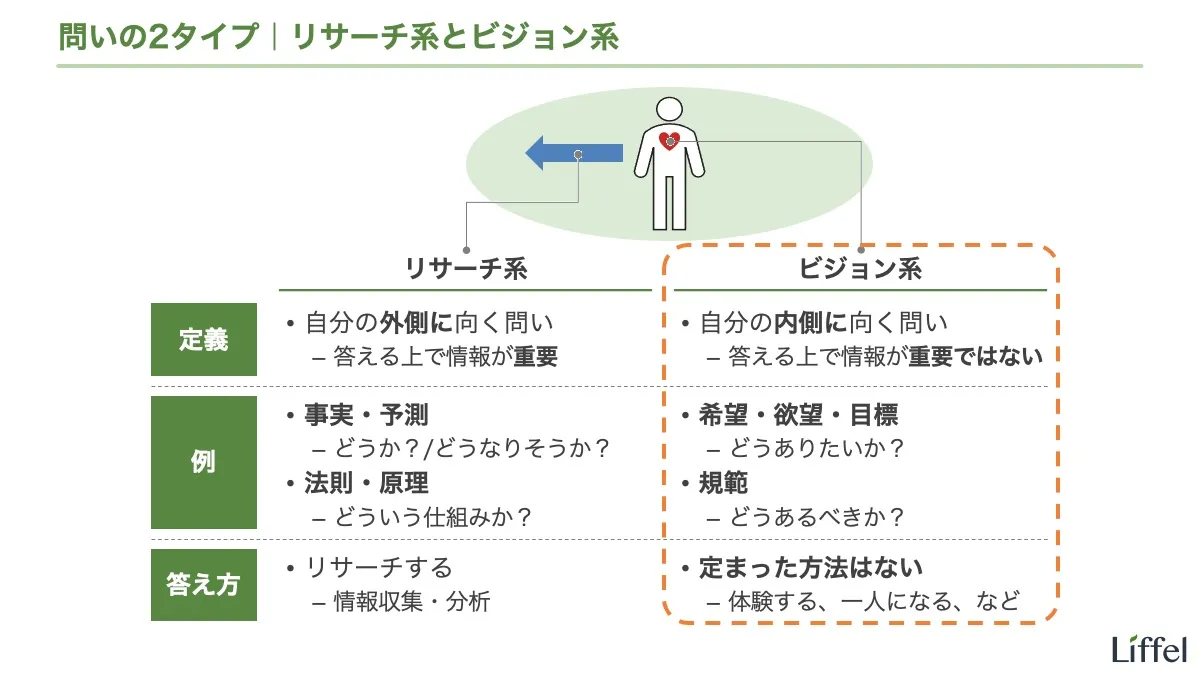
Next, let’s look at vision questions.
A vision question is a question that points inside yourself. You could simply think of them as “questions that aren’t research questions.”
Vision question: a question that points inside yourself
Let’s look at some examples. Vision questions are questions like these:
- How do (I) want to live?
- What kind of work should (I) do?
- What should I / our company be like?
Unlike research questions, these questions point inside us. Questions like these are vision questions.
In answering vision questions, information doesn’t play as decisive a role as it does for research questions. The reason is simple: the answer is inside you. In other words, you won’t get an answer without asking your heart. No matter how much outside information you gather, it won’t necessarily reveal your heart.
That doesn’t mean information is completely useless in answering vision questions. For example, when thinking about how you want to live, learning how others live (= information) can be helpful.
But whether such information will lead you to the right answer is hard to say. It may sometimes even become noise. Also, someone with a firm sense of self could choose how to live without researching how others live.
In the end, compared with research questions, information doesn’t play a decisive role in vision questions.
In answering vision questions, information isn’t (decisively) important
What Vision Questions Ask
Vision questions ask about hopes, desires, and goals or norms. You can remember them as “want or should.”
- Hopes, desires, goals (want)
- How do I want to be?
- Norms (should)
- How should things be?
The examples above all fall into these categories.
When You Deal with Vision Questions
As mentioned, we don’t often deal with vision questions. That’s because goals and norms aren’t things you change often. They’re often treated as given assumptions (not worth thinking about).
Also, since this type of question has no “right answer,” the answer is “decided” rather than “reached by thinking.” So there’s no point in thinking about it with many people either.
For these reasons, we don’t often deal with vision questions. So when do you need to answer vision questions?
Although it’s hard to generalize, I recommend remembering that when you tear everything down and start over, vision questions arise. The formal way to say it is when you “think from zero.”
Let’s look at some examples. First, a case where you tear down your career and start over.
- I punched my boss and quit. There’s probably no place for me in this industry anymore. What work will I do from now on?
- What kind of work do I want to do?
- Other questions (industry growth, my chance of winning, pay, relationships, etc.)
Next, a case where you tear down your business model and start over.
- Because of COVID-19, our current business model is slowly dying. What should our new business model be?
- What kind of business model do we want to do business with?
- Other questions (industry growth, our chance of winning, etc.)
Finally, let’s tear down the office and start over.
- Since the way we work has fundamentally changed, let’s fundamentally change the office too. What should the new office be like?
- How do we want to work? (Or “What kind of office do we want to work in?” etc.)
- Other questions (cost, feasibility, etc.)
As these examples make clear, vision questions arise as the first sub-question when you think about something from zero. That’s because without a “standard to stand on,” such as goals or norms, you can’t judge anything.
When you think about something from zero, vision questions arise
As of 2020, when this was written, COVID-19 is tearing everything down, so there are likely to be many occasions when vision questions arise.
The Importance of Vision Questions
In situations where a vision question has arisen, answering it properly is very important. Probably more important than answering a hundred research questions correctly.
That’s because the answers to vision questions become the criteria for judging research questions. In other words, unless goals and norms are properly set, no matter what facts you gather, there’s no way to interpret them.
Made concrete with the earlier examples:
- If it’s unclear what kind of work you want to do, there’s no way to interpret information gathered by industry
- If it’s unclear what kind of business model you want, there’s no way to choose a business model
- If it’s unclear how you want to work or what kind of office you want, there’s no way to decide the office’s concrete specs
All of these are obvious. Of course, in reality there are situations where you have to move forward with unclear goals and norms (the classic case is college students job hunting), but in principle, vision questions come before research questions.
Answering vision questions is far more important than answering research questions
In other words, the starting point for thinking about something isn’t your eyes or your brain but your heart. The world is well designed, isn’t it?
How to Answer Vision Questions
So what should you do to answer vision questions?
To give you the disappointing conclusion first: I don’t know. The way to reveal your heart is something only you can figure out.
There’s no set way to answer vision questions
But it’d be a shame to end there, so let’s think a little more.
First, as a rule, the direction will be to throw something at yourself, since your heart is inside you. Looking for something outside won’t help. Check the slide.
The image of carving a sculpture from a log fits perfectly. You drive a chisel (stimulus) into the log (your vague self) to bring out what you want to make (your true self).
So what can serve as a chisel? Here are some ideas:
- Experience
- Ask yourself
- Do nothing
Let’s look at them one by one.
How to Answer Vision Questions 1: Experience
First, there’s experiencing. This is the classic approach.
With the earlier examples, it looks like this:
- Since it’s unclear what kind of work you want to do, try various jobs for now
- In fact, many people recommend doing various part-time jobs in college for this reason (whether part-time experience can be applied directly to your main career is debatable)
- Since it’s unclear what kind of business model you want, try doing business with various business models for now
- This seems unrealistic
- Since it’s unclear how you want to work or what kind of office you want, visit various companies’ offices
- This is actually done
- Ideally, you’d actually work in those offices, but that’s not realistic
Personally, I think experience is the most powerful chisel. In other words, the “experience” approach is probably the most effective for answering vision questions.
The “experience” approach is the most effective for answering vision questions (isn’t it?)
Saying this, some of you may recall the famous saying attributed to Bismarck: “Fools learn from experience. Wise men learn from history.”
But what we’re thinking about here are vision questions. When it comes to knowing what you want, anyone who can’t even trust what they felt through their own experience is the real fool. Research questions and vision questions call for different approaches.
How to Answer Vision Questions 2: Ask Yourself
Next, there’s asking yourself. This is probably a major approach too.
We often don’t know ourselves as well as we think, do we? So you drive a question into yourself and try putting the answer into words.
With the earlier examples, it looks like this:
- Think about what kind of work you want to do, and write down the answer
- Think about what kind of business model you want, and write down the answer
- Think about how you want to work and what kind of office you want, and write down the answer
Since this approach is easy, unless you get the key points right, it ends with “thinking you’ve thought about it.” Keep the following in mind:
- Always write down the answer
- Unless you write, it won’t be clear what’s clear and what’s vague
- However, there’s no point in being swayed by what you wrote, so if it feels wrong when you write it, erase it
- Set aside a place and time to think about the question
- If you’re serious, going alone to a seaside hotel or the like seems good
- Since you’re driving a question into yourself, you shouldn’t bring your devices
Although it’s a bit embarrassing when you actually do it, since you don’t think about vision questions often in the first place, I recommend doing it without embarrassment.
How to Answer Vision Questions 3: Do Nothing
Finally, there may also be doing nothing (having free time). This is less a chisel than taking off your armor.
As a general rule, when you’re busy, you can’t turn your attention inward, since something outside grabs your attention. For example, if you’re swamped with school or work from morning to night and your phone keeps buzzing afterward, you have no time to think about what you want.
If you want to think about yourself, you need to step away from your tasks and communications, even for a little while.
The easiest way is to go for a walk without your phone. That alone shuts out almost everything. If you’re really committed, I also recommend taking a train somewhere a little farther away.
For now, these three are all I can think of. There are probably others. Think about them yourself too.
That covers how questions can be classified. That’s all for vision questions. From the next entry, let’s dig into research questions.

Entries related to critical thinking are collected on the page below. Feel free to use them as a reference.
Footnotes
-
We generally don’t call being taught something “research,” but since you’re still getting information from outside yourself, think of being taught as research here. ↩
-
Ultimately, since everything is decided inside our heads, you could interpret even facts and principles as existing inside us. But once you start saying that, anything goes, so this site doesn’t adopt that interpretation. ↩
-
However, language and math classes focus not on facts and principles themselves but on analysis (processing that combines facts and principles to derive conclusions). Still, it’s fine to consider these research questions in the broad sense. ↩