In this entry, you’ll learn what research is and what methods there are.
Research is almost essential when answering a question. Unless you gather information through research, you can’t reach the right answer to a question.
However, since “research” is such a common word, its meaning differs from person to person. What exactly is “research,” and what methods are there?
toc
- What Is Research?
- An Overview of Research Methods
- Research 1: Information Gathering
- Research 2: Analysis
What Is Research?
First, let’s define “research.” As mentioned at the start, since it’s such a common word, its meaning differs from person to person.
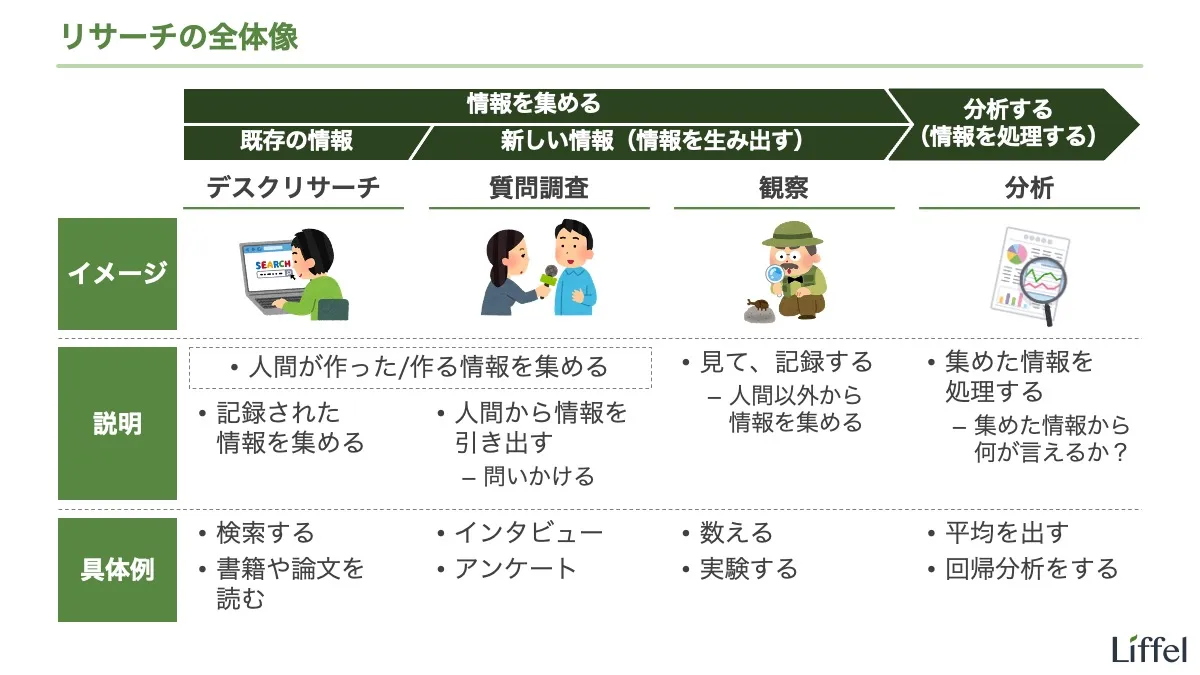
This site defines research as “the act of gathering and processing information to answer a question.”
Research: the act of gathering and processing information to answer a question
The slide below summarizes specific research methods. Since I’ll explain the details later, just get a rough picture of research here.
You’ve probably already done some of the examples here. Activities like these are research.
A Condition for Research: A Question Has Been Asked
There’s an important point about the definition of research: research is an act for answering a question.
It’s easier to see the other way around. Gathering information without a question can’t be called “research.”
For example, you can gather information by “reading a book,” but you can call it “research” only when the following two conditions are met:
- You have a question you want to answer
- You’re reading a book you can expect to contain the answer, or information leading to it
Reading a book idly without meeting these two conditions isn’t research.
Although you may think this is obvious, in my experience, the biggest cause of failed research is starting research (or something like it) without a question.
This is like “casting a line into the sea with no hook.” Naturally, since there’s nothing to catch on, you won’t catch any fish. In the same way, without the hook of a question, even if you dive into the sea of information, the information you need won’t catch on. Get a picture of it from the slide below.
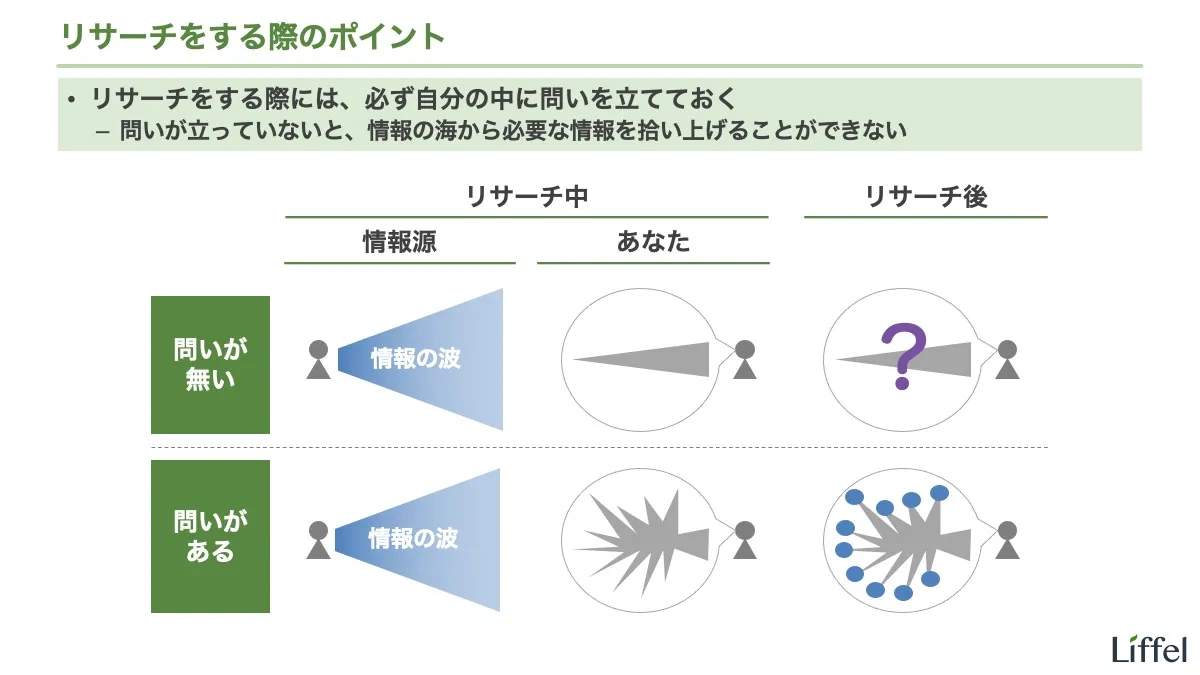
If you start research without a question, before you know it, “gathering information” itself becomes the goal, and you end up researching endlessly. Naturally, no output comes of it either. Always ask a question before you research.
Ask a question before you research
An Overview of Research Methods
Next, let’s look at specific research methods. Here’s the slide again.
First, research can be broadly divided into two:
- Information gathering: gathering information
- Analysis: processing the information gathered
Whether you go as far as analysis depends on the case. For a simple question, information gathering alone may be enough. When people say “research,” the focus is generally on information gathering.
Let’s look at each in turn.
Research 1: Information Gathering
First, information gathering can be classified into three types:
- Gathering existing information: (1) desk research
- Generating information
- Drawing information out of people: (2) surveys and interviews
- Other: (3) observation
Let me explain each in turn.
Information Gathering 1: Desk Research
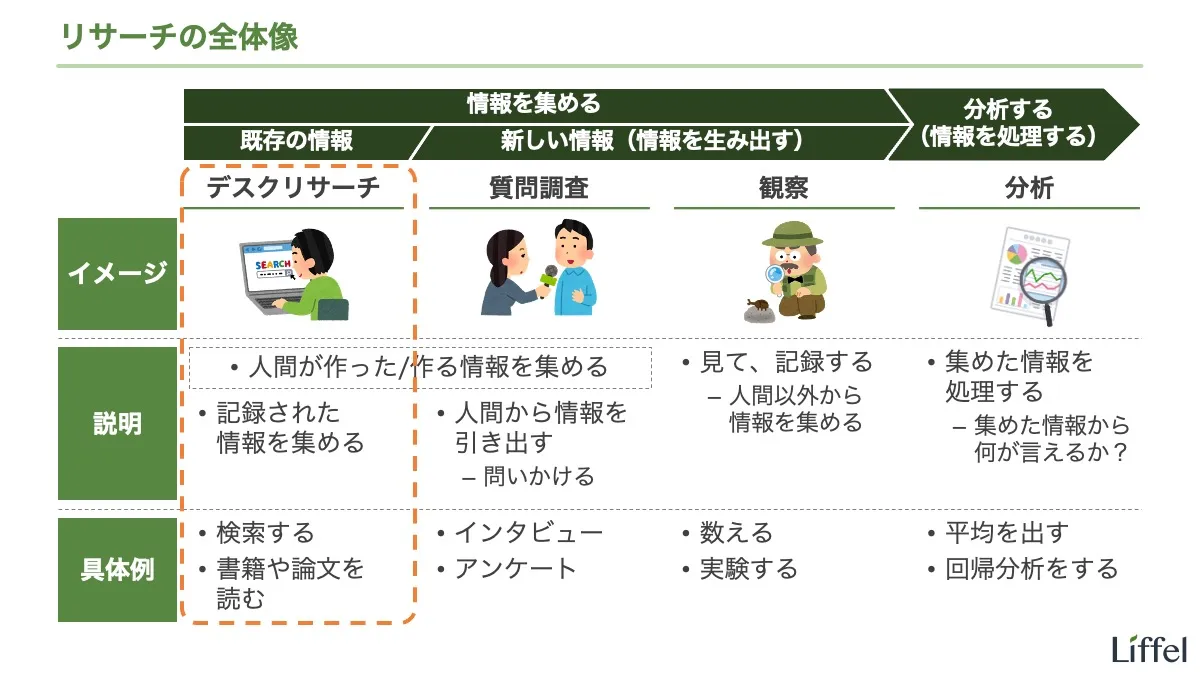
First, research that gathers information already existing in the world is called “desk research.” As the name suggests, it’s “desk” research because it can be done at a desk. Strictly speaking, it’s more a computer and a library than a desk.
Desk research: research that gathers information that already exists
Examples of desk research include:
- Searching online
- Reading books and papers
- Reading news articles
- Watching videos
All of these gather information recorded somewhere. Activities like these are desk research. In short, it means “looking things up.”
Today, almost all of the above can be done entirely online. If you want to read an out-of-print book that isn’t available as an e-book, you have to go to a library, but such cases are the exception.
So it’s fine to think of “desk research = gathering information online.” In ten years or so, all information may be concentrated online, and desk research may come to be called “online research.”
Desk research today is synonymous with “research online”
Desk Research First
As the slide shows, the first step of research is desk research. Conduct the surveys, interviews, and observation described below only when desk research can’t give you an answer.
The reason is simple: desk research costs the least. “Cost” here means both money and time.
Although not all information online is free, it’s still often cheaper than surveys, interviews, or observation. As for time cost, there’s no comparison at all.
Also, there’s no point at all in reproducing information that already exists. If you’re going to spend money on surveys, interviews, or observation, you want to generate new information. For that, you need to know through desk research “what’s known and what isn’t.”
Desk research first
Synonyms for “Desk Research”
Several words are used with the same meaning as “desk research” explained here. Let me introduce them.
- Secondary research
- In contrast to “primary research,” which generates new information through surveys, interviews, or observation
- Literature review
- However, this term strongly implies “examining prior studies and books for reference when writing a paper”
- Information gathering
- However, this sometimes includes surveys and interviews as well, not just desk research
Which term to use is a matter of preference. This site adopts “desk research” to emphasize the nuance of “a type of research, and the easiest one.”
Information Gathering 2: Surveys and Interviews
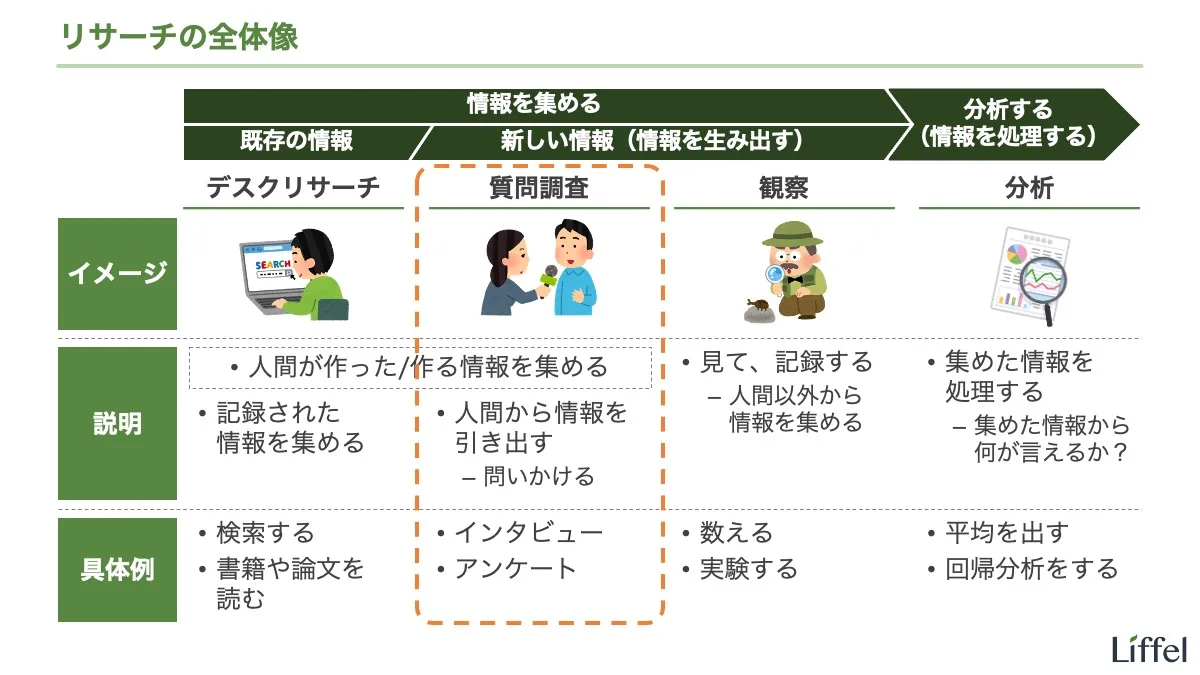
From here on, it’s research that “generates information.” First up are surveys and interviews.
Surveys and interviews are research that draws information out of people. Specifically, they include:
- Interviews (asking questions in person)
- Ordinary interviews (one-on-one)
- Group interviews (one-to-many)
- Questionnaires (having people answer a written questionnaire)
- Other
- Asking questions by email
- Asking questions on forums or social media and collecting answers
- Asking livestreamers questions in the chat
Confirm that in all of the above, you pose questions and draw information out of people. Research like this is surveys and interviews.
Surveys and interviews: research that poses questions and draws information out of people
Before Asking Questions
To repeat, the first step of research is desk research, not surveys and interviews. In other words, look it up before you ask people.
As listed under “Other” above, the internet has made it easy to ask questions. On X (formerly Twitter) and Instagram, an ordinary person like me can even ask celebrities questions (not that I have).
Although that’s wonderful in itself, I don’t recommend asking about everything, for three reasons:
- If the question can be answered by looking it up, you’re more likely to find the right answer by looking it up
- Asking what you could have looked up lowers your credibility
- If you get used to relying on asking, you won’t develop your thinking skills
As a rule, the questions you use surveys and interviews for should be “deep questions whose answers you can’t find by looking them up.” The role of surveys and interviews is to gather qualitative information (interviews) or quantitative data (questionnaires) on such questions.
Information Gathering 3: Observation
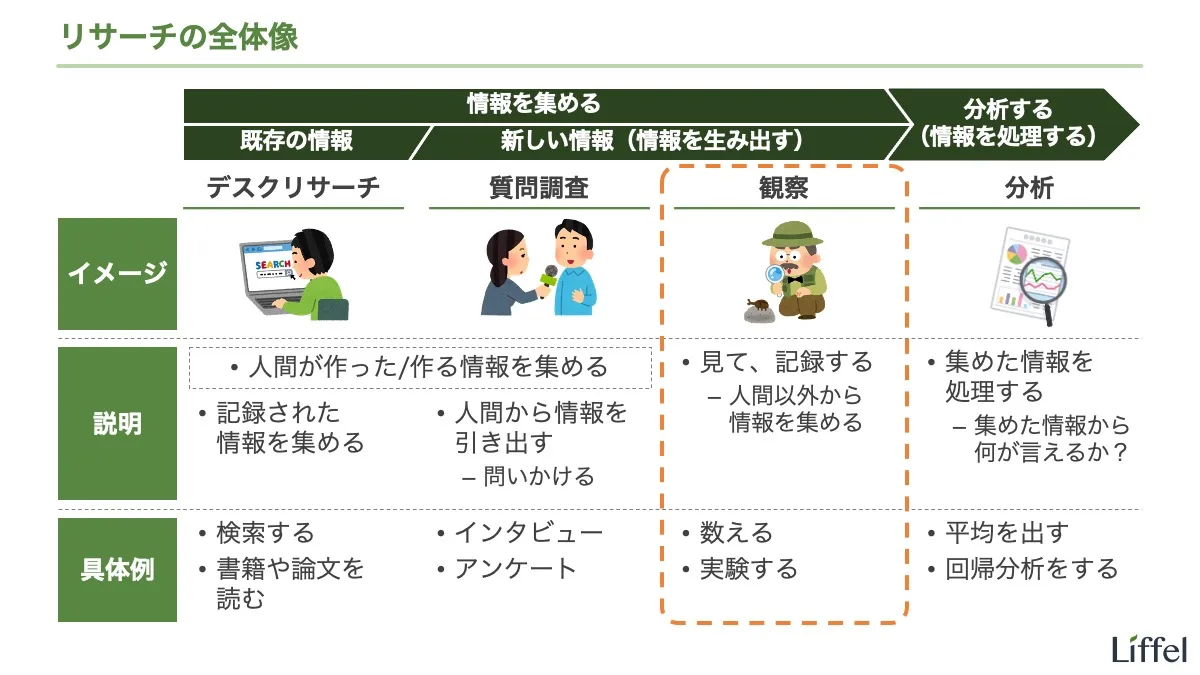
The second type of research that generates information is observation. As the word says, it’s “research that watches and records.”
Observation: research that watches and records
The main subjects of observation include:
- Natural phenomena
- What happens in test tubes and laboratories
- The behavior of animals (including humans)
- However, you don’t ask people questions (that would be surveys and interviews)
Counting or experimenting on these subjects is observation.
Observation Is King
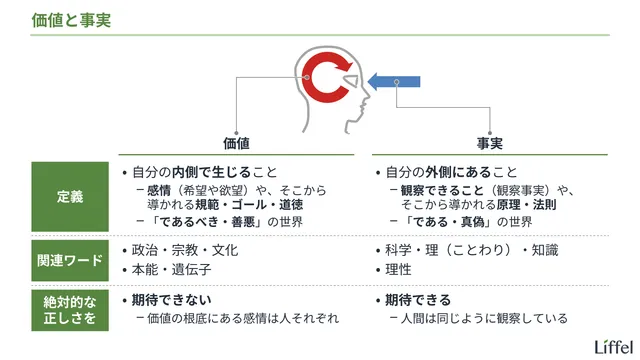
Observation is the king of research. If you want to build valid premises, think about whether the question can be answered through observation.
The reason is simple: information made by humans (= information obtained through desk research or surveys and interviews) may be wrong.
As you know, humans make mistakes and sometimes lie. In other words, you can’t easily trust information made by humans.
What’s more, this tendency has accelerated with the recent information explosion. A situation where lies in text are commonplace (e.g., posts on forums and social media) and the term “fake news” is used routinely would have been hard to imagine before the internet age.
So when doing desk research or surveys and interviews, you have to evaluate whether the information you get is really right. With observation, on the other hand, you can skip this step.
Of course, even in observation, you might make mistakes or lie. But since raising this would make all premises untrustworthy, in “settings where participants’ quality is assured and everyone is trying to think seriously,” such as business or research, the etiquette is “not to doubt information obtained through observation”1. For details, see the link below.

Research 2: Analysis
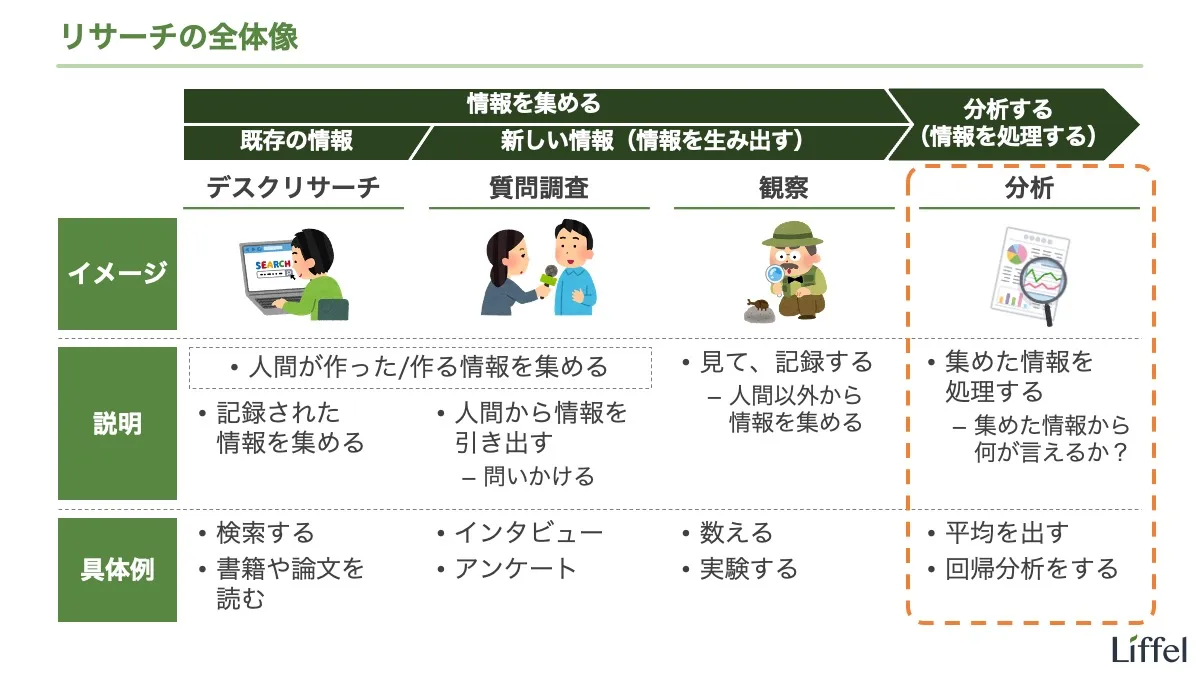
Finally, let me explain analysis.
As mentioned, analysis means processing the information you’ve gathered. Put simply, it’s working with the information you’ve gathered on a computer or in your head. Typical examples include:
- Analyzing quantitative data (numbers)
- Calculating descriptive statistics (means, deviations, variance, etc.)
- Testing (t-tests, etc.)
- Graphing
- Analyzing qualitative data
- Organizing it in tables
- Summarizing
Depending on the question, information gathering alone often can’t give you an answer. In that case, you need to change the form of the information through analysis to derive the answer to the question.
A Key Point for Analysis
The key point is to decide what analysis you’ll do before gathering information.
The reason is simple: unless you decide in advance what analysis you’ll do, you won’t be able to gather all the information needed for it. Nobody wants a graph full of gaps. Information gathering becomes worthwhile because you know “I’ll do this analysis at the end, and for that, I need this information.” Don’t get the order wrong.
Think about what analysis you’ll do before you start gathering information
That covers the overview of research. In a future entry, I plan to compare the three types of information gathering and look at their characteristics and advantages.
Entries related to critical thinking are collected on the page below. Feel free to use them as a reference.
Footnotes
-
Unfortunately, this etiquette probably can’t be applied to online discussions. There’s no mechanism for excluding liars. ↩