In this entry, you’ll learn about objective premises. Since this is the most basic point for building valid premises, make sure you understand it well.
This entry focuses on what the word “objective” (objectivity) means. I’ll assume you understand the word “premises,” so if you’re unsure about it, read the link below first.

There’s also a video version of this entry (in Japanese; simplified compared with the text). It’s embedded at the end of this entry (you can jump to it from the table of contents).
Let’s begin.
toc
- What Does “Objective” Mean?
- Value and Fact
- Why Are Objective Premises Valid?
- If You Want to Keep Learning
- Learn or Review with the Video
- References
What Does “Objective” Mean?
First, let’s clarify what the word “objective” means. Dictionaries typically define it as something like “not influenced by personal feelings or opinions,” that is, the opposite of “subjective.”
But that seems to say little more than “objective means not subjective,” which doesn’t help much.
What’s more, this definition leaves out something important. In practice, the word “objective” is often used to mean “I’m the one who’s right.”
For example, “Objectively speaking…” is often used to mean “Anyway, I’m right.” In this case, “objective” is just an introductory phrase to bolster one’s own rightness, with no concrete meaning. The same goes for words like “logical,” “rational,” and “scientific.” Most people don’t think about what these words mean or how they differ.
So the dictionary definition isn’t enough. Let’s adopt a definition that goes one step further.
Objective means based on facts (what can be observed). In critical thinking, you can treat this as the meaning of “objective.”
Objective: based on facts (what can be observed)
Conversely, subjective means based on what can’t be observed. Remember this as a pair.
Subjective: based on what can’t be observed
Let’s check with concrete examples. Which of the following sentences is objective?
- This cake is delicious.
- 95 out of 100 people said, “This cake is delicious.”
(1) is subjective, and (2) is objective.
First, “delicious” can’t be observed. No matter how you look at the cake, all you see is cream and strawberries. “Delicious” isn’t there. “Delicious” is something you feel, and it’s impossible to observe directly. So (1) is a subjective statement.
On the other hand, “someone answered ‘delicious’” can be observed, whether you hear the statement with your ears or see the survey results with your eyes. So (2) is an objective statement.
In this way, judge by whether you can see or hear it.
Value and Fact
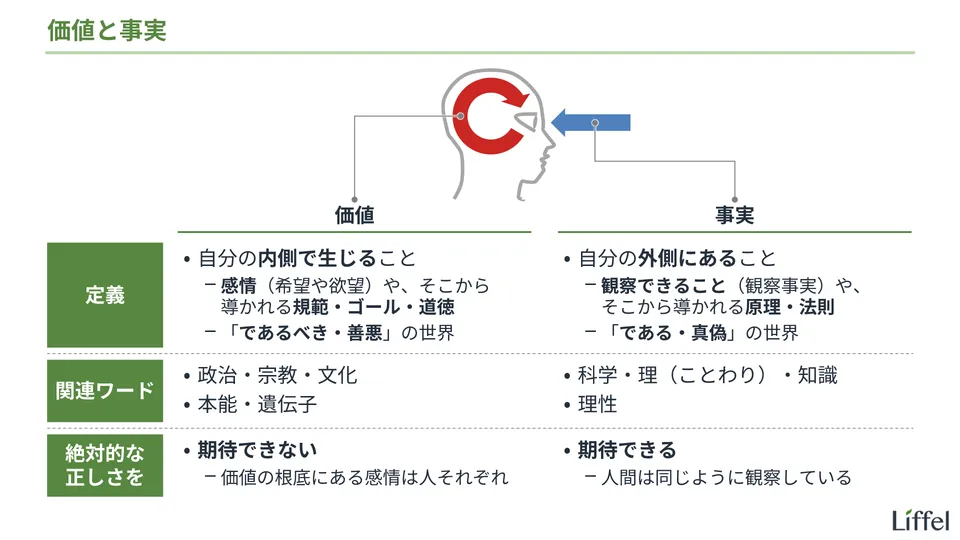
The distinction “can it be observed?” is the most important perspective for thinking about “rightness.” Take a look at the slide below.
This slide divides what we put into words into two broad categories: value (what arises from within yourself) and fact (what exists outside yourself).
Although both “value” and “fact” are used differently from their everyday meanings, this entry uses them in these senses.
Let me explain each in turn.
Value
First, let’s call “what arises from within yourself” value.
Value: what arises from within yourself
Typical examples of value (statements belonging to it) include:
- Hopes, desires, goals, aesthetics (want)
- How do I want to be?
- What should my goal be?
- What is desirable? (Is it good or bad?)
- Norms and justice (should)
- How should things be?
- What rules or laws should we have?
- Impressions and emotions
- How do I feel?
- Is it interesting or boring?
- Do I like it or dislike it?
As noted in parentheses, it’s easiest to start by remembering “want and should.” “Goals and rules” is another handy pair.
All of these happen or are understood inside your head. In other words, they can’t be observed. For example, you can’t see the norm “you should do XX” with your eyes.
Fact
Next, let’s call “what exists outside yourself” fact.
Fact: what exists outside yourself
Examples of facts include:
- Other people’s actions and statements
- Numerical data
- Natural phenomena and animal behavior
Confirm that all of these exist outside you. And you perceive them with your eyes or ears.
The reason for separating value and fact is that they differ in how easily they can be shared (co-recognized) with others. Facts can be shared in an instant by having others observe them, but value can’t. As I’ll explain later, this is an important point when thinking about “rightness.”
Where to Draw the Line Between Value and Fact
Note that this site doesn’t draw a strict line between value and fact.
Where value ends and fact begins is a very difficult question and a major theme in philosophy and cognitive psychology.
For example, since “there’s a red pen” can be observed, it’s generally treated as a fact. Strictly speaking, though, what we observe is “a red cylindrical object,” and it’s our mind that interprets it as a “pen.” But classifying “there’s a red pen” as value (something that happens in our head) doesn’t feel right at all.
So this theme runs extraordinarily deep. However, for critical thinking, the rough classification “outside or inside your head” works well enough in most cases. Let’s not dig into it here. If you’re interested, study philosophy or cognitive psychology.
Examples of Objective Premises
Back to the topic. Let’s look at examples of objective premises. First, a case where the premises get torn down because they’re subjective.

Should we have Company X or Company Y design our poster?

Company X. I think Company X’s designs are better.
”Company X’s designs are better” is just your subjective opinion. Other people might say Company Y’s are better.
“Company X’s designs are better” can’t be observed. Like “delicious,” “better” is value (you can’t see it). That’s what Bear critiqued.
Let’s change it to objective premises.
Should we have Company X or Company Y design our poster?
Company X. I surveyed 50 people around me, and 30 said they liked Company X’s designs.
You’re right. Let’s go with Company X.
“I surveyed 50 people, and 30 said they liked Company X’s designs” can be observed. By making the premises objective like this, Panda got the claim accepted.
Confirm that the difference between the two premises lies in whether they can be observed.
Why Are Objective Premises Valid?
Why are objective premises valid? In other words, why are statements based on facts (what can be observed) accepted as “right”?
This question holds an important clue for thinking about “rightness.” Let’s think it through step by step.
When You Observe Together
First, look at the photo below.
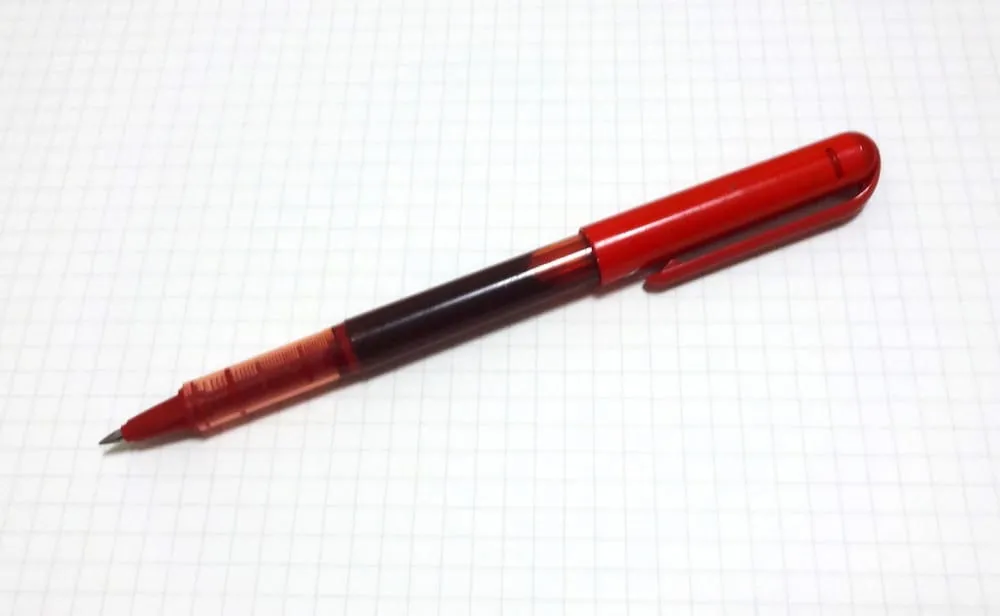
Suppose I say, “There’s one pen.” Is this statement right?
It’s undeniably right, isn’t it? Unless you have some condition that makes you see double, you have no choice but to accept it as “right.”
In this way, if you observe something together and describe it as it is, it’s right. That’s because people observe the same things in the same way1.
If you observe the same thing and describe it as it is, it’s right
When You Can’t Observe Together
In actual discussions, people almost never observe things together like this. Only the person building the argument observes.
In that case, you can’t expect the same airtight rightness as when observing together. From the perspective of those who didn’t observe, there’s room to suspect falsehood. Specifically:
- Suspecting lies
- Suspecting mistakes
- Suspecting errors of perception (seeing or hearing wrong)
- Suspecting errors of processing (data entry or calculation errors)
Let’s look at an example.
Should we have Company X or Company Y design our poster?
Company X. I surveyed 50 people around me, and 30 said they liked Company X’s designs.
Did you really do a survey? Aren’t you lying?
Here, Bear suspects a lie, but Bear could also suspect a mistake, like this:
Did Company X really get 30 votes? Didn’t you miscount?
In this way, when you didn’t observe together, there’s room to critique for falsehood.
Basic Etiquette for Thinking Constructively
So is it okay to make critiques like these?
To give the conclusion first: as a rule, you shouldn’t suspect falsehood. Since this is important, I’ll call it “the basic etiquette of critical thinking.”
The basic etiquette of critical thinking: as a rule, don’t suspect others of falsehood
However, there are a few things to note about this etiquette.
First, this is etiquette (something you should follow as a rule), not a law (something you must always follow). When an utterly unacceptable argument comes along, this doesn’t necessarily apply.
As a last resort, we always retain the right to doubt facts others have observed. What I’m saying is that you shouldn’t abuse critiques that suspect falsehood.
Also, this etiquette should apply only to people you want to think constructively with. It doesn’t mean “trust all information in the world.”
Since the world is overflowing with lies and mistakes, it’s your responsibility to pick out the information you can trust. Stop believing things unconditionally.
Why Not Doubt Facts Others Have Observed?
Why don’t we (as etiquette) doubt facts others have observed?
The reason is simple: if you doubt facts others have observed, discussion becomes impossible. You could also say that decision-making becomes dramatically less efficient.
Since the conclusion is the same whether you suspect lies or mistakes, let’s focus on lies first.
Look at the earlier example.
Should we have Company X or Company Y design our poster?
Company X. I surveyed 50 people around me, and 30 said they liked Company X’s designs.
Did you really do a survey? Aren’t you lying?
First, in most cases, Panda can’t prove that they aren’t lying. The survey forms may remain, but to prove that the people around Panda (not Panda) actually filled them out, you’d need video of them answering. Normally, nobody records things like that.
Can Bear, then, prove that Panda is lying? That’s nearly impossible too. Unless it’s a criminal case or certain research fields2, you can’t go around gathering evidence.
In other words, suspecting a lie gets you no answer. Since the only certain outcome is that things turn sour between Bear and Panda the moment Bear suspects a lie, there’s no point in suspecting it.
What’s more, the question “Did Panda really conduct the survey?” is far removed from the question we actually want to think about: “Should we have Company X or Company Y design our poster?” Thinking about it is nothing but a waste of resources.
In the end, once you suspect a lie, there’s no more discussion. You can’t examine the validity of premises. That means a world where no claim can be accepted as right, a world where thinking with others is impossible.
Critical Thinking and Lies
That means to have constructive discussions, you have no choice but to assume that no one is lying. Not lying, and not suspecting others of lying, becomes the etiquette of practicing critical thinking. Let me restate the basic etiquette with a focus on lies.
To think constructively, don’t lie, and don’t suspect others of lying
This is less the etiquette of critical thinking than basic etiquette for living in society. It’s so obvious that it isn’t taught in school. But be clearly aware of it once again here. Neither lying nor suspecting lies is okay.
In particular, people rarely realize that suspecting lies is also a breach of etiquette.
I’ve seen many people say “Isn’t that a lie?” when faced with an argument they find hard to accept. I think they simply mean “I can’t believe it,” but suspecting a lie, even just in words, is the greatest insult to someone who has seriously built an argument. When you’re thinking seriously with critical thinking, don’t carelessly use the word “lie.”
What Happens If Your Lie Is Exposed
Of course, you can lie if you want to. In fact, when you’re struggling with a difficult question, you may be tempted: “If only this data didn’t exist, it would lead smoothly to my claim (hypothesis).”
And since everyone around you assumes that you don’t lie, your lie will likely go undetected.
But remember this: “not suspecting lies” is only a gentleman’s agreement. If your argument smells too much like a lie, someone will suspect you. And if you lie and it’s exposed, you’ll never again be part of thinking.
As mentioned, the assumption that no one is lying is an absolute requirement for thinking constructively. If a liar gets mixed in, everything has to be doubted, and thinking as a group becomes impossible. Just look at discussions online.
That’s why communities that try to think properly impose the severest penalties for lying. A witness who lies in court commits perjury and becomes a criminal. In research and business, there are no clear-cut rules, but you’ll certainly lose your position and never be trusted again. That’s only natural, because no one knows how to trust a liar again. Probably there’s no way.
Once it becomes public that you lied, you’ll never be able to think with anyone again
Since this is truly important, let me put it another way. Arriving at a wrong claim is fine, but lying gets you banned for life on the spot. It’s not a mild penalty like being sent off or suspended.
Deriving a wrong claim from premises without lies is no problem at all. In fact, it’s unavoidable. As humans, there’s no way we can keep arriving at right claims forever.
Lying is behavior on an entirely different level. It tramples on the goodwill of everyone who is thinking seriously, and it can’t be justified.
What’s more, there’s no recovering from it. You can’t prove that “I lied in the past, but I’m not lying now.” Once it becomes public that you lied even once, no one will trust you again. If you want to remain part of thinking, never lie3.
When You Suspect Mistakes
Since I’ve focused on lies so far, let me add a note on suspecting mistakes (of perception or processing).
First, suspecting perception leads to the same outcome as suspecting lies. In other words, there’s no more discussion. To the person critiqued, “Didn’t you see (or hear) it wrong?” sounds like nothing but nitpicking. You wouldn’t want to discuss anything with someone who says that.
What about suspecting processing? Since we’re human, anyone can make data entry or calculation errors. Since anyone can make them, is it okay to suspect them? That is, critiques like this:
Should we have Company X or Company Y design our poster?
Company X. I surveyed 50 people around me, and 30 said they liked Company X’s designs.
Did Company X really get 30 votes? Didn’t you miscount?
The conclusion is that, as a rule, you shouldn’t suspect this either.
As with lies, Panda can’t prove there are no data entry or calculation errors. Although Bear could redo the entry and calculations if the data remains, that would mean completely denying Panda’s competence. It would leave hard feelings.
Also, people normally don’t have the resources for that. Realistically, it’s only possible in cases like a manager and subordinate on the same team.
Next, and this is the essential reason, you can’t draw a line between suspecting processing and suspecting lies.
For example, “pretending you didn’t see something (lying)” and “accidentally deleting data (a processing error)” are different processes, but they have the same result: data that should exist disappears.
That means if you treat mistakes as acceptable because “humans make mistakes, unlike lies,” then “claiming you accidentally deleted the data (actually a lie, passed off as a mistake)” becomes acceptable too. Then people could lie as much as they liked.
So, as a rule, you don’t suspect processing either, because it’s no different from suspecting lies.
In other words, making a processing error is as serious an offense as lying. It may seem harsh, but since others can’t tell lies from mistakes, there’s no way around it.
Making errors in processing observed facts betrays others’ trust as much as lying does
That means you must prevent processing errors with the same determination as not lying. Although everyone has accidentally gotten an Excel formula wrong at some point, if you do it when it counts, no one will be able to trust you. Be careful.
Subjective vs. Objective
Let’s sum up. In normal situations, the rightness of objective statements isn’t doubted. If observed together, they’re unconditionally right, and even if not observed together, etiquette says not to suspect falsehood (in communities that try to think seriously, at least).
In other words, the rightness of objective statements is rock solid. They’re like diamonds. Barring something extraordinary, the hammer of critique won’t break them.
Such overwhelming rightness comes precisely from the fact that they can be observed. You can’t expect such solid rightness from what can’t be observed, that is, from value (subjective things).
As an example, look at the earlier photo again.
Suppose I say, “This pen is easy to write with.” This is a subjective statement. Do you think it’s right?
In this case, the only people who’d think this statement is right are those who (1) have used the same kind of pen and (2) found it easy to write with. The airtight rightness of an objective statement (“There’s one pen”) is nowhere to be found. Getting something subjective accepted as “right” is far harder than getting something objective accepted.
In this way, the root of an objective statement’s rightness is that it can be observed (it’s a fact). When we decide what’s right, nothing is more certain than what can be observed.
Nothing is more certain than what can be observed when deciding “rightness”
So the basic stance for building valid premises is to observe (gather facts). If you want to make a certain claim, think about what you’d need to observe to make it. Conversely, when you’ve observed something, think about what you can claim from it.
In any case, put what you observed at the foundation of your premises. That raises the validity of your premises.
To build valid premises, put what you observed at the foundation of your premises
Note that this doesn’t mean “objective premises can support any claim.” Whether premises as a whole are valid also depends on their universality and exhaustiveness. What I’m saying here is that if you say “I observed this,” everyone will accept that it’s right.
However, at the root of that rightness lies the trust of those around you that “you’re not a liar, and there’s nothing wrong with your perception or processing.” Betray that, and your objectivity will be doubted, and you’ll never be able to build valid premises again. Be careful.
That covers objective premises. This is the most important point for increasing the validity of premises. Make a habit of always checking the objectivity of your premises.
If You Want to Keep Learning
Thank you very much for reading this far. Next, let’s deepen our understanding of the words used for premises. Continue to the entry below.
Entries related to critical thinking are collected on the page below. Feel free to use them as a reference.
Learn or Review with the Video
Here’s the video mentioned at the start (in Japanese). Although the content isn’t exactly the same, the main points are.
References
Footnotes
-
Strictly speaking, you could doubt the assumption that people observe the same things in the same way. But since doubting things at this level makes discussion impossible, this assumption normally isn’t doubted. ↩
-
In research fields that involve experiments, researchers apparently record their observations in research notebooks (lab notebooks). When data fabrication becomes an issue, these notebooks can be examined to verify whether someone lied. ↩
-
What I’m describing here is how lies are treated in public settings (business and research). Small lies in private life aren’t treated this harshly (I think). Still, “it’s hard to trust a liar again” holds true in both public and private. ↩