In this entry, you’ll learn what premises are and why we need them.
When you claim something, you should back it up with premises. As I’ll explain later, unless you’re a god or a celebrity, others won’t accept a claim without premises. If you want your claims to be accepted, you need to understand what premises are and why they’re needed, and back up your claims with valid premises.
Let’s begin.
toc
What Are Premises?
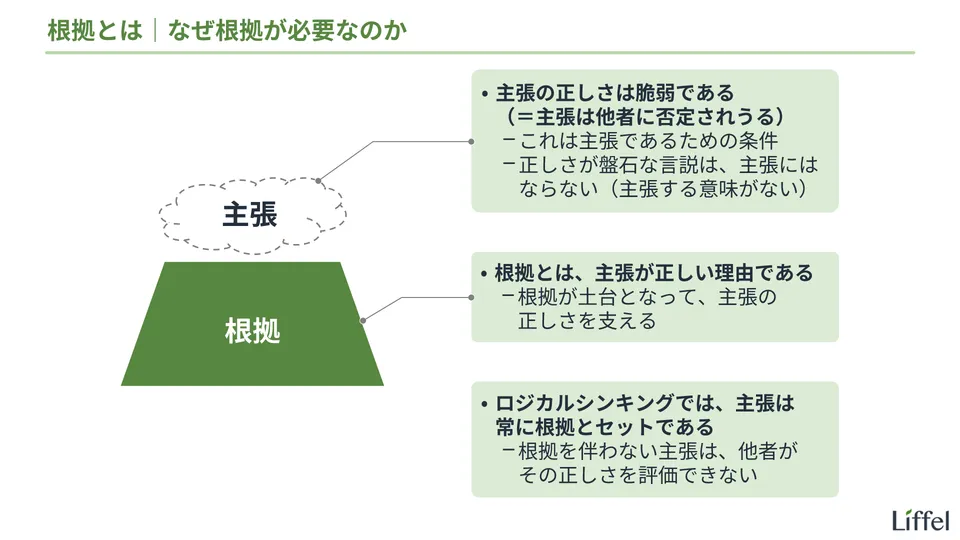
Let’s get right to the point. Premises are the reasons a claim is right.
First, look at the example below.

Someone ate the pudding in my fridge. Who did it?

Yasuda did it.
Here’s why I think so.
First, there’s evidence. An empty pudding cup was found in Yasuda’s room.
And Yasuda has a motive, too. He loves pudding.
The parts in bold are the premises. They explain why the claim (“Yasuda did it”) is right. In this way, when there’s a claim, the statements that explain why it’s right are its “premises.”
Premises: the reasons a claim is right
Let’s dig into this definition.
Condition 1: There Is a Claim
First, a claim must exist before premises. Premises can’t exist on their own. This is the most important point.
The reason is simple: premises are a concept defined in relation to a claim. In other words, the claim is primary and the premises are secondary. If you don’t know the claim, you can’t know the premises. The claim always comes first1.
The claim comes before the premises
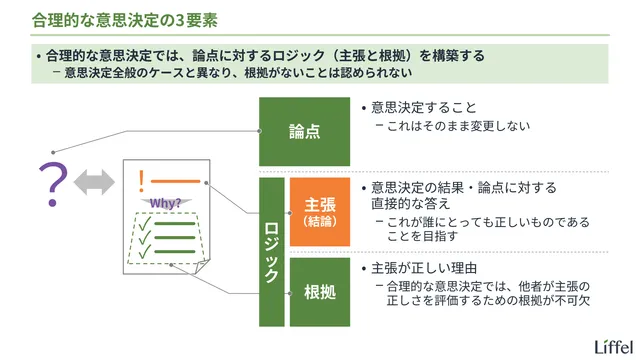
So what’s a claim? It’s a direct answer to the question. Roughly speaking, think of it as “what you most want to get across.”
I explain claims in the entry below. If you’re not confident about what a claim is in a discussion, read it before going further. You can’t understand premises without understanding claims.

Condition 2: They Explain Why the Claim Is Right
Next, premises must explain why the claim is right. Since that’s how premises are defined, this is only natural.
This is easier to see the other way around, by looking at what doesn’t count as premises. Even if a statement is made alongside a claim, it can’t be called a premise if it can’t be seen as supporting the claim’s rightness. Let’s look at an example.
Yasuda did it.
Here’s why I think so.
First, there’s evidence. An empty pudding cup was found in Yasuda’s room.
Oh, mind if I grab some coffee?
And Yasuda has a motive, too. He loves pudding.
The part in bold contributes nothing to supporting the claim’s rightness. A statement like this isn’t a premise. It’s noise.
Noise this blatant is unusual, though. It barely works here because the example is a conversation. Nobody writes “By the way, could I have some coffee?” in argumentative writing. In other words, no one deliberately includes noise when making a claim.
What you actually see more often is this: what the person making the claim thinks are premises actually contribute nothing to supporting the claim’s rightness, and end up as noise.
Whether to call this “noise” is debatable, though. It might be better to call these “wrong or invalid premises.”
Not every statement made alongside a claim supports the claim’s rightness
Exercise
Let’s check what you’ve learned with an exercise.
Identify the premises in the conversation below.
I’ve solved the mystery…
First, given the circumstances, only two people besides Bear could have eaten the jelly: Yasuda or me.
And I didn’t eat the jelly.
Therefore, Yasuda did it.
Write your answer in the box below before checking the answer.
First, the claim is “Therefore, Yasuda did it.”
It’s tempting to call everything else the premises, but “I’ve solved the mystery…” should be treated as noise. The rest are the premises.
Note that identifying the premises doesn’t mean the claim is right. For the claim to be right, the premises have to be valid.
Why Do We Need Premises?
In critical thinking, claims and premises always come as a pair. Stating a claim alone isn’t allowed. Specifically, the following is required:
- The person making the claim: backs it up with premises
- The receiver (the person the claim is made to): asks for premises along with the claim (= judges the claim based on the premises)
This is an iron rule of critical thinking.
In critical thinking, claims and premises come as a pair
Why?
Because from a claim alone, others can’t evaluate whether it’s right.
Let me explain step by step.
What It Means to Make a Claim
First, let’s think a bit more concretely about what it means to make a claim.
Every claim can be denied by others. In fact, only what others can deny counts as a “claim” (as explained in the entry on claims).
Yet the person making the claim thinks it’s right. Otherwise, they wouldn’t claim it.
In other words, when people make a claim, they’re calling something that others could deny “right.” That’s the key point.
Let’s check this with the earlier example. I’ve removed the premises to make it clearer.
Yasuda did it.
As you can see, Panda’s claim is “Yasuda did it.” And from this alone, you can’t tell whether the claim is right. The culprit might be someone else.
In this way, a claim on its own has only shaky rightness. Even so, people make claims because they think they’re right.
Making a claim means calling something “right” whose rightness isn’t obvious to others
This applies to every claim, and there’s nothing strange about it. In fact, it’s a condition for a statement to be a claim.
For the receiver, however, this creates a problem: from a claim alone, there’s no way to decide whether it’s right. Even if the person making the claim thinks it’s right, the receiver has no reason to go along with it. They’re free to deny it.
How a Claim’s Rightness Is Decided
So how should the receiver decide whether a claim is right?
To give the conclusion first, there are only two ways:
- Believe (accept the claim unconditionally)
- Think (evaluate the premises)
Let me explain each in turn.
Way 1: Believe
The first way to decide whether a claim is right is to believe it. In other words, you accept “the claim is right” unconditionally.
The clearest example is God. Believers don’t ask God for premises. They accept unconditionally that God is right.
In this way, once the receiver decides to believe, the claim’s rightness isn’t questioned. A claim’s rightness, normally shaky, becomes unconditional.
Way 1 to decide a claim’s rightness: believe (accept the claim unconditionally)
However, for a claim to be believed, the person making it must be someone the receiver considers worth believing. Such a presence is often an absolute one backed by authority. In fact, the word “God” itself implies an absolute being.
Besides God, the following are treated as absolute presences worth believing:
- Government authorities
- Your boss
- Experts
- Scholars, licensed professionals, and so on
- Celebrities and influencers
- Laws (especially the constitution)
Some people accept these things and people uncritically (without examining the content)2. This way of thinking is generally called authoritarianism.
Structurally, authoritarianism is the same as believing in God. In fact, blind fans of celebrities and influencers are sometimes called “believers” or even “cult followers.” In Japan, where religion isn’t very prominent, things other than God may be especially likely to become objects of faith.
Way 2: Think
The second way to decide whether a claim is right is to think. Specifically, you evaluate the premises presented.
Let’s check with the earlier example.
Yasuda did it.
If Panda were Sherlock Holmes or Hercule Poirot, you might be able to believe this claim. Otherwise, there’s no way to decide whether it’s right. This alone is decisively short on information.
To go further, you have to ask for additional information that supports the claim’s rightness. That’s what premises are. Get a picture of it from the slide below.
As shown, the person making a claim supports its wobbly rightness with premises (a foundation). The receiver, in turn, decides whether to accept the claim by evaluating how well the premises are built.
Here, the receiver is using their own head. In other words, they’re thinking.
Way 2 to decide a claim’s rightness: think (evaluate the premises)
Which Way to Choose
Which way you use to decide rightness can depend on the situation. There’s no correct answer.
However, critical thinking doesn’t use the “believe” approach. In critical thinking, rightness is always decided by thinking, that is, by evaluating the premises.
There’s no deeper reason for this. Deciding rightness by thinking is simply what we call critical thinking. It’s logical thinking, after all. You have to think.
To sum up, critical thinking means deciding whether a claim is right by thinking, and that requires premises. That’s why, in critical thinking, it’s an absolute requirement that claims and premises come as a pair.
In critical thinking, you always decide whether a claim is right by thinking (evaluating the premises)
Don’t get me wrong: I’m not saying that believing is bad.
I’m simply saying that believing is the opposite of thinking. To believe is not to doubt, and not to doubt is not to ask for premises. Since thinking requires premises, once you believe, you can’t think3.
If you want to think, stop believing and ask for premises. Ask “Why?” Evaluate the premises presented and judge for yourself whether the claim is right.
It takes energy and effort. But at the same time, I think it’s also fun.
And I’m sure you, too, are someone who can enjoy thinking. Try thinking about what my premises for that claim might be.
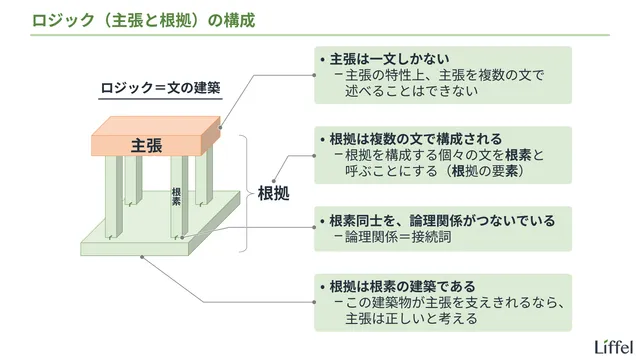
That covers what premises are and why we need them. Next, let’s get a three-dimensional picture of how claims and premises relate.
Entries related to critical thinking are collected on the page below. Feel free to use them as a reference.
Footnotes
-
“The claim always comes first” refers to the conceptual order. In actual explanations, since some people stop listening to the premises if you start with the claim, observe the other person and decide what order to present things in. ↩
-
For laws, I don’t mean doubting whether to obey the law. I mean doubting whether a particular law is valid (whether it’s needed). ↩
-
In fact, I think dictionaries could list “believe” as an antonym of “think.” “Act” would be another candidate. Depending on what you contrast it with, “think” can have several antonyms. ↩