In this entry, you’ll learn what a “claim” is.
If you’re arguing for something, you need a claim. Yet what a claim is, and what kind of statement can be one, is often misunderstood. Take this opportunity to understand what “claim” means in critical thinking (that is, in the context of trying to make rational decisions).
Let’s begin.
toc
- “Claim” in Everyday Language
- What Is a “Claim” in Critical Thinking?
- Condition 1: There Is a Question
- Condition 2: It Directly Answers the Question
- Condition 3: It’s Open to Debate
“Claim” in Everyday Language
First, let’s look at the everyday meaning of “claim.” In everyday English, a claim usually means an assertion that something is true, often one made without proof. Think of phrases like “a dubious claim” or “unfounded claims.”
In other words, the word often carries a somewhat negative nuance, suggesting someone insisting on something they can’t back up.
For now, forget all of these meanings and images.
As I’ll explain later, “claim” in critical thinking is far removed from its everyday meaning. Not only does it carry no negative nuance, but it’s actually indispensable.
If the everyday meaning of “claim” stays in your head, what follows will be harder to understand. Reset your mind here.
What Is a “Claim” in Critical Thinking?
Let’s get to the point and explain “claim” in critical thinking. From here on, “claim” refers to this (non-everyday) meaning.
First, look at the example below. It’s in the style of a mystery novel.

Someone ate the pudding in my fridge. Who did it?

Yasuda did it.
Here’s why I think so.
First, there’s evidence. An empty pudding cup was found in Yasuda’s room.
And Yasuda has a motive, too. He loves pudding.
The part in bold, Panda’s statement “Yasuda did it,” is the claim in this conversation. That’s because this statement directly answers the question.
In this way, a claim is a direct answer to the question. Make sure you understand this definition first.
Claim: a direct answer to the question
This definition leads to three conditions for a statement to be a claim:
- There is a question
- It directly answers the question
- It’s open to debate
Let me explain each in turn.
Condition 1: There Is a Question
The first condition of a claim is that there is a question. This is less a “condition” than a “premise.” Since a claim is defined as “a direct answer to the question,” it can’t exist on its own. The question always comes first.
“The question” here simply means a question you’re asking. There’s something you don’t know, and the question asks for the answer. A statement that answers that question head-on is a claim.
I explain the question in detail in another entry. If you’re unsure about it, read the entry below before going further.


Back to the topic. Let’s check with the earlier example.
Someone ate the pudding in my fridge. Who did it?
Yasuda did it.
Here’s why I think so.
First, there’s evidence. An empty pudding cup was found in Yasuda’s room.
And Yasuda has a motive, too. He loves pudding.
Here, the question is “Who did it?” Since Bear doesn’t know who did it, Bear is asking. In a mystery novel, the question is always this one1.
And since “Who did it?” is the question, “Yasuda did it” becomes the claim. This statement directly answers the question, doesn’t it?
Conversely, if the question isn’t “Who did it?”, then “Yasuda did it” is no longer a claim. Look at the example below.
Maybe I’ll do some push-ups. How many should I do?
Yasuda did it.
(What on earth…)
This time, they’re completely talking past each other. Since Bear’s question is “How many push-ups should I do?”, any claim has to be about a number. But for some reason, Panda is talking about the culprit.
In other words, Panda’s statement is out of line with the question Bear raised. In a situation like this, there’s no way to analyze Panda’s statement. Naturally, there’s no way to tell what the claim is either.
The question comes before the claim
When There Is a Question
So what exactly does it mean that “there is a question”?
When there is a question, the following two things hold:
- There’s something you want to know the answer to
- The answer isn’t clear yet
This is obvious if you think about it the other way around. We don’t ask about things we don’t want to know. Nor do we ask about things whose answers are obvious.
In other words, whenever these two things hold, there is a question.
When you’re thinking alone, that’s all there is to it. If these two things hold, there’s a question in your mind.
When other people are involved, this applies to “discussions” and “argumentative writing” (writing or reading it).
First, we call exchanges with others in which these two things hold a “discussion.” Although people these days tend to see discussion as something like a quarrel, that’s not what discussion really is. Discussion is working with others to find or agree on the answer to a question.
Argumentative writing is even more direct. Its very definition is “writing in which the author presents their claim on a question.” The author tries to persuade the reader that their claim is right.
When There Is No Question
In situations that don’t fit the above, there’s no question. Specifically, these are situations and forms like the following:
- Literary writing (writing meant to move people)
- Novels, poems, haiku, and so on
- Writing meant to share information
- Example: an email saying “There’s a fire drill tomorrow”
- Ordinary chitchat
- (Most) comics
- Most comics are meant to move people
- However, some comics are mainly meant to argue or explain (e.g., “XXX: A Comic Guide”)
None of these are trying to reach an answer to anything. So there’s no question, and no claim either.
That said, there are cases where a novel or comic is, in effect, the author making a claim (or seems to be). A common technique is to have characters debate as mouthpieces for the author2.
Given this, you can’t decide whether there’s a question based on the form. You have to judge what the author’s purpose is. Form is only a hint for judging the author’s purpose.
If you judge that the author is arguing for something, make the question clear. The direct answer to it is the claim.
Condition 2: It Directly Answers the Question
The second condition of a claim is that it directly answers the question.
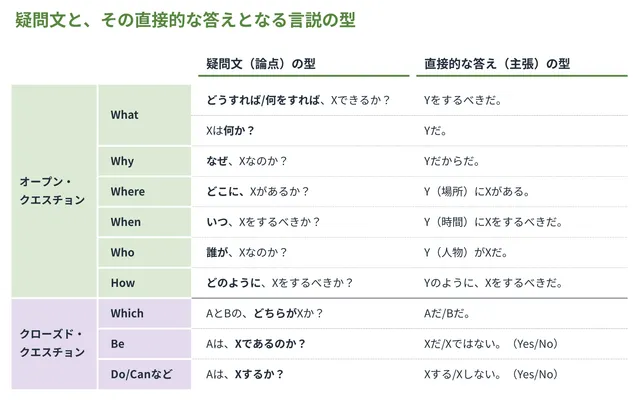
“Directly answers” here refers to a rule of language. Take a look at the table below.
As shown, there’s a correspondence between a question and the statements (claims) that can directly answer it. When a question on the left side of the table is asked, only the statements on the right side can be direct answers. This isn’t a matter of reasoning. That’s just how it is.
Let’s check with the earlier example.
Someone ate the pudding in my fridge. Who did it?
Yasuda did it.
Here’s why I think so.
First, there’s evidence. An empty pudding cup was found in Yasuda’s room.
And Yasuda has a motive, too. He loves pudding.
As mentioned, the question is “Who did it?” In the table above, it’s a question asking “Who.”
As the right side of the table shows, only a statement that identifies a person can directly answer this question. That’s how we know “Yasuda did it” is the claim.
In this way, there’s a correspondence between the question and the claim. A statement that matches this correspondence from the question’s side is what we call a claim.
The table above is explained in detail in the entry below. If the table didn’t click, see this entry.
When the Question Isn’t Stated
Now let’s think about claims when the question isn’t stated.
In discussions and argumentative writing, the question isn’t always stated. Look at the example below.
Yasuda did it.
Here’s why I think so.
First, there’s evidence. An empty pudding cup was found in Yasuda’s room.
And Yasuda has a motive, too. He loves pudding.
This time, Panda starts talking out of nowhere. Since it’s written as a conversation, this may feel odd, but plenty of argumentative writing is like this. It jumps straight to “what I want to say” before stating “what it’s arguing about.”
In a situation like this, where the question isn’t stated, how is a “claim” defined?
To start with the conclusion, the definition doesn’t change. Even when the question isn’t stated, a claim is a direct answer to the question.
What do I mean?
First, this situation is different from “when there is no question” described above. Panda is clearly arguing about “Who did it?” It’s not that there’s no question. It’s just that the question isn’t stated. To improve it, Panda could say this:
I’m going to give my view on the question “Who ate Bear’s pudding?”
Yasuda did it.
Here’s why I think so.
First, there’s evidence. An empty pudding cup was found in Yasuda’s room.
And Yasuda has a motive, too. He loves pudding.
It’s become almost unnaturally formal, but it’s easier to follow, isn’t it?
Even without such improvements, though, you can often tell what’s being argued about. In fact, even before the improvement, you probably understood without any trouble that Panda was arguing about who the culprit was.
Why is that?
The answer is the table above. Since the question and the claim correspond, you can infer the question as long as you know the claim. This time, you read the table from right to left.
We infer the question from the claim like this unconsciously. You could say it’s at the core of what we call “language ability” or “reading comprehension.”
Even when the question isn’t stated, you can infer it from the claim
Is It Fine Not to State the Question?
However, this doesn’t mean it’s fine to leave out the question. On the contrary, leaving out the question is not recommended at all. Never do it. Whenever you argue for something, always state the question at the start.
The simple reason is that stating the question makes things easier to follow. But there’s another big reason. A fair number of people can’t infer the question from the claim (the kind of people you always seem to talk past). Conversely, there’s no real benefit to leaving out the question, so always state it.
Whenever you make a claim, always state the question
To sum up so far: think about the question, not the claim itself.
If you’re arguing for something, start not with the claim (what you want to say) but with the question (what you’re trying to answer). If someone else is arguing for something, don’t jump on their claim. Ask yourself, “What is this person arguing about?” This will clear up the whole discussion and make the claim clearer, too.
Condition 3: It’s Open to Debate
The third condition of a claim is that it’s open to debate.
Specifically, “open to debate” means “others can deny it.” For example, if you’re making a claim, only a statement that someone other than you can deny counts as a “claim.”
Let’s check with the earlier example.
Yasuda did it.
Here’s why I think so.
First, there’s evidence. An empty pudding cup was found in Yasuda’s room.
And Yasuda has a motive, too. He loves pudding.
No, you did it. I saw you eat it. I was just testing whether you’d own up.
In this case, Panda claimed “Yasuda did it,” but Bear claims “Panda did it.” Bear denied Panda’s claim. In this way, a claim must leave room for others to deny it.
A claim is a statement that others can deny
Why does this condition arise? First, let’s look at concrete examples of statements that can’t be claims (because others can’t deny them).
Statements That Can’t Be Claims 1: Emotions
First, emotions can’t be claims, because others can’t deny them. Look at the example.
Emotions like likes and dislikes leave no room for anyone but the person feeling them to deny. Expressing emotions like this is sometimes described as “claiming” (as in “claiming one’s love”), but that’s just a literary turn of phrase. Emotions can’t be claims.
Emotions can’t be claims
What Are “Emotions”?
By “emotions” here, I mean any statement whose rightness can only be determined by the person making it.
Since that definition is a bit abstract, here are the major types of “emotions.” Please remember all of them:
- Positive and negative feelings: I’m happy / sad, I’m having fun / I’m angry
- Preference: I like X / I don’t like X
- Fear: I’m afraid of X
- Desire: I want to do X / I don’t want to do X
- Belief: I believe that X is the case
- You can deny X itself, but not the feeling of believing it
- Physical sensations: My heart is pounding, I feel sick, I have a headache
Notice that others can’t deny any of these statements. They’re all confirmed as right the moment they’re put into words.
Let’s look at an example. As shown below, it’s completely absurd for someone else to deny an emotion.
In this way, others can’t deny emotions.
An easy line for deciding what counts as an emotion (something others can’t deny) is your skin. Things that can’t be observed and happen inside your skin are classified as emotions3.
Also, since they express what’s inside your skin, statements of emotion always have a first-person subject (I, me, etc.). Remember that, too.
Statements That Can’t Be Claims 2: Facts
Next, facts can’t be claims either. Again, let’s start with an example.
As with emotions, facts about what someone did (what they saw or what happened) leave no room for anyone but that person to deny. So facts as a rule can’t be claims either.
However, unlike emotions, facts come with the caveat “as a rule,” because they leave a little room for others to deny them. Specifically, others can suspect lies or mistaken perceptions. Let’s look at an example.
In this way, facts leave some room for others to deny them.
Normally, though, no one doubts things like this. And if someone does go that far, then before the fact itself, you need others to accept that you’re not lying or mistaken. Since others can deny that (they can say “You’re lying” or “You’re mistaken”), it’s a full-fledged claim.
Facts (as a rule) can’t be claims
Statements That Can Be Claims: Opinions
So what can be a claim? Opinions.
Although “opinion” is a widely used word, it always carries the nuance that “this isn’t absolutely right.” That’s exactly what satisfies the condition for being a claim.
In other words, when an opinion is stated as a direct answer to the question, it’s called a claim. Since others can deny opinions, they work as claims. If you were unsure about the difference between opinions and claims, this should make it clear.
Why Must Claims Be Open to Debate?
Let’s get back on track. The reason only statements that are open to debate (that others can deny) can be claims is that only such statements can answer a question.
As we saw under Condition 1, for a claim to exist, there must be a question. And for a question to exist, there must be something unknown, something whose answer isn’t settled.
But emotions and facts have no corresponding “something unknown, something whose answer isn’t settled.” Emotions are confirmed as right the moment they’re put into words, and facts are, as a rule, right as well (no lies or mistaken perceptions). In other words, no question can exist that corresponds to emotions or facts4.
In other words, the moment you claim something that others can’t deny, there’s no question. This contradicts the basic premise for a claim to exist: “there is a question.”
So the condition “it’s open to debate” is really just another way of saying “there is a question.” Still, when checking your own claims, this condition is easier to use.
Are you claiming something that others can deny?
If the answer is no, the statement you think is a “claim” isn’t a claim. Go back and rethink it from the question.
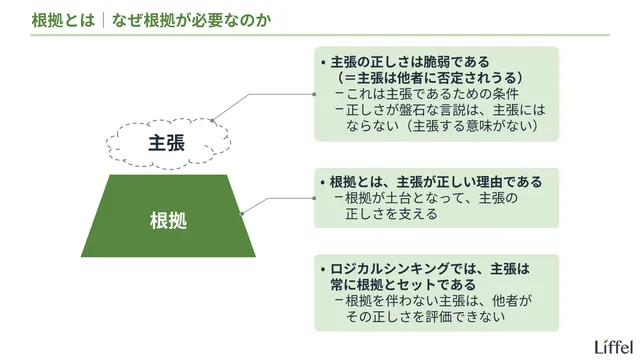
And it’s precisely because others can deny a claim that its rightness is called into question. Supporting it is the job of premises.
So next, let’s learn about premises. Continue to the entry below.
Entries related to critical thinking are collected on the page below. Feel free to use them as a reference.
Footnotes
-
Strictly speaking, it’s the question for the detective character in the novel, not the question of the novel itself. Generally speaking, novels don’t have a question. Writing that has a question is called argumentative writing. ↩
-
Then again, since every line a character speaks comes out of the author’s head, it’s impossible to separate a character’s own lines from the author speaking through them. Personally, I think it’s tactless as a reader to force an author’s claim out of the works listed here. ↩
-
Even inside your skin, anything that can be observed can’t be classified as an emotion. For example, “There’s a tumor in my colon” happens inside your skin, but since it can be observed with a camera, it isn’t an emotion. ↩
-
Strictly speaking, you can create an interrogative sentence that asks about an emotion or a fact (e.g., “Am I angry?”). But there’s no point in making such a sentence the question. ↩