This entry explains interrogative sentences (questions). In particular, let’s learn how questions are classified into open questions and closed questions.
To set the right question, you need to understand questions and be able to write good ones. Although you may already know much of this, let’s think about questions from scratch.
toc
What Is a Question?
As you know, a question (interrogative sentence) is a sentence that asks for an answer.
For example, right now we’re thinking about “What is a question?” That itself is a question.
Question (interrogative sentence): a sentence that asks for an answer
How to Tell a Question
How can you tell whether a sentence is a question?
In English, questions are clearly distinguished from declarative (ordinary) sentences in two ways:
- They end with a question mark (”?”)
- The question word or verb comes first, reversing the word order of a declarative sentence
Some languages are even more explicit. Spanish, for example, also puts an inverted question mark at the beginning (e.g., “¿Cómo estás?”).
Not every language is like this, though. As far as I know, Japanese, my native language, has no sure way to tell a written question at a glance1. Word order in Japanese is very flexible, and since the question mark wasn’t originally part of the written language, some people still consider it inappropriate in formal writing.
Much as I love Japanese, I consider this its greatest weakness. Even though questions are the starting point of thinking, the language has no built-in way to make a question explicit.
What to Do
The lesson applies to any language: make it explicit that you’re asking. When you write a question you want to think about, write it as a complete interrogative sentence and end it with a question mark. At least when it comes to words for your own thinking, that solves the problem.
Use a question mark (”?”) to make it explicit that a sentence is a question
The Overall Picture of Questions
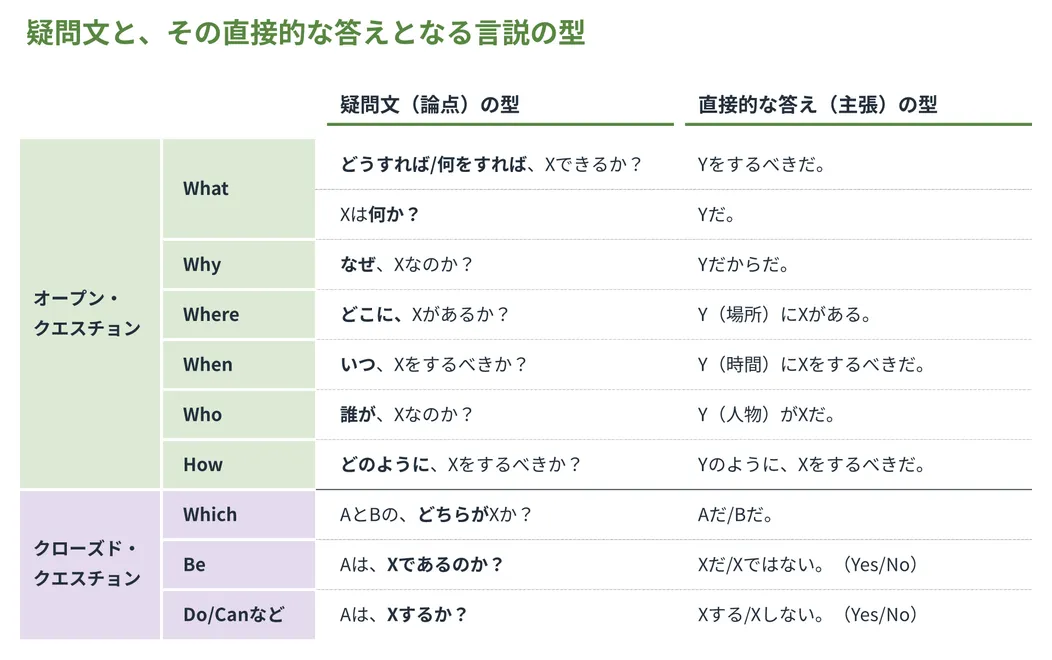
Next, let’s look at the overall picture of questions. Take a look at the table below.
There are two points to understand:
- Questions can be broadly divided into open questions and closed questions
- The type of statement that can answer a question is fixed
Let’s take a closer look.
Open Questions
An open question is a question whose range of answers isn’t limited.
Open question: a question whose range of answers isn’t limited
Open questions begin with the following question words:
- What
- Why
- Where
- When
- Who
- How
Questions beginning with these words can be answered in countless ways. For example, if someone asks you, “What’s the most fun game?”, you could name any game in the world.
However, even open questions don’t allow just any answer. Let’s look at an example.

That makes Panda seem a bit unhinged, doesn’t it? Since the question asks “why,” Panda has to give a reason (“Because X”). Panda is free to fill in X, but the “because” can’t be dropped.
In this way, “there are countless ways to answer” doesn’t mean “any answer is fine.” The question itself determines what kind of statement can answer it. Check this in the table above as well.
Closed Questions
Next, a closed question is a question whose range of answers is limited. It’s the opposite of an open question.
Closed question: a question whose range of answers is limited
A closed question is one of the following:
- Yes-no question: the only answers are “yes” or “no”
- Questions starting with a form of “be”
- Questions starting with “do” or another auxiliary verb
- Choice question: the only answers are the options already given
- Which
With closed questions, what can count as an answer is fixed even more strictly than with open questions. Obviously, if you’re asked a yes-or-no question, you should basically answer only yes or no. Beyond that, perhaps “I don’t know” or “I’d rather not answer.”
At press conferences held by politicians or CEOs, you often see people asked a closed question who don’t answer it.
They may be doing it on purpose, but it’s frustrating to watch.
Exercise
Let’s check what you’ve learned with an exercise.
Is each of the following questions an open question or a closed question?
- Will it be sunny tomorrow?
- What will the weather be like tomorrow?
- Are you angry?
- What are you thinking?
- Is each of the following questions an open question or a closed question?
The odd-numbered questions are closed questions, and the even-numbered ones are open questions.
Open vs. Closed Questions
Finally, let’s look at the practical differences between open and closed questions. Take a look at the table below.
| Open question | Closed question | |
|---|---|---|
| Pressure on the respondent | Low (relaxed) | High (puts them on the spot) |
| How easily the conversation expands | Expands easily | Doesn’t expand easily |
| Clarity of the answer | Tends to be vague | Clear |
As you can see, since open questions leave the answer wide open, they’re gentle on the respondent. From the questioner’s point of view, though, they have a drawback: they don’t settle things one way or the other. Closed questions, on the other hand, settle things, but since they inevitably feel intimidating, they risk leaving hard feelings.
In interviews and similar settings, start with open questions, and once the other person has warmed up, ask the closed questions you really care about.
The same goes for thinking. Even if you start with an abstract open question, you can’t test it through research unless you break it down into closed questions that settle things one way or the other. Always ask yourself, “Do I have the key closed questions ready?”
That covers the types of questions.
If You Want to Keep Learning
Thank you very much for reading this far. If you’d like to keep learning critical thinking, continue to the entry below.
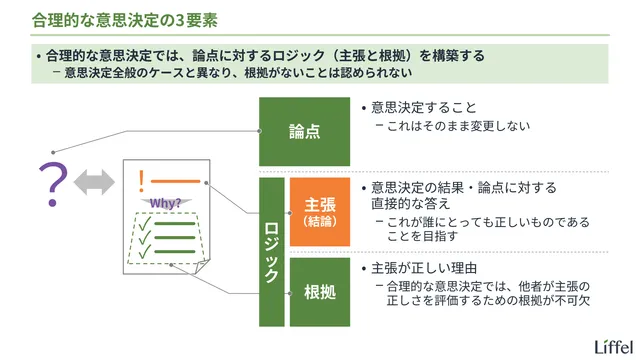

Entries related to critical thinking are collected on the page below. Feel free to use them as a reference.
Footnotes
-
A sentence ending with the particle ka is likely to be a question, but not every question ends with ka, and it isn’t nearly as obvious as a question mark. ↩