
This entry explains what “the question” means in the context of critical thinking.
The question is the starting point of critical thinking and problem solving. Since everything starts here, make sure you understand it well.
There’s also a video version of this entry with almost the same content (in Japanese). It’s embedded at the end of this entry (you can jump to it from the table of contents).
Let’s begin.
toc
- “The Question” in Everyday Language
- The Question in Critical Thinking
- Points to Watch in Practice
- Aside: Other Names and Other Uses for “the Question”
- Learn or Review with the Video
“The Question” in Everyday Language
What is “the question”?
First, let’s look at how the phrase is used in everyday language. When we say “the question” in a discussion, as in “That’s not the question” or “The question is whether…,” we usually mean the matter at issue.
In other words, in everyday usage, “the question” often means “what we want to discuss right now,” “the central topic,” or “the point where opinions clash.” It’s close to “the key point.”
However, since this definition is too vague to be useful in critical thinking, this site defines “the question” a bit more strictly.
The Question in Critical Thinking
In critical thinking, the question is the single question (interrogative sentence) you’re trying to answer.
The question (in critical thinking): the single question (interrogative sentence) you’re trying to answer
For example, here’s the question for this entry:
- What is “the question” in critical thinking?
You’ve read this far because you want to know the answer to this question (I hope you’ll read to the end). That’s what the question is.
It differs from the everyday definition above in two ways:
- The question is an interrogative sentence
- There is only one question
Let me explain each in turn.
Condition 1: It’s an Interrogative Sentence
The first condition is that the question is an interrogative sentence.
In other words, in critical thinking, always write the question as an interrogative sentence.
From here on, anything not written as an interrogative sentence isn’t a question. For example, “Which company should I work for?” is a question, but “job hunting” isn’t, because it’s not an interrogative sentence.
Writing the question as an interrogative sentence is crucial to practicing critical thinking. Always follow this rule.
Why Only Interrogative Sentences?
Why is it so important to write the question as an interrogative sentence?
Because no form other than an interrogative sentence can express what you want to think about specifically.
This is so important that I’ll say it the other way around too: no matter what you write as a word or phrase, what you want to think about won’t become specific. Take a look at the slide below.
Expressing the question as a word or phrase means putting forward something like this as the question (what you want to think about):
- New product development (word)
- About developing new products (phrase)
Expressions like these aren’t specific at all. For example, from the phrase “about developing new products,” you can imagine any number of interrogative sentences:
- Should we develop a new product?
- What kind of new product should we develop?
- How many new products should we develop?
- Is new product development on schedule?
As you can see, when you try to express what you want to think about as a word or phrase, it doesn’t narrow down to one thing. You can’t think like that.
Of course, writing the question as an interrogative sentence doesn’t automatically narrow down what you want to think about. An interrogative sentence containing vague adverbs or adjectives can still be unclear. We’ll learn how to deal with that later.
For now, understand that to express what you want to think about specifically, you must at least write it as an interrogative sentence.
The only way to express what you want to think about specifically is to write it as an interrogative sentence
The Main Types of Interrogative Sentences
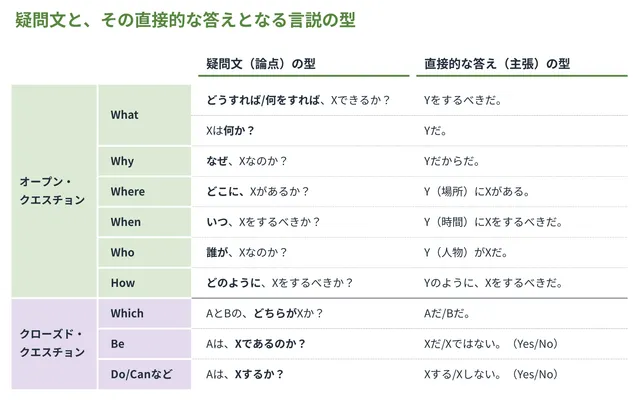
For reference, here’s a table of the main types of interrogative sentences and the types of answers (claims) that go with them.
In most cases, the question you set should take the same form as one of the interrogative sentences in this table. Pay attention to what you’re asking (= what you’re trying to think about).
I’ll explain this table in detail in the next entry.
Condition 2: There’s Only One
Let’s move on. The second condition is that there’s only one question.
This may be obvious, but keep it in mind just in case. It would be strange to have several things you want to focus on at the same time. Narrowing it down to one is what lets you concentrate your thinking on it.
If there are several questions you want to think about, separate them in time: “This is the question now, and that’s the next one.” Then again, there’s no other way to do it1.
A Characteristic of the Question: It Can’t Be Answered Easily
These conditions reveal a characteristic of the question: the question is one that you can’t easily answer.
This becomes clear when you consider how the question is treated. You deliberately pick out one question and set out to answer it, thinking, “This is the question. I want to know the answer to it.” Such a question can’t be one you can answer in three seconds.
For example, there’s no point in calling “What should I have for lunch today?” the question and racking your brains over it. You just eat what you feel like eating.
In other words, once a question is labeled “the question,” it’s by definition one you can’t easily answer.
The question is a single question that can’t be answered easily
Points to Watch in Practice
Next, here are some points to watch when using the question in practice.
As mentioned, by definition any type of interrogative sentence can be the question. However, in critical thinking in practice, the question is almost always the type that asks about action: “How can I do X?” or “What should I do to achieve X?”2
Check the earlier table. Only the top type of question will do.
The reason is that, unless you’re a student or researcher, you use critical thinking as part of problem solving.
As a rule, problems don’t get solved without action. Without action, the current state never moves closer to the goal. In problem solving, these “actions that move the current state closer to the goal” are called solutions. See also the slide below.
I explain this slide and the term “problem solving” in another entry. If what I’ve said so far doesn’t click, read the link below before going further.
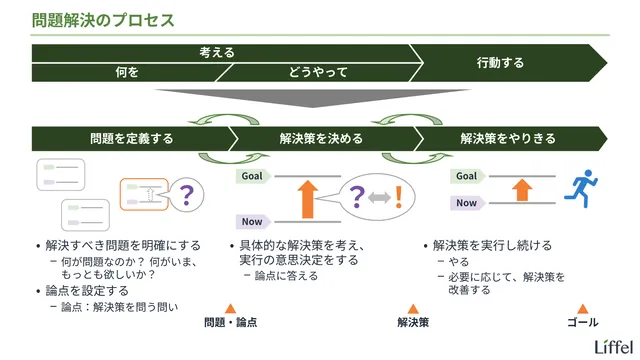

To sum up, in problem solving, you use critical thinking to think about solutions (actions to take). So the question needs to ask about action.
The typical pattern is: “Something undesirable (a problem or challenge), XX, is happening. What should we do to solve it?” Think of this as the basic form.
Of course, you can set a question that doesn’t ask for a solution. But in that case, it’s worth doubting whether it’s really the right question, especially in business. How will thinking about something that doesn’t lead to action in the end satisfy your customers? You need an answer to that.
In business, the question is almost always an interrogative sentence that asks for a solution (an action)
Aside: Other Names and Other Uses for “the Question”
Finally, as an aside, the concept I’ve called “the question” in this entry goes by different names in different fields. Some people also use the term in a different sense. Let me explain these two points.
Other Names for the Question
Besides “the question,” the following words are also used to mean “the question you want to think about”:
- Theme, topic, or issue (widely used)
- Agenda (common in global companies)
- Research question (research)
You can treat these words as synonyms for the question as explained in this entry (= no difference in meaning). However, definitions only work if the people using them share them. If you’re unsure, check with those around you.
As for which name to use, since a name is just a label, there’s no need to stick with “the question.” Choose whichever you like or whichever is used around you.
Personally, though, I feel words like “theme” and “agenda” carry a risk. People who use them a lot tend to express the question as a word or phrase.
Since words and phrases are catchy, there’s nothing wrong with putting them forward as a “theme” or “agenda” to grab attention. But behind them, you need an interrogative sentence that you want to think about. Just watch out for that.
To sum up, you don’t need to worry about what you call the question. What matters is whether what you want to think about or discuss is made clear as an interrogative sentence and shared with everyone in the discussion.
Check that the interrogative sentence you want to think about is clear and shared
“The Question” Used in a Different Sense
Next, here’s a case where words like “question” and “problem” are used in a different sense from this entry.
In some business books, words like “issue,” “challenge,” or “problem” are used to mean the “root cause” (the culprit among candidate causes) found as a result of root-cause analysis.
The difference becomes clear if you think of it this way:
- “The question” on this site: doesn’t require much work or evaluation to decide on
- You decide on the question first, then do the work and evaluate the question
- You don’t yet know whether it’s worth devoting resources to
- “Issue” in the other sense: found as a result of much work and evaluation
- Something that undeniably must be answered or solved
Since this is simply a difference in usage, just remember that some people use the words this way. On this site, I’ll simply call it the “root cause.”
That covers what the question means in critical thinking.
Next, let’s study what an interrogative sentence is. As explained in this entry, the question is an interrogative sentence. Understanding interrogative sentences is the first step toward handling questions well.
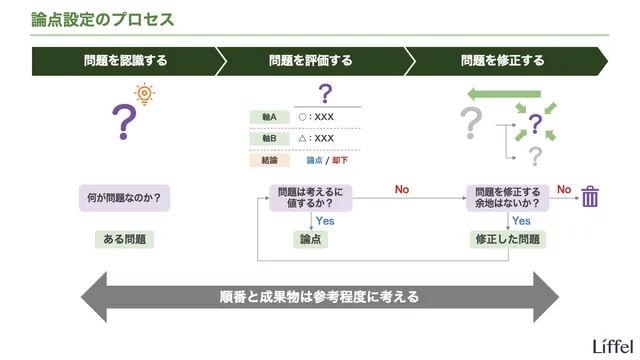
If you want to learn how to set the question, see the entry below. Note, though, that it jumps ahead in the learning order and the content gets much more advanced.
Finally, entries related to critical thinking are collected on the page below. Feel free to use them as a reference.
Learn or Review with the Video
Here’s the video mentioned at the start (in Japanese). Although the content isn’t exactly the same, the main points are.
Footnotes
-
That said, since your thinking on one question sometimes moves forward while you’re thinking about a completely different one, perhaps the human brain does some unconscious parallel processing. ↩
-
Of course, an interrogative sentence like “Why is X happening?” can be called the question, but finding the cause is basically never the end of the story. In other words, since you investigate causes in order to act, “why” questions are essentially sub-questions of “what should I do” questions. ↩