In this entry, you’ll learn what problem solving is and how to go about it. Along the way, I’ll also explain how problem solving relates to critical thinking. You hear both terms all the time once you start working, but how exactly are they related?
Let’s begin.
toc
- Summary
- What Is Problem Solving?
- The Problem-Solving Process
- Problem Solving and Critical Thinking
- References
Summary
Since this entry is long, here are the key points up front:
- Problem solving means closing the gap between the current state and a goal (by moving the current state toward the goal). In short, think of it as “making your wishes come true”
- Problem solving is achieved by (1) defining the problem, (2) deciding on a solution, and (3) seeing the solution through
- Critical thinking is the skill you use in “(2) deciding on a solution,” one step of the problem-solving process
- You need critical thinking to come up with the right solution
- What really matters is problem solving, not critical thinking
- Critical thinking is a tool for solving problems efficiently
Once you understand these points, you’ll also gain a deeper understanding of common criticisms of critical thinking.
Let’s go through them in order.
What Is Problem Solving?
First, let’s define “problem solving.” The slide below sums it up.
As shown, problem solving means closing the gap between the current state and a goal by moving the current state.
Problem solving: closing the gap between the current state and a goal by moving the current state
That alone probably doesn’t make much sense. Since problem solving means “solving” a “problem,” let’s look at each part in turn.
What Is a “Problem” in Problem Solving?
Let’s start with “problem.” Take a look at the slide below.
As shown, in the context of problem solving, a problem is defined as “a current state that has a gap with a goal.”
Problem: a current state that has a gap with a goal
This definition is probably quite different from how you usually use the word “problem.” It may feel strange at first, but just accept it for now.
Explanation
Let’s take a closer look at the slide. For convenience, let’s say the problem is yours.
Suppose you currently can’t speak English. That’s your “current state.”
Whether this current state is a “problem” for you depends on whether you have a goal that corresponds to it. Look at the slide again.
The left side of the slide shows the case where you have the goal “I want to be able to speak English.” Here, there’s a gap between your current state (can’t speak English) and your goal (can speak English). Only then does your current state become a “problem” for you.
Now suppose, as on the right side of the slide, you think, “I don’t need to speak English.” In that case, your current state of not speaking English has no corresponding goal. Naturally, there’s no gap. Here, not being able to speak English isn’t a “problem” for you.
In other words, you have a problem when you have some goal and your current state doesn’t match it. That’s the definition of “problem” in the context of problem solving.
Incidentally, once a goal exists, there’s obviously a gap between it and the current state (anything that’s no different from the current state can’t be a goal). So you could simply say “problem = goal.” However, since some points are easier to explain if you think of a problem as “the gap between the current state and a goal” (more on this later), the definition takes this form.
What Does It Mean to “Solve” a Problem?
Next, let’s think about what “solving” means. When we say a problem has been solved, what has happened to it?
The answer is simple. We say a problem has been solved when it no longer exists. In other words, “solving” a problem means that a problem that existed is gone.
So how does a problem go away? Since a problem is “the gap between the current state and a goal,” the problem disappears when the current state and the goal match.
Solving a problem means that the problem that existed is gone (the current state and the goal match)
Two Ways to Solve a Problem
Specifically, how can you solve a problem? Take a look at the slide below.
As shown, there are broadly two ways to solve a problem (make the current state and the goal match)1:
- Move the current state to match the goal
- Drop the goal (move the goal to match the current state)
Achieve either one, and the problem is solved.
Of these, “(2) drop the goal (move the goal to match the current state)” basically means giving up. I doubt anyone thinks of “giving up” as a good thing, but it’s actually a perfectly valid way to solve a problem.
However, when people talk about “problem solving,” giving up isn’t included in the scope. That’s why problem solving is defined as it was at the start. Here’s the slide again.
Problem solving: closing the gap between the current state and a goal by moving the current state
Problem Solving and Giving Up
Note that leaving giving up out of problem solving doesn’t mean giving up is bad. Don’t get this wrong.
In reality, some goals can’t be achieved no matter what. Rather than being trapped by such a goal and pouring resources into it endlessly, it’s sometimes better to give up and move toward another goal.
However, there’s no know-how to learn about giving up. Try thinking about the following questions:
- When (in what situation) should you give up?
- How can you bring yourself to give up?
- How can you stop wanting something?
It’s hard to imagine answers to these that everyone would accept.
What’s more, if you think about this from the start, you’ll never reach your goal. Japanese pro wrestler Antonio Inoki famously slapped an announcer who asked him about losing, saying something like, “What idiot thinks about losing before a match?”
In the end, you can’t say anything more than “depending on the situation, it may be better to give up.” In my personal view, the know-how of giving up belongs to the realm of religion.
Also, when you learn problem solving as a skill, the ultimate goal is to provide problem solving to someone (= to solve other people’s problems), because that’s the definition of work.
Work: solving other people’s problems
However, only the owner of a problem can give up on it, and they can do so entirely on their own. In other words, no one gets paid for saying, “You’d better give up.”
For these reasons, giving up falls outside the scope of problem solving (as a skill area). Still, when it comes to solving your own problems, keep in mind that giving up is always an option.
The Problem-Solving Process
Now that we have the definitions, let’s move on. How do you go about solving a problem?
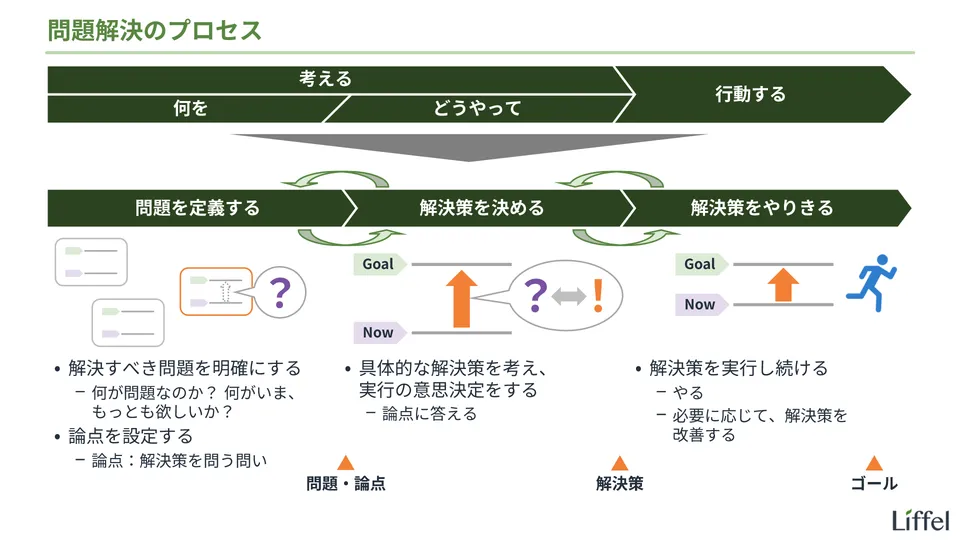
The slide below summarizes the problem-solving process.
The top row of the slide shows the basic idea: think about “what” your goal is, think about “how” to reach it, and “act.”
Put in more formal terms, this becomes the following three steps:
- Define the problem: decide what your goal is (which problem to devote resources to)
- Decide on a solution: decide what actions to take to reach the goal
- See the solution through: carry out the chosen solution and reach the goal
Let’s look at them one by one.
Step 1: Define the Problem
The first step of problem solving is defining the problem. This means choosing the one problem you’ll try to solve.
You don’t need to overthink it, though. Defining the problem simply means deciding which goal you’ll seriously pursue.
For example, deciding “It’s the summer of my senior year of high school, so I’ll quit my club and focus on studying for entrance exams. My goal is to get into University X without taking a gap year” is defining a problem. You can see that it makes clear what you’ll do and what you won’t do.
Why Define the Problem First?
Why is defining the problem the first step?
This relates to the idea that “problem = goal,” mentioned earlier.
Put bluntly, a goal is a desire. And desires can arise without limit (though this varies from person to person). You want to get rich, win over that person next to you, compete in the national championship, eat something delicious. All of these desires can exist at the same time.
In other words, you can recognize many problems (goals) at once.
However, you can’t solve every problem at the same time, because your resources are limited. So you need to decide which problem to solve. That is, you list the problems (goals) you’re aware of and prioritize them.
And even if you do solve several problems at once, you can simply treat them as separate, parallel processes. When you think of problem solving as a process, there’s no reason not to narrow it down to one problem.
For these reasons, you start by defining the problem.
The Question
Once the problem is defined, the question emerges at the same time. The question is the interrogative sentence that asks for a solution. Think of it as the question “What should I do to make the current state match the goal?” made specific to the problem at hand.
Question: an interrogative sentence that asks for a solution
Let’s go back to the earlier example. The problem (goal) was “getting into University X without taking a gap year.”
The moment you define this as your problem, that is, commit seriously to this goal, the question “How much, what, and how should I study each day to get into University X without taking a gap year?” arises. An interrogative sentence like this, asking for a solution (actions to reach the goal), is the question.
Skills and Abilities Needed to Define the Problem
What skills and abilities help you define problems well?
The first thing to understand is that there’s no all-purpose know-how in this area.
In a sense, that’s only natural. Deciding what counts as a problem (what you want and will pursue) is a matter of values, not something you handle with skills or abilities. You shouldn’t rely on someone else’s know-how for something like this. Decide what your problem is with your own head and heart.
That said, it’s not as if there’s no know-how at all. I’ll add more on that in the next entry.
Step 2: Decide on a Solution
The next step is deciding on a solution.
Unless you act, the current state won’t move any closer to the goal. In other words, solving a problem requires actions that bring you closer to the goal. In problem solving, these actions are called solutions.
Solution: an action that moves the current state closer to the goal
So once you’ve defined the problem, the next step is to decide on a solution. You think about what to do, when, how much, and how. That’s what deciding on a solution means.
Put another way, it means answering the question.
As mentioned, once the problem is defined, the question (the interrogative sentence that asks for a solution) emerges at the same time. In other words, answering the question gives you the solution.
In the earlier example, answering the question “How much, what, and how should I study each day to get into University X without taking a gap year?” means nothing other than spelling out which subjects to study, with which study guides, for how many hours, where, and how. In this way, answering the question gives you the solution.
Skills and Abilities Needed to Decide on a Solution
What skills and abilities help you decide on solutions well?
This is where the skills known as ways of thinking come in. Here are some typical ones:
- Critical thinking
- Logical thinking
- Creative thinking
- Lateral thinking
I’ll explain the differences between them in the next entry. For now, focus on what they have in common: all of these ways of thinking deal with “how to find the right answer to a question that has no correct answer.”
In this step, we try to answer the question (what should I do to make the current state match the goal?). And this question often has no ready-made correct answer (questions that do have one can simply be looked up).
Nobody wants to do something pointless or take the long way around. In other words, we want to know the right solution (one that moves the current state toward the goal efficiently when carried out). Ways of thinking help with that.
Critical thinking, mentioned above, is a typical way of thinking and focuses on “what is right.” That’s why critical thinking helps you find the right solution.
Since critical thinking is the skill of judging what is right, it helps you find the right solution
Here are some skills other than ways of thinking.
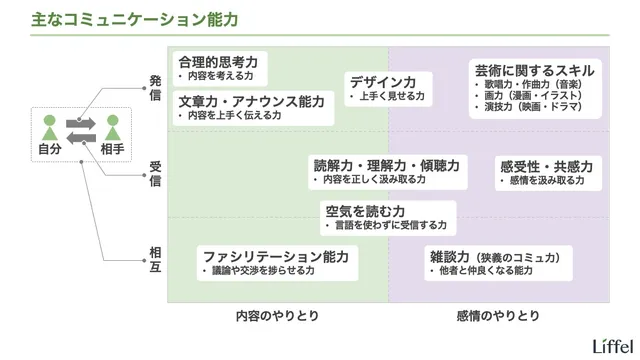
First, if you’re solving other people’s problems as work rather than your own, communication skills are also essential. You need to convince others that your solution is right. For details, see the entry below.

You also need decisiveness. “Thinking up” a solution and “deciding to do it” are completely different things. Since this step ends with deciding on a solution, someone has to make that decision for it to end. That’s a different skill (ability) from critical thinking.
One common objection to critical thinking is that “once you learn critical thinking, you just think and never act.” I admit it has this side (worrying too much about whether your answer is right can keep you from deciding and acting), but it’s impossible to come up with the right solution without critical thinking. It’s better to think of critical thinking and decisiveness separately.
I’ll explain this in more detail in later entries.
Step 3: See the Solution Through
The last step is seeing the solution through.
Deciding on a solution alone doesn’t change the current state at all. It’s like deciding to run 10 km every day to lose weight: the decision alone won’t take off a single gram.
To move the current state closer to the goal, you need to carry out the solution. If you keep at it, you’ll reach the goal someday. That’s what seeing the solution through means.
In reality, though, seeing a solution through doesn’t always solve the problem. The solution you came up with may be wrong, or the goal may have been unrealistic to begin with.
That’s why the slide has arrows pointing backward. Depending on the situation, you may revise the solution or even go back and reset the goal.
Skills and Abilities Needed to See the Solution Through
What skills and abilities help you see a solution through?
This ability is generally called drive or execution2, but memorizing such words is pointless. The real question is how to develop them.
Needless to say, the most important factor is motivation. It’s not really a skill or ability, but in any case, it’s impossible to see a solution through without motivation. In that sense, it’s important to define a problem that motivates you.
Habit formation also matters. For example, you don’t need motivation to brush your teeth. You do it because it’s what you always do. Likewise, once you make a solution a habit, you no longer need motivation. The standard approach is to build up your motivation first and turn the solution into a habit while you’re still motivated.
For problem solving in a work context, you also need to consider the following:
- Mechanization and automation (stop having people carry out the solution)
- When people carry out the solution
- Documentation (so that anyone can understand and carry out the solution the same way)
- Incentive design (create systems that motivate people)
None of these are really skills or abilities, but they’re all important, so make sure you understand them.
Problem Solving and Critical Thinking
Now that we’ve covered problem solving, let’s finish by sorting out how it relates to critical thinking.
There’s just one point. What matters is problem solving, not critical thinking. That’s because what we want is to reach our goal, not to know the right solution. The right solution is only a means of reaching the goal efficiently.
Critical thinking is a tool for solving problems efficiently
That covers how problem solving relates to critical thinking. Keep this firmly in mind and put critical thinking to work in your problem solving.
Next, I’ll explain the types of ways of thinking that I touched on in this entry.
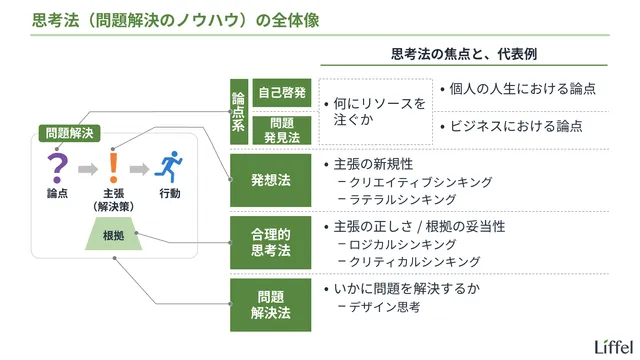
Entries related to critical thinking are collected on the page below. Feel free to use them as a reference.
References
Footnotes
-
Strictly speaking, moving both the current state and the goal partway also solves the problem, but I’ve left that out to keep things simple. ↩
-
In Japanese, the two words commonly used here carry slightly different nuances, one suggesting “acting first without thinking ahead” and the other “getting things done.” The latter is the safer choice in formal contexts. ↩