This entry explains what ways of thinking are and what types there are.
Critical thinking, design thinking, and countless other ways of thinking are everywhere. These days, it’s no exaggeration to say ways of thinking are on clearance sale.
Still, ways of thinking are meant to be useful tools that help us. Take this opportunity to get a bird’s-eye view of them.
Let’s begin.
toc
- What Is a Way of Thinking?
- Types of Ways of Thinking
What Is a Way of Thinking?
First, let’s define what a way of thinking is. You might think “a way of thinking” simply means “a way to think,” but the situation calls for a more careful definition (more on this later).
A way of thinking is know-how for problem solving. That’s how this site defines it.
Way of thinking: know-how for problem solving
That probably doesn’t ring a bell yet, so let me explain step by step.
Examples of Ways of Thinking
First, here are some examples:
- Critical thinking
- Logical thinking
- Creative thinking
- Lateral thinking
- Hypothesis thinking
- Design thinking
- Essentialism
These are ways of thinking. You’ve probably heard of a few of them1.
What Is Problem Solving?
As mentioned, all the ways of thinking listed above are know-how for problem solving.
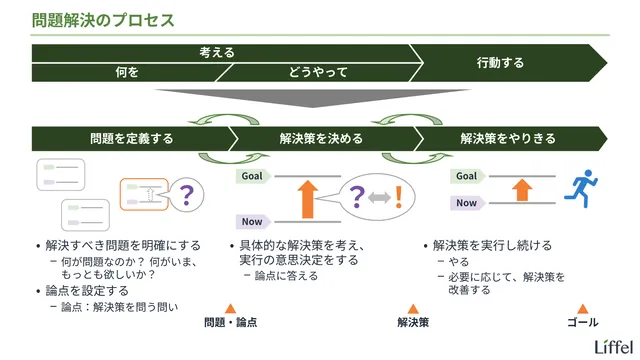
What does that mean? First, let’s review the overall picture of problem solving.
As shown, problem solving means moving the current state to the goal through the following three steps:
- Define the problem: decide what your goal is (which problem to devote resources to)
- Decide on a solution: decide what actions to take to reach the goal
- See the solution through: carry out the chosen solution and reach the goal
For details on problem solving, see the entry below. From here on, I’ll assume you understand problem solving.

Problem Solving and Ways of Thinking
How do problem solving and ways of thinking relate? Look at the slide again.
Working through this whole process without any guidance would be tough. Ways of thinking are what help you along.
A swimming analogy makes this easier to see. If you jump into a pool without knowing anything, you can’t swim fast. At best, you’ll dog-paddle slowly, and at worst, you’ll drown.
That’s why we use swimming strokes. As you know, the four best-known strokes are:
- Freestyle
- Backstroke
- Breaststroke
- Butterfly
These strokes let you swim faster or more easily. Ways of thinking are the equivalent in problem solving.
In other words, if you know ways of thinking, you can solve problems well (strictly speaking, you’re more likely to). You use ways of thinking to swim across the ocean of problem solving.
Learning ways of thinking helps you solve problems well
Unlike swimming strokes, though, there are far more than four ways of thinking. That’s why it’s worth sorting them into broad categories and getting to know the major ones.
Ways of Thinking ≠ Systematic Disciplines
Before categorizing them, there’s one more important point to understand.
Almost everything called a “way of thinking” is just one person’s rules of thumb or experience, not a systematic discipline built up by many people.
The reason is simple: most ways of thinking originated as business-book content. For example, the term “logical thinking” (rojikaru shinkingu), the usual Japanese name for the skill this site calls critical thinking, is said to have spread in Japan thanks to a Japanese bestseller titled Logical Thinking (in Japanese).
Go to a bookstore, and you’ll see that the list above is only the tip of the iceberg. There are easily more than a hundred business books titled “XX Thinking.” Maybe titles like that sell well. That’s how strong the trend is to treat just about anything as a way of thinking.

And business-book authors write whatever they like. Unlike school textbooks, business books don’t have to pass an official review before going on sale. I’m no exception: I write about “critical thinking” on this site however I like.
Ways of thinking, traced back to their origins, are nothing more than personal rules of thumb or experience
That’s why I deliberately defined ways of thinking with the cheap-sounding phrase “know-how for problem solving.”
Words like “thinking” have a lofty ring, so it’s no surprise that books with such titles keep multiplying. But at their core, ways of thinking aren’t that big a deal. There are a few exceptions, which I’ll cover later.
In other words, you shouldn’t expect ways of thinking to have the overwhelming rightness or detailed structure of school subjects. Most of them haven’t stood the test of time, or even been exposed to criticism from many people. For all you know, the way of thinking in front of you might just be the title of a book that didn’t sell.
What to Watch Out for When Learning Ways of Thinking
The fact that ways of thinking are just personal know-how has two implications for you as you start learning them:
- There’s a limit to how well you can understand what a given way of thinking is
- There’s no point in fixating on the word “thinking”
First, don’t put too much effort into getting a bird’s-eye view of ways of thinking. Even ways of thinking with the same name differ in definition and content from author (creator) to author.
For example, the critical thinking explained on this site doesn’t match the book Logical Thinking mentioned above (though they overlap in places). Also, I take the position that logical thinking and critical thinking are essentially the same, but some people treat them as different things.
Given this background, trying to pin down what “XX thinking” really is won’t get you an answer.
Instead, you should actively use whatever seems useful in the ways of thinking you actually pick up.
Your goal in learning ways of thinking should be to solve problems well, not to become an expert in ways of thinking. If something seems useful, go ahead and put it into practice. If you choose the right situations to try it in, you have nothing to lose even if it fails.
Rather than trying to understand what a way of thinking is, look for what’s useful in the one in front of you
Second, there’s no point in fixating on the word “thinking”. If a business book offers know-how you can use for problem solving, there’s no reason to rule it out just because its title says something else.
For example, The 7 Habits of Highly Effective People below doesn’t have “thinking” in its title, but it offers know-how you can use for problem solving, so it counts as a way of thinking in its own right.

From here on, I’ll treat any content that offers know-how for problem solving as a “way of thinking,” whether or not it’s called “XX thinking”2.
Types of Ways of Thinking
Now that we’re ready, let’s categorize ways of thinking. Note that this entry only covers the broad categories.
Also, as mentioned, there’s a limit to how well you can categorize ways of thinking from a bird’s-eye view. Treat the explanation here as a rough guide, and focus on picking up individual content and putting it into practice.
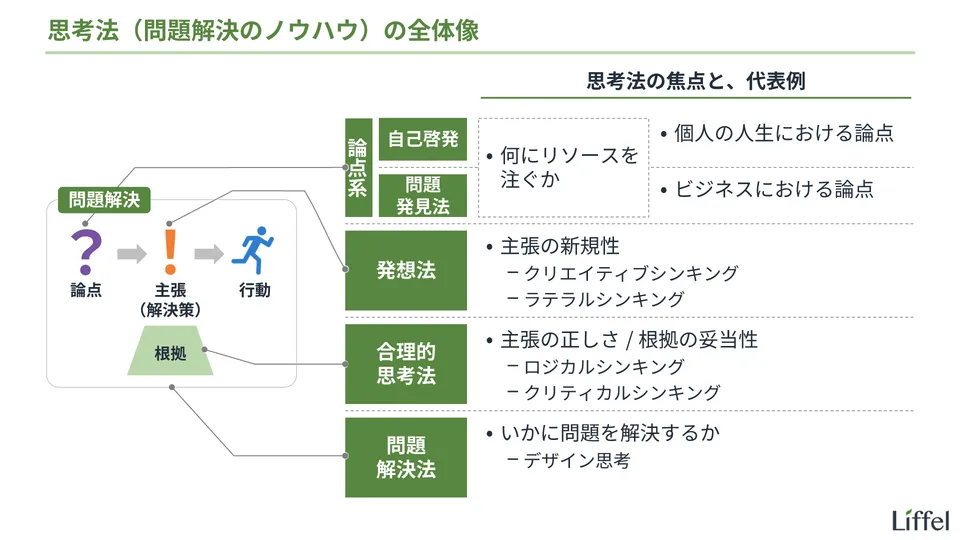
Let’s begin. The slide below gives an overview of ways of thinking.
The left side is a simplified version of the problem-solving process explained earlier. “Premises” have been added below “Claim,” which I’ll explain later.
First, understand that different ways of thinking focus on different parts of problem solving. This site categorizes ways of thinking by where they focus.
Different ways of thinking focus on different parts of problem solving
Let’s look at them one by one.
Type 1: Question-Focused Thinking
First, I’ll call ways of thinking that focus on the problem and the question “question-focused.”
What Is Question-Focused Thinking?
The most important thing in problem solving is not to get wrong the problem you’re trying to solve or the question you’re trying to answer. In other words, aiming for the right goal is everything.
If you actually want to go east, there’s no point in getting somewhere south quickly. Before thinking about how to run or running hard, you need to think carefully about where you want to go, or where you should go.
That’s exactly what question-focused thinking focuses on. This type teaches the attitudes and techniques for identifying what deserves your resources and pouring your resources into it.
Question-focused thinking: ways of thinking that focus on what you should devote your resources to
Question-focused thinking deals with questions like these:
- What should I devote my resources to?
- How can I find it?
- What should I do to focus on what deserves my resources?
Self-Help and Problem Finding
Depending on what they discuss, question-focused ways of thinking split into “self-help” and “problem finding.” Check the difference on the slide below.
In short, self-help asks “what should I devote my resources to in order to be happy in my own life?” while problem finding asks “what should we devote resources to in business?”3
Strictly speaking, it’s not “self-help” as a whole but “one topic within self-help.” Much of what’s called self-help discusses how individuals should allocate their resources. Examples include the following:

As for problem finding, the books I’d cite as examples are Japanese ones (in Japanese), such as Kazunari Uchida’s Ronten Shiko (issue thinking) and Kazuto Ataka’s Issue kara Hajimeyo (start with the issue).
That’s all for question-focused thinking for now. I plan to cover its content and what to watch out for when learning it in a separate entry.
Type 2: Rational Thinking Methods
Next, I’ll skip idea generation for a moment and explain rational thinking methods first (this order makes idea generation easier to understand).
Claims and Premises
First, let me explain what the “premises” on the slide above are. Look at the problem-solving process.
As shown, once the problem is defined (the question is set), you need a solution. In other words, you need to arrive at a statement like “To achieve goal X, do action Y.”
The statement in bold is generally called a “claim.” It’s a claim because it directly answers the question “What should I do to achieve the goal?” You could also call it a “conclusion.”
In other words, what you want in the second step of problem solving is a claim that states a solution. You want to know what to do.
In problem solving, once the question is set, what you want is the claim (the solution)
However, a claim alone doesn’t tell you whether it’s right. That’s the key point.
Since you’re taking the trouble to solve a problem, you’ll want to think carefully about whether the solution you carry out will lead you to the goal.
That’s the job of premises. Premises are the reasons a claim is right. Simply put, if you have proper (valid) premises, you consider the claim right (= the solution you came up with leads to the goal).
What Are Rational Thinking Methods?
Rational thinking methods are ways of thinking that focus on premises. This type teaches what valid premises look like and how to build them.
Rational thinking methods: ways of thinking that focus on whether a claim is right (whether its premises are valid)
Typical rational thinking methods include the following:
- Logical reasoning
- Logical thinking
- Better thought of as different from “logical reasoning” (more on this later)
- Critical thinking
- Scientific thinking
- Rational thinking
Although they go by many names and vary in content, in my view they belong to essentially the same category, because they all deal with how to think about what is right. Or rather, it may be that what should be one thing has been split into pieces.
Needless to say, “what is right” is a major theme for humanity. So this area has a long history of research, and there’s an international consensus on its standard forms (in my view).
In other words, rational thinking methods are the one exception to what I said earlier, that most ways of thinking are personal know-how. Some countries build them into their school curricula, and Japan is debating doing the same.
Explaining more would make this far too long, so I’ll stop here.
Logical Reasoning vs. Logical Thinking in Japan
As an aside, in Japan, two terms that both translate as “logical thinking” refer to different things: ronriteki shiko (the native Japanese term, which I’ll call “logical reasoning” here) and rojikaru shinkingu (the loanword from English). The differences are as follows:
- Logical reasoning (ronriteki shiko): focuses on “logic” in the strict sense (formal logic)
- Teaches how to ensure the validity of inferences within a closed system (assuming the given premises are true)
- Philosophers and logicians prefer this term
- Logical thinking (rojikaru shinkingu): focuses on “considering things exhaustively” and “explaining the whole clearly”
- Concepts such as MECE and logic trees appear
- Rarely focuses on logic itself
In Japan, “XX thinking” is usually interchangeable with its native Japanese equivalent, “XX shiko,” but this pair is the exception.
Type 3: Idea Generation
Next, I’ll call ways of thinking that focus on claims “idea generation.”
Examples of idea generation include the following:

Others include Hiroshi Mori’s and Shigehiko Toyama’s books on how to think (in Japanese). Creative thinking and lateral thinking also fall into this category.
Let’s dig a little deeper.
What Is Idea Generation?
As mentioned, rational thinking methods focus on premises. You could say this is a weakness: what really interests us in problem solving is the claim, yet it isn’t the focus.
Also, rational thinking methods build premises from what can be observed (otherwise, you can’t share what’s right with others). Because of this, some point out that relying on rational thinking methods makes everyone’s claims similar (you can’t come up with claims that differ from other people’s)4.
That suggests another approach: coming up with the claim directly. Instead of approaching the claim from the premises, you go straight for the claim.
In this case, the claims you come up with have no premises behind them, so what you actually produce are “seeds of claims,” that is, what are called ideas, hypotheses, inspirations, or flashes of insight.
That’s exactly what idea generation focuses on. This type teaches how to arrive at new claims and ideas. Whereas rational thinking methods pursue a claim’s rightness, idea generation pursues its novelty (how interesting it is).
Idea generation: ways of thinking that focus on how to arrive at new claims and ideas
Idea generation deals with questions like these:
- How can I come up with interesting (novel) claims and ideas?
- How should I acquire knowledge? How should I handle knowledge?
Idea generation is often simply called “how to come up with ideas.” The word “creativity” is also useful when you search for related content.
Will a Definitive Method for Idea Generation Ever Appear?
As far as I know, no definitive know-how for generating ideas has been found. If it existed, the world would be mass-producing geniuses, and it isn’t. Since idea generation depends on a combination of individual experience, sensibility, and knowledge (it has an artistic side), there seems to be a limit to how far it can be turned into general-purpose know-how.
In other words, there are questions and answers that you’ll be the first to find. Exciting, isn’t it? The fact that idea generation can’t be turned into know-how isn’t bad news but good news.
That said, studying the content listed above isn’t pointless. Personal know-how abounds, and every kind of method has been published. It’s a mixed bag, which makes it a fun genre. Take a look when you have time.
Type 4: Problem-Solving Methods
Finally, I’ll call ways of thinking that focus on problem solving as a whole “problem-solving methods.”
As far as I know, the only example of a problem-solving method is design thinking.
What Are Problem-Solving Methods?
As you can see, this type of thinking focuses on the entire problem-solving process.
Problem-solving methods: ways of thinking that focus on problem solving as a whole
Problem-solving methods deal with this question:
- How can I solve problems effectively and efficiently?
Now, something odd has happened. I defined ways of thinking as know-how for problem solving, yet at the end, a way of thinking that covers all of problem solving has appeared. You might think I should have just called them “problem-solving methods” from the start instead of “ways of thinking.”
Why did this happen?
Simply put, because design thinking became popular. That forced me to broaden the definition of ways of thinking.
Let me explain step by step.
Design Thinking and What Makes It Unusual
First, most ways of thinking focus only on the first two steps of problem solving, that is, on thinking.
The three types explained so far all dealt with the thinking part (the first two steps). If these were the only ways of thinking, defining them as “ways to think” would have been fine.
But in the late 2010s, a way of thinking called “design thinking,” which clearly extends to action, became popular.
Roughly speaking, design thinking carries out the “three steps of problem solving” on the slide above through the following five steps (look it up if you want details):
- Empathize
- Define the problem
- Ideate
- Prototype
- Test
Prototyping and testing are clearly actions. In other words, design thinking packages know-how that includes action as a “way of thinking.”
As I understand it, what’s called design thinking is really “a designer’s approach to problem solving,” and it shouldn’t be labeled a “way of thinking” at all.
Don’t get me wrong. Design thinking’s concepts of “thinking while acting” and “action (trial) generates the next thought” are innovative and not to be dismissed. In fact, although the buzz around the term “design thinking” is over, you could even say its concepts have taken root. All I’m pointing out here is that the name may have been misleading.
Even so, it would be unreasonable today not to count design thinking as a way of thinking. Given this background, this site has broadened the very definition of ways of thinking to one that includes design thinking.
Incidentally, although design thinking is, as far as I know, the only problem-solving method packaged as a way of thinking, there are many problem-solving methods besides my three steps. Since I like simplicity, I kept it to three, but some people break the process down further. If you’re interested, look around.
About Know-How for Action
Some of you may be thinking, “The last step is missing. Isn’t there know-how for action?” So let me add a note on that.
To start with the conclusion: of course, know-how for action exists. It’s know-how for seeing a particular action through or making it a habit. If I had to name it, I’d call it “action methods.”
However, for the following reasons, I haven’t included action methods as a type of way of thinking (know-how for problem solving) as defined on this site:
- It’s a stretch to call content focused on action a “way of thinking”
- Since action can be observed, this field is discussed scientifically based on data rather than as know-how
This area is generally the subject of behavioral economics and psychology. The words “willpower” and “habit formation” come up often, so use them when searching for content.
In areas such as studying for entrance exams or dieting, where the right actions are mostly known and quantity ultimately beats quality (or quality can’t improve without quantity), action methods are more useful than ways of thinking5. They’re worth learning the basics of6.
That covers what ways of thinking are and their broad categories. Dig deeper into the ones that interest you.
Next, let’s return to critical thinking and consider its drawbacks.

Entries related to critical thinking are collected on the page below. Feel free to use them as a reference.
Footnotes
-
If you ever teach ways of thinking yourself, watch out for trademark issues with these names. ↩
-
However, this only applies to content that offers general-purpose (meta-level) know-how for problem solving. For example, “how to design slides” is also problem-solving know-how in a sense (in fact, since business is problem solving, every business book contains problem-solving know-how). But its subject is too specific and limited, so this site doesn’t treat it as a way of thinking. ↩
-
Most problem-finding content, including the books introduced in this entry, doesn’t deal with the top-level questions of a business (questions influenced by values, such as vision or investment decisions). It mainly deals with root-cause analysis within a given business model. That’s why the arrow on the slide starts a little lower. ↩
-
I don’t agree with this point, though. To arrive at claims that differ from other people’s, you just need to observe things that differ from what other people observe. Although the claim that relying on logic impoverishes your ideas seems valid at first glance, I don’t think the facts bear it out. ↩
-
That said, rather than acting blindly, you should look up the right actions first. ↩
-
I used to recommend Willpower: Rediscovering the Greatest Human Strength here as a reference on willpower. However, the reproducibility of the research it introduces has since been called into question, so I no longer link to it. Note that “the research can’t be reproduced” doesn’t mean “the content is wrong,” so don’t misunderstand. ↩