This entry explains the process of question setting.
Question setting is the starting point of rational thinking (or decision-making) and its most important process. It is no exaggeration to say that this is where everything is decided, so make sure you understand it well.
Let’s begin.
toc
- What Is Question Setting?
- The Process of Question Setting: Overview
- Question Setting Process #1: Identify Questions
- Question Setting Process #2: Evaluate Questions
- Question Setting Process #3: Refine Questions
What Is Question Setting?
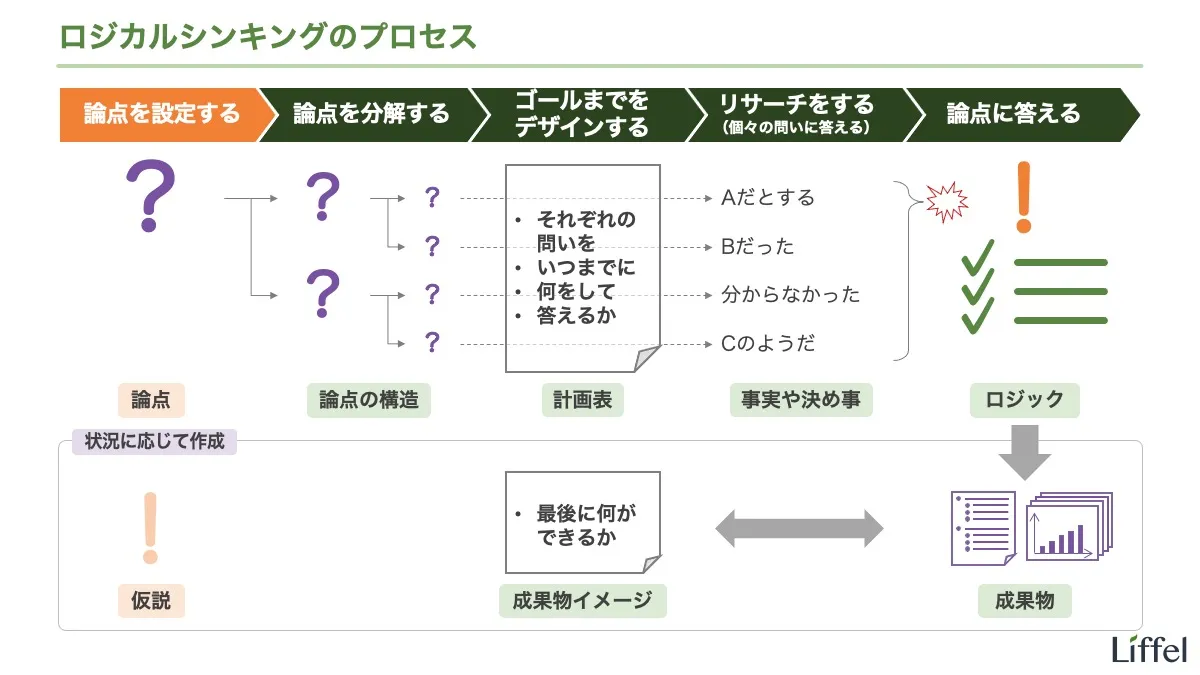
Question setting is the first process in rational thinking.
Question setting means deciding on a single question that you want to think about. You cannot do rational thinking when what you are thinking about is unclear. rational thinking begins by narrowing down to one question.
The following links explain this in more detail.


The Deliverable and the Goal of Question Setting
The deliverable of this process is, naturally, the question. Once you have identified a single question that you feel ready to commit to thinking about seriously, this process is complete.
The deliverable of question setting: the question
If the deliverable is the question, what kind of question should we aim to choose? In other words, what kind of question would we need to choose to say “question setting was successful?”
For now, let us say it is “choosing the right question.” The objection “What exactly do you mean by ‘the right question’?” is perfectly fair, but we will come back to that later.
The goal of question setting: choosing the right question
Question Setting and Logical Thinking (in the Narrow Sense)
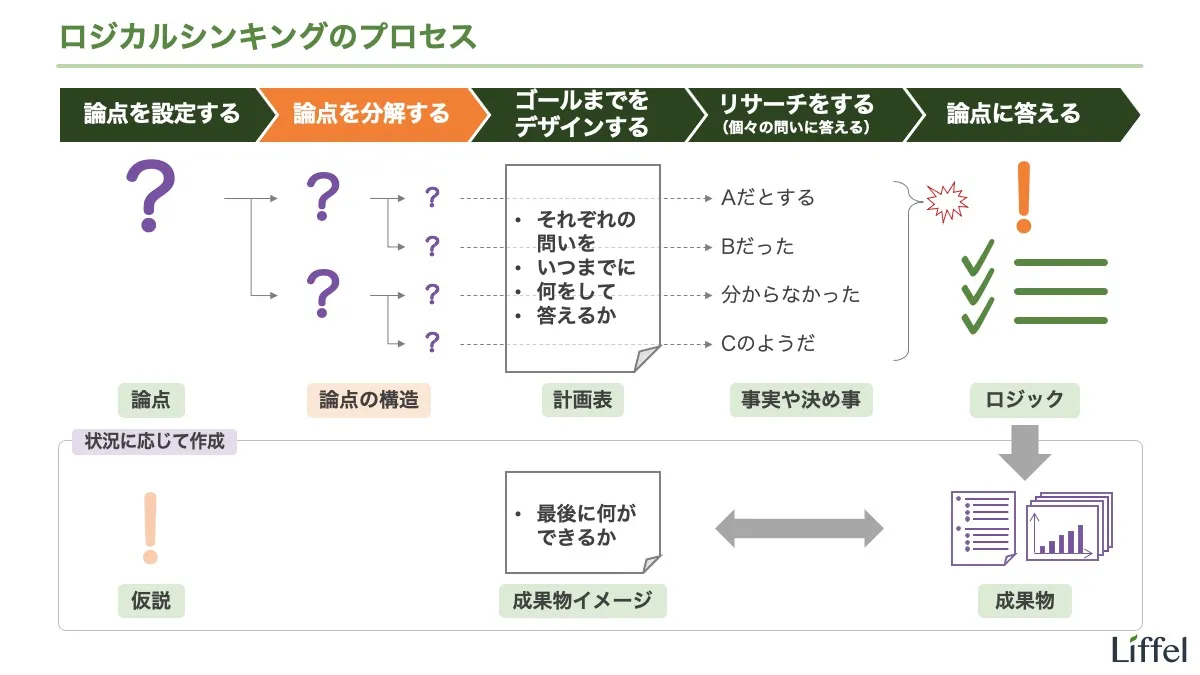
Question setting is sometimes treated as a separate skill from rational thinking, so let me add a note on this point. Take a look at the following slide.
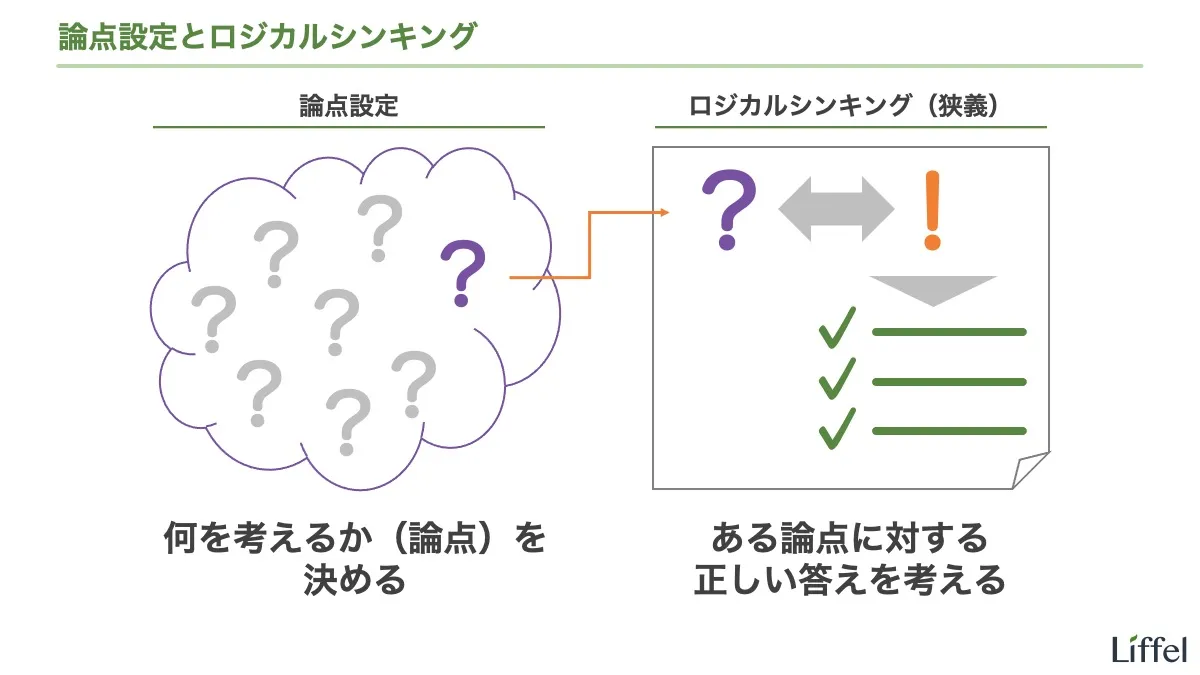
As the slide shows, rational thinking in the narrow sense is the skill of arriving at the right answer to a given question. Setting the right question does not fall within its scope.
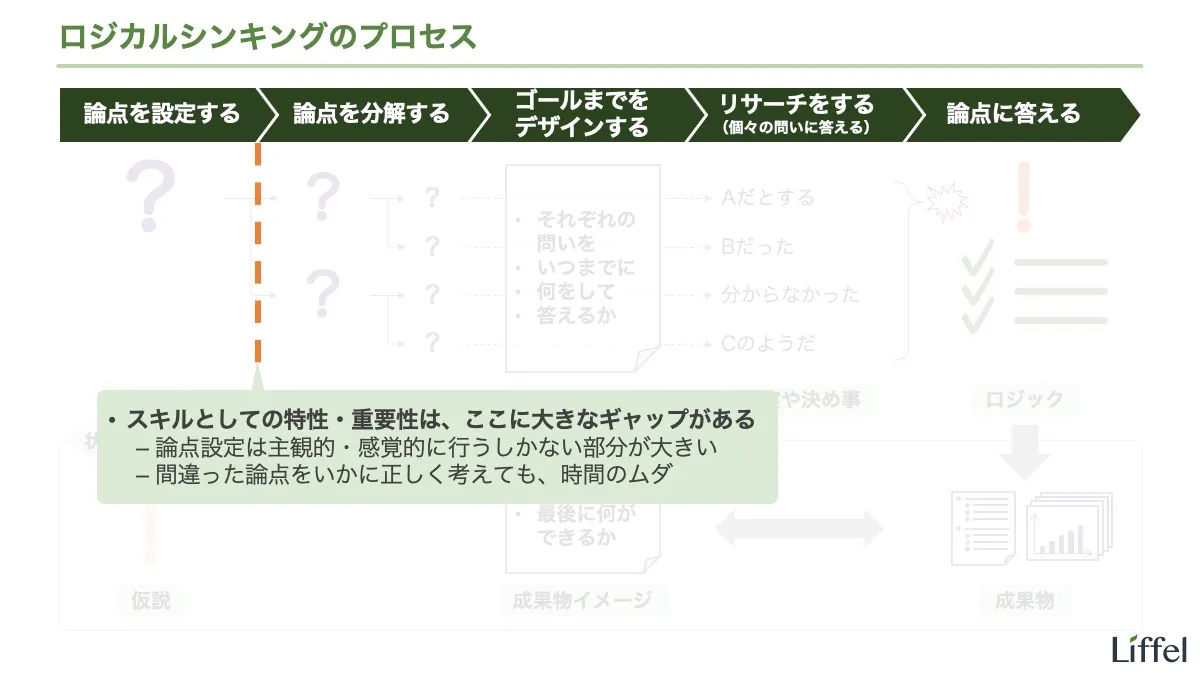
The reason is likely that question setting relies heavily on subjective and intuitive judgment (more on this later). In short, question setting is difficult to reduce to a systematic method. In fact, this site previously took the position that question setting was not part of rational thinking.
Today, however, we include question setting as the first process of rational thinking. This is because any process-based explanation of rational thinking inevitably needs to include it, and because there is the blunt truth that there is no point in thinking through the wrong question rationally.
This may not fully make sense yet, but it will once you have studied question setting. For now, just keep in mind that in terms of both its nature as a skill and its importance, question setting stands apart from all the processes that follow.
The Process of Question Setting: Overview
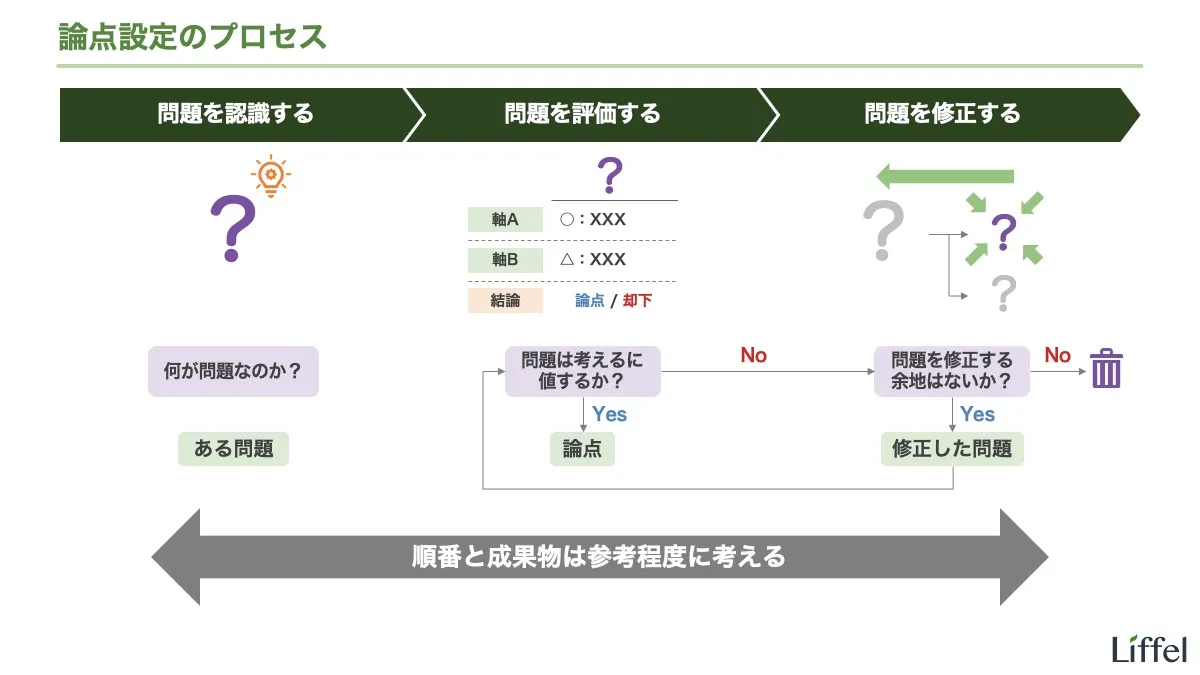
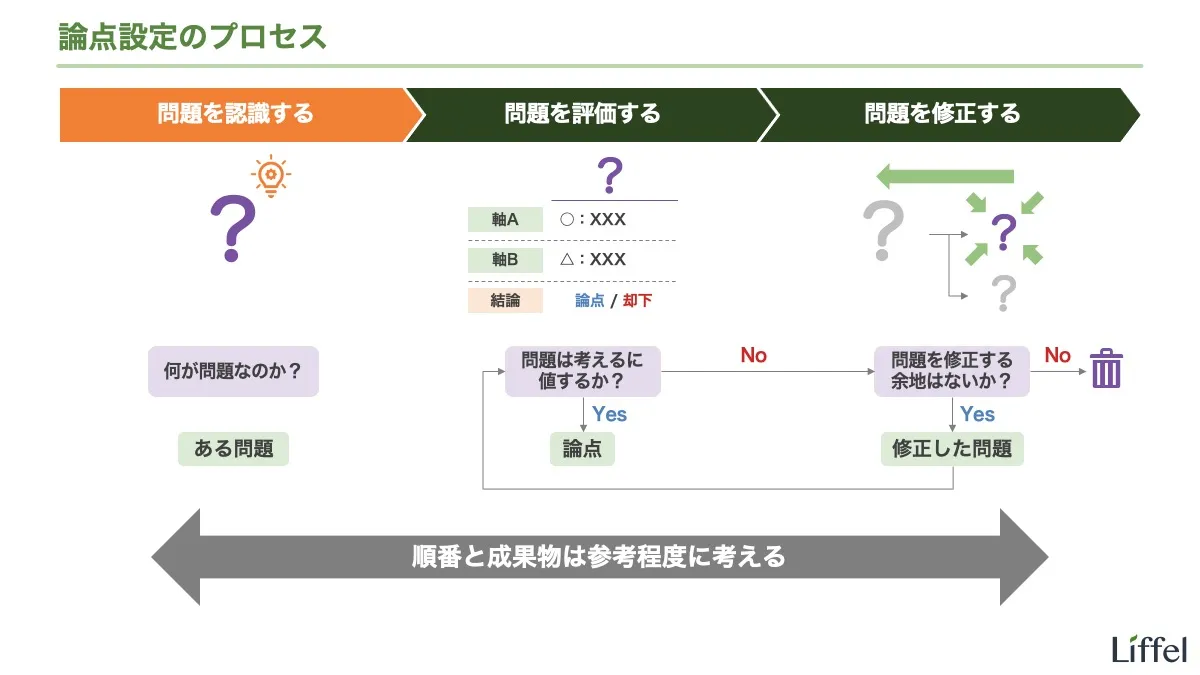
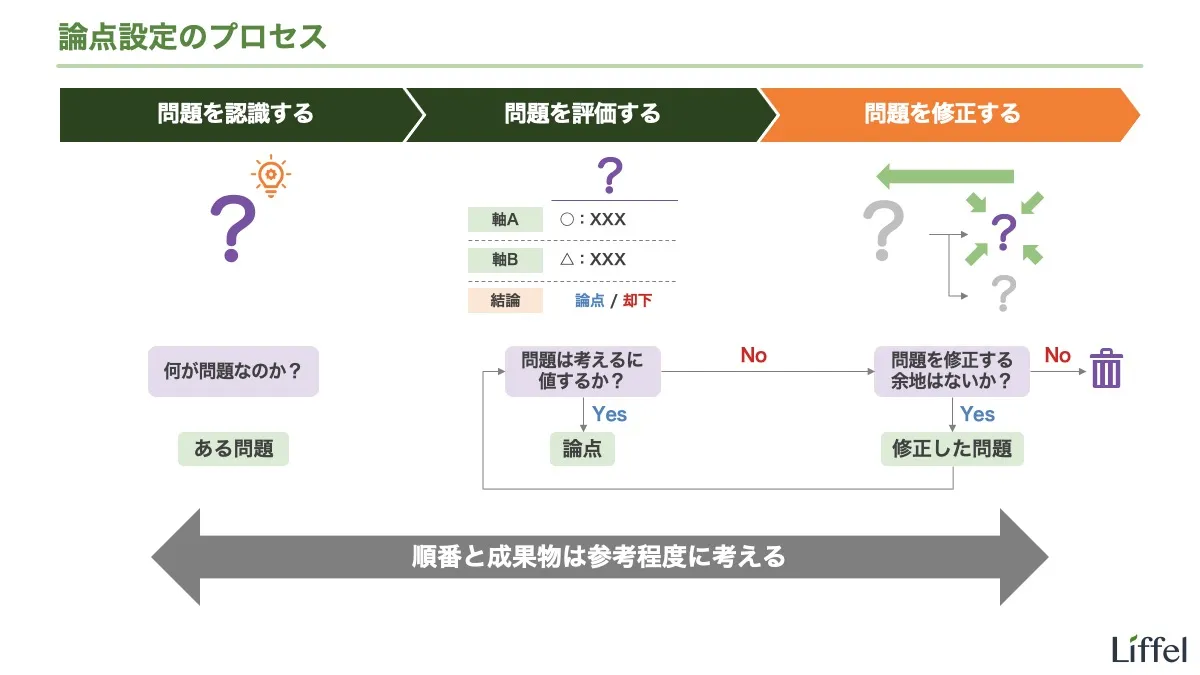
Let us get to the main topic. How do you set the question? Take a look at the following slide.
The process of question setting proceeds in the following order:
- Identify questions
- Evaluate questions
- Refine questions
Note that, as shown at the bottom of the slide, the process does not always proceed in this exact order in practice. It is normal for multiple processes to occur simultaneously or in a different sequence. The order is only for the purpose of explanation, so do not worry about it.
Questions and “the Question”
From this point on, I will be using two terms frequently — “question” and “the question” — so let me clarify their meanings here to avoid confusion.
A question is simply an interrogative sentence. Nothing more.
Question: an interrogative sentence
The question, on the other hand, is the one question you are trying to answer. This has already been explained, so it should be clear.
The question: the one question you are trying to answer
Put simply, the question is the single question selected from among all the questions you are aware of — the one you have decided is worth solving.
Now, let us look at each process in order.
Question Setting Process #1: Identify Questions
The first step is to identify questions. This means becoming aware of a question — noticing that a particular question exists.
In principle, a question you have not identified might as well not exist. A question that has not been identified can never become the question.
Identifying questions is where everything begins. This is the very first process in the act of thinking.
What Does It Mean to Identify a Question?
Let us look at a specific example. This is probably the most famous episode in the world when it comes to identifying a question.

(thud)

The apple falls, so why does the moon not fall?
As the story goes, Newton saw an apple fall from a tree and asked: “The apple falls, so why does the moon not fall?” Talk about brilliance. As you know, this insight led to the discovery of universal gravitation.
Of course, the reason Newton made history is that he set this question as the question and answered it correctly, not simply that he thought of it. Still, if he had never thought of the question, it would never have been answered. Everything began with identifying that question.
Incidentally, this episode appears to be a story invented to highlight Newton’s genius. Even so, it is a remarkably well-crafted illustration of the importance of identifying questions.
Routes to Identifying Questions
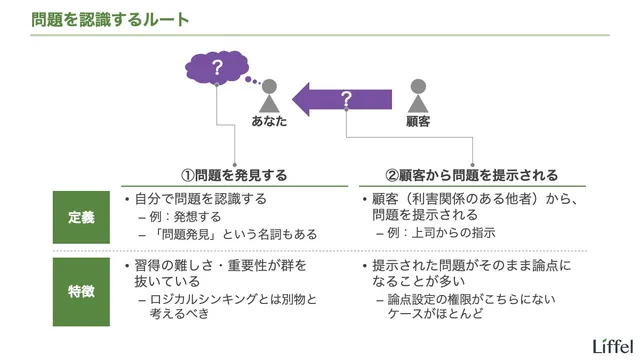
There are broadly two routes to identifying a question:
- Discover a question yourself
- Receive a question from a client
The key point here is that the question you end up thinking about is not necessarily one you yourself identified. This is important.
The question you end up thinking about is not necessarily one you yourself identified.
Looking at Newton’s example, you might get the impression that identifying questions is a privilege reserved for geniuses. However, Newton’s example represents the extreme end of just one method — “generating ideas” — within route 1 (discovering questions yourself). Not everyone is expected to identify questions that way.
When doing rational thinking in school or business, you will more often identify questions through route 2: receiving them from a client.
By “client” here, I mean someone who has a stake in your work. The most obvious examples are a teacher at school or a boss at work. These are people who assign you something to think about. This, too, is a route to identifying a question.
There are many other routes and methods for identifying questions, but let us leave it here for now and move on. The details will be covered in the next entry.
The Deliverable of This Process
The deliverable of this process is, if anything, a list of candidate questions. You compile this list here, then evaluate each question in the next process and decide which one to make the question.
In practice, however, this will probably take the form of idea notes or a notebook of raw thoughts. Your mind does not always neatly identify questions in isolation; the following often happen all at once:
- Identifying a question
- Evaluating the question (at an unconscious level)
- The later process is about doing this evaluation consciously
- Coming up with a tentative answer (hypotheses and ideas) to the question
My current approach is to put anything that comes to mind into a note-taking app. Find whatever approach works best for you.
This applies to the later processes as well: since question setting does not follow a neat, logical sequence, there is no need to worry about intermediate deliverables. Although I will mention the deliverable for each process going forward, treat these as rough guides.
Question Setting Process #2: Evaluate Questions
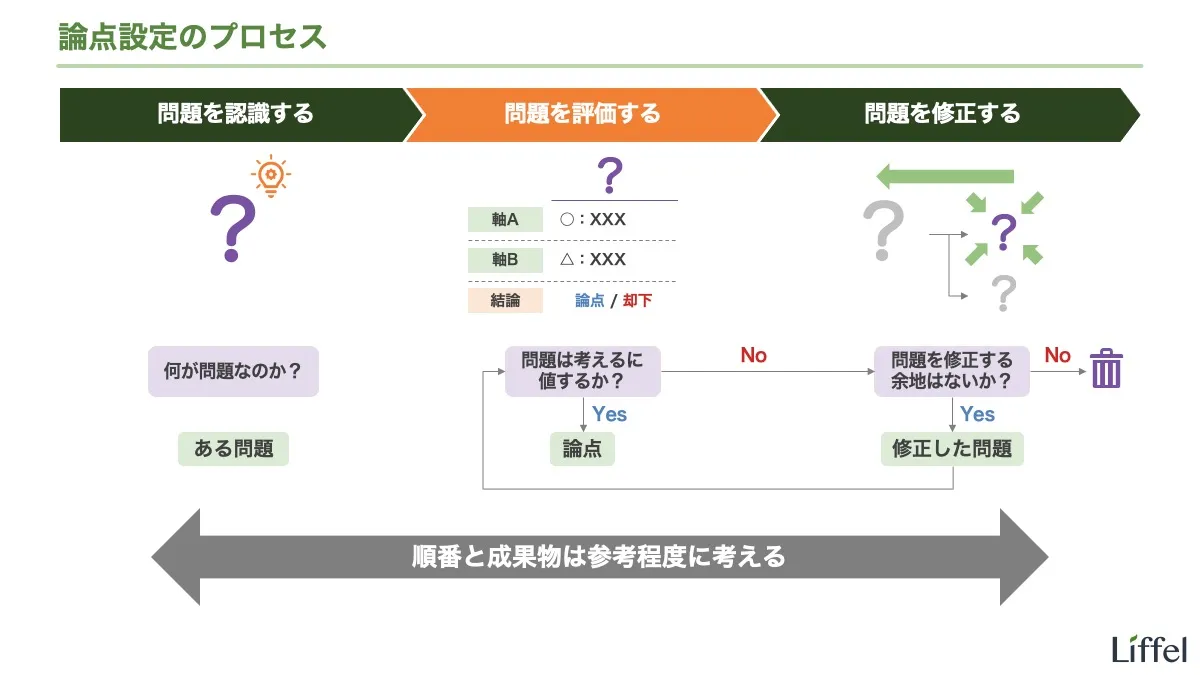
Once you have identified questions, the next step is to evaluate them. You examine whether a question is worth thinking about — that is, whether it deserves to become the question.
Naturally, it is impossible to think about every question you have identified. You do not have the resources for that. You need to narrow down to only the questions that are worth thinking about.
Incidentally, you are already evaluating questions and discarding the ones not worth thinking about. Nobody spends time endlessly thinking about things they have no interest in or do not care about. That, too, is a form of evaluating questions (at an unconscious level).
Here, we do it consciously. You sift through the questions you have identified and select those worth thinking about.
What Does It Mean to Evaluate a Question?
What, specifically, does evaluating a question involve?
This is easier to understand by doing it. For example, consider the following question:
- What should the Japanese government do to halt the declining birthrate?
Evaluating a question means examining whether this question is worth thinking about. Before reading on, try it for yourself: is this question worth thinking about? Think of a yes-or-no answer along with your reasons.
Is the question “What should the Japanese government do to halt the declining birthrate?” worth thinking about? State your opinion.
Use the answer field below to write your response.
Evaluation Criteria
So, which way did you go? As I will explain later, evaluating questions can only be done subjectively, so whichever you chose is a valid answer.
That said, you may have found it surprisingly difficult to articulate your reasons. If you have never consciously evaluated a question before, you may not know what perspectives to bring to the evaluation.
Here are the main evaluation criteria for evaluating questions:
- Importance: Is this question important to you?
- Urgency: Do you need an answer right now?
- Solvability (existence): Is the question likely to have an answer?
- Solvability (personal): Are you likely to be able to reach an answer?
- Feasibility: Can you implement the solution you come up with and change the current situation? (Only for action questions)
- Competition: How many other people are pursuing the same question?
Your evaluation of a question is determined by these criteria and your values — that is, which criteria you prioritize.
For example, the answer “This question is worth thinking about because the declining birthrate is an important issue for Japan” evaluates the question by prioritizing importance.
On the other hand, the answer “There is no point in thinking about this question. Since I am not a powerful politician, whatever answer I come up with will never be implemented. Thinking about it is a waste of time” is also valid. In this case, the evaluation prioritizes feasibility.
In this way, your final evaluation is determined by your values. This is what it means to say that “evaluating questions can only be done subjectively.”
What Is “the Right” Question?
At this point, you can start to see what “the right” question means.
As explained at the beginning, the goal of question setting is “choosing the right question.” This means you need to evaluate questions so that you can select the “right” one from among many.
As noted, however, evaluating questions depends on your values. This means we cannot say anything more than “the right question is the one most worth thinking about for you.”
The right question: the one most worth thinking about for you
Admittedly, this is just restating what “right” means, which is not very helpful. “Rightness is a relative concept determined by one’s values” is hardly a fresh insight — there is no need to deliver it like a revelation.
If you want to improve your ability to choose the right question, you need to understand the evaluation criteria listed above and examine whether the weight you assign to each is appropriate — in other words, whether your values are sound. You need to take a stance on rightness. This is a delicate matter, but we will tackle it in a separate entry.
The Deliverable of This Process
The deliverable of this process depends on the outcome of your evaluation.
If the evaluation concludes that “this question is worth thinking about,” then you have your question. The deliverable is the question. In this case, there is no need to move on to the “refine questions” process. Proceed to the next process in rational thinking as a whole: breaking down the question.
If the evaluation concludes that “this question is not worth thinking about,” then it does not become the question. There is no deliverable as such. If anything, the deliverable is the conviction that you should not be spending time on this question right now.
Even in this case, however, you do not immediately discard the question. As we will see, refining a question can change how it is evaluated. With that, let us move on to the final process.
Question Setting Process #3: Refine Questions
Even when your evaluation concludes that “this question should not become the question,” you may still refine it depending on the situation. This means exploring whether you can reshape the question into something worth thinking about while staying within the same area of interest1.
When to Refine a Question
There are broadly two situations that call for refining a question, each with its own approach:
- The question is too vague to evaluate → Make the question more specific
- The question is clearly important, but there is no path to solvability or feasibility → Reframe the (aでは?)question
I will explain each in turn, though I will not go into depth in this entry.
Refining Pattern #1: Make the Question More Specific
Making a question more specific means exactly what it sounds like: expressing the question in enough detail that it can withstand evaluation.
Questions born from a vague sense of concern are sometimes too ambiguous to tell what you actually want to think about. Such questions cannot be evaluated as they are, so you make them more specific.
Let us look at an example. Suppose you identified the following question:
- What should we do to make Japan a better country?
This question cannot be evaluated as it stands. The phrase “make it a better country” is too vague to determine what you actually want to think about. There is no clear subject, either. In short, this wording does not pin down a single thing to think about.
So let us try making it more specific. Here are three versions:
- What should the Japanese government do so that Japan can continue to build friendly relations with other countries?
- What should we do as individuals so that Japan can continue to achieve economic growth?
- What should the Japanese government do to halt the declining birthrate?
Each of these is more specific than “What should we do to make Japan a better country?” There are still ambiguous parts (for example, “economic growth” could be made even more specific), but we will get to that as we go.
Restating a question until there is no room for misinterpretation — that is what it means to make a question more specific.
Refining Pattern #2: Reframe the Question
Reframing a question means redefining it into a form that has solvability or feasibility.
This is harder than making a question more specific, so let us start with an example. Recall the practice question from earlier:
- What should the Japanese government do to halt the declining birthrate?
Suppose you evaluated this question as “not worth thinking about because the feasibility is zero” (a subjective judgment).
Now suppose that you have a deep personal concern about the declining birthrate and are reluctant to simply drop it from your list of interests.
This is the kind of situation where reframing a question can be meaningful.
Although this is not something I can assert uniformly because values are involved, as a general rule, you should not make a question with no solvability or feasibility into the question. Thinking about a question whose answer will change nothing amounts to self-indulgence2.
However, there are cases where a question that appears to have zero solvability or feasibility is genuinely important to you. When the question clearly matters, you should not discard it outright. Instead, you put effort into reshaping it into a form that can serve as the question. That is what it means to “reframe the question.”
Let us try reframing the question:
- How is Japan’s declining birthrate likely to change in the future? Given that forecast, what should I start doing now?
With this reframing, the problem of “zero feasibility” from the earlier version is resolved. You take a broader view and project how the birthrate will change, then focus your actions on what you personally can do. Feasibility is now within reach.
Here, we reframed the question using the technique of shifting your perspective. Another technique, elevating your vantage point, can also be used to reframe questions. We will explore these in due course.
The Deliverable of This Process
The deliverable of this process is the refined question. In theory, you would evaluate the refined question again. In practice, however, by the time you feel that “the refinement worked,” the evaluation is already done. There is no need to overthink it.
That concludes the explanation of the question-setting process. Starting next time, we will look at each process in depth. We begin with identifying questions.
Entries related to rational thinking are collected on the following page. Please refer to it as well.