In this entry, you’ll learn how claims and premises relate (the structure of an argument). Make sure you understand what an argument is and how its components, the claim and the premises, relate to each other.
Let’s begin.
toc
What Is an Argument?
First, let’s review what “argument” means. As the slide above shows, an argument is a claim and its premises. You could also call it “the complete answer to the question.”
Argument: a claim and its premises (the complete answer to the question)
The slide above is explained in detail at the link below. If what I’ve said so far doesn’t click, or if you have trouble with the next exercise, read it before going further.


Exercise
Let’s check what you’ve learned with an exercise.
In the conversation below, identify the question, the argument, the claim, and the premises.

Should I buy a house or rent one?

I think you should rent.
There are three reasons.
First, buying property in Japan right now means you’re likely overpaying. Japan’s population will keep declining, so there will only be more and more surplus housing. From a renter’s point of view, that means rents are likely to fall. Wouldn’t it make more sense to keep switching rentals to match market rents?
Second, flexibility to move. You’re still young, and you haven’t decided to live in this town forever, right? Then renting makes it easier to move if something comes up.
Third… (omitted)
Try writing your answer in the box below.
- Question: what Bear is asking (= Should I buy a house or rent one?)
- Argument: everything Panda says
- Claim: “I think you should rent.”
- Premises: everything from “There are three reasons” onward
The Structure of an Argument
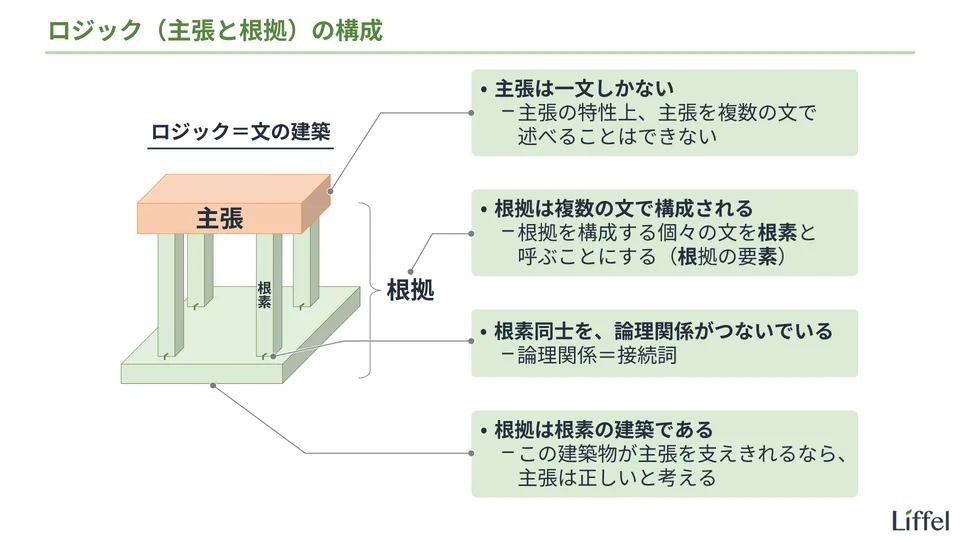
Now that we’re ready, let’s dig into the structure of an argument (= how claims and premises relate). The slide below summarizes it.
Here are the key points:
- A claim is usually a single statement
- Premises, on the other hand, consist of multiple statements
- I’ll call each individual statement that makes up the premises a “premise element”
- Premise elements are connected by logical relationships, forming the premises as a whole
- If the premises as a whole can bear the weight of the claim, the claim is right (= the premises are valid)
Let me explain each one.
The Volume of a Claim and Premises
The first point to understand is that premises consist of more sentences than the claim does. Put simply, the premises are longer than the claim.
Let’s confirm this with the exercise above.
I think you should rent.
There are three reasons.
First, buying property in Japan right now means you’re likely overpaying. Japan’s population will keep declining, so there will only be more and more surplus housing. From a renter’s point of view, that means rents are likely to fall. Wouldn’t it make more sense to keep switching rentals to match market rents?
Second, flexibility to move. You’re still young, and you haven’t decided to live in this town forever, right? Then renting makes it easier to move if something comes up.
Third… (omitted)
In this example, the claim is just a single sentence: “I think you should rent.” This is typical.
In general, among the many sentences that make up an argument, there’s only one claim. Although cases involving conditional branching mean I can’t say it’s always true, a claim almost never spans multiple sentences.
Normally, an argument contains only one sentence as the claim
The reason is simple: that’s how we defined “claim.” As the slide below shows, a claim is “a direct answer to the question.” It makes no sense to give multiple direct answers.
In fact, depending on the type of question, the form that a claim can take is already determined. See the table below.
This table is explained in detail at the link below.

Let’s move on. While a claim is a single sentence, premises consist of multiple sentences. For an argument on a difficult question, it’s perfectly normal for the premises to run to hundreds of sentences. Supporting a claim on a difficult question simply requires stating that many things as premises.
In other words, the vast majority of an argument consists of premises. A single sentence serving as the claim, with a large body of sentences serving as premises attached to it: this is the typical structure of an argument.
The vast majority of an argument consists of premises
Premise Elements
Now let’s introduce the term “premise element.” A premise element is each individual sentence that makes up the premises. Since I’ve coined this term only to make the structure of an argument easier to understand, don’t use it elsewhere.
Premise element: each individual sentence that makes up the premises
Let’s check with the earlier argument.
I think you should rent.
There are three reasons.
First, buying property in Japan right now means you’re likely overpaying. Japan’s population will keep declining, so there will only be more and more surplus housing. From a renter’s point of view, that means rents are likely to fall. Wouldn’t it make more sense to keep switching rentals to match market rents?
Second, flexibility to move. You’re still young, and you haven’t decided to live in this town forever, right? Then renting makes it easier to move if something comes up.
Third… (omitted)
As mentioned, everything from “There are three reasons” onward is the premises. Since premise elements are the individual sentences that make up the premises, each of the following is a premise element:
- There are three reasons.
- First, buying property in Japan right now means you’re likely overpaying.
- Japan’s population will keep declining, so there will only be more and more surplus housing.
- (omitted)
Having the term “premise element” gives you a clearer picture of premises.
As mentioned, premises consist of many sentences. In other words, multiple premise elements are assembled into the premises as a whole, which support the claim. Get a picture of it from the slide shown earlier.
In this way, an argument is a building made of sentences. The roof at the top, the claim, is held up by a foundation (the premises) assembled from premise elements.
Logical Relationships
Let’s move on. In a building, you need something to join the materials together. For example, you use nails or glue to join pieces of wood.
In the same way, sentences need to be joined by something. So what’s the glue that joins sentences together?
The answer is logical relationships. As a rough picture, you can think of them as conjunctions and transition words. Logical relationships (conjunctions) work as the glue between sentences.
Logical relationship: the connection between sentences (conjunctions and transitions)
The easiest logical relationship to see is the one between a claim and its premises. From the claim’s side, the premises are connected by “because,” and from the premises’ side, the claim is connected by “therefore.” Since this relationship comes from the very definition of “premises,” it never changes.
Within the premises, a wider variety of logical relationships appear. Typical ones include:
- As a premise
- First, second, third…
- Furthermore / In addition
- Note that / Incidentally
Using this glue, you can join scattered premise elements and assemble them into a single body of premises.
Let’s check this with the earlier example.
I think you should rent.
There are three reasons.
First, buying property in Japan right now means you’re likely overpaying. Japan’s population will keep declining, so there will only be more and more surplus housing. From a renter’s point of view, that means rents are likely to fall. Wouldn’t it make more sense to keep switching rentals to match market rents?
Second, flexibility to move. You’re still young, and you haven’t decided to live in this town forever, right? Then renting makes it easier to move if something comes up.
Third… (omitted)
Here, Panda is trying to support the claim “you should rent” with three pillars. That’s clear from the declaration “There are three reasons” at the start of the premises. After that, Panda also uses “First,” “Second,” and “Third” to sort the premises into three blocks. Here’s the slide again so you can match up the picture (the slide has one more pillar).
In this way, thinking of an argument as a building made of sentences makes the relationship between claims and premises easier to understand.
What Are “Valid” Premises?
Now that you have a three-dimensional picture of an argument, let’s finish by thinking about what it means for premises to be valid (= for the premises to be able to support the claim’s rightness).
Of the claim and the premises, critical thinking examines the premises. Although what we ultimately care about is whether the claim is right, critical thinking tries to decide that by evaluating the premises. For more on this, see the link below.
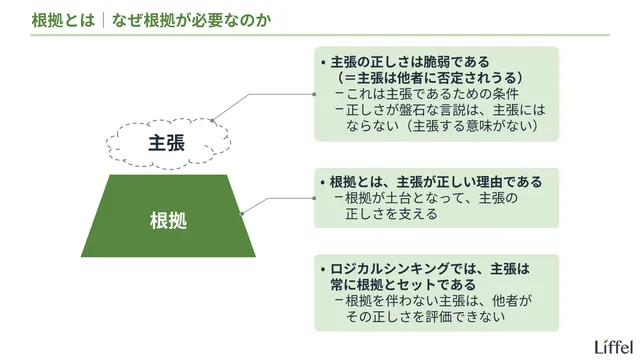
From here on, I’ll call premises that get a claim accepted as “right” “valid premises.”
Valid premises: premises that get a claim accepted as “right”
So what kind of premises are valid? The picture above helps here.
To give the conclusion, “the premises are valid” means that the assembled premises (the foundation) can hold up the claim (the roof). If the roof is stable, the claim is right. If the foundation collapses and the roof falls, the claim is wrong.
Seen this way, it’s easier to picture when premises lose their validity.
First, if individual premise elements aren’t strong enough, the premises collapse from there. For example, if a pillar is rotten, it can’t hold up the roof.
The “strength of premise elements” corresponds to the objectivity and universality of the premises. I’ll explain these in later entries, but in short, things that are just your own assumptions or things that happened by chance don’t make valid premises. Such premises can’t withstand criticism like “Isn’t that just your assumption?” or “Didn’t that just happen by chance?”
Also, even if each premise element is strong enough, if the premise elements are put together wrongly, they can’t support the claim. For example, if one of the pillars on the slide above were missing, the structure would be unbalanced and couldn’t hold up the claim. If you want to support the roof with three pillars, you need to move them.
“How premise elements are put together” corresponds to the exhaustiveness of the premises. I’ll explain this in later entries too, but in short, any gaps in the argument make the premises collapse from there. You need to think about where to place the pillars and what glue (logical relationships) to assemble them with.
To sum up, to build valid premises, you need to understand two things:
- What premise elements to prepare
- How to assemble them
Once you can concretely understand and practice what I’ve described here in pictures, you’ll be able to build solid arguments too. Let’s learn that from here on.
That covers the structure of an argument. Next time, let’s review everything so far.

Entries related to critical thinking are collected on the page below. Feel free to use them as a reference.