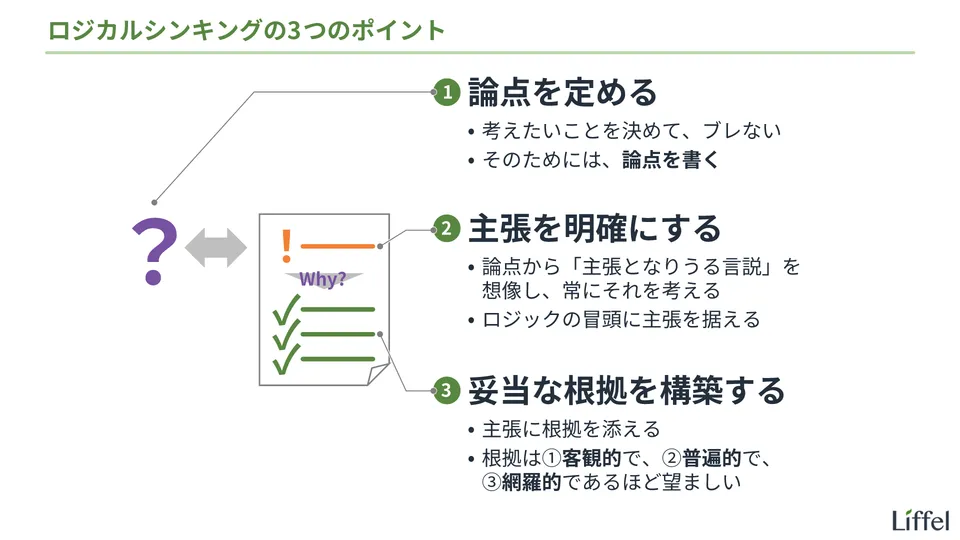
This entry explains the three key points of critical thinking. Since these three are the very basics of critical thinking, please bear with me even though this entry is a bit long.
If you get lost along the way, read the entries in order starting from the page below.

Let’s begin.
toc
- Summary
- Key Point 1: Set the Question
- Key Point 2: Make the Claim Clear
- Key Point 3: Build Valid Premises
- Summary
- If You Want to Keep Learning
Summary
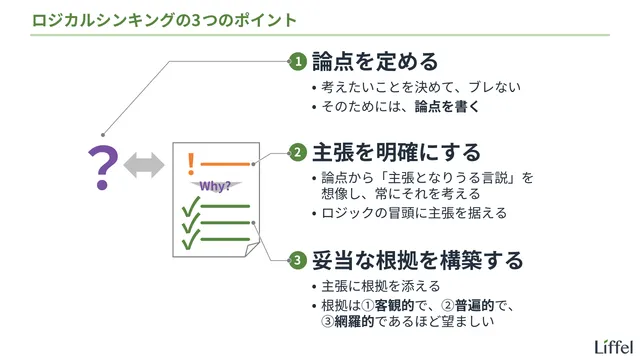
First, take a look at the slide below. It summarizes the key points of critical thinking.
As the slide shows, there are three key points:
- Set the question
- Make the claim clear
- Build valid premises
Let’s look at them one by one.
Key Point 1: Set the Question
The first key point of critical thinking is to set the question. Although it’s the most important point, many people overlook it. Make sure you understand it well.
What Is the Question?
First, let’s review what the question is.
The question: the question you’re trying to answer
As shown, the question is the question you’re trying to answer. In short, think of it as “the question you want to think about right now.”
I explain the question in detail in another entry. If you’re unsure about it, read the entry below before going further.

Why Set the Question?
Why does critical thinking require setting the question?
The answer is simple: unless you set the question, you can’t answer it.
Let me explain step by step.
Where Does the Value Lie?
As a basic premise, understand that the value lies not in thinking about the question but in answering it.
The value lies not in thinking about the question but in answering it
Anyone can think about a question. For example, try thinking about the question “How did the universe begin?” You may not have come up with anything, but at least you could rack your brains and search for an answer. In this way, anyone can think as long as they’re given a question.
And since anyone can do it, it has no value.
What creates value is answering the question, that is, presenting an argument. And an argument needs at least a claim. In other words, to create value, you need to present at least a claim. In the example above, value is created only when you can claim, “The universe began like this, for such and such reasons,” in answer to “How did the universe begin?”
Of course, to truly create value, the claim has to be right. But let’s leave that for later. What I want you to understand here is that thinking isn’t enough. You have to present the result of your thinking (an argument, or at least a claim).
Since this is important, let me put it another way.
Thinking is almost never a goal in itself.
If you’re thinking alone, your goal should be to find an answer and “change how you act” or “satisfy your intellectual curiosity.” Surely it’s not to “keep searching for an answer forever.”
That’s even more true when you think with others. The goal of a meeting or discussion is to “agree” or “decide,” not to “think.”
What You Need, at Minimum, to Create Value
So you can’t stop at thinking. You have to present a claim.
And if the question keeps changing, we can’t reach a claim.
The question is one that can’t be answered easily. Yet if it changes often, your resources get scattered, and you can’t come up with a claim on any question.
In other words, unless you focus your resources on one question, you can’t answer it. That’s why you set the question.
Setting the Question Is Hard
You may be thinking, “Of course you shouldn’t keep changing the question. What are you talking about?” But unless you pay attention, the question will change.
For example, you’ve probably had the experience of looking something up online and finding yourself, before you knew it, on a completely unrelated page. I’ve had it more times than I can count. Just now, I was supposed to be researching artificial intelligence, and before I knew it, I was digging into the history of shogi title matches.
A more familiar example is everyday conversation. When you’re chatting with friends at a diner or a bar, the question (topic) never stays put. One topic leads to the next, and nobody finds that strange. When we’re relaxed, no single question is ever maintained.
Those were examples of the question changing. A worse case is not understanding the question in the first place. The very person trying to think about something doesn’t understand the question.
This is especially common in business when a subordinate works on a question assigned by their manager. Because of problems with the manager’s communication or the subordinate’s understanding, the work starts without the subordinate understanding the question.
Of course, since you can’t think without understanding the question, what actually happens is that “they’re supposed to be thinking, but in fact they aren’t thinking about anything (or they’re thinking about the wrong question).”
In this way, the question tends to change or get lost.
How to Set the Question
So how can you set the question?
The answer is simple: write the question down.
That’s all. Once you’ve decided on the question, write it down and keep it where you can see it. Unlike what’s in our heads, a written question doesn’t keep changing. This alone sets the question. Simple as it is, it’s the most important thing in critical thinking.
What do you want to think about?
Put it into words and write it down. Just write one interrogative sentence. This is the starting point of thinking.
How to set the question: write the question (an interrogative sentence) down
Once you’ve written the question, make that interrogative sentence as specific as possible. Check it from the following angles:
- Does it contain vague adjectives or adverbs (“suitable,” “many,” “very,” etc.)?
- Is there anything that can be expressed in numbers?
- Are the subject and object written clearly?
Stare at what you’ve written and think about what you want to think about. This makes the question clear.
The Most Important Point of Critical Thinking
Writing down the question is the most important point of critical thinking. Although this entry is long, if you remember only one thing, remember this.
In my experience, people who never get better at critical thinking fail because they can’t set the question. Since setting the question is the starting point of thinking, there’s no point in moving on to further training while this remains sloppy.
When it comes to critical thinking, many people jump straight to concepts like “MECE” or “So what? / Why so?” I can say with certainty: before any of that, write one clear interrogative sentence. You shouldn’t move on until you can do this.
Above all, write down the question
In Discussions
So far, we’ve talked about how to think. Applying the key point “set the question” to how to discuss, we get the following:
When discussing with others, agree on the question at the start. For heavier discussions like meetings or presentations, you should show the written question.
This at least sets the question at the start of the discussion. However, it’s common for the question to drift during the discussion. Check the question regularly.
Also, as a discussion progresses, the question may evolve: “Before this question, we need to think about that one.” This in itself is good, but even then, I recommend making the current question clear, whether by writing it on a whiteboard or confirming it out loud. If some people can’t keep up with the question changing, the discussion stops meshing.
Let’s sum up so far. The first (and most important) key point of critical thinking is to set the question. Make what you want to think about clear, and don’t stray from it. Writing the question down is an effective way to do this.
Key Point 2: Make the Claim Clear
The second key point of critical thinking is to make the claim clear.
What Is a Claim?
First, let’s review what a claim is.
Claim: a direct answer to the question
As shown, a claim is a direct answer to the question. You could also call it a “conclusion.” Making it clear is the second key point of critical thinking.
Why Make the Claim Clear?
Why does critical thinking require making the claim clear?
As mentioned, it’s because without knowing the claim, no value is created.
To repeat, there’s no value in thinking about a question. The value lies in the answer to the question (the argument), and at the center of the argument is the claim. For thinking to create value, a claim is essential.
Of course, right after you start thinking about a question, you don’t know the claim. In that case, “I don’t know the claim yet” is your claim (confusing as that sounds). But you can’t stop there. In the end, you either claim “It’s XX” or say “I couldn’t figure out the claim.” The latter is nothing other than giving up on thinking, and it creates no value. If you want to create value, you have to make a claim.
How to Make the Claim Clear
How can you make the claim clear?
Actually, there’s nothing in particular to do. As long as the question is clear, the claim automatically becomes clear.
What do I mean? First, look at the conversation below.

How can I lose three kilos by next month?

Oh, I saw something on TV the other day. It’s a show that’s on Sundays at nine. It’s really fun, and I watch it every week. You should try the banana diet.
In this conversation, Bear’s line in bold is the question.
Which of the following five statements could be a claim? Think about it.
- To lose 1 kg of body weight, you need to burn 7,200 kcal.
- You should jog for two hours every day.
- Since ordinary meals tend to be low in protein, it’s effective to supplement protein with protein powder.
- You should try the konjac diet.
- Konjac is low in calories yet filling, so it helps ward off hunger.
The answer is 2 and 4. Statements 1, 3, and 5 say something related to dieting, but they don’t directly answer the question. The question asks “how,” that is, what you should do. So only statements of the form “You should do XX” can be claims.
Of course, right after the question is given, you can’t fill in the “XX” in “You should do XX” unless you know about dieting. And even if you fill it in, you don’t know whether the claim is right.
But that’s not the issue right now. Understand that once you know the question, the form of statement you should make as a claim (hereafter, “the form of the claim”) is determined.
The question determines the form of the claim
The table below classifies the form of the claim for each type of question. Looking at it, you should be able to tell what kind of statement can be a claim for a given question.
Back to dieting. As soon as the question “How can I lose three kilos by next month?” is set, you know you have to claim “You should do Y.” All that’s left is to fill in the “Y.”
What goes into “Y” depends on how you think. But the claim being “You should do Y” doesn’t change. In other words, the claim (its form) is already clear.
In this way, if the question is clear, the form of the claim automatically becomes clear. You don’t need to do anything extra. The claim may change as you think, but you won’t lose sight of your own claim.
If the question is clear, what you should claim (the form of the claim) automatically becomes clear
If you have no idea what could be a claim, check whether the question is clear. Then check the table above, and you’ll know the form of the claim. Since Key Point 1 (set the question) and Key Point 2 (make the claim clear) are two sides of the same coin, above all, write the question clearly.
In Discussions
When discussing with others, how can you make the claim clear?
As a basic premise, you yourself need to understand your claim. Make your own claim clear before discussing with others.
Once you know your claim, making it clear to others is easy. There are two ways. Let me introduce them in turn.
The first way is to state the claim first. Let’s check with the earlier example.
How can I lose three kilos by next month?
You should try the banana diet. I saw it on TV the other day. It’s a show that’s on Sundays at nine. It’s really fun, and I watch it every week.
The claim is easier to see now. Stating the claim at the beginning of an argument makes it easier to see.
The second way is to add words that point out which statement is the claim.
How can I lose three kilos by next month?
Oh, I saw something on TV the other day. It’s a show that’s on Sundays at nine. It’s really fun, and I watch it every week. You should try the banana diet. So, sorry for rambling, but my bottom line is: I recommend the banana diet.
Clearly saying “this is my claim (conclusion)” like this makes the claim easier to see. In conversation, you sometimes sort out your thoughts as you talk and only then arrive at a claim. In such cases, use this method.
Key Point 3: Build Valid Premises
The third key point of critical thinking is to build valid premises.
This key point actually says two things: “an argument needs premises” and “premises must be valid.”
Let me explain each in turn.
Why Are Premises Needed?
First, premises are the reasons a claim is right. That should be clear by now.
Premises: the reasons a claim is right
Why does critical thinking need premises?
To give the conclusion first, it’s because there’s no way to examine whether a claim is right other than examining its premises.
First, if you can carry out Key Point 1 (set the question) and Key Point 2 (make the claim clear), you should be able to present some claim on the question. That clears the minimum bar for thinking (searching for an answer to a question).
But that’s not enough. What we want to know is the right answer, not “any answer at all.”
In other words, presenting a claim isn’t enough. The claim has to be right.
How to Judge Whether a Claim Is Right
So how can you judge whether a claim is right?
First, understand something important: whether a claim is right is something you “decide,” not something “determined” (by some absolute rule). That’s because the questions we think about have no single correct answer.
The right answer is something you decide, not something determined by some rule
And to decide whether a claim is right, you don’t strictly need anything else.
As an example, let’s strip everything but the claim from the earlier conversation.
It’s simpler, but it still works as a conversation. As long as there’s a claim, an argument functions as an answer to a question.
Now, what we want to judge is whether the claim “You should try the banana diet” is right. If Bear thinks it’s right, Bear will probably try the banana diet, and if not, Bear won’t. Think about which you would choose.
You may think, “There’s no information other than the claim, so I can’t decide.” But if someone said, “Decide anyway,” you could. You’d just choose whether to do it or not. Since it’s a choice between two options, go ahead and just pick one. You can do it.
In this way, as long as a claim is presented, we can decide whether it’s right (whether to accept it). We don’t strictly need anything else.
In other words, a claim’s rightness is something you “decide.” Since this is something you just go ahead and do, it’s different from thinking. What’s needed here is decisiveness, not thinking ability.
What to Do Before Deciding
The question is what to do before deciding whether a claim is right.
To give the conclusion first, there’s only one thing you can do: evaluate the premises. There’s nothing else you can do before deciding whether a claim is right.
That’s just how it is. All the information in the world about a claim is either reasons why the claim is right (premises) or other information (noise). Nothing you do with noise will change your decision about whether the claim is right. All you can do is evaluate the premises.
Incidentally, evaluating premises is optional. You don’t absolutely have to evaluate them. Searching for premises, evaluating them, and explaining them to someone every time is a hassle. Since in the end you just go ahead and decide, you could skip the tedious process of evaluating premises.
In fact, among all the things you’ve decided so far, there probably aren’t many where you can clearly explain why you decided as you did. We decide the answers to many questions intuitively, without evaluating any premises.
However, deciding intuitively has one problem: you can only decide intuitively when you’re the king. Specifically, in situations like these:
- When you’re thinking about a private question
- When you’re thinking about a business question and you yourself are the CEO (strictly speaking, in a position to take responsibility for the outcome)
In these situations, you’re responsible for the outcome of your intuitive decision. In return for bearing that responsibility, you’re free to decide as you like.
So what should you do in other situations (a business question where you’re not the CEO)? In the real world, we’re almost never suddenly the king.
Besides, if the answer were “just decide everything intuitively,” critical thinking would never have become so popular. Even a baby can decide intuitively. We’ve been doing it since birth, and it requires no training.
This brings us back to where we started. All we can do is evaluate premises. Nothing else. And to evaluate premises, you have to prepare premises that can be evaluated. That’s why an argument needs premises.
Incidentally, even after evaluating the premises, you still have to just go ahead and decide in the end. In business, thinking often proceeds as follows:
- The manager sets the question
- The subordinate builds an argument (a claim and its premises)
- The subordinate and the manager evaluate the premises together
- Finally, the manager decides whether the claim is right (in some cases, several managers vote, or the claim is adjusted until everyone agrees)
Why Are “Valid Premises” Needed?
Let’s move on. Premises need to be valid. Why?
First, let’s define “valid premises.”
“Valid premises” are premises that can support a claim’s rightness.
Obviously, some premises can support a claim’s rightness and some can’t. If all premises had the same value, there’d be no point in evaluating them. In other words, some premises are better than others. It’s not as if any premises will do.
Valid premises are the ones that can support a claim’s rightness.
Valid premises: premises that can support a claim’s rightness
Let’s sum up so far. When you’re not the king, you decide whether a claim is right by evaluating the validity of its premises. If valid premises have been built, the claim is right. If not, it isn’t.
In other words, when premises will be evaluated, you mustn’t make a claim without valid premises. Such a claim can’t be considered right. Since our goal is ultimately to find the right claim, you can only make a claim together with valid premises. That’s why valid premises are needed.
What Premises Are Valid?
So what premises are valid?
Premises that meet the following three points are valid:
- Objective (based on what can be seen or heard)
- Universal (not affected by chance bias)
- Exhaustive (considering everything that needs to be considered, no more and no less)
Explaining this in detail would never end. In fact, critical thinking in the narrow sense is the discipline of learning exactly this: what premises are valid and how to build them. You can learn all of it from the link below. Check it out after you finish this entry.
Here, I’ll just explain the validity of Panda’s premises from earlier. Take a look.
How can I lose three kilos by next month?
You should try the banana diet. I saw it on TV the other day. It’s a show that’s on Sundays at nine. It’s really fun, and I watch it every week.
Since this argument contains noise, let’s cut it out to make the relationship between the claim and the premises easier to see.
How can I lose three kilos by next month?
You should try the banana diet. It was recommended on a TV show I enjoy and watch every week.
As explained earlier, the claim is “You should try the banana diet.” The premise for this claim is “(1) a TV show said the banana diet is good.” There must also be an unstated assumption (technically called a “warrant”): “(2) what this TV show says is right.” Otherwise, (1) wouldn’t connect to the claim, and the argument wouldn’t hold. Ultimately, Panda is claiming “You should try the banana diet” on the strength of these two premises.
Of these, the one that lacks validity is “(2) what this TV show says is right.” It’s a subjective opinion with no objectivity. It’s hard to support the claim’s rightness with this premise.
In Discussions
Finally, here are some points to keep in mind when practicing “build valid premises” in discussions with others. I’ll divide them into cases where you present an argument and cases where an argument is presented to you.
When You Present an Argument
First, when you present an argument, the key point is to present valid premises along with your claim. This is the same as everything I’ve said so far.
However, keep one important point in mind:
The three conditions above only work as “valid premises” for people trained in critical thinking.
Preparing such premises and saying “Therefore, this claim is right” to someone without that training has no effect. Since this point is often overlooked, make sure you understand it.
For example, I said earlier that “what this TV show says is right” lacks validity as a premise. But if the person you’re discussing with believes that what’s said on TV can be trusted, then for them, this premise is valid.
In other words, what premises are valid ultimately depends on the case. Pushing your idea of valid premises on everyone won’t work. First, observe the other person.
When an Argument Is Presented to You
When an argument is presented to you, the key point is to evaluate the validity of the premises, not the claim itself.
As mentioned, the basic stance of critical thinking is that “if valid premises have been built, the claim is right.” In other words, what you should focus on in an argument is the premises, not the claim. If the premises are valid, you should accept the claim as right. Don’t judge the claim from the start.
Judge the claim from the validity of its premises
Put another way, critical thinking doesn’t rush to conclusions. In fact, the ability to hold off on a conclusion is the heart of critical thinking. You don’t have to decide whether the claim is right until you’ve examined the premises and are convinced they’re valid.
It sounds easy, but it’s very hard. Most people instantly judge whether they like or dislike a claim.
Look at discussions online and you’ll see. In most cases, people just agree or disagree with claims (“I’m against you”), and discussions where people calmly examine each other’s premises are rare.
A much older example is Galileo Galilei. The claim that “the earth revolves around the sun (not the sun around the earth)” was unacceptable to the ruling class of his time. Without so much as glancing at Galileo’s premises, they resorted to force in the form of a trial. In this way, calmly evaluating the validity of premises isn’t easy.
Humans also have what’s called confirmation bias, the psychological tendency to look only for premises that support the claim they want to believe. This, too, is a hurdle to evaluating premises calmly.
So how can you get better at evaluating the validity of premises? I think it just takes practice. Whenever you encounter a claim, put some distance between yourself and it. Tell yourself, “I don’t have to judge this claim yet.” Once you can put psychological distance between yourself and the claim, you should be able to evaluate the premises.
Summary
Finally, let’s review the three key points.
- Set the question → write the question down
- Make the claim clear → if the question is clear, the claim automatically becomes clear
- Build valid premises → build premises that are (1) objective, (2) universal, and (3) exhaustive, and present them with your claim
Start by keeping these in mind: “When I make a claim, I back it up with premises” and “When someone makes a claim to me, I evaluate the premises, not the claim itself.” Since you won’t be able to do everything at once, start here.
If You Want to Keep Learning
Thank you very much for reading this far. If you’d like to keep learning critical thinking, continue to the entry below. It’s an exercise on what you’ve learned here.
Entries related to critical thinking are collected on the page below. Feel free to use them as a reference.