In this entry, you’ll learn what decision-making is and what elements it consists of.
Also, when you learn decision-making as a skill, you normally aim for rational decision-making. So we’ll also sort out how ordinary decision-making differs from rational decision-making.
There’s also a video version of this entry with almost the same content (in Japanese). It’s embedded at the end of this entry (you can jump to it from the table of contents).
Let’s begin.
toc
- What Is Decision-Making?
- The Three Elements of a Decision
- The Three Elements of “Rational” Decision-Making
- Learn or Review with the Video
What Is Decision-Making?
This site defines decision-making as deciding what to do or what to regard as “right.” Roughly speaking, it’s answering a question that has no correct answer. Remember whichever you prefer.
Decision-making: deciding what to do or what to regard as “right” (answering a question that has no correct answer)
Let’s look at some examples.
| What you decide | What you decided (example) |
|---|---|
| What should I wear today? | I’ll wear a tracksuit. |
| What kind of clothes make it easier to focus on work? | Clothes made of soft fabric. |
The first decides what to do, and the second decides what to regard as “right.” Neither question has a correct answer. Acts like these are decision-making.
The Three Elements of a Decision
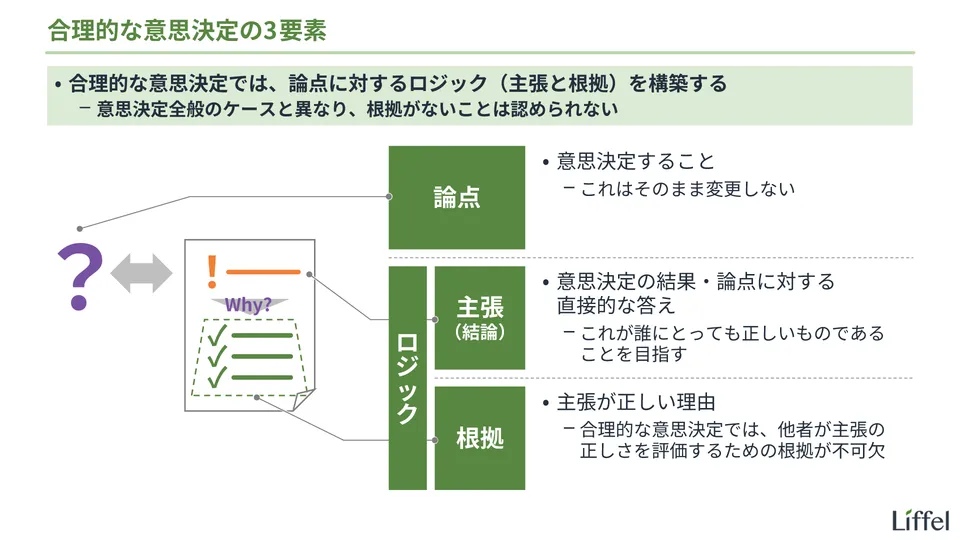
Next, let’s prepare a tool for analyzing decisions. Take a look at the slide below.
As shown, any decision consists of three elements:
- The question
- The conclusion
- The reason
Let me explain each in turn.
Element 1: The Question
First, the question is what you’re making a decision about. This is the starting point of any decision.
The question: what you’re making a decision about (what, exactly, are you trying to decide right now?)
Let’s apply this term to the earlier table. Look at the headings.
| Question | What you decided (example) |
|---|---|
| What should I wear today? | I’ll wear a tracksuit. |
| What kind of clothes make it easier to focus on work? | Clothes made of soft fabric. |
Much tidier.
Element 2: The Conclusion
Next, the conclusion is the result of a decision.
The conclusion: the result of a decision
Let’s apply this to the table as well.
| Question | Conclusion (example) |
|---|---|
| What should I wear today? | I’ll wear a tracksuit. |
| What kind of clothes make it easier to focus on work? | Clothes made of soft fabric. |
Tidier still.
Element 3: The Reason
Finally, the reason is the background or basis behind the conclusion. Put simply, it explains why you reached that conclusion.
The reason: the background or basis behind the conclusion (why you reached that conclusion)
Here’s the earlier table with reasons added.
| Question | Conclusion (example) | Reason (example) |
|---|---|---|
| What should I wear today? | I’ll wear a tracksuit. | It was within reach. |
| What kind of clothes make it easier to focus on work? | Clothes made of soft fabric. | That’s how it feels from experience. |
Check that in both cases, the reason is the background or basis from which the conclusion was drawn.
Note that we aren’t yet concerned with the quality of the reasons, and not every decision needs a reason. Don’t get this wrong.
The Three Elements of “Rational” Decision-Making
As I said at the start, when you learn decision-making as a skill, you normally aim for rational decision-making. Think of “rational” here as meaning “right for everyone.”
Rational: right for everyone
Although the three elements above (question, conclusion, and reason) are handy because they can describe any decision, they’re awkward when we limit ourselves to rational decision-making. So let’s update them as follows.
The slide looks similar to the previous one, but this is the one to remember. The changes are:
- “The question” stays the same
- “Conclusion” becomes “claim”
- “Reason” becomes “premises”
These three terms in bold are the key words for learning critical thinking (which on this site means “how to make rational decisions”). I’ll explain the details from the next entry onward, so for now, focus on grasping the overall structure and relationships.
Let me explain each in turn.
“The Question” Stays the Same
First, “the question” keeps the same meaning: what you’re making a decision about. Nothing changes.
“Conclusion” Becomes “Claim”
Here’s where things change. First, we’ll call the “conclusion” the “claim.”
The table below summarizes the difference in nuance between the two words. This is my interpretation, but I think most people would agree.
| Conclusion | Claim | |
|---|---|---|
| Room for change | Feels settled (“it’s already been decided”) | Feels open (“I want you to accept this as right”) |
| Presence of others | Not felt | Clearly present (a claim is normally directed at others) |
When considering whether a decision is rational (right for everyone), it’s better to call the result of a decision a “claim.”
In rational decision-making, you aim for “a conclusion that everyone would accept as right.” In other words, think of your decision as exposed to the scrutiny of others rather than self-contained. Whether or not anyone actually scrutinizes it, you make your decision with that in mind.
Put another way, in rational decision-making, you look not for a self-serving “conclusion” but for a “claim” that everyone would accept as right.
Claim: the result of a decision
Note, however, that in many contexts “conclusion” fits more naturally. I recommend treating “conclusion” and “claim” as synonyms, with “claim” as the default.
“Reason” Becomes “Premises”
Next, we replace “reason (why you reached that conclusion)” with “premises.”
Again, let’s start by comparing the two words. Take a look below.
| Reason | Premises | |
|---|---|---|
| Meaning | Can refer to any factor behind a conclusion (background, cause, grounds, etc.) | Limited to “why the conclusion is right” |
| Other | Used in all sorts of contexts | Often used alongside “claim”; carries a more formal tone |
As you can see, premises are a type of reason, limited to the sense of “why something is right.”
If this explanation alone doesn’t click, read the link below (it jumps ahead in the learning order).
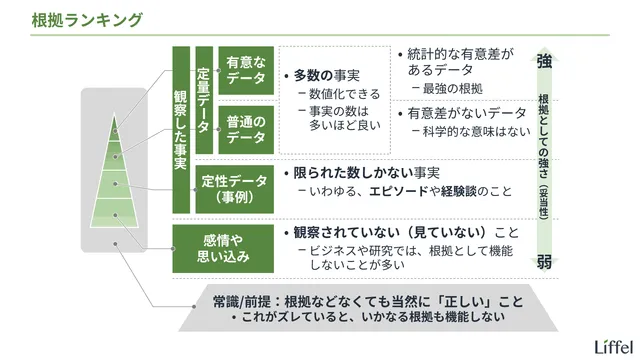

When you aim for rational decision-making, “premises” is clearly the better term. After all, you want to think about whether the claim is right.
Premises: the reason a claim is right
Claim + Premises = Argument
Finally, we’ll call the pair of a claim and its premises, that is, the complete answer to the question, the “argument.” Here’s the slide again.
This is simply because it’s handy to have a word for the whole answer. When you actually analyze a decision, don’t lump them together as “the argument.” Always distinguish the claim from the premises.
Argument: a claim and its premises (the complete answer to the question)
Note that in everyday English, “argument” often means a quarrel. That’s not what we mean here. Here, an argument is a claim supported by premises, the standard meaning in logic and critical thinking.
Using this term, let’s restate what thinking is: thinking means building an argument for the question you’ve set.
Thinking means building an argument for the question you’ve set
Exercise
Let’s check what you’ve learned with an exercise. This one is a little harder.
Identify the question, claim, and premises in the conversation below. Also, how could Panda make the point easier to follow?


- Question: How can I lose three kilos by next month?
- Claim: You should try the banana diet
- Premises: A TV show I enjoy and watch every week said so
To make Panda easier to follow, two problems need fixing: (1) the premises are hard to follow, and (2) the claim comes last.
One improvement is to put the claim first: “You should try the banana diet. A TV show I enjoy and watch every week said so.” That’s much easier to follow.
However, it’s doubtful whether these premises are valid (= whether the claim can be accepted as rational). That’s what we’ll study from here.
Summary
Finally, take one more look at the slide.
Whenever you make a decision (think about a question that has no correct answer), always keep these three elements in mind: the question, the claim, and premises. That alone should help you think much better than before.
That covers the three elements of decision-making. From here, let’s dig deeper into each element. Continue to the entry below.

Entries related to critical thinking are collected on the page below. Feel free to use them as a reference.
Learn or Review with the Video
Here’s the video mentioned at the start (in Japanese). Although the content isn’t exactly the same, the main points are.