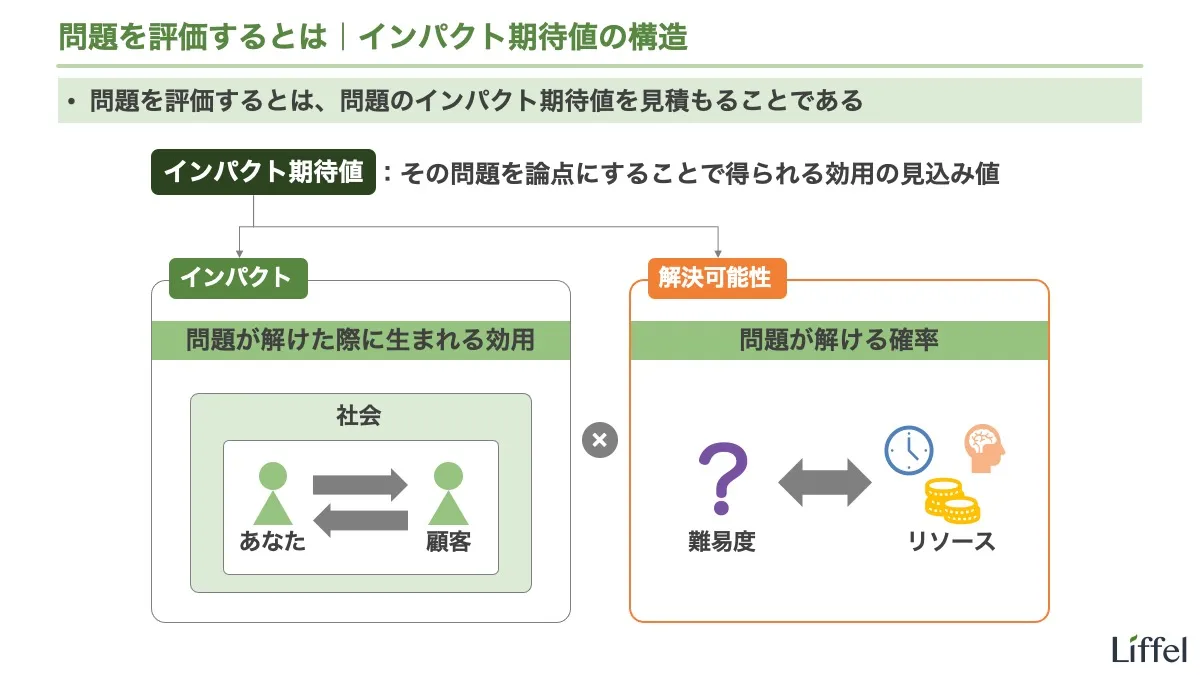
Now that we’ve covered the impact of a question, let’s think about the solvability of a question.
This entry is part of a series on evaluating questions. Read the series in order, starting from the entry below.

Let’s begin.
toc
- What Is Solvability?
- Solvability 1: Can You Reach an Answer?
- Solvability 2: Can You Carry Out the Answer?
What Is Solvability?
The solvability of a question is, as the name suggests, the likelihood of solving it. I recommend thinking about it in two parts:
- Can you reach an answer?
- Can you carry out the answer?
Let me explain each in turn.
Solvability 1: Can You Reach an Answer?
First, simply consider whether you can reach an answer. Examine whether you’re likely to be able to say “It’s XX” in the end for the question you’re evaluating.
It may be easier to understand the other way around. Evaluating whether you can reach an answer means considering whether you can avoid saying “I don’t know” to the question. If you’re likely to be able to say something other than “I don’t know,” it seems fine to make it the question.
Evaluate Whether You Can Reach an Answer Before Thinking
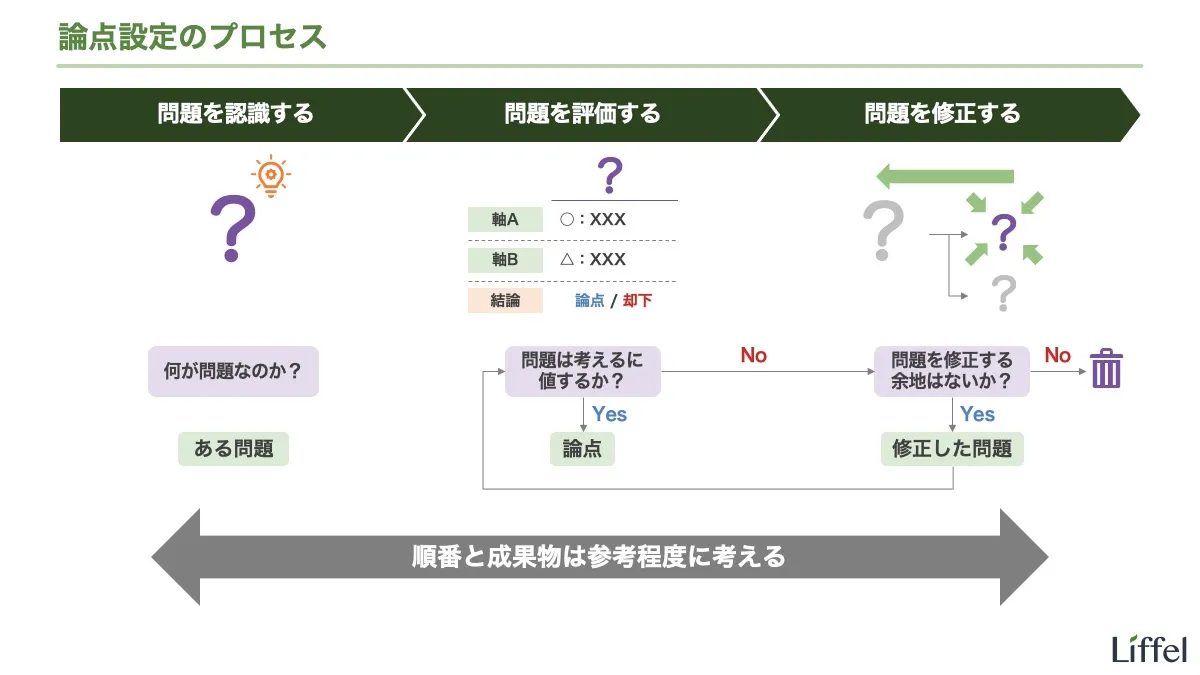
The hard part is that you need to evaluate whether you can reach an answer before actually thinking about it. Once you start thinking, it’s as good as having made it the question. Evaluating a question is something you do before setting it as the question. Check the question-setting process.
Of course, there’s no point in rigidly resolving “not to use a single resource at the evaluation stage,” so thinking a little is fine. But if you pour in a fair amount of resources, it can no longer be called “evaluation to decide whether to make it the question,” and it becomes harder to decide “I won’t make it the question because I’m unlikely to reach an answer” (the sunk cost effect).
Your Expertise in the Question: Can You Form a Hypothesis?
So how can you evaluate whether you can reach an answer without using resources?
The rough answer is to simply consider whether you have expertise in the question.
Specifically, the more of the following conditions you meet, the more likely you are to reach an answer:
- You’ve answered similar questions before
- Even if you don’t know the exact answer, you know the patterns of answers (one of A, B, or C, for example)
- You know the abstract framework for reaching an answer and could reach one if you had specific information
- A hypothesis (a tentative claim without premises) comes to mind
- And you’re confident in that hypothesis
- You can concretely picture the premises needed to make the claim and the research needed to build them
- You have, or can obtain, specific information in the field
- On-the-ground conditions, practical experience, connections to informants, etc.
The clearest indicator among these is whether you can form a hypothesis, in other words, the specific content of the final conclusion. I’ll explain hypotheses in detail in the next entry.
If you can form a hypothesis you’re fairly confident in, not a complete shot in the dark, that’s proof you have expertise (knowledge and experience) in the question you’re evaluating. You won’t know whether the hypothesis is really right until you test it, but you seem likely to reach some conclusion. In this case, it’s fine to proceed toward making it the question.
On the other hand, it’s safer not to make a question the question if you can’t form any hypothesis at all, that is, if you have no idea what the answer might be. You probably lack the knowledge or experience needed to think about it. Rather than making it the question and pouring in resources right now, it’s better to wait until the time is ripe.
Solvability 2: Can You Carry Out the Answer?
Next, don’t forget to evaluate from the angle of whether you can carry out the answer.
Although this angle applies only to questions of the type “How can I do XX?”, almost all the questions you deal with in business are of this type. Unless you’re a researcher, evaluate from this angle as a rule.
There’s a type of question where the right answer is mostly known, and it’s clear that carrying it out would be better, but it seems impossible to carry out. Since reaching an answer to such a question changes nothing, you shouldn’t make it the question.
Example 1: Do You Want to Lose Weight, or Are You Serious About It?
First, let’s look at a familiar example.

No one has no idea at all how to answer this question. If you absolutely must lose weight, you just stop eating.
Of course, if you want to lose weight healthily and efficiently, it’s certainly better to think of a method other than suddenly fasting. But if you’d lose everything unless you lost three kilos by next month, you’d start fasting before thinking, wouldn’t you? It’s obvious that cutting back on food is the right direction.
In other words, if you’re unsure whether to make this the question, you can guess that you’re not that serious about losing weight. If you were serious, you’d jump straight into action.
Example 2: Why Can’t It Be Standardized Across the Company?
Let’s also look at a more business-oriented example.
Here, “XXX” could be “the performance evaluation system” or “IT systems.” It’s obvious that such things can be standardized if there’s the will. The top just has to say “do it” and allocate a budget (whether it should be standardized depends on the case).
If it still hasn’t been standardized, you should assume there’s some reason it isn’t, or can’t be, standardized. Unless that reason can be overcome, making the above the question may well end with the conclusion “it can’t be standardized,” and nothing will change.
Questions with Obvious Answers Are Dangerous
What the two examples have in common is that what should be done seems obvious, yet it isn’t being done.
You should think carefully about whether to make this type of question the question. To repeat, if the supposedly obvious “thing to do” isn’t being done, there must be a good reason. In my experience, it’s almost always one of the following:
- It’s actually not that big a problem
- There’s no budget to carry out the solution
- It’s impossible to get the stakeholders to agree
These factors often can’t be fixed in the short term. In other words, even if you make it the question, the final conclusion will be “maintain the status quo,” and rather than end up there, you shouldn’t make it the question in the first place.
Of course, if it’s clearly a serious problem and you’re prepared to clear the hurdles of money and consensus-building, that’s a different story. In any case, think first about whether you can see the answer (solution) through.
That covers the solvability of a question. Next, I’ll explain hypotheses.

Entries related to critical thinking are collected on the page below. Feel free to use them as a reference.