This entry explains what a “hypothesis” is.
In the real world, we don’t think about questions whose correct answers are known. Whether in business or research, we think about questions whose correct answers aren’t known.
Hypotheses play an important role in thinking about these “questions whose correct answers aren’t known.” Let’s understand the advantages and disadvantages of hypotheses and learn to work with them well.
Also, the word “hypothesis” means something slightly different in ordinary conversation than when you use critical thinking (in contexts where you think seriously, such as business or research). Let’s sort that out too.
toc
- What Is a “Hypothesis”? Its Meaning in Ordinary Conversation
- “Hypothesis” in Critical Thinking
What Is a “Hypothesis”? Its Meaning in Ordinary Conversation
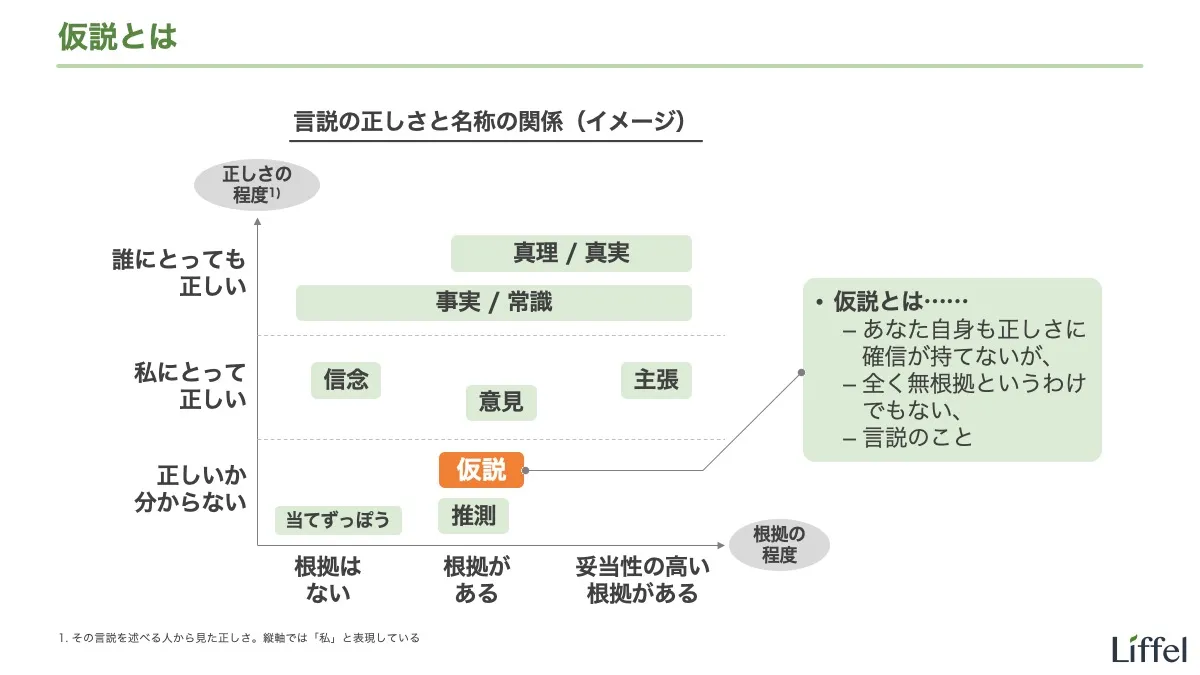
First, let’s check what the word “hypothesis” means. Since it’s a widely used word, let’s start with “hypothesis” in the broad sense. Take a look at the slide below.
To give the conclusion first, a “hypothesis” is a statement whose rightness the speaker isn’t sure of. The slide contains more detail, which I’ll explain later.
Look at a concrete example.

Every day, life feels unbearably hard. What should I do?

I’m not really sure, but why not try working out? It’s just a hypothesis, though.
The part in bold is the hypothesis. Panda is clearly not sure of the rightness of the statement “(if life is hard) you should work out.” In this way, a statement whose rightness the speaker isn’t sure of is a “hypothesis.”
As I’ll explain later, in critical thinking, “hypothesis” is used in a somewhat stricter sense. Even so, the essence of a “hypothesis” is that “the speaker isn’t sure it’s right.” Make sure you understand this first.
Hypothesis: a statement whose rightness the speaker isn’t sure of
How the Rightness of a Statement Relates to What We Call It
From here, let’s dig into the slide above and understand the word “hypothesis” by comparison. Although some of this may seem unrelated, it’s important for understanding the role and drawbacks of hypotheses. Bear with me for a while.
This slide maps out “what names a statement is called.” From here on, for clarity, let’s assume that you’re the one making the statement (written as “I” on the slide).
Before the content, let me explain the framework.
Vertical Axis: Confidence in the Rightness of the Statement
First, look at the vertical axis. It shows “how confident you are in the rightness of the statement.”
For example, suppose you state, “Humans can’t live without taking in water.” You wouldn’t call this statement an “opinion” or a “guess,” would you? You’d probably choose either “fact” or “common sense.”
That’s because you can’t imagine anyone denying the statement “Humans can’t live without taking in water.” In other words, you’re sure it’s right. And in fact, it probably is.
In other words, words like “fact” and “common sense” carry the nuance “I’m sure this statement is right.”
In this way, what a statement is called changes depending on how confident you are in its rightness. Make sure you understand this first.
What a statement is called changes depending on how confident the speaker is in its rightness
As the slide shows, “confidence in the rightness of a statement” can be broadly divided into three levels:
- High confidence: I can’t imagine anyone denying it
- Medium confidence: it’s right for me, but I don’t know whether others will think so
- Low confidence: even I don’t know whether it’s right
Depending on the level, there are several names for a statement.
Horizontal Axis: The Validity of the Premises Behind the Statement
So how is your confidence in the rightness of a statement determined?
For now, let’s tentatively say that “the more valid the premises, the more confident you become in the rightness of the statement.” That’s not so strange, is it? So the horizontal axis shows the validity of the premises. The further right, the more valid the premises behind the statement.
In other words, as valid premises are found, the name of a statement gets upgraded upward. For example, something that was only a “wild guess” gets promoted to an “opinion” when premises are found.
Note, however, that “the validity of premises” and “what people think is right” aren’t that strongly correlated. In other words, the names of statements don’t line up neatly on the 45° line of the slide (they aren’t proportional).
People grow more confident in statements they want to accept as right, regardless of whether there are premises or how valid they are. That’s because humans have the ability to “believe.” I’ll say more about this later.
What Statements Are Called: Where “Hypothesis” Fits
Now that we’re ready, let’s look at what statements are called at each level. Since this is a detour to clarify what “hypothesis” means, don’t forget to focus on how each differs from “hypothesis.”
High Confidence: Truth, Fact, Common Sense
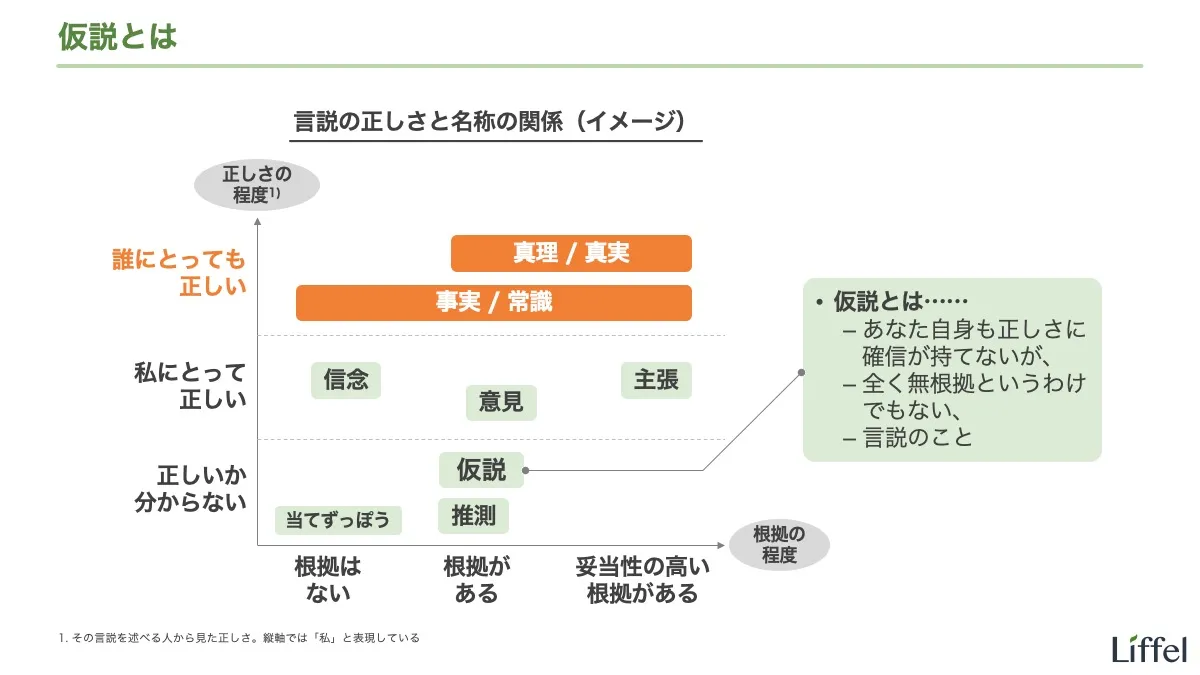
First, let’s start with statements at the highest level of confidence in their rightness. Specifically, these are names used for statements you think “should be right not only for me but for everyone.”
Names in this category include:
- Truth (in the universal sense)
- Often used for mechanisms or laws that can’t be observed
- Example: the truth that “all things have gravitational attraction”
- Truth (in the sense of what really happened)
- My impression is that it’s rarely used outside fiction (mystery novels, song lyrics, etc.)
- Fact
- Used for just about anything
- Statements with especially solid premises and no dissent among scholars are sometimes called “scientific facts”
- Common sense
- Tends to be used for social norms and values that can’t be said to have clear premises
- Example: it’s common sense that you mustn’t kill people
All four of these carry the nuance that “everyone should accept this statement as right.” “Truth,” in particular, carries the strong nuance of “its rightness is beyond debate”1. In other words, when you use these names, you’re sure the statement is right.
Incidentally, you shouldn’t use these words carelessly in argumentative writing.
The reason is simple: we have no way of knowing what others will accept as right. Unless you conduct a mandatory survey of the world’s entire population, you can’t know what others think. And even if you did, there’s no guarantee everyone would answer honestly.
In other words, we can’t know what “truth” or “common sense” is2.
Overusing the words above is nothing but the arrogance of “Of course others should accept what I think is right.” It doesn’t make you more persuasive. If anything, it only makes you look cheap.
As an aside, since these words (especially “truth”) have power in themselves, I think they should be used actively in fiction.
There are three truths…
Medium Confidence: Claim, Belief, Opinion
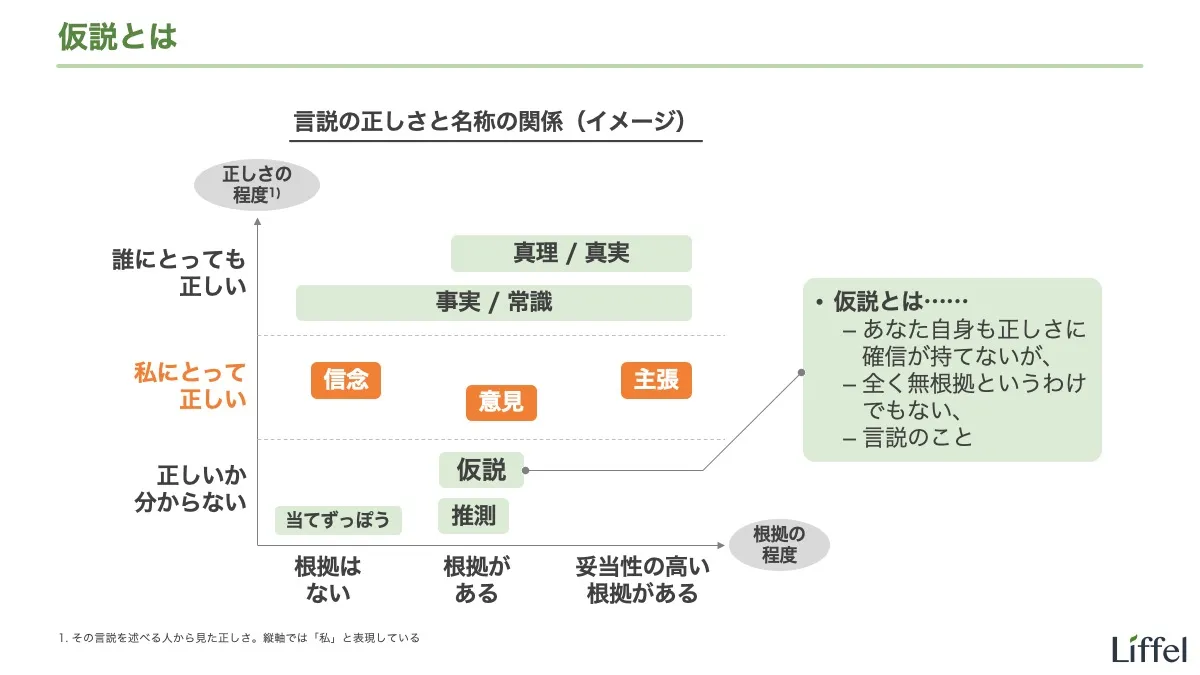
Let’s lower the confidence a little. Next are names used for statements you think are “right for me, but I don’t know whether others will accept them as right.”
Names in this category include:
- Claim
- Carries the nuance “It’s right for me, and I want others to accept it as right too”
- Often comes with premises that are highly valid (from the claimant’s point of view)
- Belief
- Strongly carries the nuance “There are no premises, but it’s right for me. What others think doesn’t matter”
- Example: the belief that “if you have energy, you can do anything”
- Opinion
- Of these three, the confidence in its rightness is somewhat lower
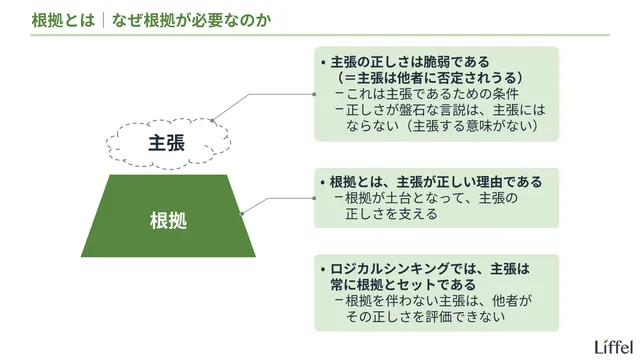
First, since “claim” is a main character in critical thinking, it’s explained in detail in the entry below. Let me skip it here.

Here, it’s interesting to consider “belief” in contrast to “claim.” The two have in common that they’re “right for me,” but they differ in whether you want others to accept them as right.
Also, beliefs don’t need premises. Whatever you accept as right becomes right (for you) on that basis alone. Beliefs are a symbolic example of what I said earlier: “the validity of premises” and “what people think is right” aren’t that strongly correlated. See also the entry below.
Although I included “opinion” in this category, opinions may differ on this.
For example, when you say “This is just one opinion,” you may not be confident in its rightness. Would you put “opinion” in this category or the next one? What’s your opinion?3
Low Confidence: Hypothesis, Guess, Wild Guess
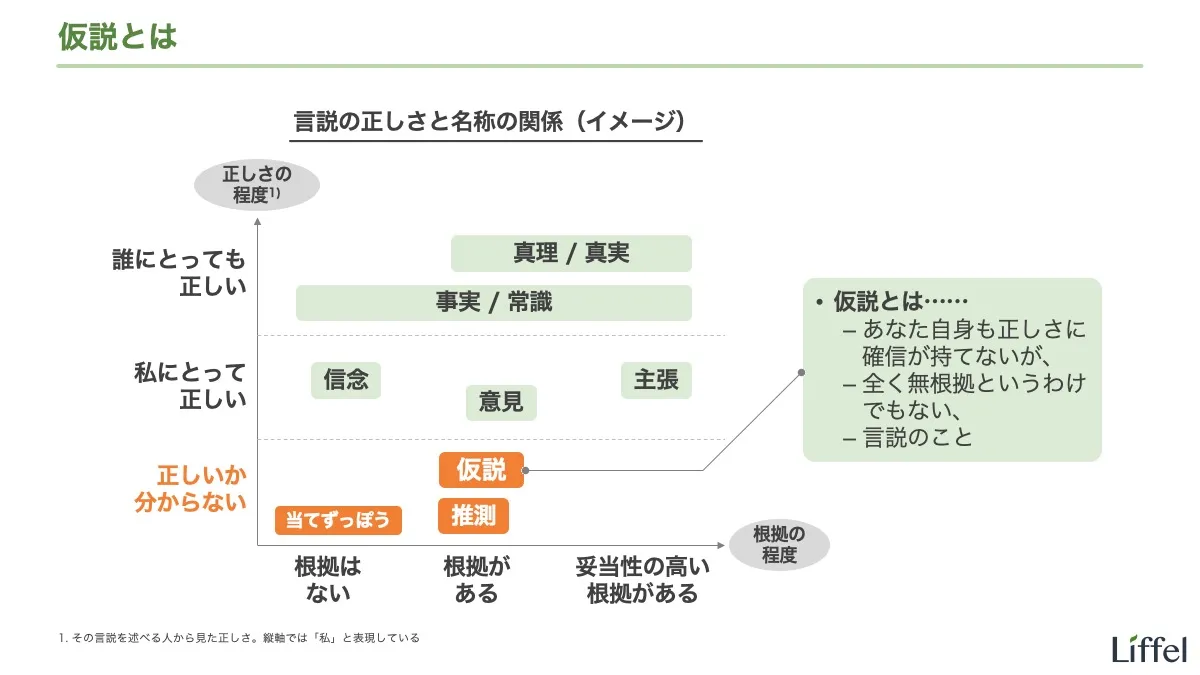
Finally, let’s lower the confidence to the minimum. Specifically, this is the level of “even I don’t know whether it’s right.”
Names in this category include the following. As mentioned, this is where our main topic, “hypothesis,” belongs.
- Hypothesis
- Guess
- Also “speculation,” “prediction,” etc.
- Wild guess
Statements in this category are normally made together with a phrase like “this is a hypothesis / guess / wild guess.” Otherwise, the listener won’t know that the statement belongs to this category (= that you’re not confident it’s right). Let’s look at an example.
Every day, life feels unbearably hard. What should I do?
Why not try working out?
This makes it look as if Panda is fairly confident in the statement “(if life is hard) you should work out.” Unless you add some phrase with the nuance “I’m not vouching for the rightness of what I’m about to say,” the statement will look like at least an “opinion.”
Conversely, if you say “this is a hypothesis / guess / wild guess,” you don’t have to take responsibility for the statement.
For example, there’s the phrase “This is just my hypothesis, but…” This simply sugarcoats “I won’t take responsibility if what I’m about to say is wrong (= I’m going to say something offhand).” I use it sometimes myself, and it’s handy.
In this way, by making it explicit that a statement belongs to this category, you don’t vouch for its rightness. Conversely, it’s fine for it to be wrong. In other words, it’s fine for a hypothesis to be wrong. This seems obvious, but it’s often forgotten.
It’s fine for a hypothesis to be wrong
However, even when you use these names, the statement is certainly “the most right” in your mind. There’s no need to go out of your way to say what seems second or third most right. Even a complete wild guess is still your best guess.
Finally, and this is a matter of feel, I think “hypothesis” carries the nuance of more confidence than “guess” or “wild guess.” Whether or not you’ve put it clearly into words, you have some premises. The slide reflects this.
The following definition is also helpful.
A hypothesis is something more than a wild guess but less than a well-established theory.
That’s “hypothesis” in the general sense.
“Hypothesis” in Critical Thinking
From here, let me explain what “hypothesis” means in critical thinking. Take a look at the slide below.
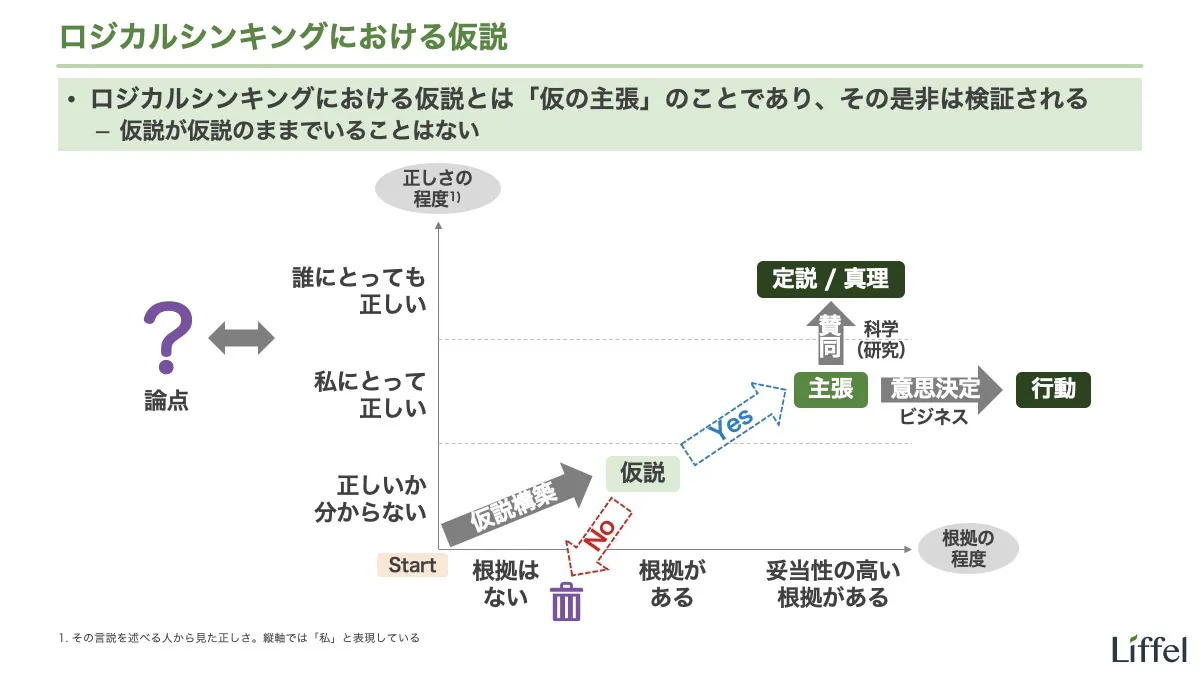
As you can see, the names unrelated to critical thinking have been shown the door.
To give the conclusion first, in critical thinking, a hypothesis is a tentative claim. You could also call it “the leading candidate for the claim at this point.”
Hypothesis (in critical thinking): a tentative claim
Furthermore, that hypothesis is tested through research and either gets promoted to a claim or is rejected. In other words, a hypothesis never stays a hypothesis. This is the decisive difference from “hypothesis” in the general sense.
In critical thinking, a hypothesis is something to be tested, and it never stays a hypothesis
Let’s go through the slide in order.
It Always Starts with the Question
First, critical thinking always starts with the question, not with a hypothesis or a claim. So the question is on the left side of the slide.
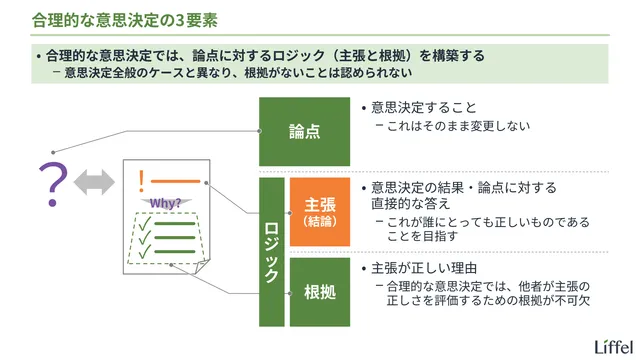
And once the question is set, what you want to know is the claim (strictly speaking, an argument with premises). For more on this, see also the entry below.
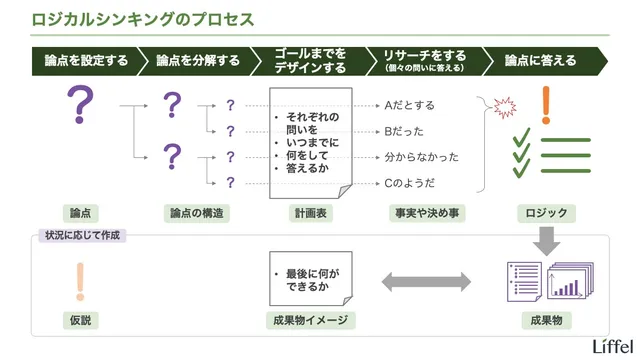
It Ends with Action or an Established Theory
Next, let’s look at the end. The route after the claim is known differs between business and research.
First, since business is problem solving, action awaits after thinking. Once the claim you’ve derived is accepted as “right” by you or your organization, you make a decision and act on it.
In research, the goal isn’t problem solving but the pursuit of truth. So your claim is scrutinized by the research community, and if it wins agreement that it’s “right,” your claim comes to be called an “established theory”4.
How Premises Differ Between Business and Research
As an aside, because of this difference between business and research, the level of premises required to turn a “hypothesis” into a “claim” differs greatly.
Put simply, what business really cares about isn’t whether a claim is “right” but whether acting on it produces results. So even with premises far too weak for a claim from a research standpoint, people in business make claims on that basis and act. It’s also common to use data from those actions as premises for new claims and actions.
In research, on the other hand, the only interest is whether something is “right.” So the validity of premises is strictly demanded and thoroughly scrutinized by others.
In other words, a business “claim” sits toward the lower left of the box, and a research “claim” toward the upper right. The slide shows “claim” as a single item for clarity, but try moving it around in your head.
What’s more, business sometimes skips the “claim” altogether. Once a hypothesis is formed, you quickly take action, test the hypothesis by the results, and improve your actions. When the cost of acting and the downside risk of failure are small, this is more efficient. For more on this, see also the entry below.
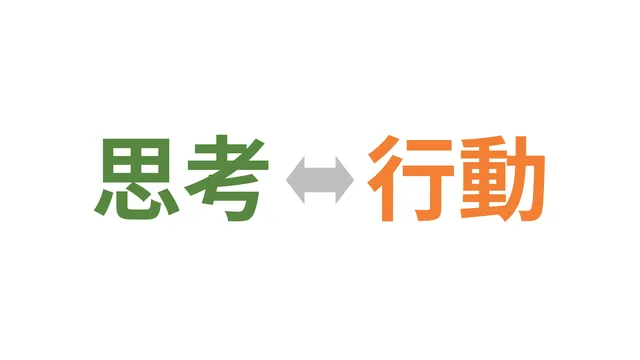
Despite these differences, though, my impression is that the level of premises required in business has been rising recently. Data can now be collected everywhere. Or rather, perhaps the companies that can collect such data and turn it into high-precision decisions are the ones that win.
From the Question to the Claim
Let’s get back to hypotheses. A hypothesis is what exists between the question and the claim described so far.
What lies between the question and the claim can be broadly divided into two parts5:
- Until a hypothesis forms: from nothing to a hypothesis
- After a hypothesis forms: deciding whether to promote the hypothesis to a claim or reject it
Let’s start with the latter, which is easier to understand.
(2) After a Hypothesis Forms
What happens after a hypothesis forms is simple. Since your immediate goal is to make the claim clear, once you have a hypothesis, all you need to do is judge whether it’s okay to promote it to a claim.
And what promotes a hypothesis to a claim is the existence of valid premises.
In critical thinking, the assumption holds that “the more valid the premises, the more right the statement.” That’s the framework critical thinking works within.
In other words, if you can build (find) valid premises strong enough to support the hypothesis, you can promote the “hypothesis” to a “claim.” If you can’t, you have no choice but to reject the hypothesis. Into the trash it goes. Check the slide.
This work of testing whether a hypothesis is true is called “hypothesis testing.”
Hypothesis testing: the work of testing whether a hypothesis is true
Specifically, hypothesis testing means research, in one of the following forms:
- Desk research
- Surveys and questioning
- Interviews
- Questionnaires
- Observation
- Experiments, etc.
For details on research, see the entry below.
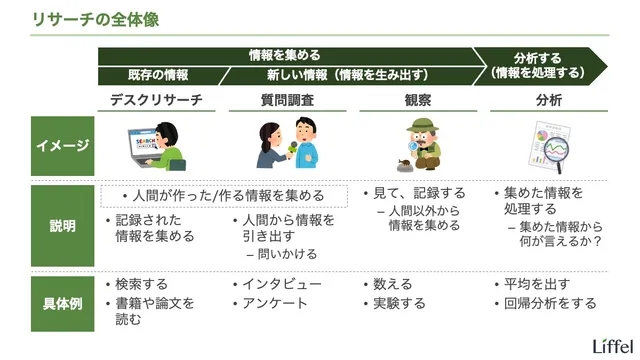
Through hypothesis testing, a hypothesis either gets promoted to a claim or goes into the trash (= the hypothesis is rejected). To repeat, a hypothesis never stays a hypothesis.
A handy way to remember this is “a hypothesis is a hamachi.” Hamachi, a young yellowtail familiar from sushi, can’t stay a hamachi either. It either grows into a full-grown yellowtail (buri in Japanese) or ends up in our stomachs.
Hypotheses in critical thinking and hamachi have one thing in common: neither can stay as it is
This is the decisive difference from “hypothesis” in the general sense. When people say “hypothesis” in the general sense, it merely means “I’m not responsible for its rightness,” and they aren’t required to settle whether it’s right.
In critical thinking, however, a “hypothesis” must then be tested so that its rightness can be settled one way or the other.
(1) Until a Hypothesis Forms
Now let’s step back. This is the tricky part.
When and how does a hypothesis form?
Let’s think it through step by step. First, let’s assume that when the question is set, you have no information or experience related to it at all. In reality, such cases are rare, but let me make this assumption so we can think from scratch.
In that case, since you have no information, you can’t even make a wild guess. In other words, you start from a state with no candidate answers, at the lower left of the box.
And somewhere between this starting point and the claim, a hypothesis always forms.
This is obvious if you think about it the other way around. Right up until the moment you know your claim, it’s impossible to have “absolutely no idea what my claim will be.” Before you know your claim, you’ll always have a sense that “the claim will probably be XX.”
In other words, no matter how hard you try not to form a hypothesis, one will form before the claim. It’s unavoidable6.
A hypothesis will always form at some point as you approach the claim
However, in both business and research, a hypothesis isn’t something that “forms on its own” but something you deliberately “go out and form.”
And you form it quite early. It’s no exaggeration to say that you sometimes form a hypothesis before setting the question. Whether you can form a hypothesis is one of the angles for evaluating a question’s solvability (= if you can’t form a hypothesis, solvability is low, so it’s better not to make it the question). This was explained in the entry on solvability, but in any case, forming a hypothesis early has clear advantages.
This attitude or thinking style of trying to form a hypothesis as early as possible is called hypothesis-driven thinking in business.
Hypothesis-driven thinking: the attitude or thinking style of trying to form a hypothesis as early as possible
However, my understanding is that whether you can practice hypothesis-driven thinking well (= form an appropriate hypothesis early) lies outside the framework of “critical thinking.” Whether you can form an appropriate hypothesis before doing any research depends largely on inspiration and experience, which theory can’t do much about.
Hypothesis-driven thinking also has clear drawbacks. It’s not an attitude to use for every question, and using it without understanding this is dangerous, so be careful.
Although there’s much more to say, this entry is getting long, so let’s stop here for now.
That covers “hypothesis” in critical thinking. In a future entry, I plan to dig into the following questions:
- Why should you form a hypothesis early?
- What are the drawbacks of forming a hypothesis early?
- How can you form a hypothesis early?
Entries related to critical thinking are collected on the page below. Feel free to use them as a reference.
Footnotes
-
Strictly speaking, “truth” carries the nuance of “the real state of things, independent of human judgments of right and wrong (true or false, not right or wrong).” But the moment we try to figure out what’s “true,” human judgment comes into play, so it’s impossible to decide what’s “true” apart from human judgments of right and wrong. ↩
-
Taken to its extreme, this stance becomes “there’s no such thing as truth.” ↩
-
You might also think of “opinion” as a concept that covers everything from “claim” down to “guess.” ↩
-
In practice, the world treats this as “truth” or “scientific fact,” but since established theories can be overturned, my impression is that scientists don’t use those words. ↩
-
This process runs in parallel with the critical thinking process. As I’ll explain later, since when a hypothesis forms, and when you should form one, can’t be stated in general terms, I didn’t include it in the critical thinking process. ↩
-
However, this applies to cases where you make steady progress toward a claim. If there’s no progress at all, no hypothesis forms. ↩