In this entry, you’ll learn the critical thinking process (what to do, and how to proceed, when you practice critical thinking).
This entry assumes basic knowledge of critical thinking. If you get lost along the way, study the entries in order starting from the link below.

Let’s begin.
toc
- The Critical Thinking Process: Overview
- Step 1: Set the Question
- Step 2: Break Down the Question
- Step 3: Design the Path to the Goal
- Step 4: Do Research
- Step 5: Reach an Answer
The Critical Thinking Process: Overview
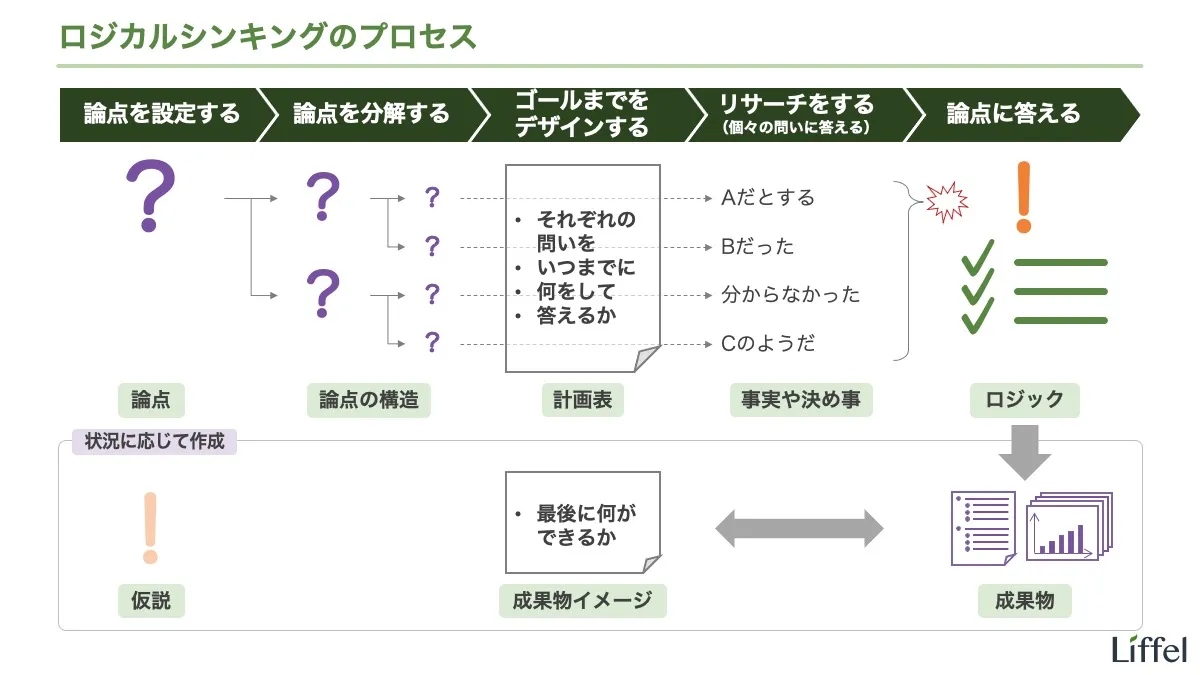
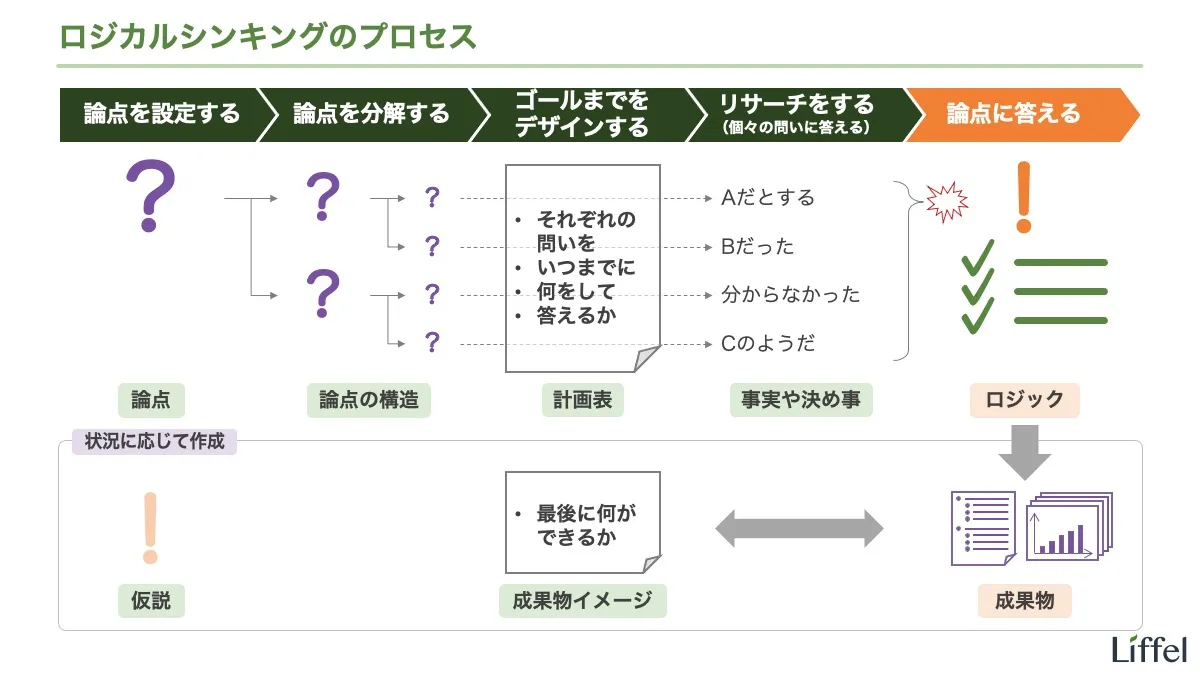
First, let’s look at the overall picture. Take a look at the slide below.
As shown, critical thinking proceeds through the following five steps:
- Set the question
- Break down the question
- Design the path to the goal
- Do research
- Reach an answer
Note that this is a very rough summary of the process. Strictly speaking, each of these steps contains more detailed steps.
However, since too many steps make it hard to follow, I’ve grouped the whole into five. In this entry, focus on grasping the rough overall picture. I’ll fill in the details in other entries, so don’t worry if some parts aren’t clear yet. Just keep going.
Let’s go through the steps in order.
Step 1: Set the Question
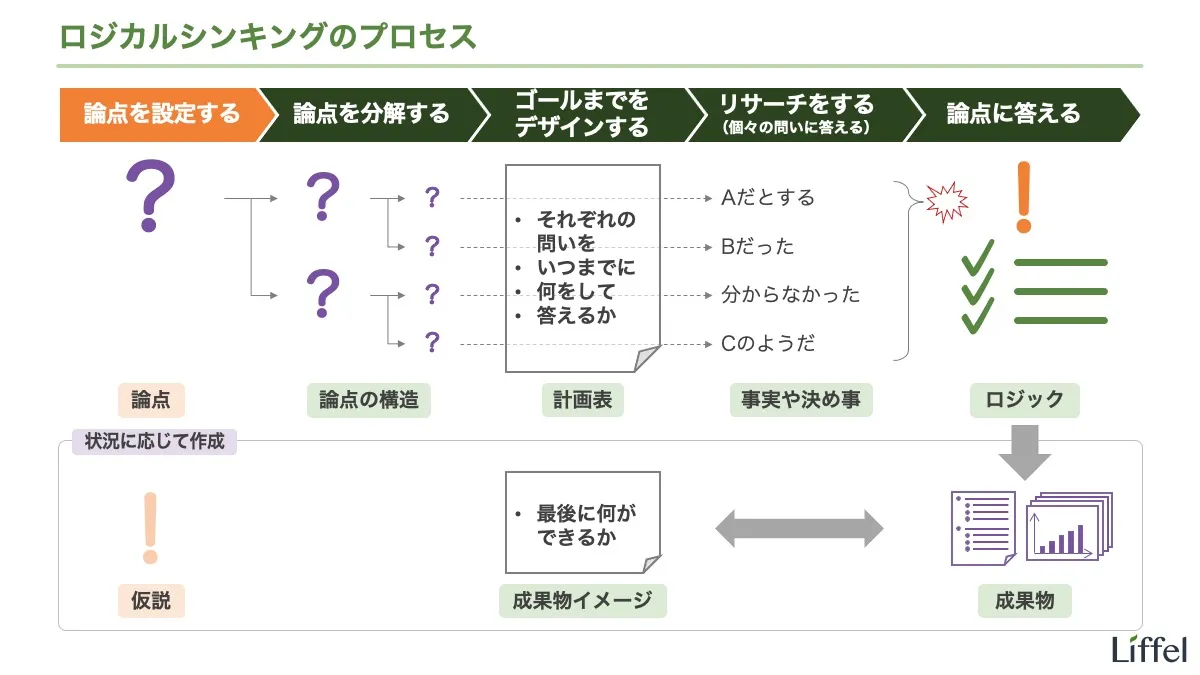
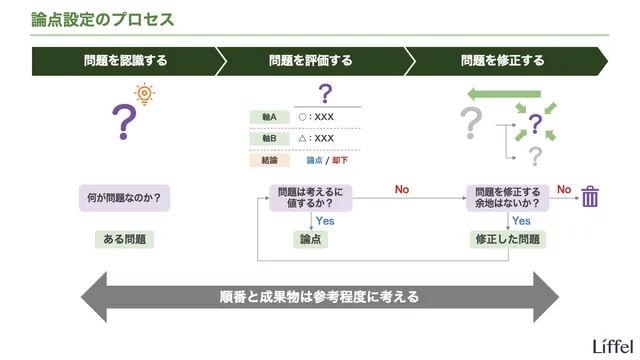
The first step of critical thinking is to set the question. This step is often called “question setting,” so remember that term too.
What Is the Question?
The question is the single question (interrogative sentence) you’re about to think about.
The question: the single question (interrogative sentence) you’re about to think about
In other words, the starting point of critical thinking is deciding on the single question you’ll think about.
Why Set the Question?
The reason question setting is the starting point of critical thinking is simple: unless you settle on one thing to think about, you can’t think.
For example, look at the list of questions below:
- How can I master English within two years?
- How can I get in shape by summer?
- How can I spend less time on my phone?
It’s entirely possible for someone to be interested in all three (= want answers to all of them). You’re probably interested in at least two yourself.
However, humans can’t think about multiple questions at the same time (depending on how long “at the same time” is). And even if you think about several questions in parallel, you can simply separate them into distinct processes. So one critical thinking process deals with one question. This is a rule we set.
One critical thinking process deals with one question (a rule we set)
That’s why you need to narrow down the many questions you’re interested in to “the one question you’re about to think about.” This is why you set the question.
The Goal of Critical Thinking
Once the question is set, what you want to achieve through the critical thinking process, that is, the goal of critical thinking, also becomes clear.
It’s to reach the right answer to the question.
Needless to say, once a question has been asked, you want to know the right answer. Let’s search for it.
The goal of critical thinking: reaching the right answer to the question
For more on this, see the link below.
Step 2: Break Down the Question
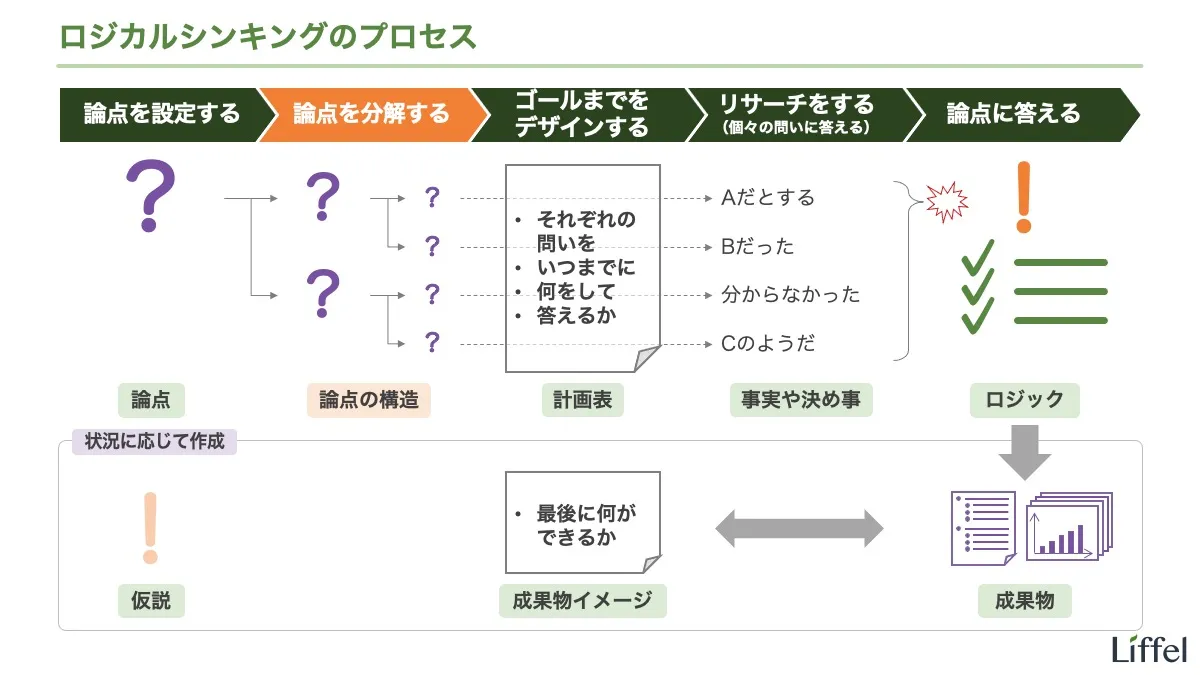
The second step of critical thinking is to break down the question.
Breaking down the question means turning the question into a set of smaller questions.
For example, suppose you set the question “How should I study to score 100 on the TOEFL in one year?” Here’s an example of how this question can be broken down:
- How should I study to score 100 on the TOEFL in one year?
- How many hours a day do I likely need to study?
- What score should I aim for in each of the four sections (Reading, Writing, Listening, Speaking)?
- What’s my current score in each of the four sections?
- How much study is likely needed to close the gap?
- How will I secure the study time I need?
- When and where will I study?
- Which section should I study first?
- Should I work on all four equally, or prioritize some?
- How should I study each section?
- What materials should I use?
- What study methods are effective?
- How will I track my progress (whether I’m getting closer to the goal)?
- How often should I take the TOEFL?
- Are there other low-cost ways to track progress?
- How many hours a day do I likely need to study?
Confirm that the question has turned into a set of smaller questions. On this site, this is called the question structure. I’ll explain it in detail in later entries.
Question structure: the broken-down questions and how they’re structured
Here, confirm that breaking down the question has turned it into more specific questions that are easier to verify.
For example, to answer “What’s my current score?”, you just need to take the TOEFL. In fact, if you’re serious about getting a high TOEFL score, that’s the first thing you should do. You can’t think about what to do without understanding where you stand.
Why Break Down the Question?
The reason to break down the question is that no other way of “thinking” has been found. Since this part is a little difficult, just skim it if it doesn’t make sense.
Let me explain with the earlier example. The question was “How should I study to score 100 on the TOEFL in one year?”
There are infinite answers to this question. Since all you need is to decide how to study, even “Just study like crazy with the study guides I have on hand” is a perfectly good answer.
But you can’t call that an answer reached by thinking. It’s just acting on whatever comes to mind. In other words, it’s an answer, but no one knows why it’s right.
So how do you reach an answer by “thinking”? As shown above, the only way is to break down the question. You bring the question “How should I study?” down to smaller, more specific questions that can be answered clearly through knowledge or research.
Of course, there are many cases where you can’t reach answers even after breaking down the question. Still, you start by listing out “which (smaller) questions, once answered, would let you answer the (bigger) question you ultimately want to answer”1.
Let’s leave it here and move on. This is a part you understand by practicing rather than through theory. Don’t worry if it doesn’t click yet. You’ll get it as you break down lots of questions.
Step 3: Design the Path to the Goal
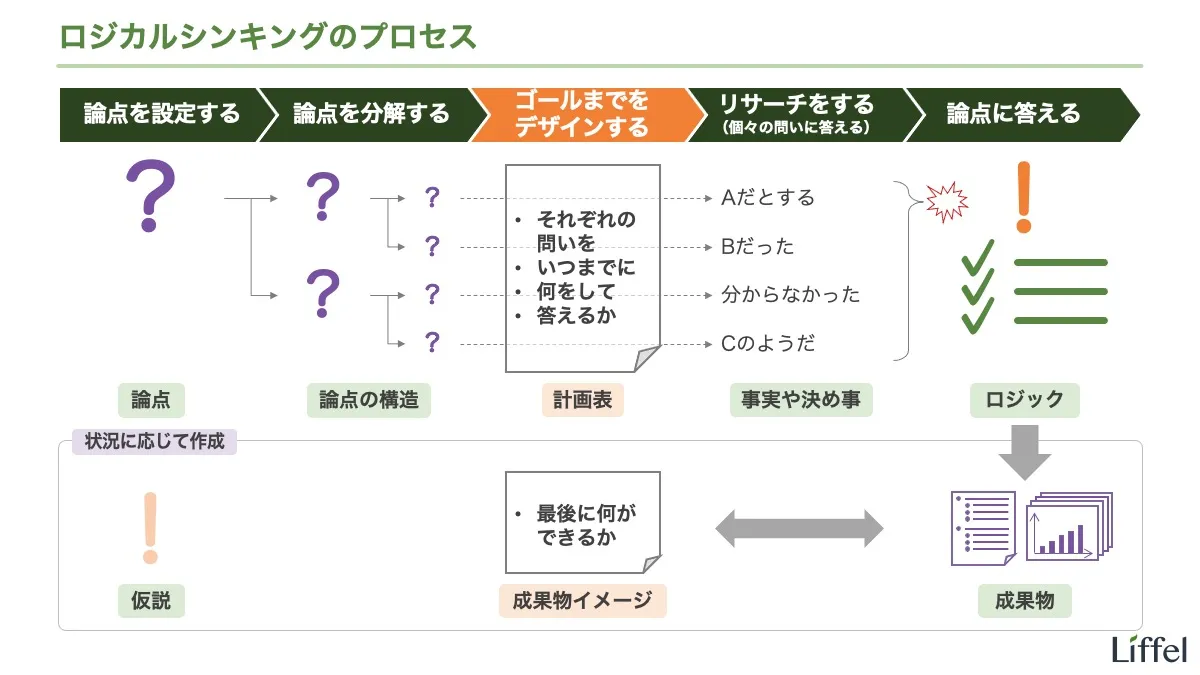
The third step of critical thinking is to design the path to the goal.
Specifically, designing the path to the goal means creating the following two things:
- A work plan
- A mockup of the deliverable
Let me explain each in turn.
Path Design 1: The Work Plan
A work plan summarizes how each question in the question structure will be answered. In short, it’s a schedule, although this site calls it a “work plan” to give it the feel of a formal deliverable.
Specifically, you summarize the following elements in Excel or a similar tool:
- Which question (in the question structure)
- Through what work
- By when
- By whom (only when thinking as a team)
- Will be answered
In my opinion, you only need to create a work plan when you’re dealing with a question that will likely take more than a month to answer, or when you’re thinking as a team. I’ll explain this in detail in another entry.
Path Design 2: The Deliverable Mockup
A deliverable mockup is, as the name suggests, a rough mockup of the final deliverable. Put simply, it’s what you want to see at the end.
As the slide shows, you only create this when you’ll produce a document or presentation as a result of critical thinking. Here are some concrete examples:
- Common to all deliverables
- A hypothesis-based argument / outline
- The question structure (interrogative sentences) flipped into declarative sentences
- (If you’ll be analyzing data) mockups of the graphs you ultimately want to see
- A hypothesis-based argument / outline
- Created according to the deliverable
- Document: a table of contents (for a blog, the heading structure)
- Presentation: a skeleton deck
- Hand-drawn sketches of each slide
As you can see, the deliverable mockup varies depending on the final deliverable. Note that there’s no one-size-fits-all answer.
Why Design the Path to the Goal?
The reason to design the path to the goal is that otherwise, you’ll think inefficiently. At worst, you’ll never reach the goal.
The human brain is strange: for some reason, it seems to be built in a way that makes it hard to head straight for the goal2. When you’re thinking about specific questions at the ends of the question structure, you get absorbed in them and spend too much time, or you forget why you were thinking about them in the first place.
A common case is “someone collecting data and doing all sorts of analysis without knowing what the analysis is for.” Getting sidetracked out of simple intellectual curiosity is also common.
Since such detours and digressions sometimes lead to unexpected insights, I can’t say they’re entirely bad. But in most cases, the reality is that there’s a deadline for reaching an answer, and you want to think efficiently. That being the case, it’s safest to have a concrete picture of the goal and the route to it before you start working.
Metaphorically speaking, once you start working, you inevitably take a bug’s-eye view, so you need a map to maintain a bird’s-eye view. That’s why you design the path to the goal.
Step 4: Do Research
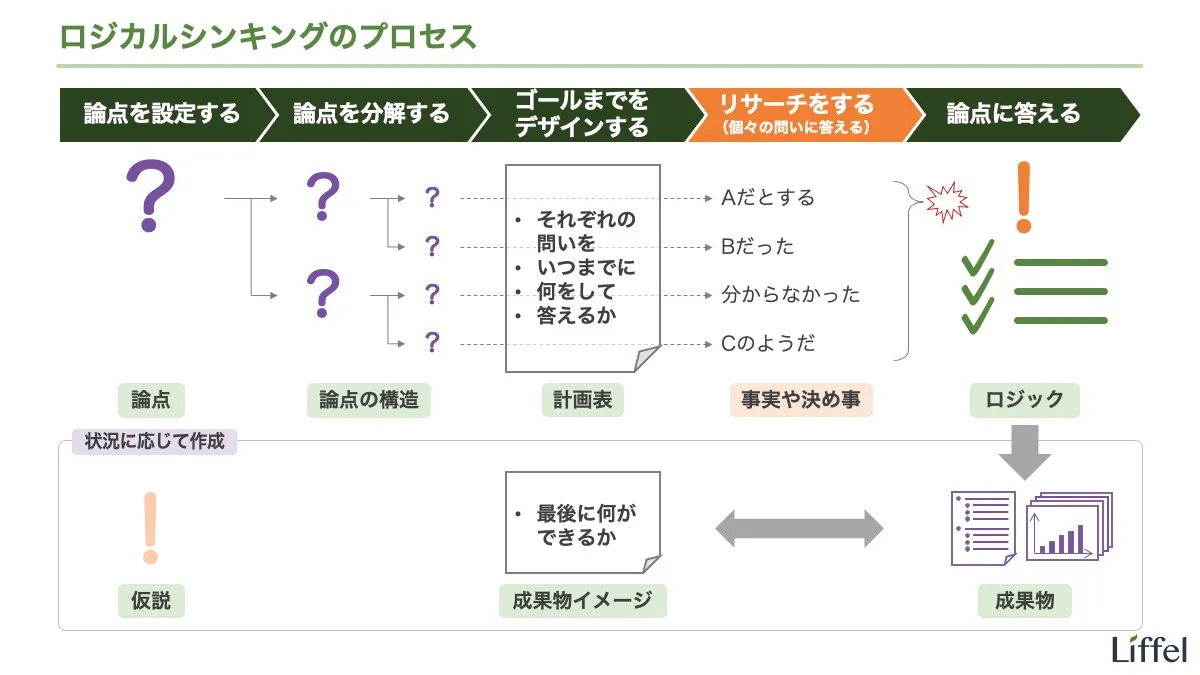
The fourth step of critical thinking is to do research.
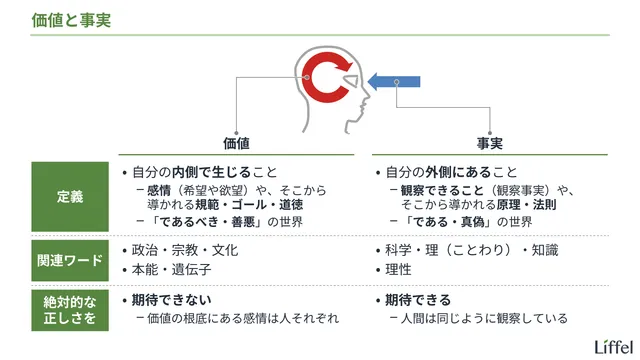
Once you’ve designed the path to the goal, the next step is research. For an overview of research, see the slide below.
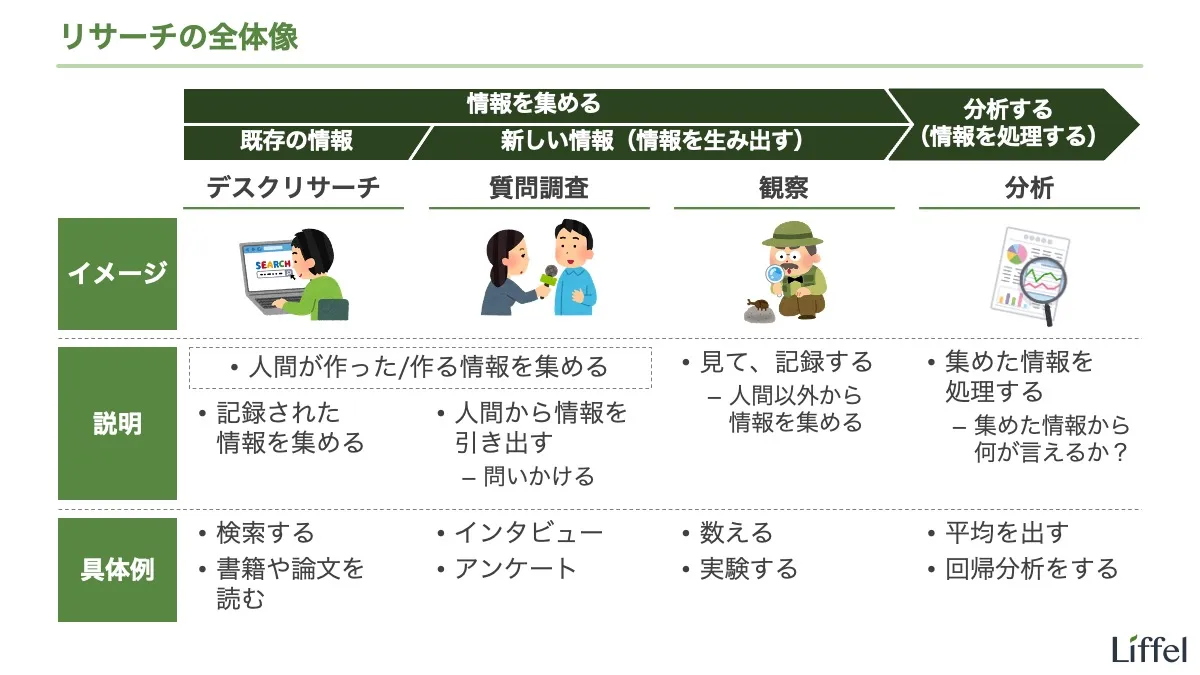
This is the part where you work with your hands more than your head. Let’s learn the individual tasks from here on.
Note that not every question can be answered through research. Some questions require you to “decide” the answer (explained in later entries).
So strictly speaking, this step is “answering each question,” but since that’s hard to follow, the slide just mentions it in small parentheses.
Why Do Research?
The reason to do research is that there’s no other way to build highly valid premises.
This is easier to see the other way around. If you could answer a question without doing any research at all, that would mean the answer consisted only of “what was already in your head.” In other words, the premises consist only of subjective statements3. The claim would lack persuasiveness and wouldn’t be accepted as right.
Since this has already been explained in another entry, I’ll skip it here. See the link below.
Step 5: Reach an Answer
Finally, you reach an answer.
Reaching an answer means putting forward a statement (claim) that answers the question. When you’ve finished your research, you may know the answers to the individual questions in the question structure, but you still don’t know the direct answer to the question. Pull together everything you’ve learned so far and make clear what the answer is, in short. Settle it.
The claim you put forward is supported by the objective facts gathered through research. These become the premises, and together they ultimately form an argument (a claim and its premises).
Why Reach an Answer?
The reason to reach an answer is simple: otherwise, critical thinking never ends.
Recall once more the goal of critical thinking from the first half of this entry: reaching an answer to the question. Naturally, the final step is reaching an answer.
You Don’t Have to Force an Answer
Now, it may sound contradictory to say this at the very end, but you don’t have to force an answer.
It’s common for research not to go as planned, or for research to yield no clear implications. If you try to force an answer in such situations, you take on risks like these:
- The risk of reaching a wrong answer
- The risk of lying
- Example: fabricating data to get the answer you want
Rather than that, you can say “I can’t say anything about the answer yet” and wait and see, or think about another question.
Of course, in situations where you actually practice critical thinking, especially in business, you often can’t afford to take it easy like that.
In business, critical thinking is just a means. The true goal is to act and solve problems. More often than not, you’ll have no choice but to pick an answer and act even when the answer isn’t clear. I’d recommend that too (depending on the question).
But that’s a matter decided by conditions outside critical thinking. For critical thinking on its own, you don’t have to force an answer when you can’t reach one you’re satisfied with.
Holding off on a conclusion isn’t a bad thing. Don’t get this wrong.
In critical thinking, you don’t have to force an answer
So unlike the previous four steps, this step of reaching an answer isn’t something you can always carry out. But since you basically do reach an answer, I’ve laid it out this way.
Start with a question and end with an answer. That’s the critical thinking process.
That covers the critical thinking process. From here, let’s learn each step. First up is question setting.
Entries related to critical thinking are collected on the page below. Feel free to use them as a reference.
Footnotes
-
Incidentally, you don’t need to answer every broken-down question. You can ignore the less important ones. However, judging what’s important requires knowledge and experience related to the question at hand. ↩
-
There may be people who aren’t like this, but I’ve never met one. ↩
-
Strictly speaking, it’s also possible that the question was easy for you. In that case, you could combine the knowledge in your head to build objective premises. But that’s either a failure of question setting (you set a question not worth your thinking) or simply outputting knowledge. ↩