This entry explains what it means to “think.” This is the starting point of critical thinking, so make sure you understand it well.
Also, as AI rapidly develops and spreads, people have started asking: Is there any point in humans thinking? What kind of thinking can only humans do? In that sense, too, it’s worth thinking carefully about “thinking” first.
There’s also a video version of this entry with almost the same content (in Japanese). It’s embedded at the end of this entry (you can jump to it from the table of contents).
Let’s begin.
toc
- What Is Thinking?
- The Two Steps of Decision-Making
- Learn or Review with the Video
What Is Thinking?
Let’s start with a question: what does it actually mean to “think”?
You might say, “Well, it means using your brain.” In the everyday sense, that’s correct. But “thinking = using your brain” is too vague to tell us what it means. By that definition, the only people who aren’t thinking are the dead.
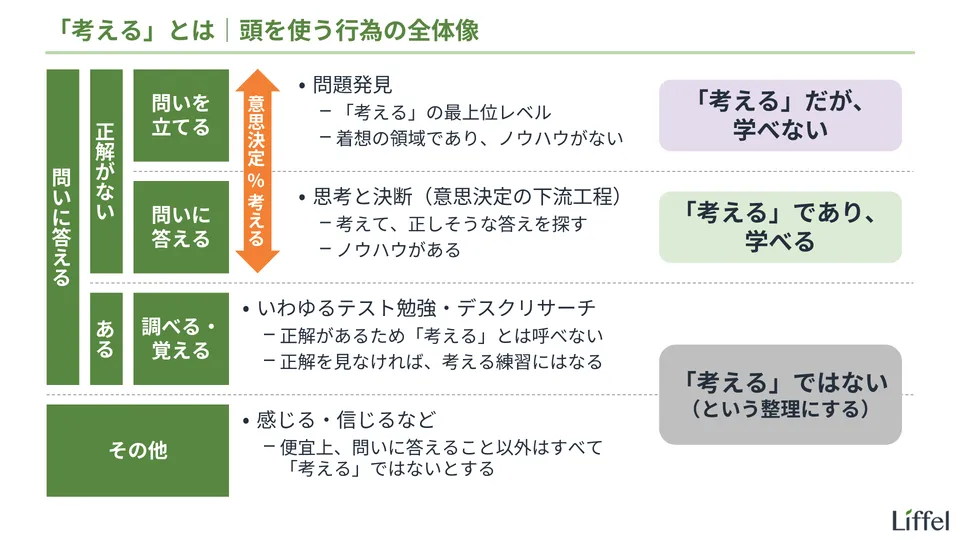
So let’s define “thinking” more narrowly. A definition isn’t practical unless it can at least sort living people into those who are thinking and those who aren’t. Take a look at the slide below.
To give the conclusion first, this site defines thinking as answering a question that has no correct answer (making a decision).
Let me explain step by step.
Thinking, Part 1: Answering a Question
First, although our brains do many things for us, we’ll consider only “answering a question.” Since we want a narrow definition of thinking, let’s cut everything else away.
In other words, the following acts and functions are brain functions, but they don’t count as thinking:
- Feeling
- Believing
- Processing information
- Controlling the body
This much is for convenience, so just accept it.
Thinking, Part 2: Does the Question Have a Correct Answer?
Next, we sort by whether the question you’re trying to answer has a correct answer. Here, a “correct answer” means “a single answer that is right beyond dispute.”
Correct answer: a single answer that is right beyond dispute
Even when you’re “answering a question,” what you actually do is completely different depending on whether the question has a correct answer. Let’s call each act the following:
- Answering a question that has no correct answer: decision-making
- Answering a question that has a correct answer: studying for a test
- You could also call it “desk research”
Of these, studying for a test doesn’t count as thinking. As you know, you can find a correct answer by searching or asking someone. These days, AI is becoming reliable for this, too.
In other words, answering a question that has a correct answer means looking up the correct answer. You aren’t doing anything with your own head. Counting this as thinking would only confuse things.
Looking things up and memorizing don’t count as thinking (on this site’s terms)
What Studying for Tests Is Good For
Don’t get me wrong: some studying for tests is good practice for thinking. I won’t go into detail since it’s a digression, but if you work through a thinking-based subject like math without looking at the answers, you’ll develop a skill you can also use in decision-making (answering a question by building up right steps one by one).
In fact, it may be that unless you study for tests with that mindset (I’m practicing thinking), studying for tests has finally become pointless. Again, that’s because we now live in a world where you can get any correct answer by asking your phone.
Of course, some value remains, such as truly understanding knowledge and making it your own, or scoring high on real tests where you can’t use your phone. But you can learn knowledge properly when you actually need it, and in the real world, nobody thinks without using the internet1. For questions that have a correct answer, you just look it up online and move on.
Overall, keep these two points in mind:
- It’s a stretch to call studying for tests “thinking”
- When you study for tests, you should do it with the mindset of practicing thinking and building your thinking skills
Let’s move on.
Thinking, Part 3: Decision-Making
Let’s define what’s left, answering questions that have no correct answer (making decisions), as “thinking.” That’s much more specific and narrower than “using your brain.”
Thinking: answering a question that has no correct answer (making a decision)
For example, answering the following questions is thinking:
- Should I go to college or get a job?
- Which company should I work for?
- Should I buy a house or rent?
None of these questions has a correct answer. Answering questions like these is what thinking means.
Are We Thinking?
Once you define thinking this way, you’ll realize that we hardly ever think in daily life.
Look back on the past week. How much time did you spend clearly aware of a question with no correct answer and searching for an answer to it? Unless you’re exceptional, probably not much. Thinking isn’t all that common.
Exercise
Let’s check what you’ve learned with an exercise.
Define the act of “thinking.” Then, using that definition, describe something you thought about in the past week.
Try writing your answer in the box below.
Thinking is answering a question that has no correct answer.
Note: What you thought about can be anything, but ideally you should write it as a question, such as “What existed before the universe began?”
The Two Steps of Decision-Making
We’ve defined thinking as making decisions. Now let’s dig into decision-making.
Look at the slide above. As shown, decision-making can be broadly divided into two steps:
- Asking a question
- Answering the question you asked
Although together they make up thinking, they use your head in completely different ways. Don’t lump them together.
Let me explain step by step.
Step 1: Asking a Question
Decision-making starts with asking a question. In other words, you think about what to think about. Let’s look at an example.

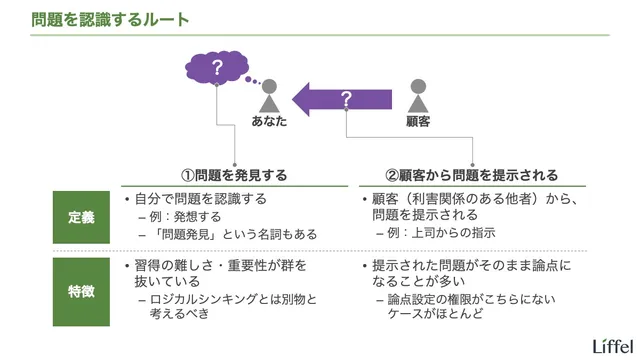
Asking a question on your own like this is called “problem finding.” Remember this term while you’re at it.
Problem finding: asking a question that has no correct answer on your own
Problem finding isn’t the only way questions arise. As below, questions can also come up naturally in daily life.
Others (a manager or a teacher) may also tell you, “Think about this.”
In any case, decision-making can’t begin until someone asks a question that has no correct answer. This is truly the very first step.
Thinking in the Age of AI
In the age of AI, the first kind of thinking expected of humans as their work is probably this ability to ask questions.
As you know, AI doesn’t suddenly come to you and ask, “Shouldn’t you think about this?” (although it may make suggestions at the end of a conversation). We have to ask the question first.
In other words, asking questions (and, more fundamentally, deciding to think at all) should remain a human stronghold to the very end. If even this were left to AI, we’d be in a world where humans have no need to think at all. Surely that’s still science fiction.
What Makes a “Good” Question?
Ideally, as humans, we want to come up with good questions. So what makes a question good?
In general, a good question is one that:
- Would create great value if answered, and
- Seems answerable
This becomes obvious if you think about it the other way around. There’s no point in thinking about a question whose answer creates no value, and there’s equally no point in thinking about a question that can’t be answered.
Asking Questions Can’t Be Learned
Here’s the bad news: asking good questions is hard, and no one knows how to build the ability to ask them. This is the realm of ideas and inspiration, and no one has put the know-how into words. At least as far as I know, no such know-how has been proven to work for everyone.
In other words, although asking questions is the most important part of thinking, the reality is that we don’t really know what to do about it.
Asking questions is the most important part of thinking, but no one really knows how to get better at it
So let’s leave this topic here for now. I’ve written a more detailed explanation in another entry, so if you’d like to dig deeper, read the one below (it jumps ahead in the learning order).

Step 2: Answering the Question You Asked
Let’s move on. Once a question has been asked, what remains is answering it. This is the second step of decision-making.
To give you the key point first: I recommend that you start by treating this step as “thinking” and working to get better at it.
What do I mean?
The Goal Once a Question Has Been Asked
First, once a question has been asked, the goal is, needless to say, to reach the right answer2.
That’s obvious. No one wants to arrive at a wrong answer. Nor does anyone want to keep thinking forever. Once you start thinking, you want to find the right answer at some point and be done.
The goal of decision-making (once a question has been asked): reaching the right answer to the question
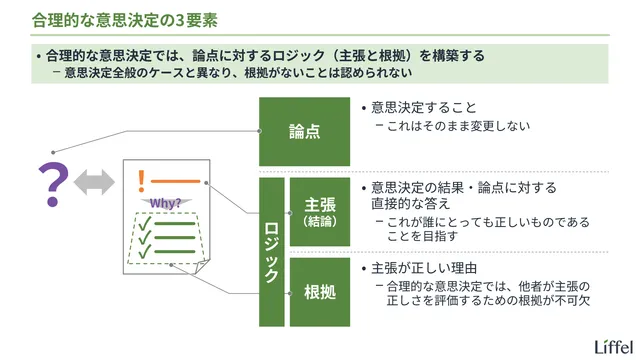
However, this goal isn’t easy to achieve. Again, that’s because the questions we think about have no correct answer. Unlike test questions, there’s no answer key. You have to decide for yourself what counts as “right” and then choose an answer.
How Can You Reach the Right Answer?
So how should you think to reach the right answer?
In the end, this question is everything. Everyone wants to know the answer to it:
How can you arrive at the right answer to a question that has no correct answer?
And the answer to this question is known (to some extent). Take a look at the list below:
- Critical thinking
- Also logical thinking, logical reasoning, and so on
- Rationality
- Science
All of these are systems (ways of thinking, skills) for finding the right answers to questions with no correct answer. Although they go by various names and vary in content, in my view they’re essentially the same thing.
Or rather, it’s more accurate to say that what should be one and the same has been split into pieces. All we want is to find the right answers to questions with no correct answer, not to acquire many different ways of thinking. If you can reach the right answer, one way of thinking is enough.
On this site, I use the term “critical thinking” as an umbrella term for these ways of finding the right answers to questions with no correct answer. Note that this differs slightly from the common usage.
”Critical thinking” on this site: how to find the right answers to questions with no correct answer
Start by Learning the Basic Forms
To sum up, unlike asking questions, answering them does have know-how. The right approach is known, and if you put in the effort, you’ll definitely improve.
Of course, learning critical thinking doesn’t guarantee that you’ll always find the right answer. Answering questions with no correct answer isn’t that easy.
Even so, you’ll certainly do much better than if you knew nothing. When you take up a sport, you first learn the basic forms. In the same way, there are basic forms you can use when thinking about questions with no correct answer. Learning them lets you think far better than you would by thinking blindly.
Critical Thinking Keeps You from Blindly Following AI
Also, not only asking questions but also answering them should remain human thinking. Since there’s no correct answer, AI can’t know it either. Although AI may offer candidate answers, it’s up to us to decide whether they’re right.
In particular, from what I’ve observed, AI tends to do the following (as of 2026):
- State things confidently even when they’re made up
- Tell you what you want to hear
- This tendency is especially dangerous when it comes to answering questions with no correct answer properly
When you use a tool with these tendencies, unless you can say, “It’s up to me to decide what’s right, and I can do it,” you’ll end up doing whatever the AI tells you. To use AI properly, critical thinking is essential.
So I recommend starting with critical thinking (= how to reach the right answer once a question has been asked). You can then take your time working on how to ask questions.
That covers what it means to think. Next, let’s prepare the tools for analyzing decisions. Continue to the entry below.
Entries related to critical thinking are collected on the page below. Feel free to use them as a reference.
Learn or Review with the Video
Here’s the video mentioned at the start (in Japanese). Although the content isn’t exactly the same, the main points are.
Footnotes
-
That said, when you want to think deeply on your own, it’s better to step away from the internet. What I mean here is that it’s unrealistic to go without the internet from start to finish. ↩
-
Since we’re thinking about questions with no correct answer, strictly speaking, it’s “the answer most likely to be right.” ↩