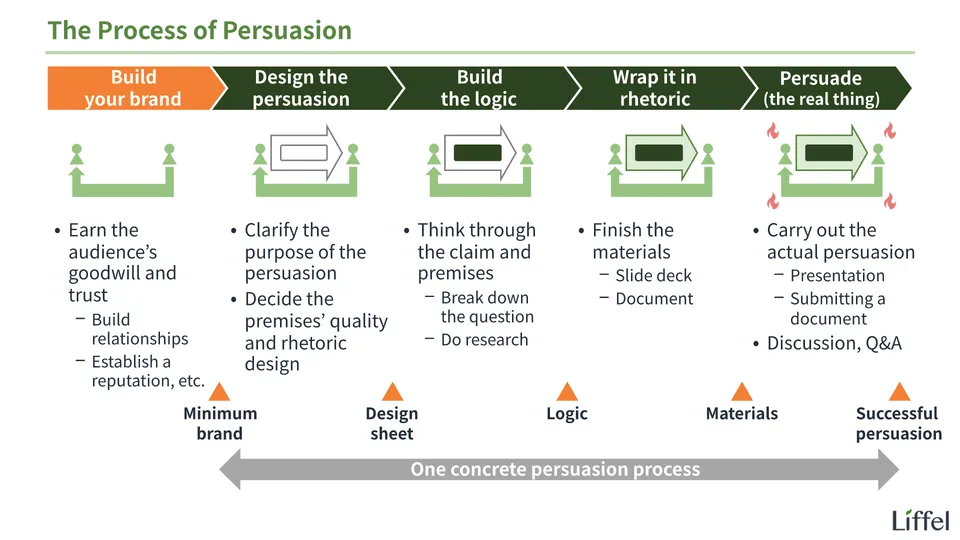
This entry explains how to build your brand, the first step of persuasion. In other words, how do you earn the audience’s trust and goodwill?
Having at least a minimum brand with your audience is a precondition for successful persuasion. And of course, the stronger your brand, the better. This entry looks at what a brand is made of and what you can do to strengthen it.
Let’s begin.
toc
- How to Build Your Brand
- Brand Point #1: Growing a Brand
- Brand Point #2: Brand and Rightness
- Brand Point #3: Introducing Yourself During the Real Thing
- Going Forward
How to Build Your Brand
So what, concretely, should you do to build your brand?
First, take another look at the elements that make up a brand.
As shown, a brand consists of “the persuader themselves” and their “track record.” That means there are only two broad ways to build a brand:
- Improve yourself
- Build up a track record (with a specific audience)
The table below summarizes actions for building your brand.
Although it may not be exhaustive, I believe it covers the main ones1. Since it covers such a wide range, some items may be questionable or vague. Please bear with me.
The stronger the brand you build through these actions, the higher your chances of persuading successfully.
How This Site Handles Brand
I’m sorry to say it, but I won’t go through this table in detail. Its contents are simply too far from the main theme of this category, presentations. At this point, it’s really a matter of “branding.”
Also, although this isn’t the reason I’m skipping it, I believe it’s wrong to dig into these actions in the context of “making persuasion succeed.”
That’s because building a brand is nothing other than becoming a better person. After all, that’s the kind of person we trust.
Seen that way, “becoming a better person in order to persuade successfully” sounds rather sad. We don’t improve ourselves or contribute to others because we want our persuasion to succeed. Of course, that motive can be part of it, and this entry does explain things in that context. Usually, though, there are nobler reasons.
In fact, if your attitude of “building a brand to persuade successfully” becomes too obvious, you’ll actually fail to build one. For example, we can’t trust someone whose aim of persuading us when it counts (say, getting us to buy something) is plain to see. People are complicated.
For these reasons, this entry doesn’t explain the actions for building a brand in detail. On brand, I’ll cover only the following points:
- Growing a brand
- Brand and rightness
- Introducing yourself during the real thing
Let me explain each in turn.
Brand Point #1: Growing a Brand
First, a brand can’t be built overnight. That’s clear from the table above. Here it is again; take a look.
Of these actions, only those in the “adornment” category can be expected to pay off quickly. There’s no quick way to improve your attributes2, and building up a track record takes time too.
Needless to say, perfect adornment alone doesn’t give anyone a strong brand.
In other words, if you find yourself wishing your brand were a bit stronger for an upcoming act of persuasion, it’s unfortunately too late. Better to accept that and focus on logic and rhetoric.
Raising your brand for an imminent act of persuasion isn’t realistic
Start with Adornment
Turning this around, we can say the following:
The first brand-building to tackle is adornment (clothing, makeup, hair, and nails). If you haven’t already, invest in adornment.
The reason, as the table shows, is that adornment improves your appearance quickly. Other aspects of appearance, such as your physique or teeth, can’t be changed that fast. Even by the shortest estimate, they all take six months to a year (whitening alone is a bit quicker). Not only in time but also in cost and effort, adornment is the easiest to improve.
So it’s best to get adornment up to a passing grade as soon as possible.
What counts as a “passing grade,” then? You don’t need to dress head to toe in luxury brands (overdoing it is actually a risk); you just need to look clean and well kept. Search online for specific criteria and methods. You’ll find plenty.
The first step in building a brand is adornment
Grow Your Brand over the Long Term
Beyond adornment, all I can say is that it depends on the case. Even so, I think growing your brand from a long-term perspective is a good investment.
The reason is the one given above: this isn’t something you do to make persuasion succeed, but an effort to become a better person. Since a brand simply follows as a result, there’s no reason not to do it.
As the table shows, everything other than adornment is hard and takes time. Since tackling it all at once isn’t realistic, think about what you need right now.
When growing your brand, also keep in mind that a negative track record can’t be erased. A criminal record is the obvious example. Even if you’ve properly made amends, you can’t undo the damage to your brand of being “someone who once did XX.”
What’s more, in an age where people talk about our “digital footprint,” negative actions are recorded online and stay there more or less forever. Even as time passes, even if you move, you can’t escape your past negative actions. The world has become an unforgiving place.
Even if living a completely spotless life is hard, “don’t write careless things online, and don’t post careless photos or videos online” may be the single most important thing for building a brand over the long term.
Brand Point #2: Brand and Rightness
Next, brand has nothing to do with whether a claim is right. This is especially worth remembering when you’re the one being persuaded.
Although what “rightness” means is itself open to debate, if we take so-called “scientific or logical rightness” as the standard, only the premises determine it. Rhetoric and brand have nothing to do with rightness.
Here are the structures of persuasion and logic again.
Rhetoric, however, is indirectly related to rightness. If the delivery is poor, the audience may not understand the premises in the first place. Premises the audience doesn’t understand can’t contribute to rightness (for that audience). For more on this, see the following entry as well.
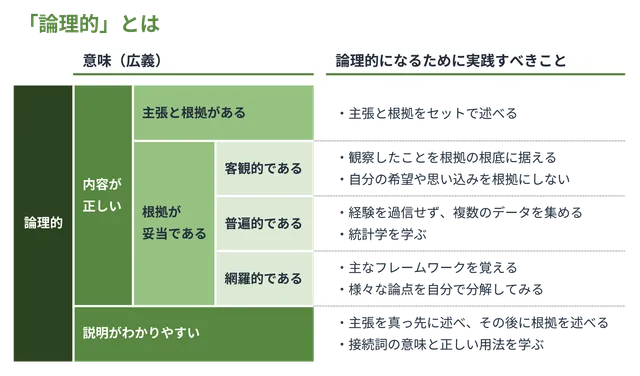

Brand, however, has nothing to do with it at all.
In other words, who says something has nothing to do with whether the claim is right. If you want to evaluate whether a claim is right, ignore brand and focus on the logic.
The Halo Effect
People, however, aren’t good at thinking that way. We tend to feel that whatever someone with a strong brand says is right, without question. For example, what a university professor says can sound right even when it’s outside their field.
This psychological phenomenon is called the “halo effect,” and it’s perfectly normal. You and I both get pulled along by brand. There’s nothing we can do about it.
Brand has nothing to do with rightness, but people get pulled along by it (the halo effect)
To sum up, brand has nothing to do with “whether something is really (scientifically or logically) right,” but it is effective at “making the audience feel that it’s right.” Although this may be confusing, keep the distinction in mind.
How should we think about this fact?
When you’re the audience, it’s simple. Remember the term “halo effect.”
When you’re the audience, your goal isn’t to be persuaded. With that as your goal, you’d keep getting talked into buying everything and end up penniless.
Your goal should be to make the decision that’s right for you. The persuader’s brand doesn’t contribute to that goal. Step back and watch yourself to see whether you’re being pulled along by brand too much. For truly important persuasion, try writing out the premises you’ve been given.
When you’re the persuader, it’s a little more complicated.
Let’s assume that you don’t want to deceive your audience. You want them to accept what you believe is right.
In that case, it would be a waste not to use what you have just because brand has nothing to do with rightness.
Although there’s no single answer here, my view is that you should use what you have. In other words, if you have a strong brand, you should use it to raise your chances of persuading successfully.
The time to do so is at the start of the real thing. However, you should keep it in moderation.
What do I mean? Let’s move on to the last point.
Brand Point #3: Introducing Yourself During the Real Thing
In fact, you can also build your brand at the start of the real thing.
Strictly speaking, there are two brand-related parts of the persuasion process:
- Raising each element that builds your brand: placed at the start of the persuasion process, and it takes a long time (it isn’t really part of any specific persuasion process)
- Showing the brand you currently have (especially your attributes) to the audience in front of you: at the start of the real thing
What I’m talking about here is the bolded one. Use the following slide to get a feel for it.
This is simply introducing yourself at the start of the real thing. If you push it hard, it becomes “self-promotion.”
Note that this applies only to persuasion where most of the audience doesn’t know you, such as seminars or books. If the audience already knows you (an internal meeting, for example), there’s obviously no need to introduce yourself. If that’s the only kind of persuasion you do, feel free to skim this section.
Back to the topic. Let’s break down what you might cover in a self-introduction:
- Attributes
- Appearance
- Other (family, hobbies, etc.)
Let’s look at each in turn.
Attributes
First come attributes. These are your background and achievements, and talking about them establishes your authority with the audience.
A self-introduction centers on your attributes, because you want to establish authority at the start of the persuasion and make the audience think, “What this person says is probably right.”
Appearance
Next, let’s think about appearance.
When the audience can see you, as in a presentation or a video meeting, there’s no debate. They can see you without any introduction.
In this case, the better your appearance, the more seriously the audience will listen to your persuasion. As celebrities show, people with good looks draw others in.
In this sense too, investing in adornment pays off handsomely. On the day of a presentation, at least, you’ll want to look sharp.
What about persuasion where you don’t necessarily have to show your appearance, such as a book?
There’s no single answer here. To repeat, since brand has nothing to do with rightness, neither does your appearance. There’s no strict need to show your face or yourself.
Although that’s right in theory, I suspect most people simply trust someone who shows their face more. In my opinion, unless you really don’t want to, it’s better to include a photo of your face.
Other
Finally, you might also share other information, such as your family or hobbies. You do this to make the audience feel closer to you.
If you had to sum up brand in a word, it’s whether the audience likes or dislikes you, not whether they find you impressive.
We don’t necessarily come to like people because they’re impressive (though some people might). If you talk only about your attributes, you may establish authority, but you risk coming across as someone who’s full of themselves.
So it may be worth adding information that conveys your personality and humanity.
How Far to Go
A self-introduction like this isn’t just effective for persuading successfully; you could even call it basic courtesy.
You do need to be careful, however: if your brand-building in a self-introduction is too blatant, some members of the audience will become distrustful.
The reason, as I said, is that brand has nothing to do with rightness. To an audience that knows this (an audience that knows the term “halo effect”), relentless brand-building during the real thing looks like a lack of confidence in your logic, or a sign that you assume the audience isn’t very smart.
For example, in my experience, how blatantly a book builds its author’s brand is clearly inversely related to the quality of its content. Specifically, books like the following are almost always duds (their claims aren’t convincing, and there’s nothing to learn):
- The self-promotion section at the beginning is long
- If the whole first chapter is self-promotion, it’s definitely a dud
- They make a big show of numbers the reader has no way to verify (income, page views, etc.)
- People often say “numbers don’t lie,” but liars make up numbers
- The cover is a photo of the author
- If it’s a close-up of their face, it’s definitely a dud
Although this is only my own rule of thumb, I’m fairly confident it holds up. Test it yourself the next time you buy a book.
In the end, I think it comes down to this: “Brand has nothing to do with rightness, but people who lean too hard on brand aren’t right.” Maybe I’m just too cynical, but I get the impression this tendency has been accelerating lately. Be careful when you’re the audience.
The same goes for when you’re the persuader. Think about the quality of your audience, and be careful not to overdo it.
Advanced Technique: Let the Audience Talk
Finally, a side note: during the real thing, letting the audience talk as much as possible raises your brand. People tend to trust those who listen seriously to them more than those who talk at them. That’s just how it is.
In persuasion you prepare for in advance, such as a presentation, you inevitably end up doing most of the talking. The audience often expects that, too, and if you let them talk carelessly, things may not go as you planned.
So although it depends on the case, even if you can’t help doing most of the talking, you should avoid situations where you’re the only one talking right up to the end. Your persuasion should go better if you hand the ball to the audience at each break in the presentation (“Any questions so far?”) or allow plenty of time for Q&A at the end.
Remember how boring classes were when the teacher just talked at you the whole time? Don’t do the same to your audience.
Going Forward
That covers brand.
As I said, this site’s explanation of brand ends here. From now on, I’ll proceed on the assumption that “you have a minimum brand (there’s no problem with your brand).”
From the next entry on, I assume that you have a minimum brand
This doesn’t mean, however, that brand isn’t important. There are many cases where the success of persuasion depends on brand. I’m skipping the explanation only for practical reasons, so please don’t misunderstand.
Starting with the next entry, let’s learn how to design persuasion. Please continue to the following entry.
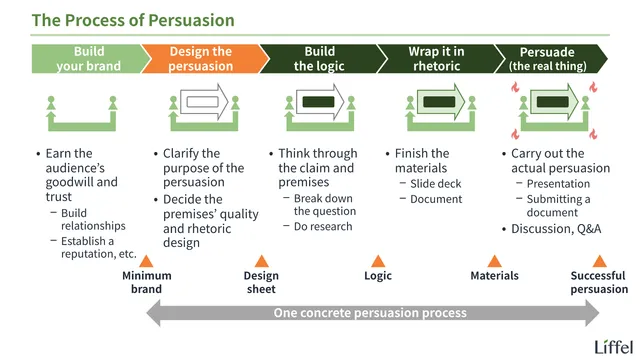
All presentation-related entries are collected below.

Footnotes
-
Note that I’m not recommending every action on this list (cosmetic surgery, for example). I’m simply listing what could conceivably raise a brand. ↩
-
Strictly speaking, there are ways to improve your attributes instantly. For example, if you set up a nonprofit association, you can be its chair by tomorrow. Likewise, if you start a company, you can become its CEO. Although both cost something, neither involves lying, and both are perfectly legal. Still, it’s a question of whether you’d go that far just to build a brand. ↩