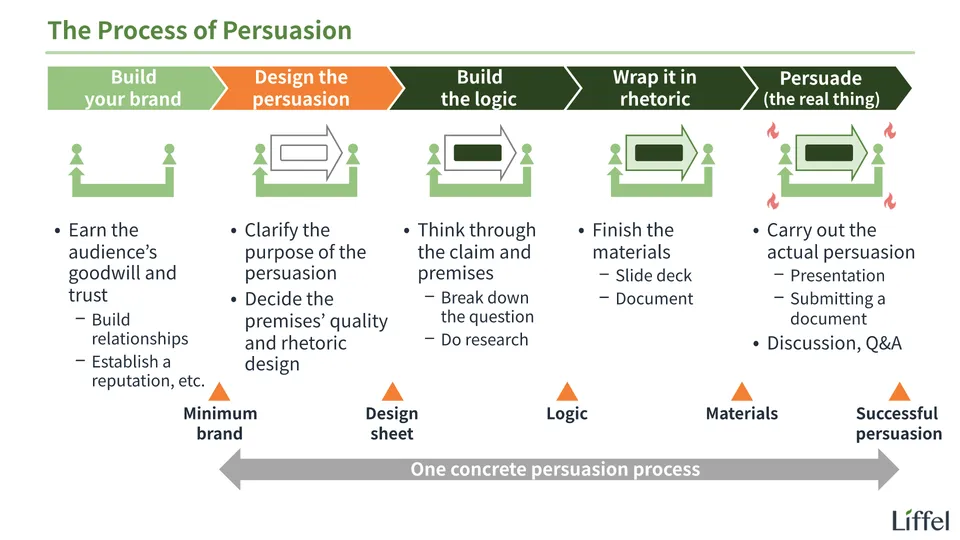
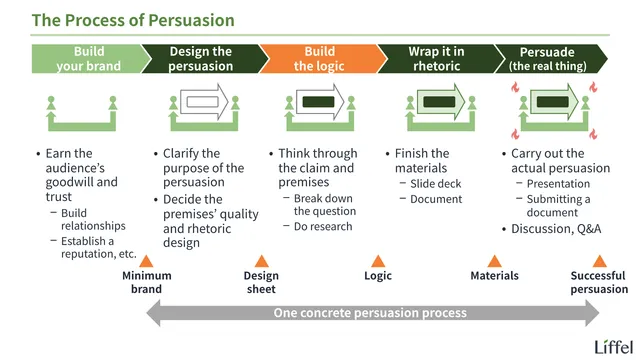
In this entry, let’s learn how to clarify the purpose of your materials (documents and presentations).
When you create materials, you clarify their purpose before you actually start making them. That only makes sense: when you try to persuade others through materials or a presentation, it’s because there’s some purpose beyond it. Starting to create materials without a clear purpose is the wrong way to go about things.
In other words, there’s something you need to do before thinking about what to convey or polishing how to convey it. In this entry, I’ll call this “thinking through what to think about first when creating materials” design. So this entry is about learning design.
Let’s begin.
toc
- What Is “Design”?
- The Purpose of the Persuasion
- The Problem and the Question
- The Direction of the Logic and Rhetoric
What Is “Design”?
What, concretely, does “design” involve?
To give the answer first, design means doing the following two things:
- Clarifying the purpose
- Thinking about the direction of the logic and rhetoric
That probably doesn’t mean much to you yet. Until I finish explaining, just think of “designing” as filling in the design sheet below.
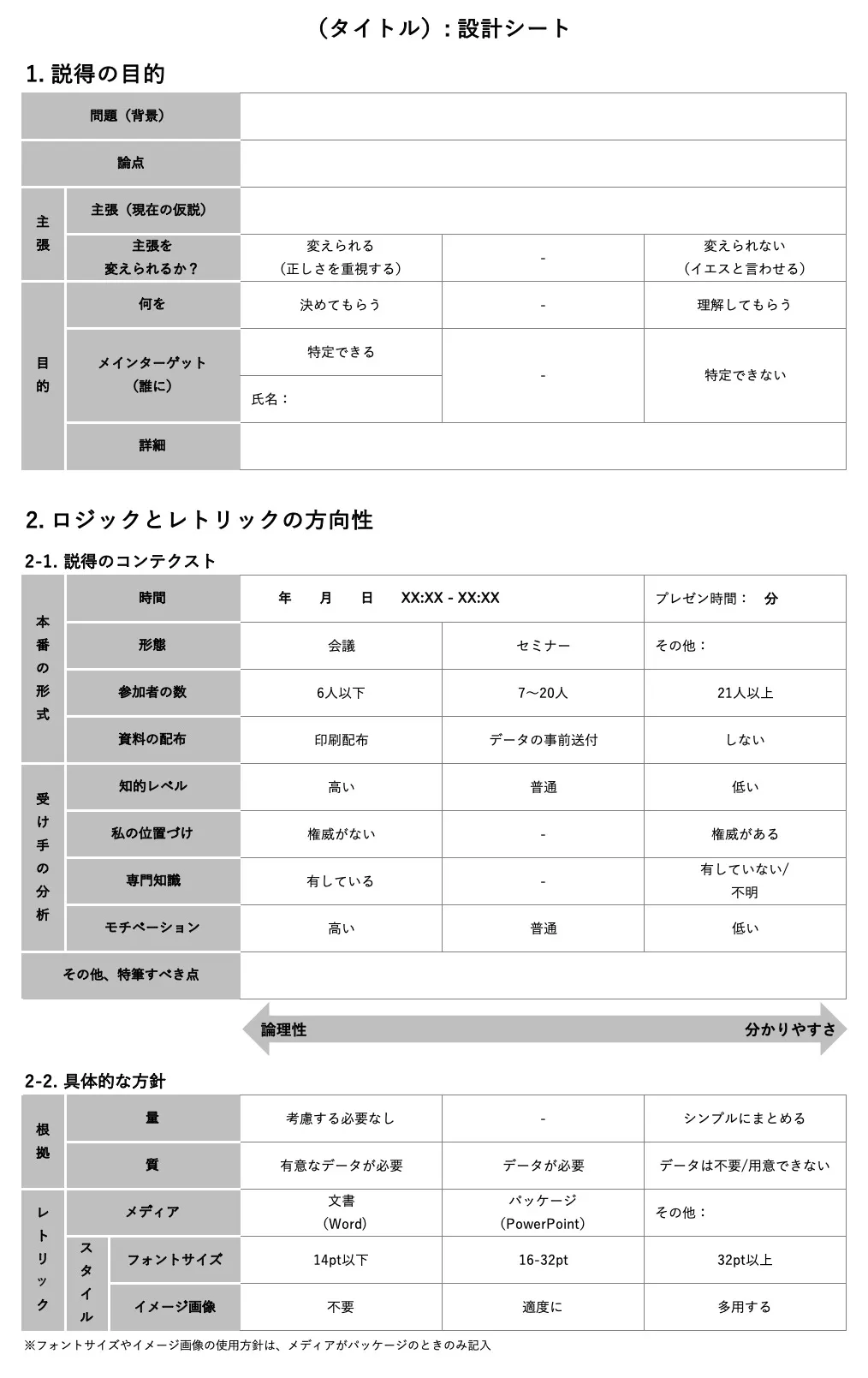
Of course, what matters is understanding what you do with this sheet; you don’t have to use this exact sheet. Since it makes the explanation easier, though, this site uses it.
A Hypothetical Situation and a Filled-In Example
Since a blank sheet alone would make the rest of the explanation hard to follow, I’ve also prepared a design sheet filled in for a hypothetical situation. The situation is as follows:
- You are the right-hand person of the president of a company (Taro Yamada)
- At last week’s performance review, it came to light that the Kansai branch’s performance is deteriorating rapidly (down 20% year over year)
- The president told you, “You’re in charge. Report back next week on what we should do”
- Today is April 1, 2020
- Company rules require that reports be given as presentations, and that the slide deck be sent to meeting participants by 5 p.m. the day before the presentation
Here is the design sheet filled in for this situation.
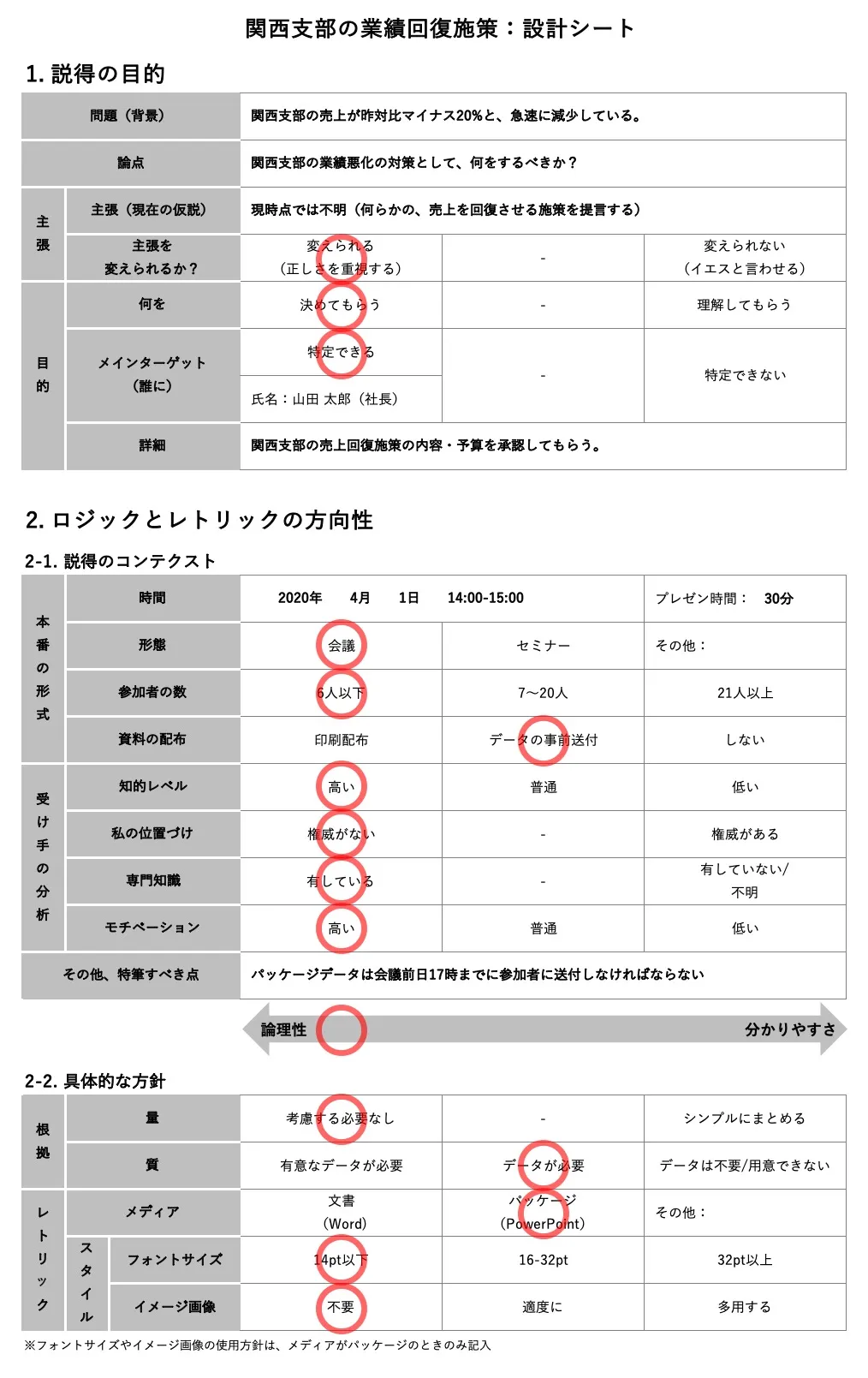
Download
You can download the design sheet with the button below (it is in Japanese). I’m releasing this sheet into the public domain (no copyright), so feel free to customize and redistribute it. Although it’s not required, I’d appreciate a mention of this site if you redistribute it.
The Purpose of the Persuasion
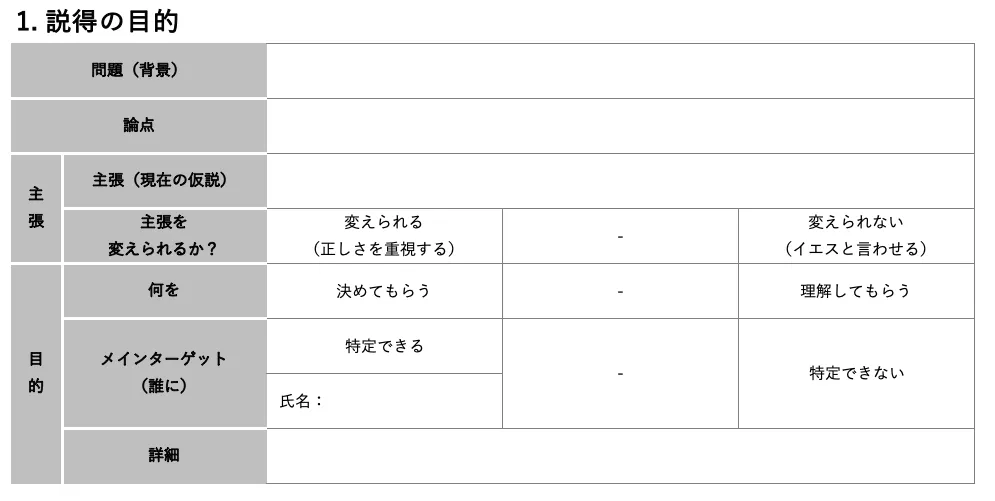
Let’s go through the design sheet from the top, starting with the purpose of the persuasion. The reason it isn’t “the purpose of the materials” is that you don’t just create materials and stop there; you use them to persuade someone.
In short, this means stating concretely “who you want to do what.” To do that, think about the following:
- What are the problem and the question? (What sense of a problem is there, and what exactly will you think about?)
- What is the answer, or what is it likely to be?
- Since you haven’t done the work yet at this point, it’s normal not to know the answer
- Who is the target? (Whom are you trying to persuade?)
- What do you want that person to do?
Let’s look at the design sheet filled in for the example above.
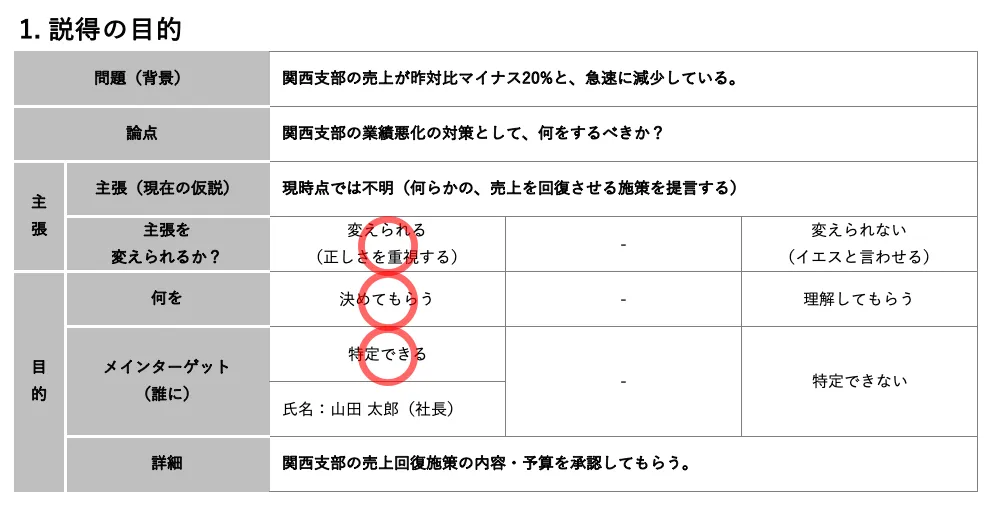
What’s written in “Details” at the bottom, “getting approval for the content and budget of measures to recover sales at the Kansai branch,” is the purpose this time.
How to Make the Purpose Concrete
What should you do to make the purpose concrete?
The answer is simple: just fill in the upper part of the sheet. In other words, to make the purpose of the persuasion concrete, you clarify the problem and the question. These two are the starting point of persuasion, and the purpose of the persuasion takes concrete shape from them.
So let’s dig into these two.
The Problem and the Question
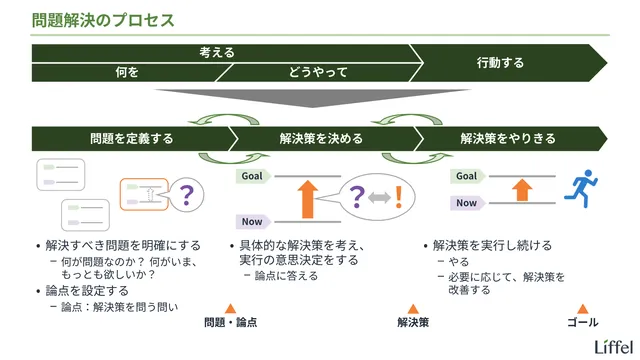
Let’s get straight to it. The following slide summarizes what the problem and the question are, and how they relate to persuasion.
Let’s go through it step by step.
The Problem
Let’s start with “the problem.”
A problem is “a current state that has a gap with the goal.” On the slide, you can see a gap between the goal and the current state.
This is explained in detail in a separate entry. If you’re not used to this way of using the word “problem,” read the entry below before moving on.

The Fundamental Starting Point of Persuasion
At the root of any persuasion, the audience needs to have a problem. In other words, for persuasion to take place, the audience must have some kind of dissatisfaction or desire.
This is obvious from the audience’s point of view. For example, you’re reading this entry right now (= being persuaded by me). Is it possible that you have no interest at all in creating materials or giving presentations? Normally, no. If you weren’t interested, you’d spend your time on something else.
In other words, no one accepts persuasion on a topic they have no problem with (= no interest in). I don’t, and neither do you.
The reason is simple: being persuaded also has a cost. Whether you’re reading a document or listening to a presentation, it definitely takes time, and sometimes money too. For the audience to pay that cost, they need the expectation that “this might solve a problem I have.”
There are exceptions, of course. The obvious ones are meetings and gatherings you’re forced to attend. Whether or not you have a problem, you have no choice but to be persuaded. Seen from the persuader’s side, this means an audience with no problem at all may show up.
Such cases, however, are only exceptions. As a rule, for persuasion to take place, the audience needs to have a problem, such as “I want to know” or “I want to do something about this.”
Persuasion only works where the audience has a problem
That means all persuasion starts with understanding the audience’s problem. This is why the first row of the design sheet is “Problem.”
Filled-In Example
Let’s look at the filled-in example of the design sheet.

In this situation, the Kansai branch’s performance was deteriorating rapidly, down 20% year over year. This is clearly “something bad” for the audience (the president). So you can simply write it down as the “problem.”
When you write the problem, above all make sure it is the audience’s problem. For example, “I have to carry out the task the president ordered” is also a problem in this situation (the goal is a state where the task has been carried out, and the current state is that it hasn’t). But that’s your problem. The audience has no interest in it. Only the audience’s problem belongs here1.
Also, since what you write here goes straight into your materials, write it in wording you could show the audience. In other words, polish every word. Most of the design sheet is for yourself and won’t be shown to the audience, but the problem and the question are exceptions.
The Question
Let’s move on. After the problem comes the question.
The “question” here is, in short, an inquiry: we call the inquiry that arises from a problem a “question.” If you want to learn more, see the entry below.

Filled-In Example
Let’s look at the filled-in example for the question. You just turn the problem around.

As with the problem, make sure it is the audience’s question. In other words, check that it’s a question the audience wants the answer to. In this example, the president would likely want to know the answer to “What should we do to recover sales at the Kansai branch?”
How to Clarify the Purpose
Once you’ve written the question, imagine the answer to it (it doesn’t have to be a final answer yet). Then think about “what you’d like the target to do in response to that answer,” and your purpose becomes clear. Check the sheet from earlier.
With that, the purpose is clear. Above all, rather than trying to “clarify the purpose” from the start, think of it as “clarifying the problem and the question.” Although it may look like a detour, it’s actually the shortcut.
The Direction of the Logic and Rhetoric
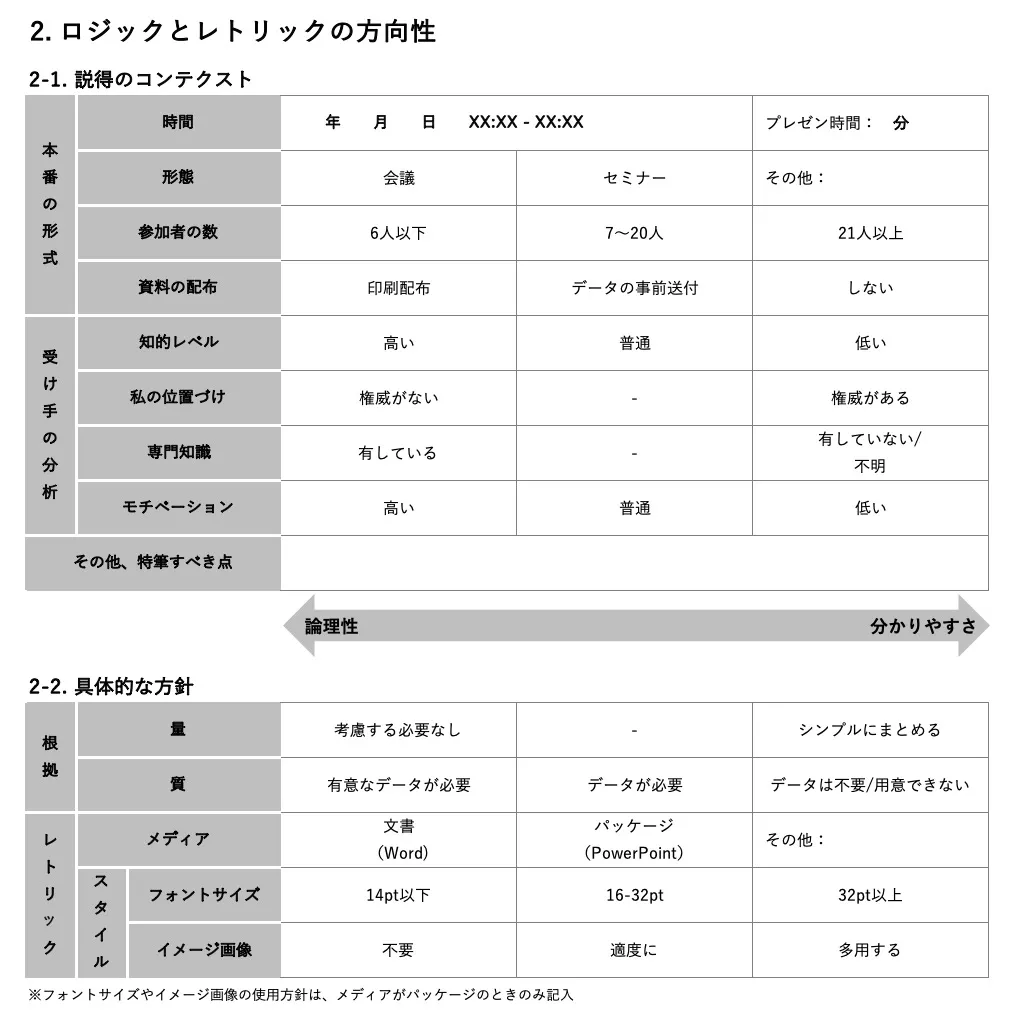
Once the purpose is clear, next think about the direction of the logic and rhetoric. Put simply, you decide on your approach to “how rigorous to make your argument” and “how to convey it.”
For example, even if you create materials on the same topic, “things to watch out for when using smartphones,” the content and delivery would be completely different for a university professor and an elementary school student in your neighborhood. For a professor, you should base your premises on data from research papers and put what you convey into writing as carefully as possible. For an elementary school student, on the other hand, it may be kinder to state just the key points firmly, in large letters.
In this way, before thinking about the content and delivery themselves, you take into account the situation and your relationship with the audience, and think about “how rigorous the content needs to be” and “how it should be conveyed.”
Specifically, think about the following:
- The format of the real thing (in what situation you’ll use the materials)
- Audience analysis (who the audience is, and what your relationship with them is)
In other words, you analyze the context in which you’ll use your materials. Since I’ll skip the details here, take a look at the sheet.
Let’s also look at a filled-in example.
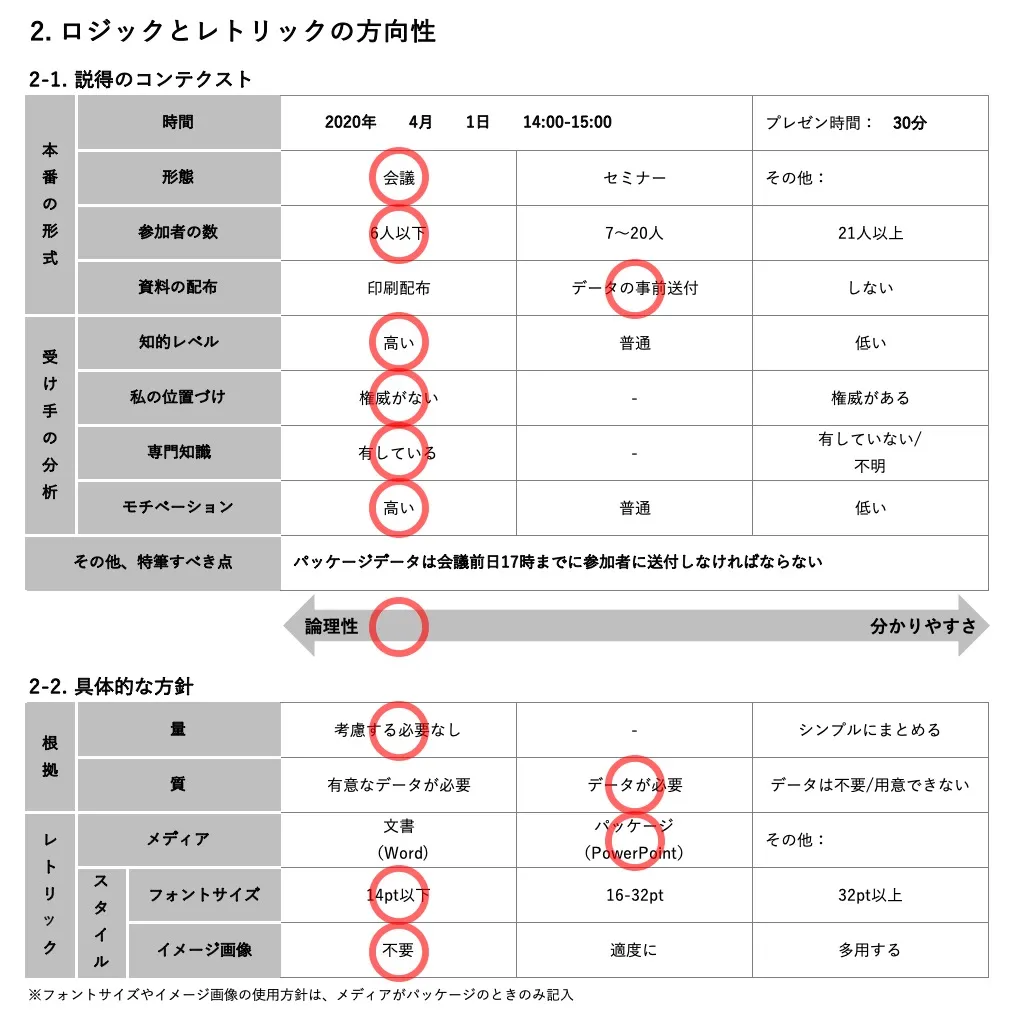
As shown, analyzing the context gives you answers to questions such as “Is a document (Word) or a presentation (PowerPoint) better?” and “If it’s a presentation, how large should the font be?” Once you’ve set these directions, start creating your materials, beginning with the content.
Incidentally, and this applies especially to presentations (PowerPoint), most of the know-how you’ll find online or in books doesn’t take this kind of context into account. As a result, much of it doesn’t apply to some people, or is even wrong for them (for example, “use as little text as possible”). Since the right answer depends on the context, I recommend starting by analyzing your own context.
That’s a brief explanation of designing persuasion. Since a detailed explanation would get far too long, this entry skips some parts entirely.
Next, let’s learn how to create the content. Please continue to the following entry.
All presentation-related entries are collected below.
Footnotes
-
Of course, the ideal is for the audience’s problem to be your problem too. That way, you’ll be more motivated and enjoy the persuasion. The only absolute requirement for persuasion to take place, however, is the audience’s problem. Your own problem is merely “better than nothing,” so don’t get this wrong. ↩