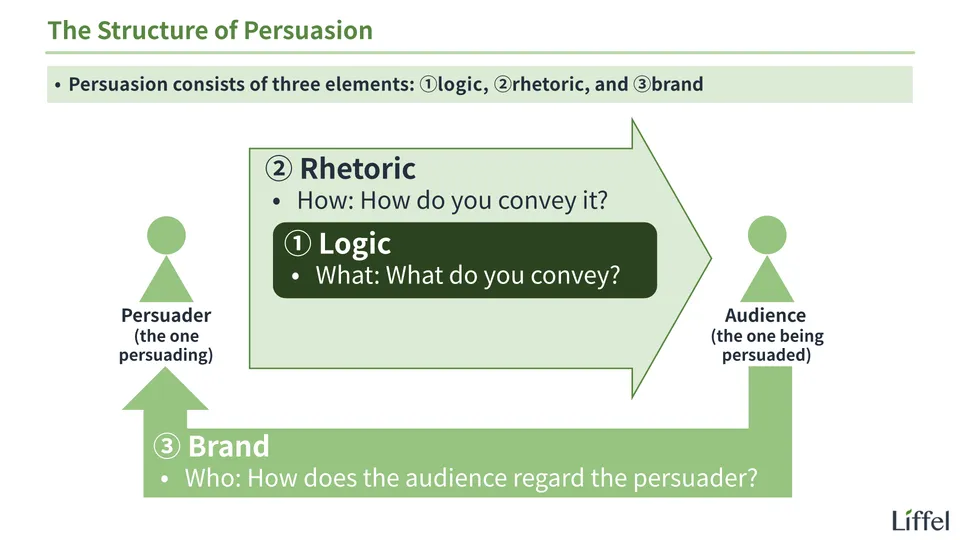
This entry explains the structure of persuasion (what elements persuasion is made of).
Presentations, documents, and the other materials we spend so much time creating at school and at work are all acts of persuasion: communication that tries to get others to accept a claim as right. Yet what actually persuades us is surprisingly poorly understood. Let’s deepen our understanding of persuasion by looking at its structure.
Let’s begin.
toc
- The Structure of Persuasion
- Element of Persuasion #1: Logic
- Element of Persuasion #2: Rhetoric
- Element of Persuasion #3: Brand
- Summary
The Structure of Persuasion
Let’s get straight to it. Take a look at the following slide. This is the structure of persuasion.
Since there’s a lot of information here, let’s go through it step by step.
First, let’s call the person doing the persuading the “persuader,” and the person being persuaded the “audience.”
Persuader: the person who persuades
Audience: the person being persuaded
Although there is, as a rule, one persuader, note that the audience can be more than one person.
The persuasion that takes place between the persuader and the audience consists of the following three elements:
- Logic (What): what you convey
- Rhetoric (How): how you convey it
- Brand (Who): how the audience regards the persuader
As I explain later, “logic,” “rhetoric,” and “brand” are names chosen for analyzing persuasion. Note that they differ slightly from the everyday meanings of these words.
In essence, persuasion consists of three elements: What, How, and Who. Since words like “what” and “how” are used so widely, though, they would be confusing as terms reserved for persuasion. From here on, I’ll use “logic,” “rhetoric,” and “brand.”
Let’s look at each element in turn.
Element of Persuasion #1: Logic
“Logic” is what the persuader conveys to the audience. This one is straightforward.
Logic: what is being conveyed
Logic consists of a claim and premises. I’ll go into these later; for now, let’s start with an example.
The Logic of a Marriage Proposal
Let me use a marriage proposal to explain logic concretely.
First, a proposal is clearly an act of persuasion. The whole point is to get the other person to say “yes.”
So what does the persuader want the audience to say “yes” to?
As you know, a proposal is a request to marry. In other words, every proposal is an act of persuasion aimed at getting a “yes” to “Will you marry me? (You should marry me.)”
The bolded part is the claim of the proposal, because it is what the persuader wants the audience to say “yes” to.
Every proposal has the same claim. That’s because we call persuasion whose claim is “Will you marry me?” a “proposal.” A proposal, as an act of persuasion, is defined by its claim.
What about premises? In a proposal, premises vary.
For example, “because I love you and want to spend the rest of my life with you” is a typical premise. “Because I want to make you happy” may be more fitting, since it takes the audience’s point of view.
Notice that both bolded parts are reasons why the audience should say “yes.” That is what premises are.
Claims and Premises
As I said, logic consists of a claim and premises. Take a look at the following slide.
As shown, a claim is “what you want the audience to say ‘yes’ to,” and premises are “the reasons the claim is right.”
Claim: what you want the audience to say “yes” to
Premises: the reasons the claim is right
Note that since not every claim is a matter of being right or wrong, in some cases it is better to read premises as “the reasons the audience should say ‘yes’ to the claim.” The proposal above is one such case.
Also, premises are not strictly necessary for logic. As long as there is a claim, the logic holds even without premises. After all, a proposal hardly needs premises to work.
On the other hand, every piece of logic needs a claim. Persuasion without an identifiable claim leaves the audience unsure what they are being asked to say “yes” to, which takes it outside the definition of persuasion.
In other words, the claim is the heart of persuasion. Whenever you persuade, make sure your claim is clear1. What exactly do you want your audience to say “yes” to?
The claim is the heart of persuasion
Element of Persuasion #2: Rhetoric
“Rhetoric” is how the logic is conveyed. Think of it as which tools you use (voice, text, facial expressions and gestures, etc.) and how you use them.
Rhetoric: how the logic is conveyed
The Rhetoric of a Marriage Proposal
Let’s continue with the proposal. What kinds of rhetoric can a proposal use?
There are countless ways to convey the claim “Will you marry me?” You can simply say it, or you can hand over a ring without a word and still get the message across.
YouTube is full of elaborate proposals, such as flash mobs (surprise performances staged in public places). If you’re curious, search for “proposal.” You’ll see just how varied rhetoric can be.
The Elements of Rhetoric
Rhetoric consists of media and style. Take a look at the following slide.
Note that both “media” and “style” mean something different from their everyday senses here.
Let’s look at them in detail.
Element of Rhetoric #1: Media
“Media” are the formats used to convey something, along with the devices used for them.
The following slide summarizes the main media.
For example, I’m using text to convey my logic to you right now. I’ve also mixed in some slides here and there. Inside the slides, besides text, there are sometimes diagrams and images.
Note that media can be nested: a medium can contain smaller media inside it.
I’m delivering the logic wrapped in these media to you in the form of a website (blog entry). And you’re probably receiving my persuasion on a computer, tablet, or smartphone.
Everything in bold here is a medium. Although this stretches the word “media” to cover quite a lot, the idea should feel intuitive, since these are all things we deal with every day.
Element of Rhetoric #2: Style
Next, “style” is the way of expressing something within a given medium. In advertising, this is sometimes called “tone and manner,” but on this site, I use “style” throughout.
Since what counts as style depends on the medium, you need to think about the elements of style medium by medium.
Let me use this entry as an example. As mentioned above, this entry mainly uses the medium of text. The style elements of this medium can be organized as follows:
- Wording
- Structure (conclusion first, chronological, etc.)2
- Tone (formal or casual, word choice, etc.)
- How the text looks (formally, “typography”)
- Font (the design of the letters)
- Typeface, text size, text color (and background color)
- Other
- Alignment, line spacing, columns, margins
- Font (the design of the letters)
All of these are style (elements of style). Notice how much each of them affects how the message comes across.
Like, say I suddenly switch my style to something super casual right here (which you’d totally never do normally). You can feel the vibe change, right?
In this way, every element that affects how a message comes across in a given medium is style. I’ve used text as the example here, but other media, such as voice and images, have their own style elements too. Try thinking about what they might be.
Element of Persuasion #3: Brand
Finally, “brand” is how the audience regards the persuader. Think of it as the sum of the audience’s feelings toward the persuader (“I like them,” “I respect them,” “I can trust them,” “I’ll listen to what this person says,” and so on).
If that’s hard to grasp, it’s not a big problem to think of it simply as “whether the audience likes or dislikes the persuader.”
Brand: how the audience regards the persuader
The Brand Behind a Marriage Proposal
A proposal is the perfect example for understanding brand.
Whether a proposal succeeds depends 100 percent on brand. For a proposal to succeed, the audience has to feel that “I’d be happy if I married this person.” That isn’t something the logic or rhetoric of the proposal itself can fix. What matters is the relationship built up over time.
Earlier, I mentioned that YouTube has plenty of proposal videos. Imagine that the person proposing in one of those videos were replaced by someone else. Even with exactly the same logic and rhetoric, the proposal would surely fail. If it succeeded, that would be scary.
What Builds a Brand
A brand is built by the persuader themselves and their track record. Take a look at the following slide.
This is easiest to understand from the audience’s point of view. You, too, are more inclined to listen to someone
- who is impressive (= excels in attributes, appearance, and bearing), and
- who has treated you well in the past (= has a positive track record with you).
Either of these reflects what the person is like inside (their character).
It may be easier to think about this the other way around. No one wants to listen to someone who is unclean, or who has treated them badly in the past, because such people don’t seem trustworthy.
Although a proposal is an extreme example, there are many cases where who is speaking matters more than the content or the delivery. Although logic and rhetoric are the only things we can control during the act of persuasion, don’t underestimate brand.
Summary
That’s the structure of persuasion. Let’s review the overall picture once more.
- Logic (What): what you convey
- Claim
- Premises
- Rhetoric (How): how you convey it
- Media
- Style
- Brand (Who): how the audience regards the persuader
- The persuader themselves
- Attributes
- Appearance
- Bearing
- Track record
- The persuader themselves
To persuade successfully, you need to strengthen all of these elements together.
So what should you do, and in what order? In the next entry, let’s learn the concrete process for creating persuasion.
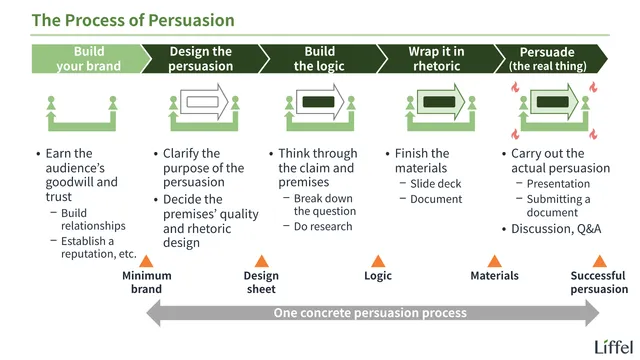

All presentation-related entries are collected below.

Footnotes
-
Note that this means “make the claim clear in your own mind,” not “state the claim clearly to the audience.” Depending on the claim, it may be better not to state it outright (for example, “Please buy this product”). ↩
-
Since structure is “the order in which the logic is conveyed,” you could also consider it part of logic rather than rhetoric (this site treats it as rhetoric). ↩