This entry introduces training in choosing clear language. It is also training in thinking about things objectively (seeing them objectively).
I will not explain the term “clarity” in detail here, so if you have time, please read the following entry first.
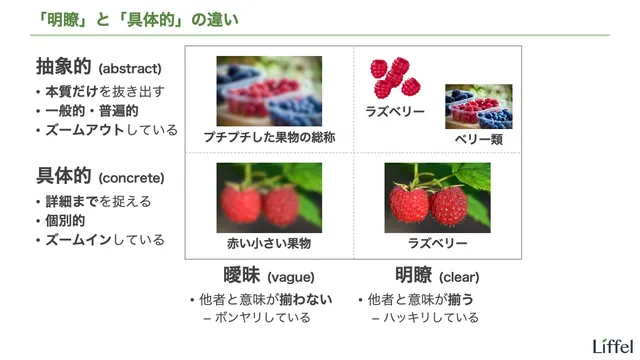

Let’s begin.
toc
Example
Rewrite the following sentence using a number to make it clearer. Use the word in parentheses, and choose any number that seems reasonable.
| Before | After |
|---|---|
| This test is very difficult. (pass rate) |
Please write your answer in the field below before proceeding.
| Before | After |
|---|---|
| This test is very difficult. (pass rate) | The pass rate for this test is 3%. |
Notice how the meaning becomes sharper and leaves less room for misinterpretation.
Explanation
As this shows, replacing adjectives and adverbs with numbers produces clearer expressions that leave less room for misreading.
Why is that?
Adjectives and adverbs cannot be observed
To begin with, most adjectives and adverbs cannot be observed. Consider the following examples.
- Adjectives
- big
- many
- crazy
- Adverbs
- very
- mostly
- rarely
None of these can be observed. To put it differently, they are subjective judgments, and their meanings are hard to align with others.
Try checking other adjectives and adverbs that come to mind. You will notice that they cannot be observed. The exceptions are adjectives that describe colors, such as “red” or “blue.”1
In short, sentences full of adjectives and adverbs come across as subjective and vague. In argumentative writing, adjectives and adverbs are tools to use only when unavoidable; they are not tools to use proactively.
The fix: cut adjectives and adverbs, and use numbers
So what kind of language should we choose? Two things to keep in mind:
- Cut any adjective or adverb that the sentence works without.
- Replace them with numbers.
First, cut unnecessary adjectives and adverbs. They only add a subjective impression. Adverbs in particular can be cut in very many cases.
Still, not every case allows cutting. When cutting is not an option, consider whether the word can be replaced with a number. The more numbers a piece of writing contains, the more objective it feels.
The reason numbers feel objective is that numbers cannot be stated without observation. Look again at the earlier example.
| Before | After |
|---|---|
| This test is very difficult. (pass rate) | The pass rate for this test is 3%. |
To say “the pass rate is 3%,” you must either count the people who passed or look up someone else’s count. Because observation lies behind a number, the impression the language gives becomes objective.2 When you find yourself reaching for an adjective or adverb, get into the habit of asking whether it can be converted into a number.
Numbers feel objective because observation lies behind them.
Numbers also make the content more concrete. As you can see from the revised sentence, it was necessary to add the word “pass rate” because a number forces you to specify what the number refers to.
The original adjective version, “this test is very difficult,” can also be read as “this test is very difficult (in content),” and the meaning stays unclear. However, this ambiguity is hard to notice in the sentence “this test is very difficult.”
In contrast, if you say “this test is 3%,” anyone will push back with “wait, what is 3%?” In that sense, numbers also work as a screening filter for ambiguity.
Exercises
Now let’s practice.
Level 1
Cut the adverbs from the following sentences.
| Before | After |
|---|---|
| He is very tall. | |
| Slightly more people are in favor. | |
| Company X is much cheaper than Company Y. | |
| This disease is incredibly frightening. |
| Before | After |
|---|---|
| He is very tall. | He is tall. |
| Slightly more people are in favor. | More people are in favor. |
| Company X is much cheaper than Company Y. | Company X is cheaper than Company Y. |
| This disease is incredibly frightening. | This disease is frightening. |
Level 2
Rewrite the following sentences using numbers. Use the word in parentheses, and choose any number that seems reasonable.
| Before | After |
|---|---|
| He is very tall. (height) | |
| Slightly more people are in favor. (proportion) | |
| Company X is much cheaper than Company Y. (price) | |
| This disease is incredibly frightening. (mortality rate) |
| Before | After |
|---|---|
| He is very tall. (height) | His height is 2 meters. |
| Slightly more people are in favor. (proportion) | The proportion of people in favor is 60%. |
| Company X is much cheaper than Company Y. (price) | Company X’s price is half (50%) that of Company Y. |
| This disease is very frightening. (mortality rate) | The mortality rate for those infected with this disease is 25%. |
As these examples show, replacing adjectives and adverbs with numbers makes the meaning clearer. Keep this in mind whenever you write practical prose.
To take your study further
Thank you for reading this far. Other writing exercises are gathered at the link below.

Footnotes
-
Even with colors, however, adjectives still leave room for misreading. To share a precise color with others, we use symbols called “color codes.” ↩
-
There are exceptions. When you say something like “it will work out about 70% of the time,” for instance, the number is a rough estimate rather than something actually counted. ↩