
This entry explains the skills you can train through AI debate. Along the way, we will also think about how you should approach AI debate.
Since this is part of a series, please read the entry below first and experience at least one round of AI debate before continuing.
toc
- Skills Trained Through AI Debate
- Skill #1: Writing Skill
- Skill #2: Reasoning Ability
Skills Trained Through AI Debate
The skills you train through AI debate fall broadly into two categories:
- Writing skill
- Reasoning ability
I will explain each in turn.
Skill #1: Writing Skill
The first skill is writing skill. By “writing skill,” I mean strictly the ability to write so that what you intend to convey reaches the reader as you intended — nothing about the content itself.
Writing skill: the ability to write so that what you intend to convey reaches the reader as you intended (independent of content)
It should be obvious that AI debate improves your writing skill. As you experienced in the previous entry, AI debate has you write text continuously and then receive feedback from the AI. Improvement is essentially guaranteed.
Make “Improving Your Writing” Your First Milestone
As I will discuss below, AI debate also trains your reasoning ability. However, I recommend setting “improving your writing” as your first milestone (the goal to reach first). There are three reasons:
- Writing skill is essential for both “thinking” and “using AI”
- Despite that, your writing skill is probably weak
- Writing skill is easy to improve, and the improvement is clearly visible
I will explain each in turn.
Reason #1: Writing Skill Is Essential
First, without writing skill you cannot think properly, nor can you use AI well. I cover this in detail in the entries below.
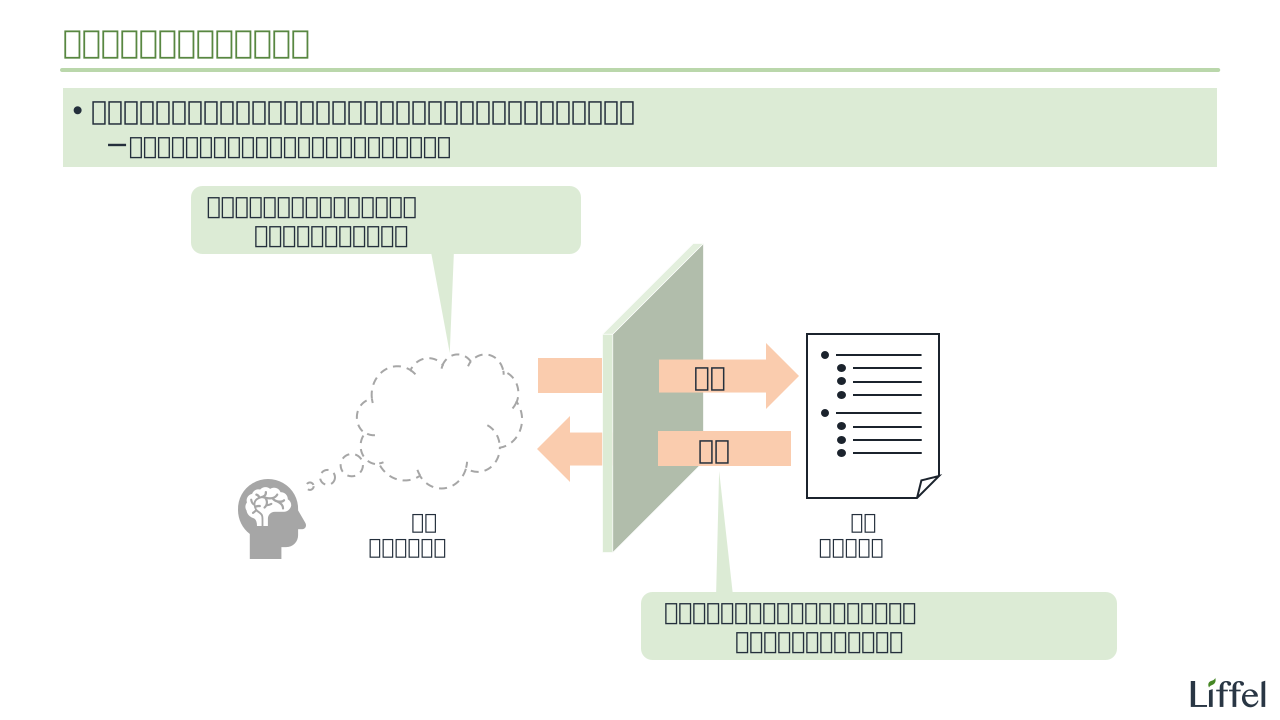
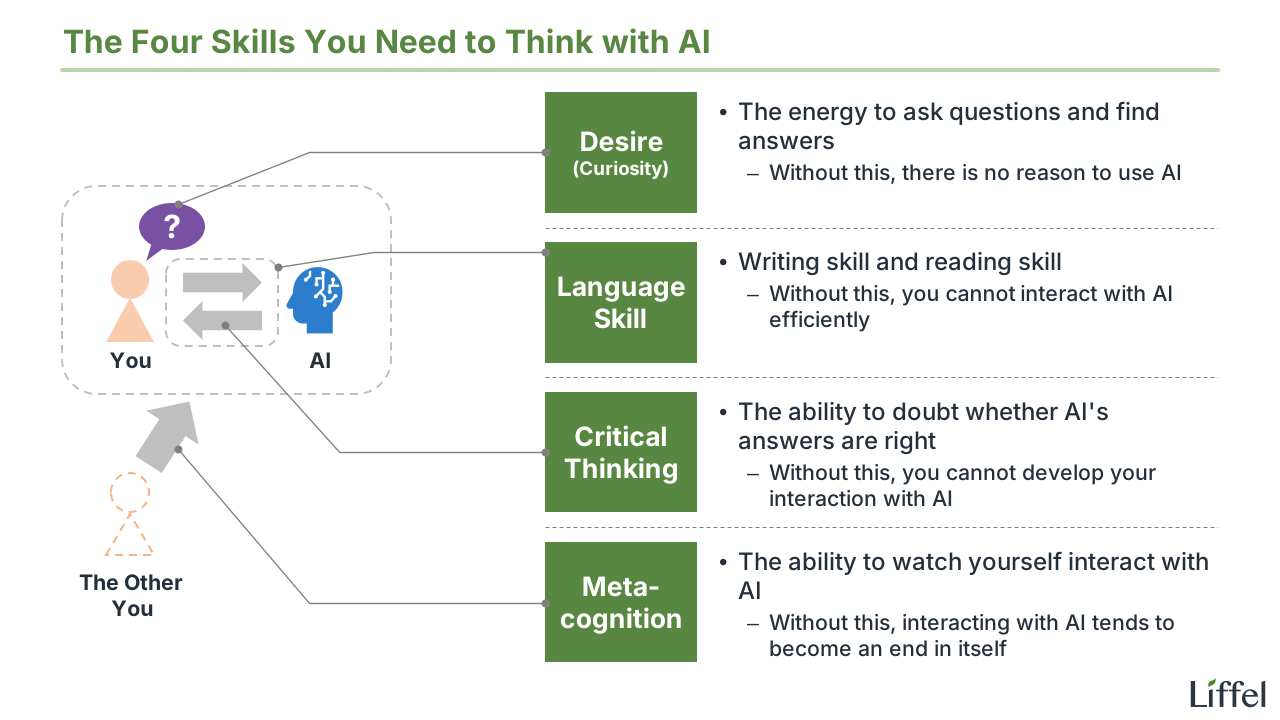
In the AI era, it is no exaggeration to call writing skill the foundation underlying every other skill.
Reason #2: Your Writing Skill Is Probably Weak
Despite its importance, your writing skill is probably weak.
The root issue is that structured practice in writing argumentative essays — and receiving feedback on them — is far rarer than people assume1. Even where such opportunities exist, the gap between casual writing and writing that defends a position with reasons is often left unbridged.
In short, practice in writing is severely lacking. As a result, most people produce sentences that are either hard to follow or grammatically off. In my experience, this holds true regardless of whether someone graduated from an elite university or works at an elite company. The three most common problems are:
- Unclear subject or object
- Sentences that run too long
- Overreliance on big words and convoluted phrasing
AI debate is a perfect opportunity to clean up these bad habits. Tell the AI in advance, “point out any problems with my writing” (the specific instructions are covered in the next entry), and improve your writing after each match.
Reason #3: Writing Skill Is Easy to Improve
If you put deliberate effort into it, your writing skill should improve dramatically and quickly. The AI will tell you specifically what is wrong and how to fix it. All you have to do is remember the feedback and avoid repeating the same mistakes — treat it like studying for an exam. Keeping a list of recurring feedback items is also a good idea.
After perhaps ten matches of AI debate with properly instructed AI, you should feel that your writing has improved. To put it more strongly: if you have done ten AI debates and feel no improvement in your writing, you are doing AI debate wrong.
The eventual goal is to reach the point where you receive almost no feedback on your writing itself. Typos will always happen, but other problems should diminish with each match.
In AI debate, train your writing skill first
Do Not Set “Becoming Good at Debate” as Your Goal
This is important enough to state from the opposite direction. In AI debate, do not set “becoming good at debate” as your goal. Unless you are on a debate team, that goal serves no purpose.
If you set “becoming good at debate” or “beating the AI” as your goal, the optimal move is no longer to build your own argument but to ask the AI the following:
I am debating the question "XXX?" Please give me the best possible affirmative constructive.Repeating this will not improve your writing. More fundamentally, you will lose the ability to think for yourself. Always keep in mind why you are doing AI debate in the first place.
Skill #2: Reasoning Ability
The second skill is reasoning ability. Look at the slide below.
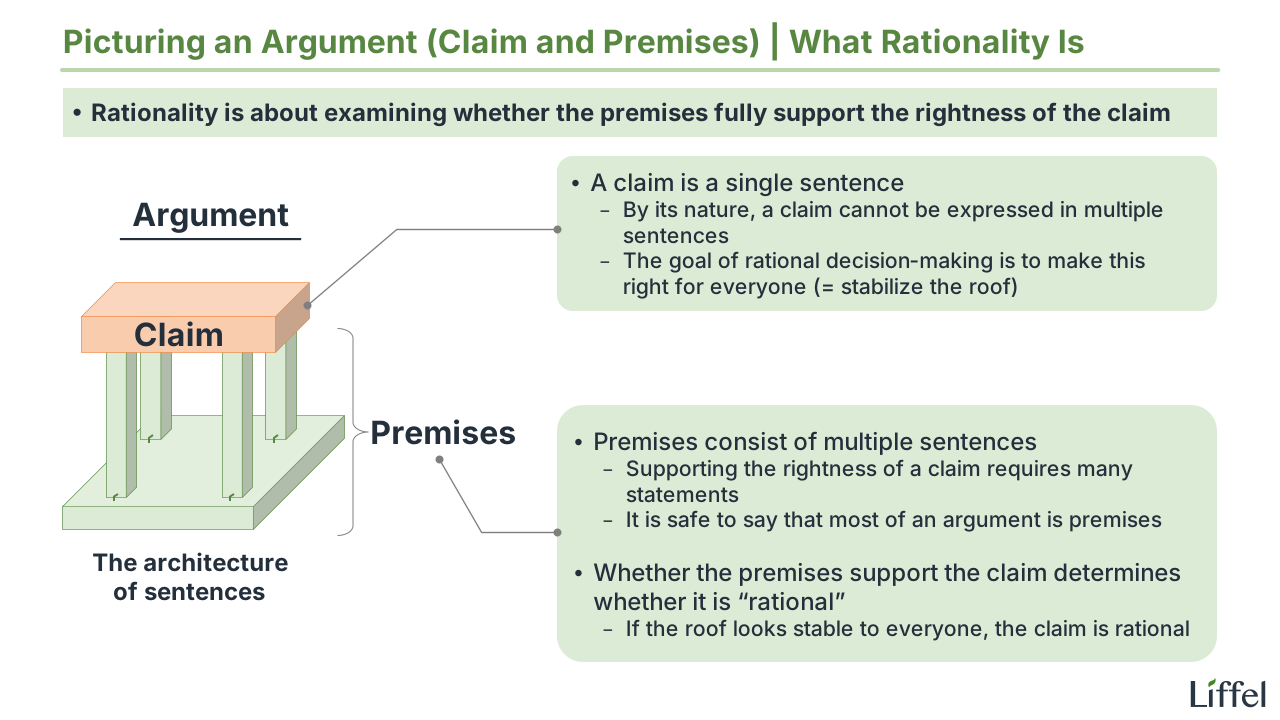
As I explained in the previous entry, debate is a game where the two sides compete on how well they can construct premises that support a fixed claim. With the roof already in place, you compete on how well you build the structure that holds it up.
Here, I am calling this “ability to construct premises” reasoning ability as a single bundle. Since that is too coarse, let us break it into three:
- Idea generation and knowledge: the ability to gather the building blocks — the contentions — for your argument
- Logical thinking: the ability to assemble those contentions into an argument
- Critical thinking: the ability to find weaknesses in the opposing argument (the ability to doubt the rightness of a claim) I will explain each in turn.
Reasoning Ability #1: Idea Generation and Knowledge
First, you need to come up with what to use as premises supporting your claim — that is, you need to gather the contentions for your argument. In standard debate terminology, a contention is a structured argument that supports your claim, with its own evidence and reasoning.
Picture the slide above: if the claim is the roof, each contention is a pillar holding it up. This is exactly how contentions are described in debate education — they are the pillars of your case.
Contention: a structured argument used as a premise to support your claim — picture it as a pillar holding up the roof of your argument
To prepare contentions, you can either come up with them yourself (idea generation) or already know them (knowledge). So AI debate requires “idea generation and knowledge,” and the more you repeat AI debate, the more this ability grows.
Do Not Train Idea Generation and Knowledge Yet
That said, I recommend not trying to train idea generation and knowledge at first.
The reason is that preparing contentions is by far the hardest part of AI debate. If you get stuck here, you cannot even start writing. That pushes your first milestone — training your writing skill — further out of reach.
For now, until you get used to it, just have the AI tell you the contentions. That is my view. If you do AI debate with the contentions already given, you will come to understand:
- What patterns of contentions exist
- Contentions tend to fall into recognizable angles (fairness, freedom, safety, efficiency, cost, and so on)
- How to write a constructive or a rebuttal
You can start preparing your own contentions after that. For now, prioritize repeating the act of writing argumentative essays.
How Many Contentions to Use in AI Debate
For the constructive in AI debate, follow this rule: two contentions, or three at most. With only one, you have no fallback if that single contention gets dismantled, and the speech is too short anyway. With four or more, the speech sprawls and takes too long to write as a coherent piece. Two to three is the sweet spot.
In AI debate, use two or three contentions
Reasoning Ability #2: Logical Thinking
Next, you need to take the contentions you have gathered and assemble them to support the claim. This is what is usually called logical thinking.
Another way to put it: debate is doing what mathematical proofs do in mathematical language in natural language. In a math proof, you prove the rightness of a given proposition (the claim). In debate, you support the rightness of a fixed claim. Only the language differs (mathematical or natural); the way the brain works is the same.
That said, in the early stages, calling this “training your logical thinking through AI debate” is overstating it. Learning the patterns of logical argument in natural language is closer to the truth. As I said above, the AI is giving you the contentions, and you are filling in a template — that is mostly pattern recognition.
How Debate Differs from a Math Proof
There is one decisive difference between debate and a math proof: in debate, you can never prove complete rightness.
The reason is simple. If either side could prove complete rightness on a given question, the game would not work. For example, “Will humans die without water?” cannot be a debate question, because the affirmative is guaranteed to win.
Because of this constraint, every debate question has to be one where both sides have a chance to win — in other words, a question that is debatable. A math proof works the other way around: it is set as a problem only after it has been confirmed to be provable (in other words, right beyond debate)2. That is the clear difference.
When you start AI debate, you may grow frustrated at how fragile your own arguments seem. That kind of frustration does not happen in conventional studying for exams (where complete right answers exist). However, debate is just like that, so do not let it bother you.
To repeat: our goal is not to become good at debate. Think of it as forcing yourself to create opportunities to write argumentative essays through the medium of debate as a game.
Every debate question is debatable by design, so complete rightness can never be proved
Reasoning Ability #3: Critical Thinking
Finally, AI debate also trains your critical thinking. In short, this is the ability to doubt. Look at the slide below.
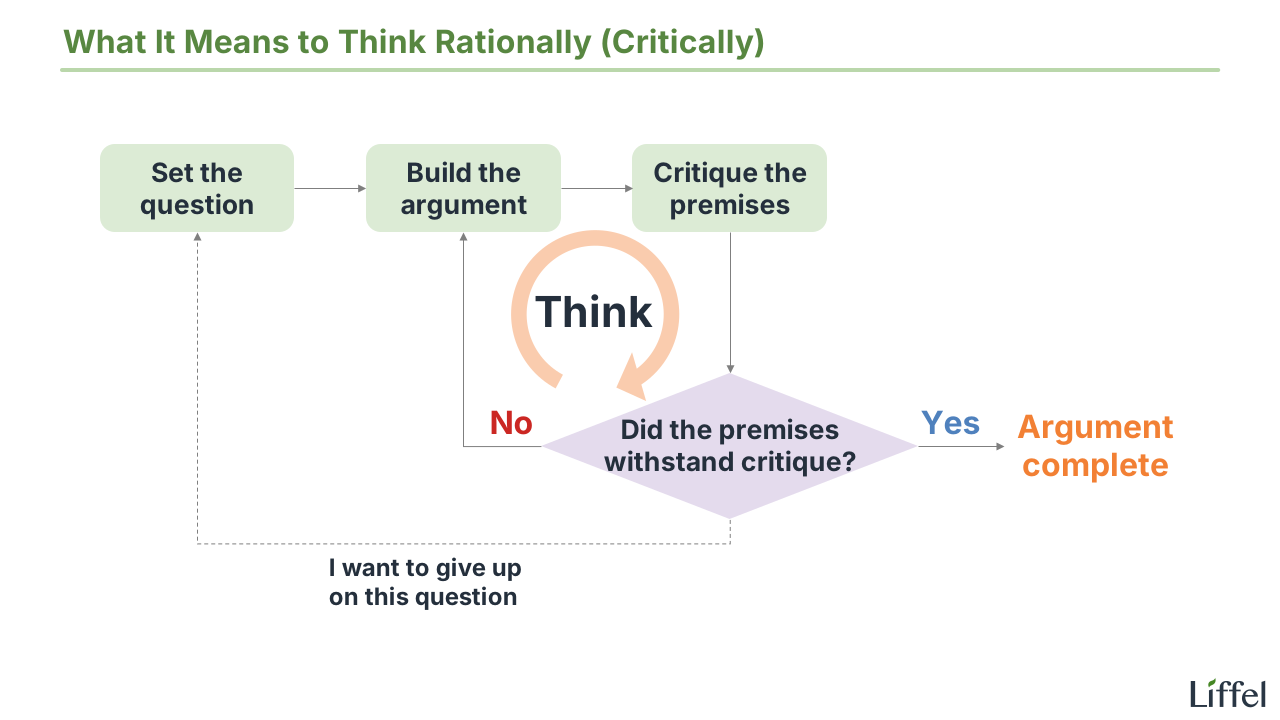
In AI debate, you will find yourself asking the following questions over and over:
- Is this constructive strong enough to win?
- Where are the weaknesses in the AI’s constructive?
This is exactly what it means to critique. You are doubting the rightness of your own and your opponent’s arguments. In the rebuttal in particular, you have no choice but to find the weak spots in the AI’s constructive — without that, you cannot write a rebuttal at all.
In other words, AI debate gives you no option but to critique, so improvement in critical thinking comes with the territory.
The slide above is explained in detail in the entry below. Read it when you have the time.
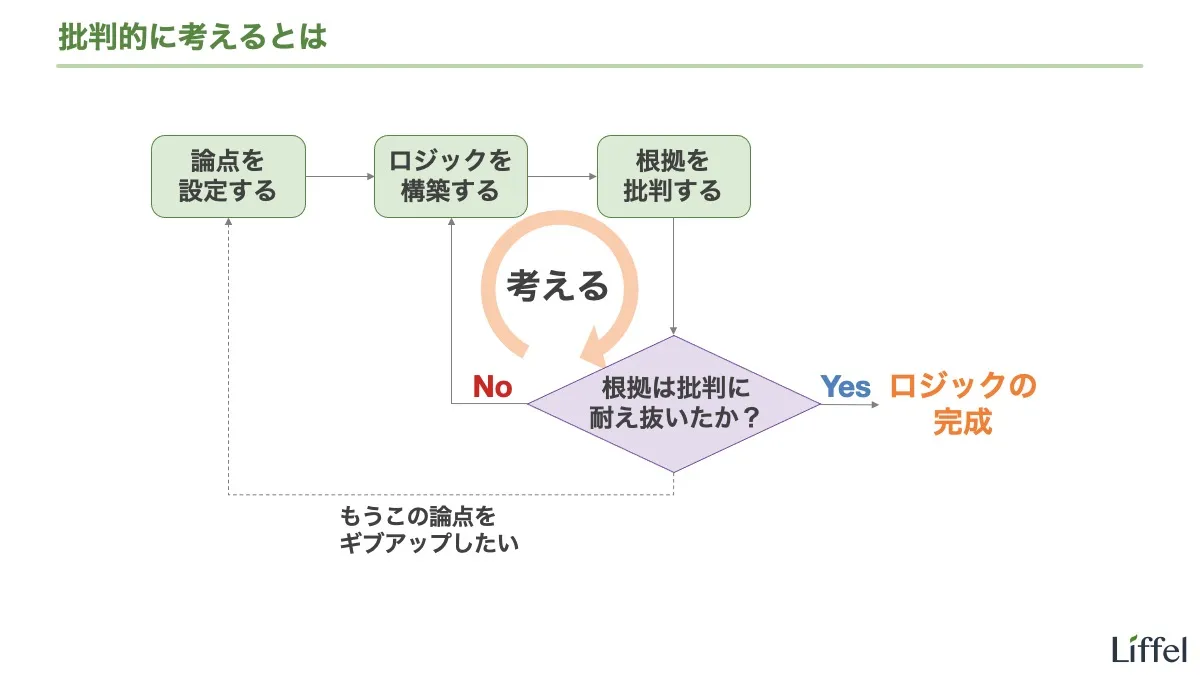
The Greatest Significance of AI Debate
As you can see, in AI debate you have no choice but to doubt the AI. To put it another way: AI debate is structured so that the AI is not “the source you learn right answers from” but “an equal whose argument you debate against”.
In my view, this is the greatest significance of AI debate. If you do AI debate, the AI will not become an oracle in your mind.
When you use AI for things like research, the AI tends to take on the status of an “absolutely right authority” in your mind. Given the pace of progress in recent years, in the near future AI will likely become “the thing that always gives you the right answer when there is one.”
That is convenient and wonderful in itself. However, if you only ever use AI in that mode, you may find yourself doing whatever the AI tells you without realizing it.
Of course, the question “what is wrong with doing whatever a right AI tells you?” is fair, and would itself make an interesting debate question. However, if we keep going in that direction, it is certain that people who can think for themselves will disappear.
Anyone who wants to remain a person who can think for themselves should hold onto at least one use case where AI is not treated as the source of right answers — that is my view. However, finding such a use case can be hard for some people. Since AI debate is one that anyone can take up, I strongly recommend it.
To keep AI from becoming an oracle in your mind, take up AI debate
Why You Should Serve as the Judge from the Start
This is also the reason I argued in the previous entry that you should serve as the judge from the very first match.
If you do a debate but leave the most important part — the verdict on which side won (i.e., which was more right) — entirely to the AI, you are still treating the AI as an oracle. Step into the same arena as the AI and decide the verdict yourself.
Of course, for a while, you will have no choice but to accept that the AI’s verdict is right. You probably do not yet understand what “soundness of premises” really means, and without that you cannot judge a debate. However, that is something you can fix later.
What truly matters is holding onto the awareness that “I, a human, decide what is right — not the AI”. It is not an exaggeration to say that this is what AI debate is for.
Whether you won or lost is for you to decide. Listening to the AI’s view comes after that.
That covers the skills you train through AI debate. In the next entry, I will introduce the methods for putting all of this into practice efficiently.
For other AI-related entries, see the following:
Footnotes
-
Worse, in the few opportunities that do exist, you can now ask an AI to “fix my writing” and the surface-level problems disappear. Opportunities to actually improve your writing skill are vanishing. ↩
-
This applies to math at the level of school education. The unsolved conjectures that research mathematicians work on are a different matter entirely — whether they can be proved at all is itself unknown. ↩