This entry explains the skills you need to use AI well as a thinking partner.
In the present age, it is no exaggeration to say that not using AI for the act of “thinking” is simply lazy and inefficient.
Modern AI is, roughly speaking, “a tireless partner who knows just about every piece of public information out there, who is dazzlingly smart, and who never tires of dealing with you.” To put it bluntly: it is like having the world’s greatest genius supporting you, for free, never showing displeasure (not that AI has a face to show it with). There is no reason not to use it.
That said, things are not as simple as “just rely on AI and you will think well.” Without the right preparation, we end up as yes-men who blindly accept whatever AI says. At that point, we are the ones being used by AI, not the other way around.
This entry thinks about what that “right preparation” actually looks like. To remain the ones using AI, what should we do?
A note on terms: by “thinking” in this entry, I mean the act of asking questions that have no settled answer and trying to answer them. Studying for tests and the like are outside the scope. Please keep that in mind. The entry below covers this in detail.


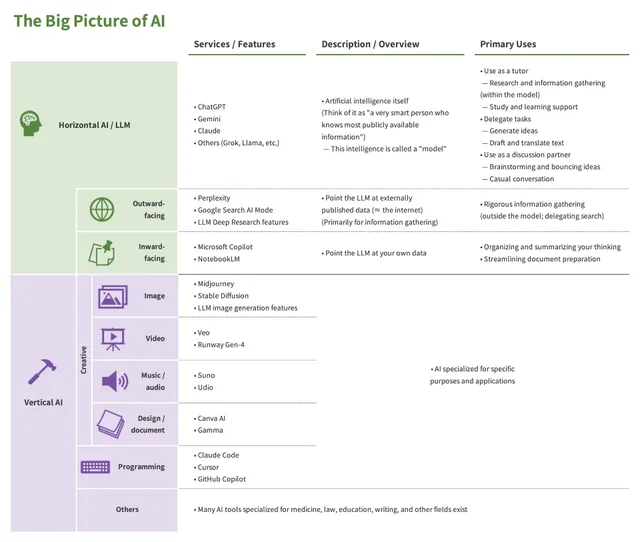
The AIs I have in mind are the three major AIs (ChatGPT, Gemini, and Claude). If you have not yet touched any of them, try at least one before reading further — it will make the rest of this entry much easier to follow. You do not need a paid plan. If you are new to AI, I recommend reading the entry below first, which explains how to classify AIs.
With that, let’s begin.
toc
- The Four Skills You Need to Think with AI
- Skill to Think with AI #1: Desire (Intellectual Curiosity)
- Skill to Think with AI #2: Language Skill
- Skill to Think with AI #3: Critical Thinking
- Skill to Think with AI #4: Metacognition
The Four Skills You Need to Think with AI
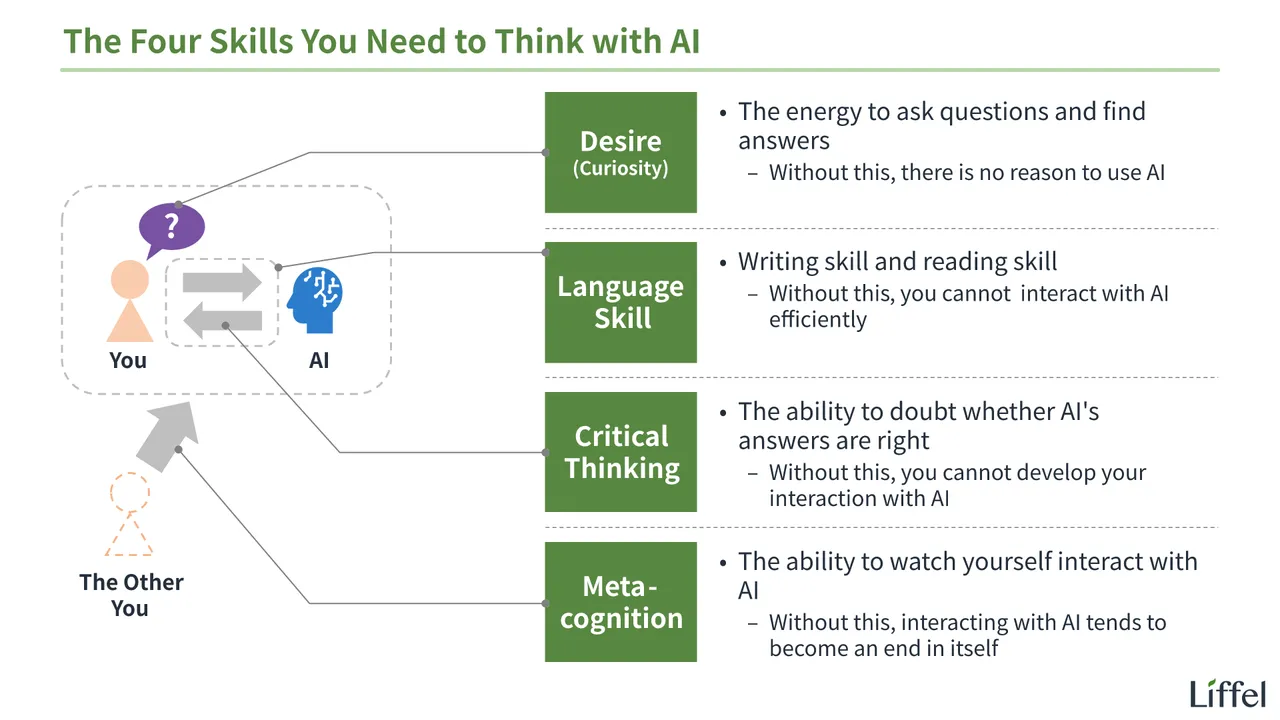
The slide below summarizes the four skills you need to think with AI.
As shown there, you need the following four:
- Desire
- Language skill
- Critical thinking
- Metacognition
I will explain each in turn.
Skill to Think with AI #1: Desire (Intellectual Curiosity)
The first skill you need to think with AI is desire (intellectual curiosity). Whether this counts as a “skill” is debatable, but the bottom line is that without desire, you cannot think with AI.
The reason is simple: AI does nothing unless you ask it something. Every interaction with AI begins with a question from you.
Put differently, without an energy that drives questions like “why is it like this?” or “can we do better?” — and pushes you to find answers — the high-powered intelligence of AI just sits there in silence. That energy is nothing other than your desire.
Desire is the fundamental engine for using AI well. Without it, nothing starts.
How to Train Desire
So, how do you train desire? Or rather, is desire the kind of thing that can be trained at all?
Frankly, this seems to be largely shaped by genetics, and I doubt there is any effective method of building it after the fact — that is my current view. Hunger and sex drive vary genetically between individuals, and no amount of effort changes that. The same probably holds for intellectual curiosity.
That said, the very fact that you are reading this entry suggests you have a healthy level of intellectual curiosity. There is little to worry about.
Keep Your Distance from Your Smartphone
To my knowledge, nothing reliably raises intellectual curiosity, but there is one thing that seems to preserve it for almost everyone.
Do not spend too much time on your smartphone.
Specifically, you should not overdo any of the following:
- Communication (including social media)
- Games
- Pornography
Get deep enough into these and your brain becomes addicted to dopamine. As far as I have observed, no one who is hooked on dopamine maintains a healthy level of intellectual curiosity. Going further would take us off track, but please remember: a smartphone is not just a convenient tool.
Skill to Think with AI #2: Language Skill
The second skill you need to think with AI is language skill. People with weak language skill cannot use AI well.
The reason is again simple: interacting with AI happens through language. Language skill matters in both directions:
- When you ask
- Without writing skill, you cannot put your desire into clear, specific words for AI
- AI calibrates its answer to the level of your question
- A low-level question gets a low-level answer — and AI’s intelligence goes to waste
- When AI replies
- Without reading skill, you cannot read AI’s replies accurately and build on them
The point in bold is the one to watch: the level of your questions sets the level of AI’s answers (or strictly, the level AI appears to operate at). If you currently feel “AI is not all that smart,” you might want to question your own language skill first.
How to Train Language Skill
So, how do you train language skill?
To begin with, let us assume your reading skill is fine. People with serious reading skill problems would not have read this far, and there is probably no quick way to improve reading skill (the only path is taking in massive amounts of text).
That leaves the output side — the questions you ask — which is writing skill. This skill can be trained by using AI heavily, and that is probably the most efficient method available.
If your writing skill is weak, the cause is almost certainly that you have not written enough in absolute terms. In many education systems, students rarely get the chance to write structured essays of any meaningful length.
Using AI heavily solves this problem. If you use AI heavily, you will produce text whether you like it or not.
How to Use AI to Train Language Skill #1: Write
That said, just using AI heavily without thinking will probably not improve your language skill. Keep the following two points in mind:
- Write moderately long passages with a keyboard (do not use voice input)
- Draft your text first (do not type directly into the chat box)
First, I do not recommend voice input at all. Although voice input is more efficient, only geniuses can produce high-quality words on the first try. Start by writing, and spend time facing your own words.
When you do, draft in a text editor or similar app. If you write directly into AI’s chat box, you will keep accidentally hitting Enter and sending half-finished text. The “extra step” of copying and pasting is also where you check what you have written yourself — and the resulting gain in language skill is well worth that small extra effort.
How to Use AI to Train Language Skill #2: Tell AI What to Do
If you want to go all in, one option is to tell AI to give feedback on your questions themselves, not just answer them.
Naturally, in default mode, AI prioritizes “answering the question” and does not point out problems with how you phrased it. There is an exception when the question is too vague to answer, but past that minimum bar, AI just gives you the answer. That makes it hard to become aware of language-skill problems on your own.
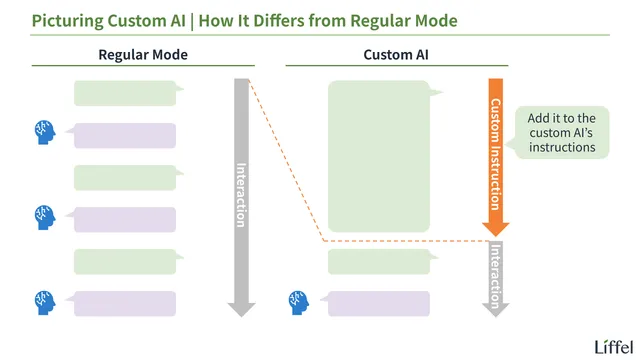
All three major AIs come with customization features (for example, Gemini’s Gems). By writing a “custom instruction” into one of these, you can change AI’s behavior so that it gives feedback on your questions in addition to answering them. The entry below explains the specifics.
Skill to Think with AI #3: Critical Thinking
The third skill you need to think with AI is critical thinking. Concretely, think of it as the ability not to swallow what AI says, but to judge for yourself whether it is right.
Without this skill you cannot have a real exchange with AI. You ask, AI answers, and that is it. “Thanks, got it” — end of conversation (no need to thank AI, by the way).
Do Not Fear AI’s Mistakes
Also, without critical thinking, you will be paralyzed by AI’s errors and unable to use it well.
As you may know, AI has a tendency known as “hallucination” — it will state false things with full confidence. This tendency is improving at a remarkable speed, but even so, AI does occasionally say strange things. In my own experience, roughly 1 out of every 10 responses contains something off (as of 2026).
However, if you carry the awareness (and ability) that “what is right is for me to decide,” this tendency does not bother you all that much. Nine out of ten times you get something useful, after all. You can let the one mistake go and reap the benefits of the nine. In my experience, when you point out “I do not think that is right,” AI will acknowledge it.
Conversely, anyone who believes “rightness is something handed to me by others, not something I get to decide” will not tolerate the occasional mistake. After all, that AI looks no different from a teacher who lies to you.
So what is fundamentally needed is not so much critical thinking as the awareness that “I am the one who decides what is right.” To carry that awareness, you need to train your critical thinking.
The Risk of AI Becoming an Oracle
Before long (perhaps around 2030?), the world of test prep and certifications will likely shift to “anyone with enough language skill and motivation studies independently with AI rather than learning from someone else.” The world’s greatest tutor sits inside a computer, after all. There is no reason to learn any other way. The institution of school and the role of the teacher will remain, but their function will be redefined.
This shift itself seems unavoidable, but using AI only in this mode — as the source of right answers in a domain where right answers exist — carries a hidden risk.
That risk is AI becoming an oracle in your mind.
Suppose someone uses AI in this way from elementary school through university graduation. For more than a decade, AI is “the entity that always tells me what is right.” By the end, that person sees AI as something close to a god — an absolute authority. After they enter the working world, treating AI as an equal whose claims you might doubt becomes nearly impossible.
In other words, if you do not train critical thinking at the same time you start using AI, the risk of becoming AI’s yes-man rises sharply. Younger people, in particular, should be careful here.
How to Train Critical Thinking
So, how do you train critical thinking?
This is the central topic of this site. Please refer to the category below.
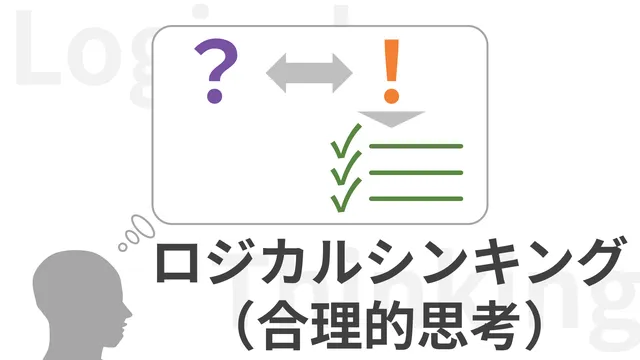
If you want to study this thoroughly, the book A Recommendation of Thinking below is also a good resource.

For the specific risk of AI becoming an oracle, debating against AI is one countermeasure (this is my own hypothesis). Put differently, you treat AI not as “the entity that tells you what is right” but as “an opponent you debate the rightness of claims with.” The next entry walks through how to do this in detail.
Skill to Think with AI #4: Metacognition
The fourth skill you need to think with AI is metacognition. As the slide above shows, this is the ability to watch yourself interact with AI.
The contrast with critical thinking makes this easier to grasp:
| Critical thinking | Metacognition | |
|---|---|---|
| Target | AI’s response | Your own cognition |
| Questions you ask | • Is AI’s response right? • Did AI explain its reasoning? • Is AI’s reasoning sound? | • What am I trying to achieve through this exchange with AI? • Is this exchange moving me toward that goal? |
The classic failure mode of weak metacognition is this: you keep going back and forth with AI, but nothing concrete comes out.
If you have the first three skills, you can interact with AI and develop your thinking. Then you look up and several hours have passed. Your thinking moves at speeds that were never possible before, after all.
I guess this is something everyone experiences once. Letting it become the norm, however, is undesirable. Our goal is not to interact with AI.
AI is, fundamentally, a tool for achieving a goal. Think of metacognition as the ability to keep this basic precondition in view.
How to Train Metacognition
So, how do you train metacognition?
To be honest, I am not sure how metacognition can be trained. The simplest approach is to design rules and processes that produce healthy AI use. In other words, picture how someone with strong metacognition would use AI, and deliberately use AI that way.
The points I keep in mind are these:
- Ignore AI’s suggestions by default (the “shall we think about this next?” lines that appear at the end of replies)
- I want to be the one deciding what to think about
- Going along with these traps you in long sessions with AI
- Do not touch AI first thing in the morning
- When your mind is fully charged, what you should do is think for yourself, not consult AI
- Delete threads when they have served their purpose, and stay aware of whether you are deleting them
- When the question has been resolved, or when the content has been turned into output, delete the thread
- Just being aware of this keeps you from forgetting that “AI is being used to get something done”
- Of course, keep what you want to keep
- Threads piling up is a bad sign
- When the question has been resolved, or when the content has been turned into output, delete the thread
Please do not get me wrong: I am not claiming “this is the right way to use AI.” What I am offering is an example of “thinking through what healthy AI use looks like for me, and turning that into specific rules and processes.” If it is useful as a reference, all the better — but the rules and processes that fit you are something you have to work out yourself.
That covers the skills you need to think with AI. Next, let’s debate against AI. As far as I know, this is the most useful method for training the skills covered in this entry.

For other AI-related entries, see the following: