
This entry explains how to debate against an AI (hereafter “AI debate”). The goal, however, is not to become good at debate itself; it is to train your reasoning ability and writing skill through the act of debating. Please do not lose sight of this point.
As far as I know, AI debate is one of the most worthwhile uses of AI for one purpose: creating opportunities to write a substantial amount of text and thereby train your reasoning ability and writing skill. For students, this is worth doing hundreds of times. For working professionals, dozens of times is worth it. The free plan is more than enough.
Because the content is heavy, I will split it into a series of entries. In this entry, set aside the details and aim for a single goal: to experience one round of AI debate. The benefits and significance will be covered in the next entry.
Goal of this entry: experience one round of AI debate
A note before we begin: I will assume you are a complete beginner in debate. If you are already familiar with debate basics, feel free to skip ahead to “What You Need for AI Debate” from the toc below. However, note that what would normally be called a “resolution” or “motion” is called a “question” on this site. That is the only difference from standard debate.
toc
Debate
First, a brief explanation of the rules of debate.
Debate is a game where participants split into affirmative and negative sides and pit their arguments against each other on a given question.
Three points to keep in mind:
- What a “question” is
- You are assigned to either the affirmative or the negative side (your actual opinion is irrelevant)
- The two sides compete on the soundness of their premises
I will explain each in turn.
Rule #1: The Question
First, a “question” is the proposition that the affirmative and negative sides argue for and against. This definition is a bit abstract, so on this site I define it as a yes/no question — that is, a question that can be answered with either “yes” or “no.”
In standard debate terminology, this is usually called a “resolution” or “motion.” On this site, I use “question” instead — the same word used for the broader concept of a question in rational decision-making, which is treated extensively elsewhere on the site.
Here are a few examples:
- Should schools require students to wear uniforms?
- Should homework be banned?
- Should smartphones be banned at school?
Each of these can be answered with yes or no. Questions of this kind are what we use in debate.
Question (in debate): a single yes/no question that the affirmative and negative sides argue for and against
Rule #2: Affirmative and Negative Sides
For this entry, we will use the following question:
- Question: Should schools require students to wear uniforms?
In a debate, one side takes the affirmative position (answering “yes” to the question) and the other takes the negative position (answering “no”). For this question, the two sides must make the following claims:
- Affirmative claim: Schools should require students to wear uniforms.
- Negative claim: Schools should not require students to wear uniforms.
In other words, your claim is fixed for you. What you argue is determined by the side you are assigned to (affirmative or negative); your actual opinion does not enter into it. This may feel difficult until you get used to it, but please accept it as part of how the game works.
In debate, your claim is assigned, not chosen — it has nothing to do with what you actually believe
You may want to debate from your own actual opinion. However, in AI debate, you swap sides and play a second round after the first one (we will set things up that way). You will always get the chance to argue from the side that matches your actual view, so do not worry about this.
Rule #3: Competing on the Soundness of Premises
Let us assume, for the sake of this walkthrough, that you are on the affirmative side. The setup is as follows:
- Question: Should schools require students to wear uniforms?
- Your claim: Schools should require students to wear uniforms.
Everything up to this point is settled the moment the debate begins (that is, when the question and the sides are assigned). Nothing demanding so far.
The real work starts here. You prepare premises that support the rightness of your fixed claim. For example:
- Focus on learning: students no longer have to worry about what to wear each day
- Requiring uniforms lets students focus on what they are actually there to do
- School is not for showing off fashion but for studying
- Requiring uniforms lets students focus on what they are actually there to do
- Financial burden on families: requiring uniforms reduces the financial burden on families
- Wearing the same outfit to school every day is not realistic for most students
- Even a five-day rotation prepared for each season is a substantial expense for a family
These support the rightness of the claim that “schools should require students to wear uniforms.” The image below makes the structure easier to grasp.
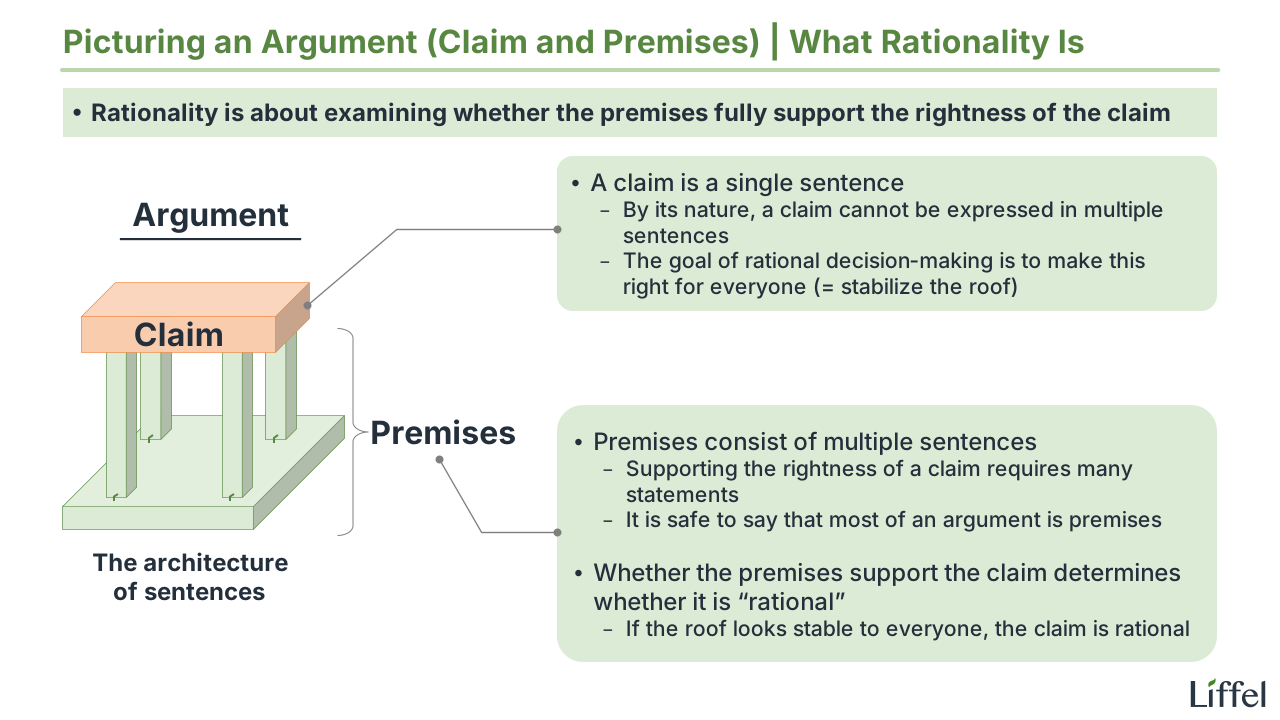
I explain this slide in detail in the entry below. If your understanding of “claim” and “premises” feels shaky, please read it before continuing.
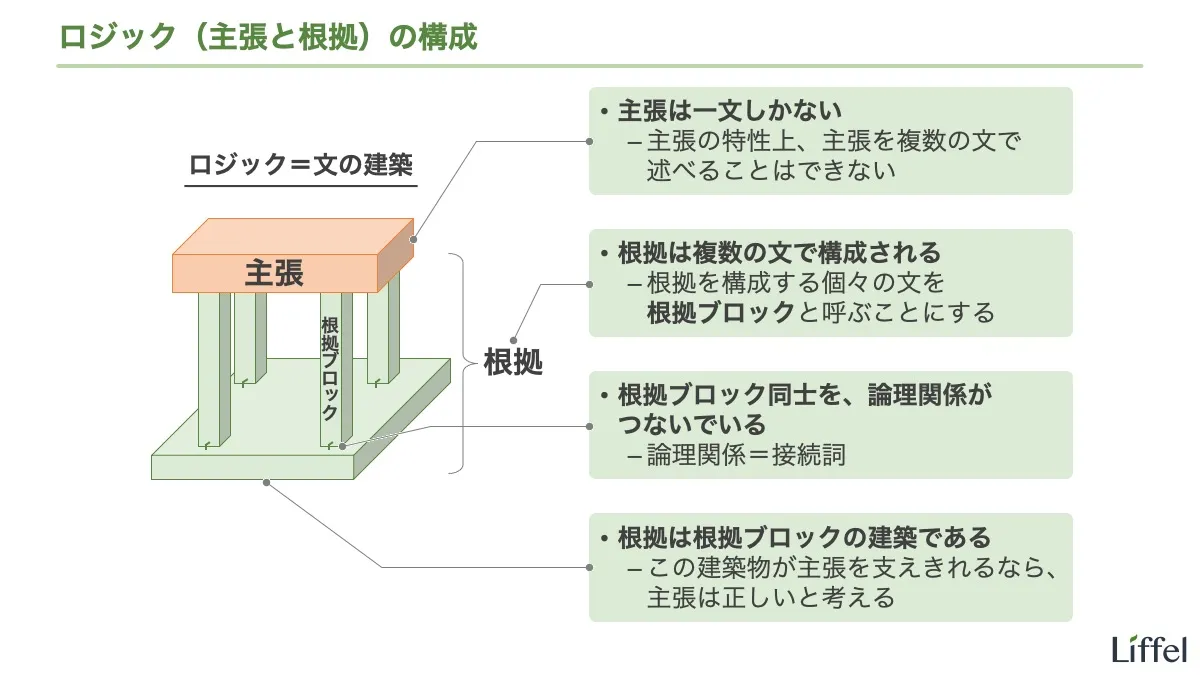
A “claim” together with its “premises” forms an “argument.” So once a debate begins, you build an argument.
Once each side’s argument is ready, both sides present them, and a judge evaluates how well they hold up. Since the claim is fixed by the side you are assigned to, what is actually evaluated is the premises.
The side whose argument holds up better — that is, whose premises are more sound — wins.
In debate, you prepare premises that support the rightness of a fixed claim, and the two sides compete on how sound those premises are
You may be wondering: what does “soundness of premises” actually mean? I will not explain it here, because it would take too long. More to the point, understanding what soundness of premises means is one of the goals of AI debate, so it cannot be explained from the start. Please bear with me.
In practice, what is judged is not just the soundness of the premises (the content) but the persuasiveness of the whole — including delivery, such as clarity and structure. However, since this is too heavy to take in all at once, for now you can simply treat it like this. In debate, the two sides compete on the soundness of their premises.
How a Debate Proceeds
In debate, presenting your argument once is called a “speech,” and the rule that determines how many speeches each side gives in a single match is called the “format.”
Since this is your first time, we will use a simple four-speech format, which works as follows:
- Affirmative constructive (you): from a blank slate, present a claim and premises affirming the question
- Negative constructive (AI): from a blank slate, present a claim and premises negating the question
- Affirmative rebuttal (you): respond to the negative constructive and reinforce the rightness of your own position
- Negative rebuttal (AI): respond to the affirmative constructive and reinforce the rightness of its own position
So in one match, you build an argument twice. Keep this in mind.
What You Need for AI Debate
Next, here is what you need for AI debate. Prepare the following three things:
- A laptop or desktop computer
- An AI (Gemini)
- An app for writing text
I will explain each in turn.
Item #1: A Laptop or Desktop Computer
First, you need a laptop or desktop computer. Strictly speaking, any setup that meets the following three conditions will do:
- A display of at least roughly 10 inches
- A keyboard
- A mouse
These three are necessary because AI debate involves writing and editing large amounts of text1. Without an environment suited to that, you cannot focus on the debate, and the learning value drops.
If you only have a tablet, attaching an external keyboard and mouse will work. A smartphone is technically possible, but I cannot recommend it at all — the learning value drops sharply because the display is far too small.
Item #2: An AI (Gemini)
Next, you obviously need an AI.
AI debate works with any AI of the type known as a “large language model” (LLM), but for the following reasons, the one I recommend by far is Gemini:
- The free plan has no usage limits (you simply get switched to a less capable model)
- The less capable model is no problem at all for AI debate
- As a debate opponent for a human, even the less capable model is more than smart enough
- The less capable model is no problem at all for AI debate
- Its custom AI feature (Gems) is available on the free plan
- Custom AIs make it much easier to repeat AI debate (covered in the entry after next)
- This training is something anyone could meaningfully do dozens of times, so ease of repetition matters
All explanations and screenshots from here on are based on Gemini. Please bear that in mind.
Item #3: An App for Writing Text
Finally, prepare an app for writing text.
As mentioned above, you build an argument twice per match in AI debate. While doing so, you do not look at the AI’s screen. You face the writing app and think on your own. You need an app for that purpose.
Since this is your first time, anything you already use will do. Microsoft Word or the draft window of an email client both work. If you are not currently using anything, Google Docs is a safe choice.
The AI Debate Process
Once you are set up, let us start the AI debate. The process has three steps:
- Sharing the rules and setting the question
- Round 1 (affirmative)
- Round 2 (negative)
I will explain each in turn.
Step #1: Sharing the Rules and Setting the Question
First, tell the AI two things:
- That you want it to be your debate opponent
- The format, rules, and question of the debate
Spending time to compose this yourself is wasted effort. For now, copy and paste the text below as is.
Please be my debate opponent. My goal is to train my reasoning ability and writing skill. My specific requests are as follows:

- Use the four-speech format (affirmative constructive → negative constructive → affirmative rebuttal → negative rebuttal). I am the affirmative.
- Keep the length of my turns and your turns roughly equal.
- Until the negative rebuttal is finished, do not give me any feedback. Focus on your own constructive and rebuttal.
- Once the negative rebuttal is finished, I will first decide the verdict on my own.
- After I have decided the verdict, you decide the verdict as well. Do not let my judgment influence yours.
- After the verdicts, give me feedback on:
    - Anything that read awkwardly or was hard to follow as English.
    - Places where my reasoning was weak.
    - Anything off about my conduct as a debater.
- After the feedback, ask me whether I want to swap sides and play Round 2.

The question for this match is: "Should schools require students to wear uniforms?"
These rules and this question are designed to be approachable for beginners while still offering high learning value. Since they are demanding enough as they are, please use them for your first time.
Step #2: Round 1 (Affirmative)
With the question set (“Should schools require students to wear uniforms?”), Round 1 begins. In the four-speech format, the round has the following five turns:
- Affirmative constructive (you)
- Negative constructive (AI)
- Affirmative rebuttal (you)
- Negative rebuttal (AI)
- Verdict and feedback
You only need to do anything for turns #1, #3, and #5.
Affirmative Constructive (Turn #1)
As mentioned above, on your turn you build an argument. Step away from the AI and face the writing app.
Since this is your first time, please use the template below.
I will now begin the affirmative constructive.

Schools should require students to wear uniforms. There are two main reasons.

First, "[write the first keyword here]."
[Explain the keyword. Ideally, give the reasoning for why it holds, then add a concrete example or personal experience.]

Second, "[write the second keyword here]."
[Explain the keyword. Ideally, give the reasoning for why it holds, then add a concrete example or personal experience.]

For these reasons, schools should require students to wear uniforms.
I have filled in the formal scaffolding aside from the premises (referred to as “reasons” in the body of the speech). Copy this into your writing app and replace the bracketed parts with your own content.
In addition to the two premises mentioned above (focus on learning and financial burden on families), the following can also serve as an element of your premises:
- Hiding economic disparity: a uniform makes a family’s financial situation invisible
- In regular clothes, a family’s financial situation shows in what students wear
- You can also bundle this together with “financial burden on families”
- Safety: it is immediately obvious which school a student belongs to
- This helps with safety on the way to and from school, and with keeping intruders out of school grounds
- Sense of belonging: it strengthens unity and a sense of community within the school
That gives five candidates in total, but you do not need to use them all. For now, pick the two that feel like the strongest premises and fill in the template.
Since this is your first time, I will not say more than this. Just keep the following three points in mind and write with all you have:
- Use only your own mind (no searching, etc.)
- Spend at least 10 minutes on it (after that, if you feel your concentration is gone, it is fine to wrap up)
- Finish it as a complete piece of writing
I will explain why these three matter in the next entry. For now, do your best. No one else is going to see it.
For reference, a sample affirmative constructive is included below. If you cannot get started, use it as a guide.
I will now begin the affirmative constructive.
Schools should require students to wear uniforms. There are two main reasons.
First, “focus on schoolwork.” Wearing a uniform creates a psychological switch into “study mode” in everyday life. By cutting out the distraction and noise of fashion, school can function as a place of learning.
From my own experience, when I attended summer school sessions in regular clothes, I caught myself worrying about how I looked and changing outfits over and over. As a result, I was late leaving the house, and even during class I could not concentrate because I kept thinking about my appearance. With a uniform, all of that needless second-guessing goes to zero, and you can devote yourself to schoolwork from start to finish.
Second, “hiding economic disparity.” Because a uniform puts everyone in the same outfit, it prevents differences in family income from surfacing.
For example, I had a friend whose family circumstances made it hard to buy new clothes. At events where students wore regular clothes, she tended to skip out, afraid people would notice she was “always in the same outfit.” At school, however, she could carry herself with confidence and never had to feel ashamed of her family’s finances. The uniform is a safety net that gives every student a sense of equal footing.
For these reasons, schools should require students to wear uniforms.
Once your constructive is ready, copy and paste it into the chat box and send it to the AI. Instantly, the AI returns its negative constructive. At first you may be deflated — “I just barely scraped that together, and you reply in seconds?” — but there is no choice but to accept it.
Affirmative Rebuttal (Turn #3)
Pull yourself together and tackle the affirmative rebuttal. Aside from the fact that you are now responding to the negative constructive, the basic shape is the same as before. The one thing to be careful about: in the rebuttal, you must not introduce new premises that did not appear in your constructive (because the other side has no chance to respond to them). This is a debate rule called “no new matter.” Make sure to remember it.
This time, please use the template below.
I will now begin the affirmative rebuttal.

To begin with, the negative argued [the negative side's premises].
However, this has the following problems.
[Point out the problems with the opposing premises (e.g., low feasibility, small impact, the existence of alternative solutions, etc.).]

On our side, [the keywords used in the affirmative constructive] are important.
This is because [reason: state why the affirmative is stronger by comparing it with the negative. Introducing new elements not in the affirmative constructive is forbidden].

Therefore, schools should require students to wear uniforms.
A sample is included below as well (assuming the AI argued for “individual freedom” and “respect for diversity” in its constructive). If you cannot get going, use it as a guide.
I will now begin the affirmative rebuttal.
To begin with, the negative argued that “we should respect individual freedom and diversity.” However, this has the following problems.
”Freedom” can be exercised plenty outside of school (after school and on weekends), and it is not the value that should take top priority within the educational setting. The negative also raises concerns about diversity — gender identity, physical traits, and so on. However, in recent years, flexible solutions that keep the framework of uniforms intact have spread. Letting girls choose to wear trousers is one example. There are other ways to protect diversity without abolishing uniforms entirely.
On our side, “focus on schoolwork” and “reducing financial burden” are important.
This is because, compared with the “freedom of fashion” the negative talks about, the sense of security that comes from every student standing on a level playing field — regardless of family income — has overwhelmingly more value in an educational setting. If we leave inequalities and noise based on clothing in place, the freedom of a few students may be protected, but many others lose their access to “equal learning.” As I argued in the constructive, hiding economic disparity and creating a foundation that lets every student focus on schoolwork is what the school should truly be doing.
Therefore, schools should require students to wear uniforms.
Once you send your affirmative rebuttal, the AI again instantly returns its negative rebuttal. With this, all the speeches from both sides are done.
Decide the Verdict on Your Own (Turn #5)
Finally, decide the verdict on your own. For this first time, it is enough to compare your argument with the AI’s and form a rough sense of which side seems more right. The AI will give its own verdict afterward, so compare yours with that.
You may object: “I have never debated before — how am I supposed to judge?” The objection is fair. Even so, my view is that you should serve as the judge from the very first match. I will explain why in the next entry, so for now just decide the verdict yourself.
Once you have decided, the AI will give its verdict and feedback. Read them carefully and put them to use in your next match. With that, Round 1 is over.
Step #3: Round 2 (Negative)
Once Round 1 is finished, swap sides and play Round 2. Send the following text:
Please run Round 2. Same question, with the affirmative and negative swapped.For what it is worth, Round 1 alone is genuinely tiring (it tired me out). There is no need to force yourself into Round 2, so wrapping up after Round 1 and saving Round 2 for the next day is perfectly fine.
I will explain in detail in the next entry, but none of the benefits of AI debate can be enjoyed without repeating it. What matters is not getting through many matches at once but keeping at it.
That covers how to do AI debate. Next, I will explain the skills it trains.
For other AI-related entries, see the following:
Footnotes
-
As a basic precondition, I assume you can touch-type. If you cannot, work on touch typing before AI debate. It is the foundation of everything. That said, your typing will improve as you repeat AI debate. Once you have acquired the bare minimum, you can start AI debate right away. ↩