This entry explains the ad hominem fallacy, informally known as a personal attack. It is one of the most common fallacies.
Let us begin.
toc
- What Is Ad Hominem?
- Names for the Act of Targeting Character
- The Causes and Countermeasures of Ad Hominem
What Is Ad Hominem?
Ad hominem is making the person behind an argument — their character — the target of debate, rather than the argument itself.
Let us look at an example.

It’s drizzling. Should I use an umbrella?

You should. Getting wet puts you at risk of catching a cold.
You’re always catching colds yourself. I don’t think I should listen to you, so I won’t use an umbrella.
What Bear is doing here is ad hominem. Let us analyze the exchange.
The question is “Should I use an umbrella?” Each animal’s argument breaks down as follows.
| Speaker | Claim | Premises |
|---|---|---|
| Panda | Use one. | Because getting wet puts you at risk of catching a cold. |
| Bear | Do not use one. | Because Panda, who claims that getting wet puts you at risk of catching a cold, is always catching colds (and therefore cannot be trusted). |
As you can see, Bear’s premise is that “Panda cannot be trusted.” This is not about the question “Should I use an umbrella?” — it is about Panda’s character. This kind of move, and this kind of argument, is what we call ad hominem.
Ad hominem: making the person behind an argument — their character — the target of debate, rather than the argument itself (and also the kind of argument that does this)
Character
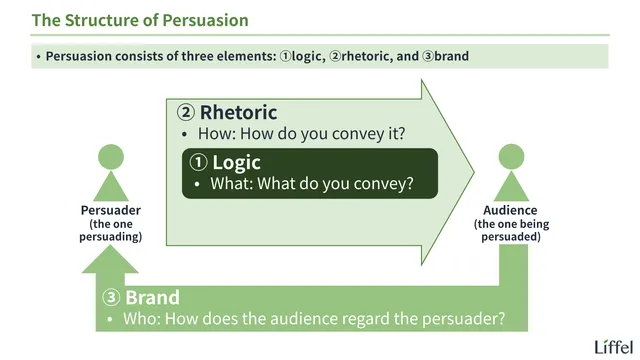
By “character” here, we essentially mean what this site calls a person’s brand. Take a look at the following slide.
As shown, a person’s “character” is made up of their attributes, appearance, and bearing, together with what they have done for you in the past (their track record). The finer-grained elements are summarized in the table below.
Since this entry focuses on why basing an argument on these things is wrong, we will not go into the images in detail here. Readers who want a deeper treatment should consult the following entry.

Why Ad Hominem Is Wrong
Why, then, is ad hominem wrong?
The answer is not intuitive. When we examine the merits of an argument, no one is completely indifferent to the character of the person making it. Before even getting to the argument, we naturally care about things like whether we know the speaker and whether they can be trusted.
However, character has no bearing on the question. Since anything irrelevant cannot count as a legitimate premise, any argument that uses character as a premise is wrong—that is, irrational1. Put simply, this is question drift.
To put it another way: If incorporating character into our premises were legitimate, such a premise would be all-powerful. For instance, if there were a person with top-tier character (say, a Nobel laureate with celebrity-level looks), everything that person said would have to be accepted as right. Conversely, nothing said by someone with the lowest-tier character could be accepted.
That amounts to treating the person as a god (or, in the opposite case, as a devil). Treating a god’s words as right is faith, not thinking. Thinking requires separating character from the argument.
Character has no bearing on the question or the argument
Names for the Act of Targeting Character
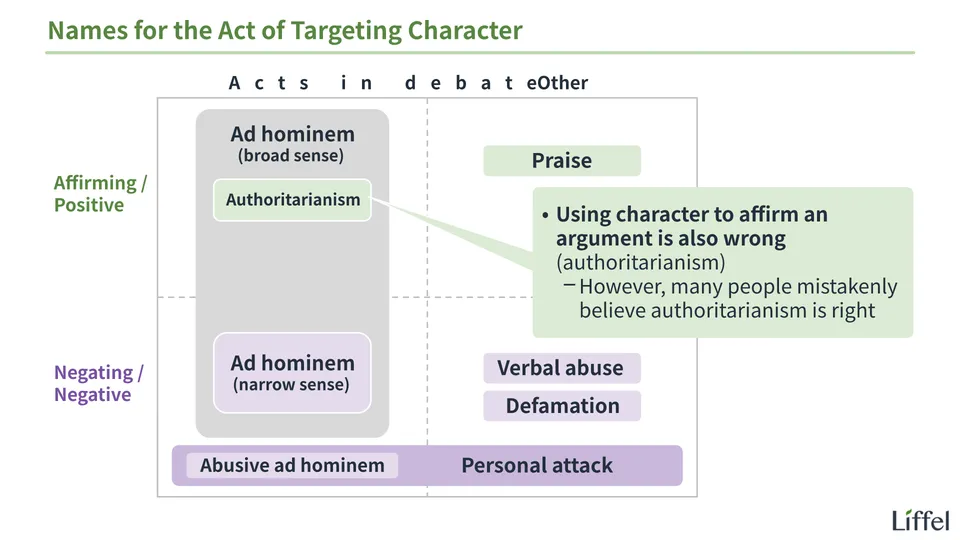
The act of making character the target of debate goes by many names besides “ad hominem.” The slide below organizes them.
The horizontal axis classifies whether the act takes place inside a debate or outside it; the vertical axis classifies whether character is used as a premise to affirm or to negate the opposing argument.
Please see the slide for details. Here, we will focus on the points that need special attention.
Caution 1: Using Character to Affirm an Argument Is Also Wrong
To begin with, ad hominem in the strict sense also applies when character is used as a premise to affirm an argument, and that too is wrong. Let us look at an example.
It’s drizzling. Should I use an umbrella?
You should. Getting wet puts you at risk of catching a cold.
You’re a doctor, so I’ll take your word for it. I’ll use an umbrella.
In this case, Bear is affirming the argument on the premise that “Panda is a doctor.”
Although affirmation and negation are reversed from the earlier example, both cases use character as a premise, and both are wrong for the same reason.
Authoritarianism
That said, in most cases the term “ad hominem” is used to mean “using character as a premise to negate an argument.” There are a few reasons for this.
First, what makes us want to commit ad hominem in the first place (though we should not) is a clash of arguments. When we agree with the other side’s argument, we just look at its content and say “I think so too.” It is only when we want to knock down the other side’s argument that we start picking at their character.
Also, “using character (especially attributes) as a premise to affirm an argument” has another name: “authoritarianism” (or “appeal to authority”). Note that on this site, “authoritarianism” does not refer to a political system. It means treating something as right because of the authority of the person who says it.
Moreover, authoritarian reasoning is the norm in Japan (it is regarded as right). Because it is not perceived as wrong, people rarely call it out as “ad hominem” or “authoritarianism.”
Since this topic could fill an entry of its own, we will leave it here. In any case, authoritarianism is a form of ad hominem, and it is wrong. Make no mistake about this.
Caution 2: The Many Names
Perhaps because authoritarianism is not recognized as wrong, the act of using character as a premise goes by many names with different shades of meaning. Here are the main ones.
- Usable only in a negative context
- Personal attack
- Abusive ad hominem
- Usable in both positive and negative contexts
- Argument to the person
- Ad hominem
- However, for the reason above, these are rarely used in a positive context
“Ad hominem” comes from the Latin “argumentum ad hominem” (“argument to the person”), and the original carries no negative nuance. Note that it covers affirming an argument as well as negating one.
That said, since the negative image now dominates, I think it is clearer to reserve these names for contexts where an argument is negated, and to use “authoritarianism” when it is affirmed. These are not words you will use often, but if you do, make sure your listener understands them the same way you do.
The Causes and Countermeasures of Ad Hominem
Finally, let us think about the causes of ad hominem and what to do about it. We will start with the causes.
Causes
The cause of ad hominem comes down to not recognizing that ad hominem is wrong.
As noted above, far from being regarded as wrong, authoritarian reasoning is treated in Japan as the “standard way of thinking.” Put differently, since tying arguments to character is not seen as a problem in Japan, ad hominem occurs as a matter of course.
In other words, the root cause of this situation is not knowing what should be regarded as a “right” way of thinking. In school, we are taught correct answers, not the right way of thinking. That is where the fundamental problem lies.
Countermeasures
The countermeasure is to recognize that ad hominem is wrong and then learn the right way of thinking.
We have already explained why ad hominem is wrong. For the right way of thinking, please refer to the following category.
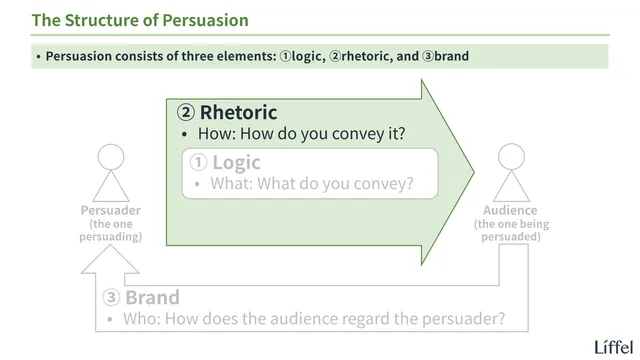
This concludes our discussion of ad hominem. Next, let us consider the problem of making “the manner of delivery” the target of debate. This too is a form of question drift. Please continue to the following entry.
A full list of fallacies (including logical fallacies and cognitive biases) is available in the entry below. Feel free to use it as a reference.
Footnotes
-
Here, “wrong (irrational)” means “incorrect as a way of thinking,” not “wrong in its conclusion.” ↩