This entry explains cognitive dissonance.
Cognitive dissonance is one of the distortions of cognition (cognitive biases) we are prone to. Let us look at what kind of phenomenon it is and think about what we can do to counter it.
toc
- What Is Cognitive Dissonance?
- When Cognitive Dissonance Becomes a Problem
- Countermeasures Against Cognitive Dissonance
- References
What Is Cognitive Dissonance?
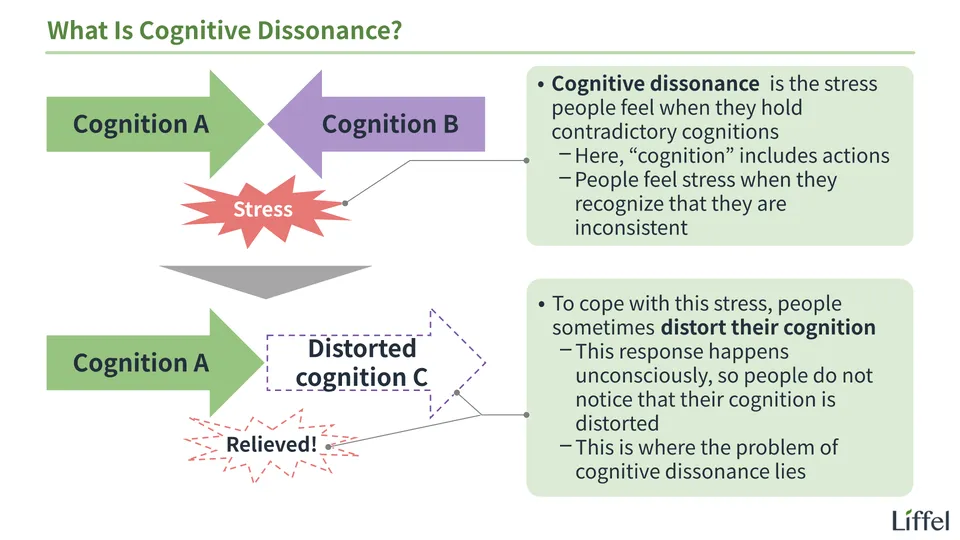
Cognitive dissonance is the psychological stress people feel when they hold contradictory cognitions or actions. Think of “psychological stress” here as covering discomfort, anxiety, and the like.
Cognitive dissonance: the psychological stress people feel when they hold contradictory cognitions or actions
And to relieve this stress, people sometimes distort their own cognition. Since the real problem with cognitive dissonance lies in this “distortion of cognition,” let us call it “cognitive dissonance in the broad sense.”
Cognitive dissonance (broad sense): the distortion of cognition that occurs when people hold contradictory cognitions or actions
The theory of cognitive dissonance was proposed by the American psychologist Leon Festinger.
Example #1: The Fox and the Grapes
Let us look at some concrete examples. We will start with the classic one: “The Fox and the Grapes.”
As you know, “The Fox and the Grapes” is the story of a hungry fox who tries to eat grapes growing high up, cannot reach them, and walks away saying, “Those grapes must be sour anyway.”
Here are the fox’s cognitions (from here on, “cognition” includes actions)1:
| Cognition A | Cognition B |
|---|---|
| I’m hungry and want to eat the grapes. | I can’t reach the grapes, so I can’t eat them. |
Here, cognitions A and B are in conflict. When people (in this case, a fox) are put in this kind of situation, they feel stress. This stress is “cognitive dissonance.”
The situation so far is illustrated below.
Strictly speaking, cognitions A and B can both be true at once, and that is reality. The point is that people have trouble simply accepting that kind of reality.
So people try to resolve cognitive dissonance by distorting one of the cognitions. In this example, the fox changed cognition A as follows.
| Cognition C | Cognition B |
|---|---|
| Those grapes must be sour and taste bad, so there’s no need to eat them. | I can’t reach the grapes, so I can’t eat them. |
Note two points here.
- By changing cognition A to C, the conflict with cognition B disappeared → the cognitive dissonance is resolved
- Cognition C is distorted (it cannot be said to perceive reality correctly)
- There is no way to know whether the grapes are sour
Although changing its cognition freed the fox from stress, the new cognition is distorted.
When people experience cognitive dissonance, they sometimes distort their cognition to resolve it
The following slide illustrates everything so far (for convenience, it shows cognition B, rather than A, being distorted).
As noted above, “cognitive dissonance” in the strict sense refers to the stress itself (caused by the conflict of cognitions), but what we should be wary of is this distortion of cognition.
Or rather, it may be more accurate to say that “unless cognition is distorted, there is no reason to bother using the term ‘cognitive dissonance.’” If you accept reality, there is no problem. There may be stress, but everyone feels some stress in life.
In this example too, if the fox had thought, “I want to eat the grapes, but unfortunately I can’t reach them. I’ll accept that and look for something else to eat,” there would be no problem (though it would not make much of a fable).
Example #2: Was the Movie Any Good?
The next example is from my own experience.
Ever since I was a child, I loved a certain movie series. I loved it so much that I imitated the characters’ lines in English, and I watched every new installment in the theater.
One year, a new installment of the series was announced. Naturally, I booked a ticket just as I always had. Let us call this cognition A.
On release day, I went to see the new installment. To my surprise, it seemed to repudiate the entire series up to that point, and it was not something I could enjoy at all. Let us call this cognition B. My cognitions were as follows.
| Cognition A | Cognition B |
|---|---|
| A new installment of my favorite movie series was coming out, so I booked a ticket. | The new installment repudiated the series up to that point, and it was unbearable to watch. |
At that moment, I was struck by an indescribable anxiety. This feeling was completely different from simply watching a boring movie. It felt as if something important beneath my feet were crumbling away.
What I was feeling then was cognitive dissonance (though I did not know the term at the time).
Too Painful to Accept: Distorting My Cognition
Actually, cognition B is my honest opinion now, not my impression right after watching the movie.
At the time, unable to accept that my favorite series had turned into something else, I came up with the following cognition C, just like the fox.
| Cognition A | Cognition C |
|---|---|
| A new installment of my favorite movie series was coming out, so I booked a ticket. | There were some things that bothered me, but the new installment was good. |
You could even say that cognition C was what I truly believed at the time. In fact, when a friend asked what I thought of the new installment, I answered, “It was good.” Since I had no reason to lie, I must have believed it (or wanted to).
As time passed, however, I never felt any desire to watch it again (I have watched the other films in the series many times). Eventually I accepted reality and arrived at cognition B. I think it took about a month.
What this shows is that the distortion of cognition caused by cognitive dissonance happens at an unconscious level. In other words, people do not notice that their cognition is distorted. That is only natural: anyone who noticed that their cognition was distorted would correct it.
Through this experience, I learned the hard way that “my own cognition is surprisingly unreliable.”
The distortion of cognition caused by cognitive dissonance happens at an unconscious level
When Cognitive Dissonance Becomes a Problem
You could argue that the two examples so far are “no big deal.” If sour grapes make you feel better, maybe that is fine (pathetic as it is), and whether a movie is good is a matter of taste. No one else is harmed.
Cognitive dissonance becomes a problem when the distorted cognition strays too far from reality and the facts (excessive self-justification). Since we ultimately live in a world of reality and facts, cognition that strays from them only leads to unhappiness. Let us look at a well-known example.
| Cognition A | Cognition B |
|---|---|
| I smoke. | Smoking is bad for your health. |
Assuming the person wants to stay healthy, these cognitions are in conflict. There are only two ways to resolve the conflict.
- Change cognition A (= quit smoking)
- Change cognition B
Since quitting smoking sounds hard, let us change (distort) cognition B instead. The result is as follows.
| Cognition A | Cognition C |
|---|---|
| I smoke. | The stress relief I get from smoking is good for my health. |
Cognition this distorted is clearly a problem.
Modern science has found that “even taking stress relief and other effects into account, smoking is bad for your health.” Since this fact will not change, thinking like cognition C gets you nowhere. Either make a clear-eyed decision to “choose a life of smoking even though it’s bad for my health,” or quit.
Other Examples of Excessive Self-Justification
Other known examples of cognition that strays from reality include the following.
- You work for an obviously exploitative company, but because you have been there a while, you look for its good points and convince yourself it is a good employer
- No matter how hard you convince yourself, if the reality is an exploitative company, your health will break down at some point
- You are dating a no-good partner, but because you have been together a long time, you decide that “I just like no-good people”
- From the standpoint of evolutionary biology, it is thought that no individual prefers no-good partners (though it depends on how you define “no-good”)
As these show, cognition that strays too far from reality and the facts does you no good. This is the problem with cognitive dissonance.
Countermeasures Against Cognitive Dissonance
Finally, let us think about countermeasures against cognitive dissonance. Depending on how you interpret “countermeasure,” it can mean either of the following.
- A way to relieve the stress caused by cognitive dissonance
- A way to accept reality while feeling the stress
Since these are different things, let us consider them separately.
Countermeasure #1: A Way to Relieve the Stress
First, if you interpret “countermeasure” as “a way to relieve the stress caused by cognitive dissonance,” then distorting your cognition is itself the way to relieve the stress. See the slide.
Since this reaction happens at an unconscious level, you do not need to do anything in particular. In this sense, we deal with cognitive dissonance automatically.
Taking this further, you might even distort your cognition on purpose. For example, when there is something you want but simply cannot get, you tell yourself, “I don’t want that anyway.” The sour grapes strategy, in other words. I think overdoing it is a bad idea, but there are probably cases where it helps.
Countermeasure #2: A Way to Accept Reality
Next, let us consider countermeasures in the sense of “a way to accept reality while feeling the stress”. Since there is no point in constantly distorting your cognition, this is what truly matters.
Put simply, the answer seems to be “accept reality.” But if that were easy, no one would struggle. To repeat, distortions of cognition happen at an unconscious level. In other words, we cannot notice that we are failing to accept reality.
Although there is no clever countermeasure here, one idea is to keep the stress from cognitive dissonance small (keep it from growing large). Clearly, the smaller the stress, the easier it is to accept reality.
According to the Japanese textbook Social Psychology (Revised Edition), the size of the stress and the degree of distortion caused by cognitive dissonance are determined by the following three factors.
- The degree of inconsistency between the conflicting cognitions
- How public the cognition is
- How much has been invested in the cognition
Although “the degree of inconsistency” cannot be controlled in advance, the other two can. Let us look at them as countermeasures.
Keeping the Stress Small #1: Do not Make Your Cognitions Public
First, the more public a cognition is, the larger the stress and the distortion become. Put plainly, once you have made something public, it is hard to back down.
Conversely, if you do not make everything public, it is easier to back down. Specifically, keep the following in mind.
- Do not say things you do not need to say
- Do not turn everything into photos or videos
- Before posting online, ask yourself, “Is there really any point in making this public to the world?”
The last point, in bold, is the most important. The more of your cognitions you publish online, the more you will be bound by them. Think carefully about whether that is really what you want.
Keeping the Stress Small #2: Do not Invest Big All at Once
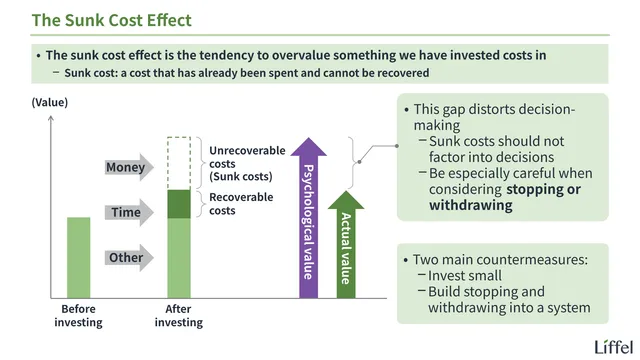
Next, the more you have invested in a cognition, the larger the stress and the distortion become. Again, put plainly, if you bet big, you cannot back out. This is also known as the “sunk cost effect.”
So it is better not to invest big all at once. Investing small at first and seeing how things go is the right approach as a “countermeasure against cognitive dissonance”2.
That concludes our discussion of cognitive dissonance. Next, I will explain the “sunk cost effect” I briefly touched on at the end.

A full list of fallacies (including logical fallacies and cognitive biases) is available in the entry below. Feel free to use it as a reference.
References
Footnotes
-
Since there is no point in separating “cognition” from “action” when it comes to understanding cognitive dissonance, this entry uses “cognition” to cover actions as well. ↩
-
That said, since the earlier you invest, the bigger the return tends to be, this attitude is not necessarily correct from a purely investment standpoint. ↩