This entry explains “sunk costs” and the effect they have on our decision-making (the sunk cost effect).
Let us begin.
toc
- What Is a Sunk Cost?
- What Is the Sunk Cost Effect?
- When Sunk Costs Become a Curse
- Countermeasures Against the Sunk Cost Effect
What Is a Sunk Cost?
First, a sunk cost is “a cost that has already been spent and can no longer be recovered.” Once sunk, it will not come back.
Sunk cost: a cost that can no longer be recovered
Let us look at some examples.
- Money spent on a purchase that cannot be returned
- Time spent waiting in line
- Emotional investment in a person or thing you love
None of these can be taken back, however much you might wish they had never happened. They are all sunk costs.
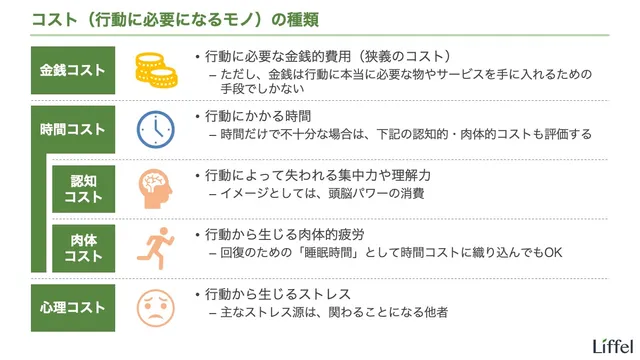
As these examples show, note that “costs” include more than money. The types of costs are explained in a separate entry below.

Most Costs Are Sunk Costs
As you know, costs other than money can never be recovered. Time cannot be taken back no matter what you do, and you cannot cancel the effort or passion you have poured into something and reassign it to something else.
This gives us the following breakdown.
- The part of money that can be recovered: not a sunk cost (e.g., money paid for something that does not lose value when sold secondhand)
- All other costs: sunk costs
In other words, most costs become sunk costs the moment they are spent. Having a special name does not make them unusual; if anything, they are the norm. Do not misunderstand this point.
What Is the Sunk Cost Effect?
With that groundwork in place, let us move on. Take a look at the following slide.
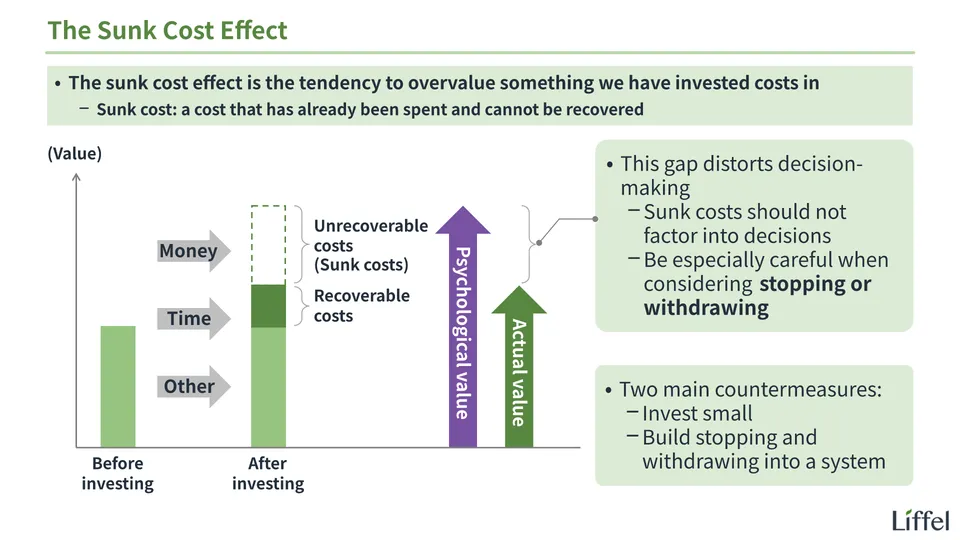
As shown, the value of something we have spent costs on rises in our minds. This rise in value is the “sunk cost effect.”
Sunk cost effect (broad sense): the rise in the psychological value of something we have spent costs on
As an example, imagine clothes or dishes you have used for a long time. To others they are just secondhand goods, but to you they are worth more than that. This is the sunk cost effect (it is also sometimes called the “endowment effect”).
Note that what I am describing here is a broader usage than the usual meaning of “sunk cost effect.” I will explain the difference later, so let us move on for now.
Is the Sunk Cost Effect a Problem?
The sunk cost effect (as defined above) is not a problem in itself. If anything, you could say it is what adds color to our lives.
For example, you surely have things you treasure and precious memories. They are “valuable” to you, and you could say that is all thanks to the sunk cost effect. After all, nothing becomes precious unless you have poured costs into it.
Things become truly valuable because we pour time, passion, and money into them. Without the sunk cost effect, we would be unable to find value in anything. What a lonely world that would be.
When Sunk Costs Become a Curse
However, in situations that meet the following two conditions, the sunk cost effect weighs on us like a curse.
- When making a decision about whether to continue or stop something you have already invested costs in, and
- When you are investing costs in an option you would clearly be better off abandoning
Under these conditions, we cannot easily let go of “the option we would clearly be better off abandoning,” because the sunk cost effect has raised its psychological value. See the slide.
Example: Can You Walk Out of a Boring Movie?
Suppose a movie turns out to be boring. The ticket cost 2,000 yen, and you are wondering whether to walk out.
First, note that the ticket price is a sunk cost. Once you have watched the movie, the ticket cannot be refunded.
That means the ticket price should not be a factor in the decision “Should I leave?” Whether you leave or keep watching, you will not get the ticket price back. You should decide purely on whether the rest of the movie is worth your time.
Since the movie is boring, the rational decision is probably to leave and spend your time on something else. But actually doing so is hard, is not it? Having paid for the ticket, you want to get your money’s worth. You think, “There’s always a chance it suddenly gets interesting from here,” and end up staying in your seat until the end.
In this way, things we have invested in become hard to let go of. When that thing turns out to be an obvious dud, the sunk cost effect becomes a curse that distorts our decision-making. It is no coincidence that the standard English name for this phenomenon is the sunk cost fallacy.
The Sunk Cost Effect in the Narrow Sense | Other Names
In the strict sense, the “sunk cost effect” means this: “our decision-making becoming irrational because of the psychological rise in value that comes from having invested costs (= being unable to stop something we would be better off stopping).”
Sunk cost effect (narrow sense): decision-making becoming irrational because the psychological value of something we have spent costs on rises
In this sense, the “sunk cost effect” goes by the following other names.
- Sunk cost fallacy
- Sunk cost bias
- Concorde fallacy (Concorde effect)
- Named after the supersonic Concorde project, which could not be canceled even after it became clear that it had no economic prospects
All of these clearly suggest that the effect is something bad. Of these, “sunk cost fallacy” is the most widely used.
However, as noted above, “the phenomenon in which invested costs raise psychological value” happens everywhere and is not necessarily negative. In that sense, I think the more neutral “sunk cost effect” is the better name.
Countermeasures Against the Sunk Cost Effect
Finally, let us think about countermeasures against the sunk cost effect (in the bad sense). There are two.
- Invest small
- Build stopping and withdrawing into a system
Let me explain each.
Countermeasure #1: Invest Small
The first possible countermeasure is to invest small. This is the standard approach.
It is self-evident that the larger the investment, the larger the sunk cost effect (= the harder it is to back out). So until it becomes clear that the benefits outweigh the costs, it is safest to keep your investment small.
In other words, it is better not to invest big all at once. Although a big investment that pays off brings a big return, it usually is not worth it, given the downside of not being able to back out if it fails.
Turning the Sunk Cost Effect to Your Advantage
Turning this countermeasure on its head, making yourself (or someone else) invest big all at once so that there is no backing out is also a common technique.
For example, with hobbies like scuba diving, tennis, or playing an instrument, people say “if you’re serious, spend money on equipment first.” The main reason is probably that “expensive equipment is better and helps you improve faster,” but you could also see it as turning the sunk cost effect to your advantage. Once you have spent several thousand dollars, you cannot easily quit.
This applies beyond hobbies: almost everything is hardest at the beginning. If you are serious about sticking with something, putting in a fair amount of money at the start is one option.
If you want to commit, investing big all at once is one option
Along similar lines, some language-learning or diet programs charge an initial fee of several thousand dollars. From the provider’s perspective, besides simply covering costs, the fee may serve the following purposes.
- They can limit their customers to people who are that determined (screening customers)
- Because customers commit after paying a large sum, the provider can ask them to do hard things
- It makes customers think the service is good (customers assume “it must be good because it’s expensive”)
If you want results no matter what, services like these may be worth considering. Of course, some may simply be rip-offs, so be careful.
Countermeasure #2: Build Stopping and Withdrawing into a System
The second possible countermeasure is to build stopping and withdrawing into a system. Since it is unavoidable that you will be caught by the sunk cost effect after investing, you let a system, not yourself, stop and withdraw for you.
Specifically, you set up the following system.
- Before investing, decide the following two things
- The criteria for stopping and withdrawing
- When to decide whether to stop and withdraw
- When the time to decide comes, decide and act mechanically
- Do not take part in the decision yourself (because you will be caught by the sunk cost effect)
- Let a rule or someone else make the decision, and if the decision is to stop and withdraw, carry it out automatically
A typical example is the “stop-loss order” in trading financial products (stocks or forex). As shown below, with this system, stopping and withdrawing (cutting your losses) happens automatically.
- Criteria for stopping and withdrawing: when you buy, decide in advance “sell if it falls to XX”
- When to stop and withdraw: the position is closed automatically when the criteria are met
- A program executes the sale automatically; you do not have to do anything
Cutting your losses while staring at a chart that is actually showing a loss is extremely difficult. That is why you make the decision calmly at the time of purchase (= when there is no loss yet and no sunk cost effect). Although such a system cannot be built in every case, keep it in mind as one possible countermeasure.
That concludes our discussion of the sunk cost effect.
A full list of fallacies (including logical fallacies and cognitive biases) is available in the entry below. Feel free to use it as a reference.