In this entry, you’ll learn what cost is and what types of costs there are.
We always pay costs whenever we act. Since this will help you in all sorts of situations, make sure you understand it well.
Let’s begin.
toc
- What Is Cost?
- Types of Costs
- Type 1: Monetary Cost
- Type 2: Time Cost
- Type 3: Cognitive Cost
- Type 4: Physical Cost
- Type 5: Psychological Cost
- Using the Classification of Costs as a Framework
What Is Cost?
First, let’s clarify what the word “cost” means.
In its narrow sense, “cost” means expenses, especially the expenses needed to produce goods. But the word is also used more broadly to include time, effort, and other things besides money.
Since I want to use “cost” in a broad sense this time, let’s include concepts other than money. So this site defines “cost” as follows.
Cost is whatever you need to do something. This “whatever” isn’t limited to physical things. It includes anything.
The clearest example of cost is, of course, money. When you “buy” something, you need to pay “money.” So here, money is the cost.
What about “passing an exam”? In this case, besides the “money” for study guides and the like, you also need “time” to study and “concentration” to understand the material. Think of everything in bold here as a cost.
Cost: whatever you need to do something (not limited to physical things)
Resources
While we’re at it, let’s also define “resources.” Since it’s a concept similar to cost, I recommend learning them together.
Resources are whatever an individual or organization possesses (not limited to physical things).
Resources: whatever an individual or organization possesses (not limited to physical things)
Although the similar definitions may be confusing, the difference is whether it’s used in an exchange. Get a picture of it from the slide below.
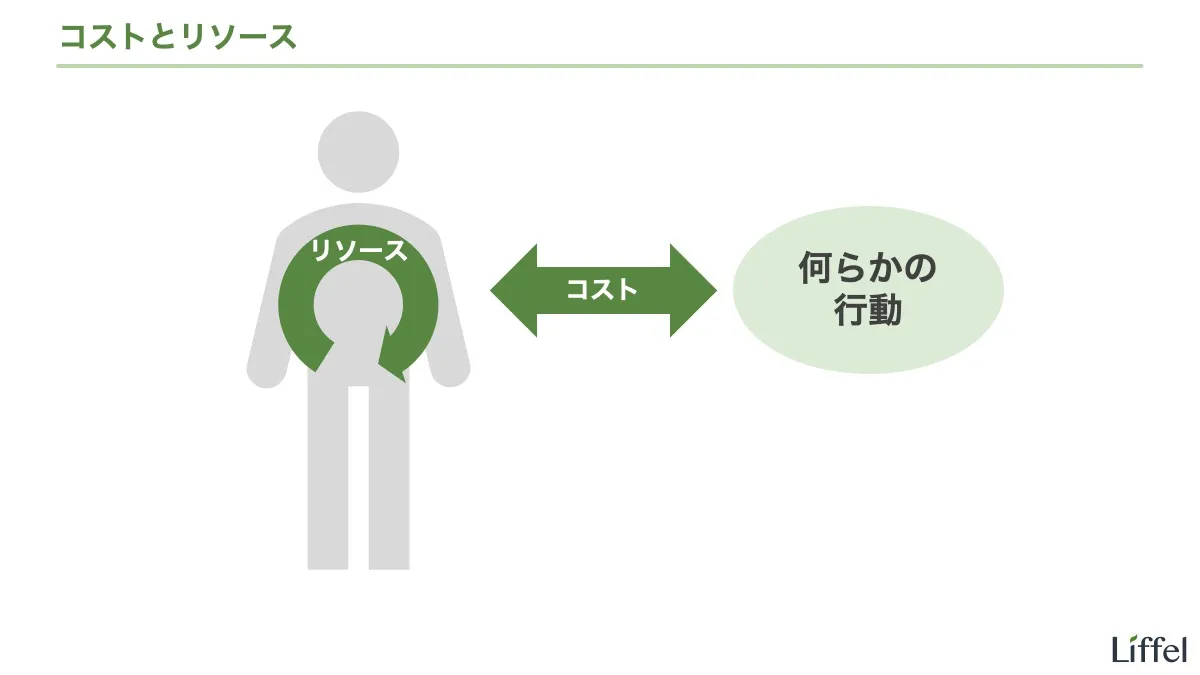
For example, the $10 in your wallet is a “resource,” but the $10 you hand over when you buy something is a “cost.” It’s easiest to think of the difference as “whether you merely possess it or are giving it up in exchange.”
In other words, when you’re about to give up a resource in exchange for something, it comes to be called a cost. Either name often refers to essentially the same thing.
Obviously, you can’t pay as a cost what you don’t possess as a resource1. You can’t spend what you don’t have. So when you think about costs, you also need to think about resources.
Although I’ll focus on costs from here on, don’t forget that “costs and resources go together.”
Why Think About Costs?
Now that we’ve defined the terms, let’s think about something important.
Why learn about costs and think about them?
The answer is simple: if you misjudge costs, you won’t be able to carry out or complete what you want to do.
As defined above, cost is what you pay to do something. Conversely, if you can’t pay the cost, you can’t take the action. And even if you can pay, if the cost turns out bigger than you thought, it affects your other actions. That’s surely not what you want.
In other words, whenever you do something, you should correctly grasp the cost of the action.
Note that there’s no action in the world that costs nothing at all. Even if you take the “action” (?) of “doing nothing,” it costs “time.”
In that sense, paying costs isn’t bad. Costs are something you have to pay. Although the word “cost” inevitably carries a negative image, don’t get this wrong.
Whatever you do, you have to pay costs, but it’s important to grasp those costs correctly
Why Take a Broad View of “Cost”?
So what’s the point of thinking about costs that include things other than money?
The answer is simple here too: taking a broad view of cost lets you correctly recognize the costs you pay.
As mentioned, paying costs isn’t a problem in itself. But if you’re paying costs you don’t recognize, that’s a problem. It’s like money disappearing from your wallet without your knowing. And if you don’t recognize costs other than money, something other than money may be disappearing, from somewhere other than your wallet, without your knowing.
In particular, in private decisions, it’s important to evaluate costs other than money.
As I’ll explain later, since most things can be bought with money, looking only at money is often enough when evaluating costs in business (or rather, realistically, it’s the only way). But when you make your own decisions, considering your limited time and stress too will help you avoid wrong decisions.
Types of Costs
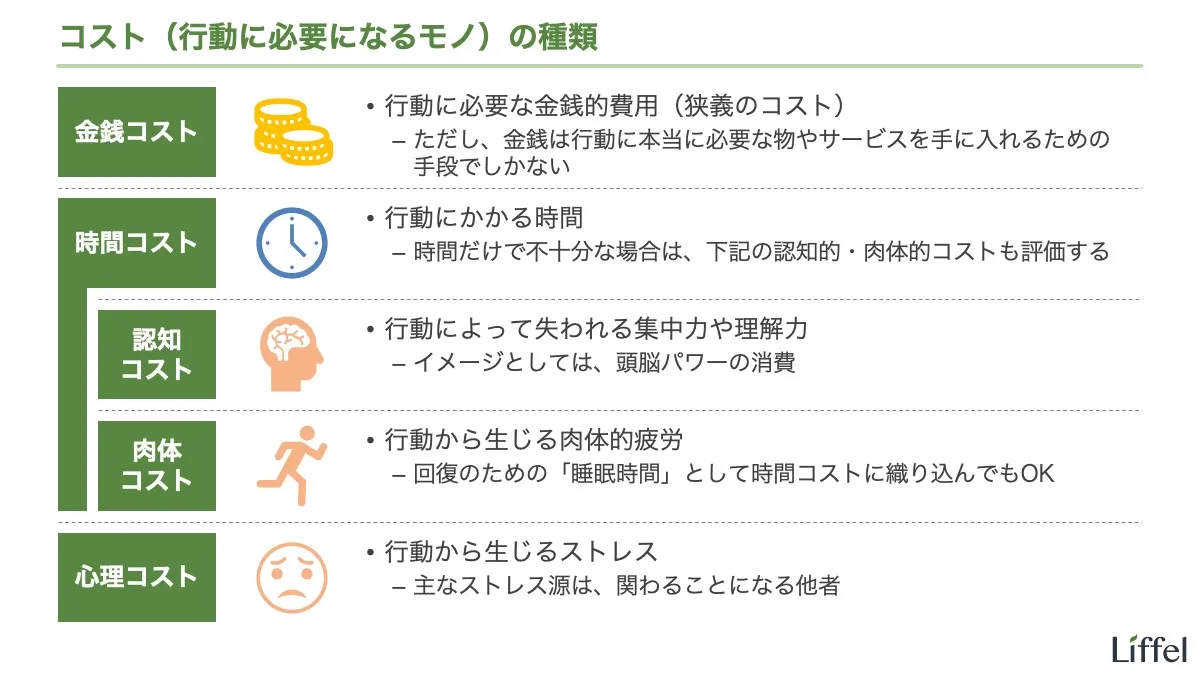
Now that we’re ready, let’s learn the types of costs. The slide below gives an overview.
As shown, I recommend thinking of costs as falling into five broad types2:
- Monetary cost
- Time cost
- Cognitive cost
- Physical cost
- Psychological cost (stress)
Let’s look at them one by one.
Type 1: Monetary Cost
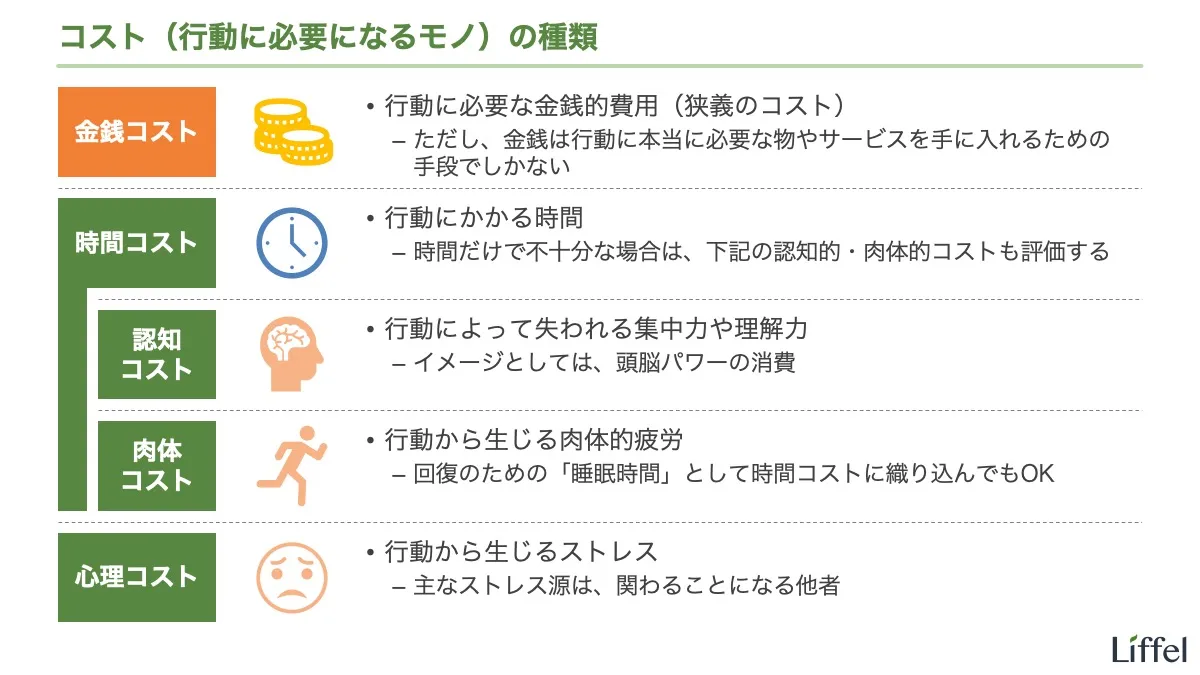
The first cost is monetary cost. Put simply, it’s expenses. “Cost” in the narrow sense means monetary cost.
Monetary cost: the financial expense of an action
However, keep in mind that monetary cost is a secondary cost, because money is just a medium of exchange. Money is never the primary cost (what an action truly requires).
For example, I said earlier that “passing an exam” requires money to buy study guides. Strictly speaking, though, the cost of this action is the study guides, not the money. In this way, money is a means of getting what you truly need3.
In general, since equipment, materials, and other people’s time (labor) can be bought with money, they get converted into monetary cost, and they should be. Since money “becomes a number and can be compared objectively,” this lets you grasp costs more accurately.
But it defeats the purpose if looking only at money obscures the real cost. Always record what you valued, and at how much. In some cases, you may be able to procure the cost more cheaply. In the earlier example too, if an upperclassman gives you their study guides for free, you don’t need money. That’s perfectly fine.
For monetary cost, the details (what you valued, and at how much) matter
Since this entry focuses on costs other than monetary cost, let me stop here. I’ll explain monetary cost in detail in the next entry.
Type 2: Time Cost
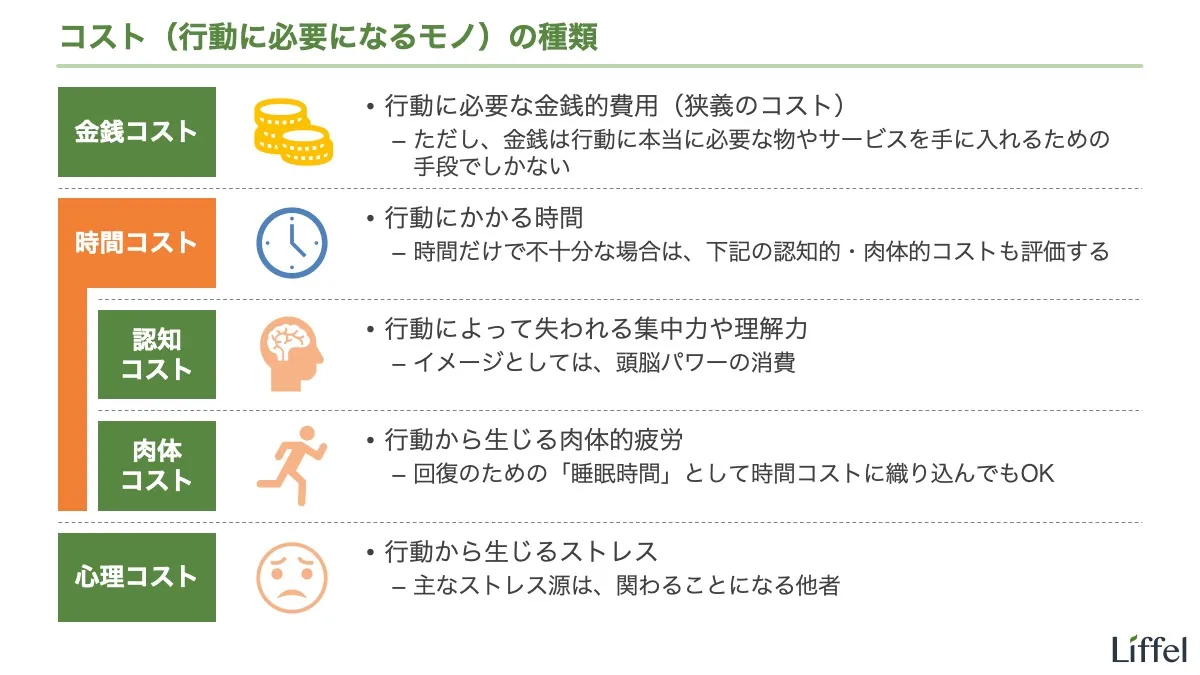
The second cost is time cost. As the name says, it means “how much time it takes to carry out the action.”
Time cost: the time an action takes
Monetary cost and time cost are the two main costs. Whatever action you take, I recommend checking at least these two.
At minimum, check monetary cost and time cost
Time cost has the following characteristics:
- It can be quantified
- It has an absolute limit
- Other costs are invested along with it
Let’s look at them one by one.
Characteristic 1: It Can Be Quantified
The first characteristic of time cost is that it can be quantified. Time can be measured. This is the same as monetary cost.
When evaluating time cost, note that your sense of how much time something takes can differ from how much time it actually takes. Preparation, cleanup, and travel time are especially easy to overlook. When you want to evaluate time cost seriously, list your activities properly and measure the time.
Characteristic 2: It Has an Absolute Limit
The second characteristic of time cost is that it has an absolute limit. A day has 24 hours for everyone, and that can’t be changed.
In other words, if you pay time cost for something, the time cost (time resources) you can pay for other things decreases. If you don’t like that, you either pay monetary cost to buy other people’s time or don’t take the action.
Characteristic 3: Other Costs Are Invested Along with It
The third characteristic of time cost is that other costs are invested along with it.
When we spend time on something, we never spend “only time” in the true sense. That would just be waiting for time to pass, doing nothing.
In other words, when we invest time, we invest something along with it. That something is often expressed as “effort,” but there are two problems:
- The time and effort invested aren’t necessarily proportional
- The word “effort” is vague, and it’s unclear what it means
Studying is an easy example. For example, suppose you decide, “I’ll study three hours a day,” and block out the time. In other words, the time cost is secured. But as you know, actually studying for three hours is extremely hard. Sometimes your head gets tired partway, and sometimes you want to check your phone.
In other words, in this case, you run out of the ability to pay the cost called “effort” before the time cost. In this situation, “effort” specifically means things like “concentration and comprehension.” If you want to see your studying through, focusing only on time cost won’t do. You need to think about how to secure this “concentration and comprehension.”
In this way, depending on the situation, you need to define what “effort” is and separate it out as a cost distinct from time cost.
What Is “Effort”?
So what is “effort”?
Roughly speaking, human effort comes from only two places: the head or the body. So there are two possible costs:
- Effort of the head: cognitive cost
- Effort of the body: physical cost
I’ll explain them in detail from here. For now, remember that these two are variants of time cost.
Type 3: Cognitive Cost
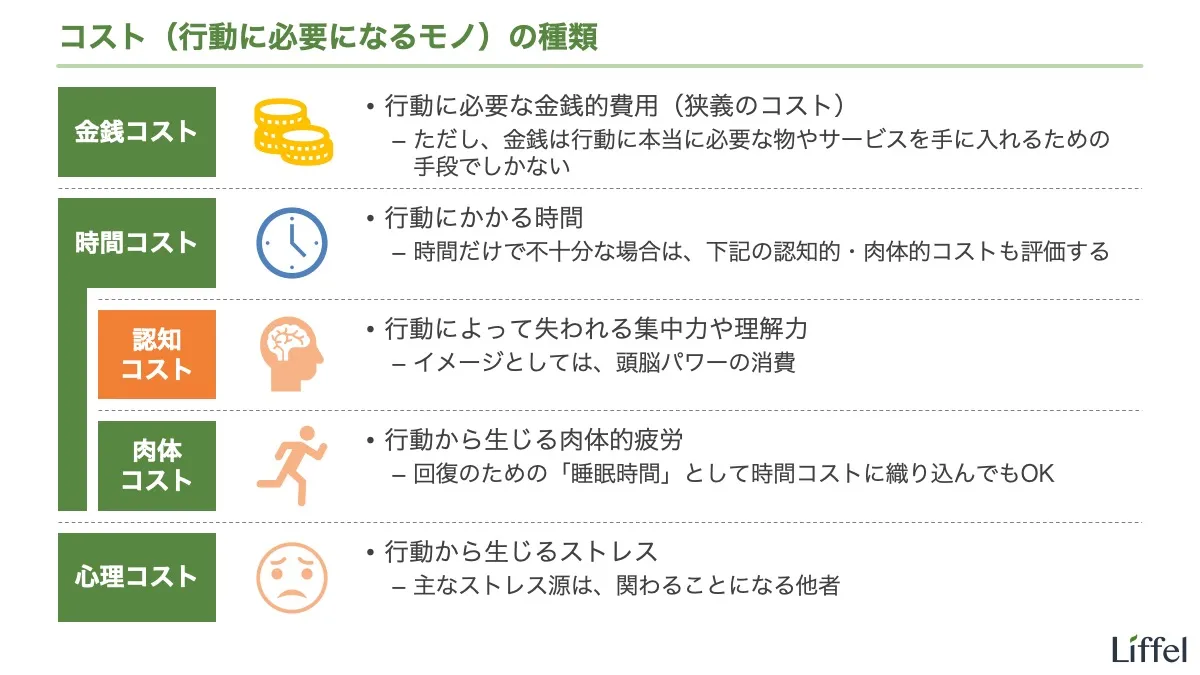
The third cost is cognitive cost.
Cognitive cost is the effort of the head. Think of it as brainpower. Words like “concentration” and “comprehension” are also close.
Cognitive cost: the cost paid for the cognitive activity, such as concentrating or understanding, that accompanies an action
Here are some cases where you should consider this cost.
First, for activities like studying or intellectual work, where “spending time is pointless unless your head is working,” you should consider whether you can pay the cognitive cost (whether you have enough cognitive resources). If your head is tired and you can’t pay the cognitive cost, it’s just a waste of time.
Next, when thinking about things you want users to understand and use smoothly, such as presentations or website designs, you should consider how to lower the user’s cognitive cost. For example, in a presentation, if you don’t follow basic rules like “lay out content from the upper left to the lower right of the slide, following the flow of the story,” you make users pay unnecessary cognitive cost.
In this way, for actions that use your head, check the cognitive cost.
Type 4: Physical Cost
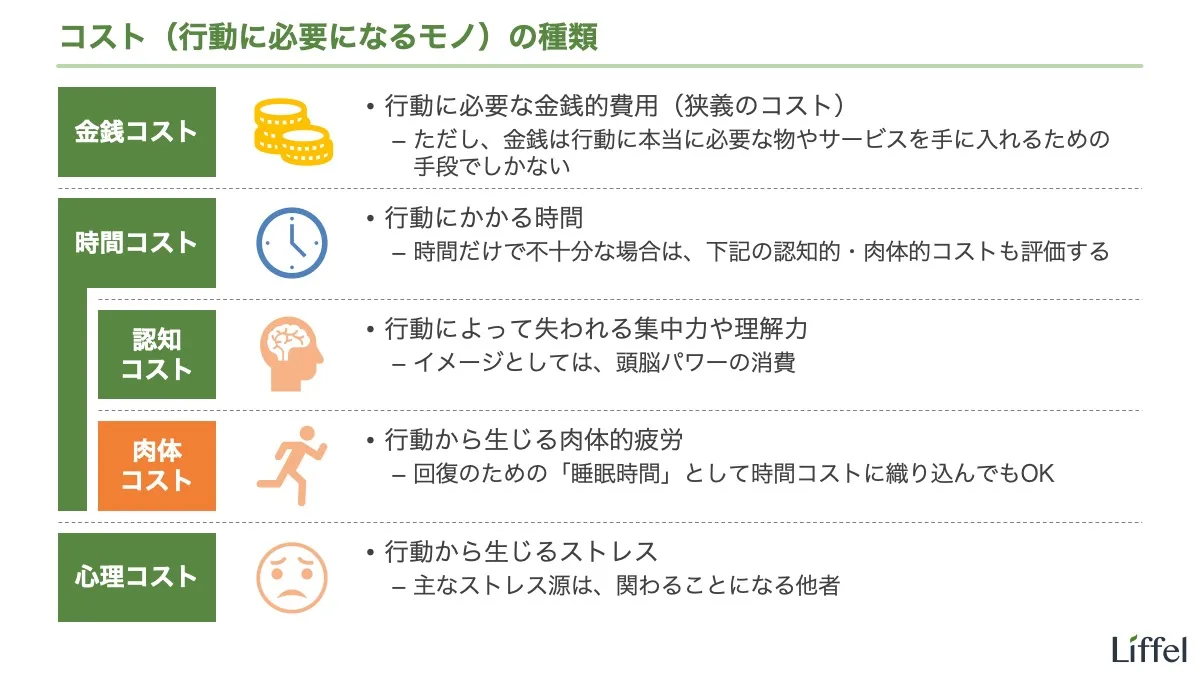
The fourth cost is physical cost. As the name says, it’s the physical fatigue that results from an action. In a broad sense, you could include the risk of injury or illness.
Physical cost: the physical fatigue that results from an action
A typical case for considering physical cost is choosing a job. Since there are terms like “mental labor” and “physical labor,” everyone cares about the physical cost of a job. For example, since most part-time jobs have a high physical cost, the exceptional ones with low physical cost, like tutoring or lifeguarding, are always popular.
Physical cost can often be converted into the time cost of “sleep (recovery) time.” That’s because recovering from physical fatigue requires sleep.
As an example, consider the action “do 30 minutes of strength training at home every day.” At first glance, the time cost of this action seems to be 30 minutes, but in many cases, strength training increases your sleep time. If it increases your sleep by an hour, the actual time cost should be an hour and a half.
In my view, overlooking this additional time cost is a big reason people fail to make exercise a habit. Unless you plan from the start to increase your sleep time along with starting exercise, something will give somewhere.
Be careful, since this kind of “additional time cost arising from physical cost” is easy to overlook. Since time cost is easier to handle as a number, it’s better to include it in time cost when possible.
The Head and the Body Aren’t Separate
Finally, a caution. So far, I’ve divided the sources of effort into the head and the body and considered two costs. But as you know, in reality, the head and the body aren’t separate.
For example, after you’re worn out from sports practice or a part-time job, you don’t feel like studying something new. In other words, if you pay too much physical cost, you can’t pay cognitive cost afterward. You can’t think of the head and the body as completely independent.
Although separating them into head and body is the only way to think concretely, something is lost by thinking of them separately. It’s good to keep in mind the perspective of “overall effort / energy” as well.
Type 5: Psychological Cost
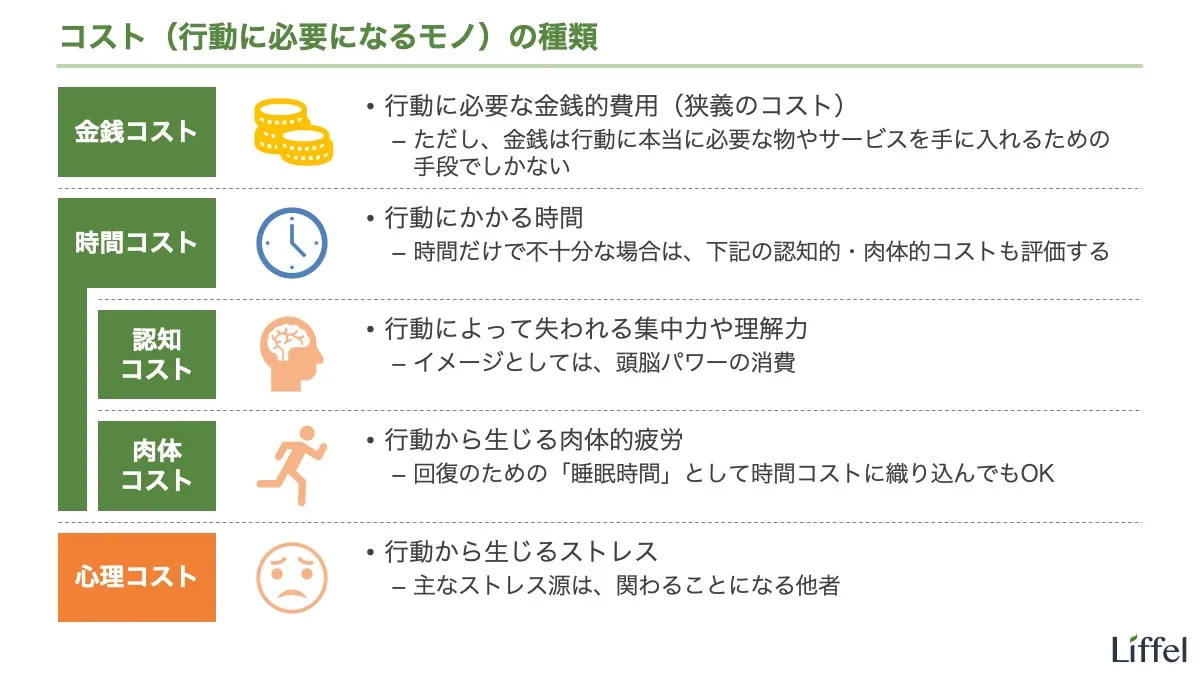
The last cost is psychological cost. As the name says, it’s psychological or mental cost. In short, it’s stress4. It needs no particular explanation.
Psychological cost: the (psychological) stress that results from an action
The clearest example of psychological cost is your boss at work. Unless you work independently, you can’t avoid facing your boss day after day to “work and get paid.” And if you don’t get along with your boss, working every day becomes stressful. That’s psychological cost.
Psychological cost has the following characteristics:
- The threshold is what matters
- It’s completely subjective
Let me explain each in turn.
Characteristic 1: The Threshold Is What Matters
The first characteristic of psychological cost is that the threshold is what matters.
First, a “threshold” is, put simply, a borderline. For psychological cost, think of the threshold as “the level (of stress) beyond which your mind and body are affected.”
It’s generally said that too much stress leads to depression or autonomic nervous disorders. And these illnesses don’t heal as easily as a cold. In other words, if psychological cost exceeds the threshold, you risk long-term harm to your life. That’s serious.
On the other hand, trying to reduce psychological cost to zero isn’t realistic. Some stress is inevitable in life, and we can handle moderate stress without problems anyway. In fact, there’s even a claim that “moderate stress is good for your health” (whether it’s true is unclear).
In other words, psychological cost is a big problem when it approaches the threshold (= the line you mustn’t cross), but when it’s well below the threshold, you don’t need to worry about it as a cost. This is very different from monetary or time cost.
Characteristic 2: It’s Completely Subjective
However, it’s impossible to judge objectively whether psychological cost is approaching the threshold, because this cost is completely subjective. This is the second characteristic of psychological cost.
Here, “subjective / objective” means “whether it can be observed and counted (objective) or not (subjective).” If you’d like to learn more, see the entry below.
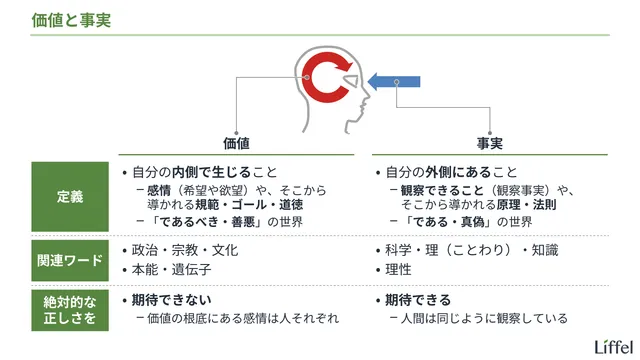

Back to the point. Just off the top of my head, psychological cost has the following characteristics:
- What counts as stress differs from person to person
- What’s more, even for the same person, simply changing how you think can make something that was stressful until yesterday stop bothering you at all
- There’s no way to measure your own threshold (mental toughness) either
- People who think “I’m mentally tough” sometimes suddenly break down
As a result, it’s impossible to evaluate psychological cost the way you evaluate monetary or time cost. Neither the size of the cost nor what that size means can be judged objectively.
The Main Sources of Stress
Psychological cost itself can’t be evaluated objectively. But its sources, that is, the sources of stress, can be perceived. The main sources of stress are as follows:
- People
- Yourself
- People who worry endlessly or hold grudges reproduce stress themselves
- Others (whom you can’t avoid dealing with)
- In modern society, you often have no choice but to deal with others who stress you out
- Bosses and colleagues at work, teachers and classmates at school, etc.
- Yourself
- Lack of money
- Creates anxiety about your future life
- Health (feeling unwell)
- Makes it hard to think positively; creates anxiety about your future life
When considering stress as a cost, the one to focus on most is “others.” Taking some action often increases the number of people you have to deal with. Going on to a new school or starting a job are classic examples. The other sources of stress rarely need to be considered as psychological cost.
Of course, perceiving the sources of stress doesn’t change the fact that stress itself is subjective. But recognizing the sources of stress first should make it easier to take countermeasures.
Although psychological cost is harder to handle than monetary or time cost, its importance is growing in modern society. Even if your evaluation is subjective, it’s better not to ignore it lightly.
Using the Classification of Costs as a Framework
From here, it’s the advanced part. Let’s use the types of costs you’ve learned as a framework. Note that this assumes you’ve read the entry below.
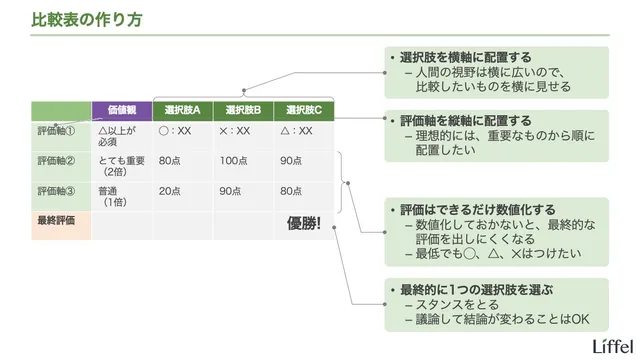
Back to the point. As explained at the start, cost is what you pay in exchange for some action. In other words, whatever solution you carry out, costs always arise. So when evaluating solutions, it’s fine to include “cost” as an evaluation criterion unconditionally.
Let me explain step by step. First, the entry above introduced a framework for evaluating options.
Evaluating options = Evaluation criteria × Evaluation by criterion × Values
Always include “cost” among these “evaluation criteria.” As needed, break that cost down further using the classification you’ve learned this time. As a question structure, it looks like this:
- Evaluating options: Which option is best (= should be chosen)?
- Evaluation criteria: From what angles will we evaluate each option?
- How much is the cost?
- Monetary cost?
- Time cost?
- Cognitive cost?
- Physical cost?
- Psychological cost?
- (Since these five aren’t completely exhaustive, you may add “Other costs?” here)
- Other
- How much is the cost?
- Evaluation by criterion: How does each option evaluate on each criterion?
- Values: How will we weight each criterion?
- Evaluation criteria: From what angles will we evaluate each option?
When actually using this framework, keep the following two points in mind.
First, you don’t need to evaluate every type of cost. Think about which costs to evaluate depending on the situation.
Also, name the costs thoughtfully. Using wording suited to the situation makes them easier to grasp intuitively.
Example
Let’s check with an example. Look at the club comparison table created in the entry on evaluating options.
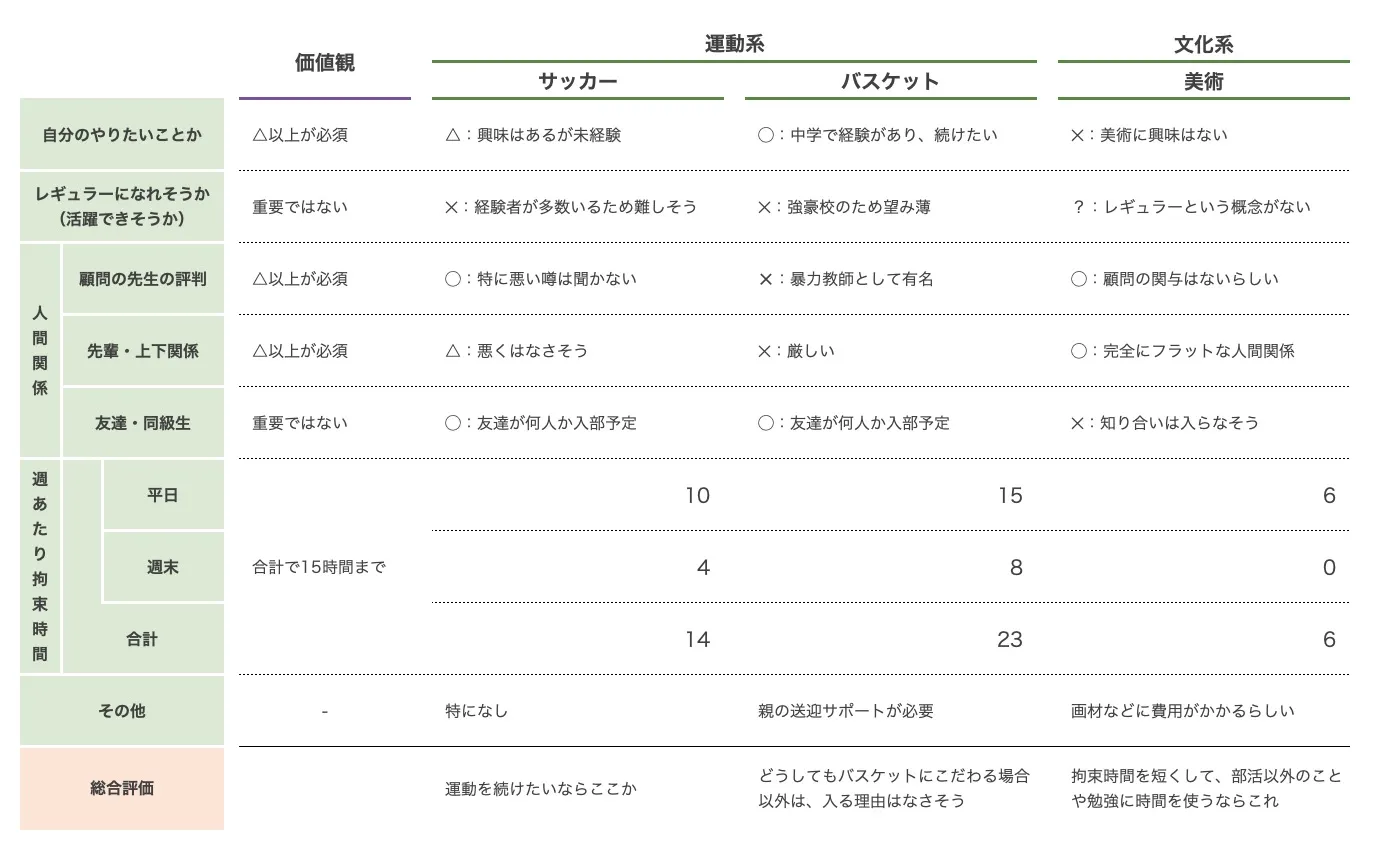
Now, a question.
Which of the evaluation criteria in the comparison table above does each cost you learned this time correspond to? If none corresponds, answer “none” and give your view on whether it was okay not to evaluate that cost.
Try writing your answer in the box below. Since what you write here can’t be saved, if you’d like to keep your answer, use your own notes app or something similar.
For costs that weren’t evaluated, I discuss why I left them out and whether that was right.
- Monetary cost: none
- I didn’t evaluate it, assuming school clubs cost almost nothing
- Since monetary cost isn’t completely zero, given that the setting is high school students, perhaps it should be evaluated too
- Time cost: weekly time commitment
- Cognitive cost: none
- I left it out since there was no way to evaluate it
- There’s probably no reason to evaluate this cost when considering clubs
- Physical cost: none
- I left it out because whether physical fatigue from sports clubs should be called a cost is complicated
- Regardless of whether fatigue is a cost, sports clubs will certainly increase your sleep time. If you consider this seriously, it may be better to convert this cost into time cost and factor it in
- Psychological cost: relationships
- Of course, evaluating relationships has aspects other than psychological cost (e.g., whether you’ll get proper coaching). I mean that this item includes an evaluation of psychological cost
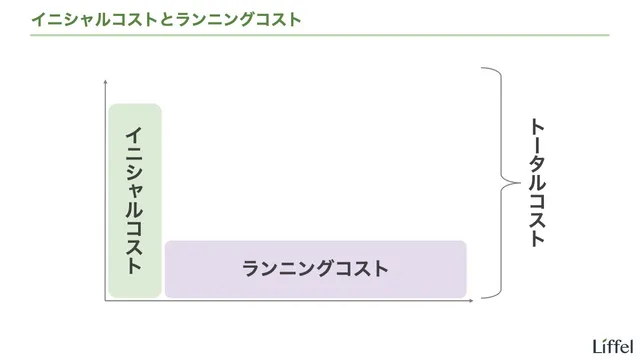
That covers the types of costs. Next, let’s learn the classification of monetary costs.
Entries related to critical thinking are collected on the page below. Feel free to use them as a reference.
Footnotes
-
You might think, “If I borrow money, can’t I pay costs even without resources?” In that case, think of “the ability and creditworthiness to borrow” as the resource. ↩
-
There are many other ways to classify costs and resources. Although I’ve adopted a classification that prioritizes clarity this time, the classification of “capital” in economics is also worth looking into if you’re interested. ↩
-
The exception is when shopping itself has become the goal. For example, a fair number of people say “shopping relieves stress.” ↩
-
Strictly speaking, “stress” means “load,” which includes physical loads. But since physical loads were already considered under physical cost, “stress” here is limited to its psychological sense. ↩