This entry explains question drift.
In a conversation or discussion, you’ve probably felt at times that “we’re not on the same page” or wondered, “why are they bringing this up now?” When this happens, what’s going on is question drift.
When question drift occurs, the conversation or discussion stops being productive. Let’s learn what question drift is and how to prevent it.
Note that this entry does not explain “the question” itself. Understanding question drift requires understanding the question first, so if the explanation below doesn’t make sense, please read the following entry first.

Let’s begin.
toc
What Is Question Drift?
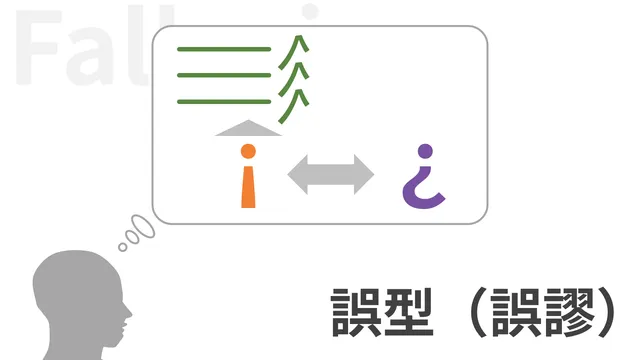
Question drift is, as the name suggests, when the underlying question drifts (no longer aligns). Take a look at this example.


The question has drifted in this exchange.
What do I mean? Let’s analyze the question underlying the conversation.
As you can see, the underlying questions in what the bear and the panda are saying do not match. This is what question drift is: when the underlying question is not shared among participants in a discussion, or when it changes without anyone noticing.
Question drift: when the underlying question is not aligned, or changes without anyone noticing
Question drift mostly occurs during conversations and discussions, but be aware that it can also happen when you’re thinking alone. You might find yourself, after a long stretch of thinking, considering something far removed from your original question — without realizing it.
Related Terms
Question drift goes by several related names in English:
- Missing the point (the standard term in critical thinking)
- Ignoratio elenchi (the Latin term, literally “ignoring refutation”)
- Changing the subject
- Shifting the goalposts (when someone changes the criteria mid-argument)
Of these, “missing the point” is the most established term in formal logic and critical thinking. The reason I prefer “question drift” is that it captures the dynamic nature of the phenomenon — the question drifts away over time — whereas “missing the point” describes a static state. Both terms refer to essentially the same problem, so use whichever feels more natural to you.
Deflection
When a participant in a discussion intentionally shifts the question, this is sometimes called deflection.
I don’t recommend dwelling on this distinction, however, because there is no way to definitively determine whether a question shift was intentional (unless the person admits it when pressed).
For example, the earlier exchange could fairly be called deflection by Panda, but there’s no way to prove Panda is doing it on purpose. In reality, many people genuinely believe that responses like that are valid rebuttals, so rather than accusing them of “shifting the question,” the practical solution is usually to end the discussion.
This is also why I avoid terms like “changing the subject” or “shifting the goalposts” for general use — they carry an accusatory tone, implying the other person is doing it deliberately1. In my observation, most question drift happens unconsciously, and intentional deflection is rare.
My recommendation is to think about this in three steps:
- Judge only whether the question has drifted — don’t worry about whether it was deliberate
- If the question has drifted, just point out the fact and re-align the question
- If you’re dealing with someone who drifts frequently, end the discussion (or don’t engage in the first place)
This approach lets you focus on productivity without getting tangled up in motives.
It’s not worth speculating whether a question was shifted “on purpose”
Causes and Countermeasures
Now let’s think about why question drift happens, and what to do about it.
There are three possible causes:
- Attention gravitates toward answers rather than the question
- Different participants have different ideas of what’s “relevant”
- One participant’s position is fixed
Let me explain each.
Cause #1: Attention Gravitates Toward Answers
The first cause is that once humans start thinking, our attention gravitates toward answers rather than the question.
Once a discussion starts, people tend to set the underlying question aside and just say what they want to say (the answer). Before long, the conversation drifts, and the question that should anchor the answers has shifted without anyone noticing.
When you’re discussing things with reasonable people, this is almost always the cause of question drift. When attention drifts away from the question, the question drifts.
Countermeasure #1: Write the Question Down
Put it in reverse, and the solution becomes clear: to prevent question drift, keep attention on the question. The specific actions are:
- Write the question where everyone can see it
- During the discussion, periodically check whether you’ve drifted from that question
- If you think the question should change, acknowledge it consciously (or communicate it during a discussion), and then rewrite the question
Of these, the most important by far is the first: write the question where everyone can see it. Unlike the inside of our heads, a written question doesn’t keep changing on its own.
To prevent question drift, write the question where everyone can see it
This is an important technique in any setting, but I especially recommend making it a rule in video meetings. In video meetings, it’s hard to point out that “the question has drifted,” and off-topic talk tends to continue unchecked. When a discussion begins, display the question in large text on the shared screen. This alone will suppress question drift, and it also makes it easier to point out when drift does occur.
Always Be Aware of the Question-Answer Relationship
For a more fundamental countermeasure, stay conscious of the question that lies behind any answer — and explicitly refer to it (though this is easier said than done).
As a rule of language, there is a correspondence between questions and answers. Take a look at the following table.
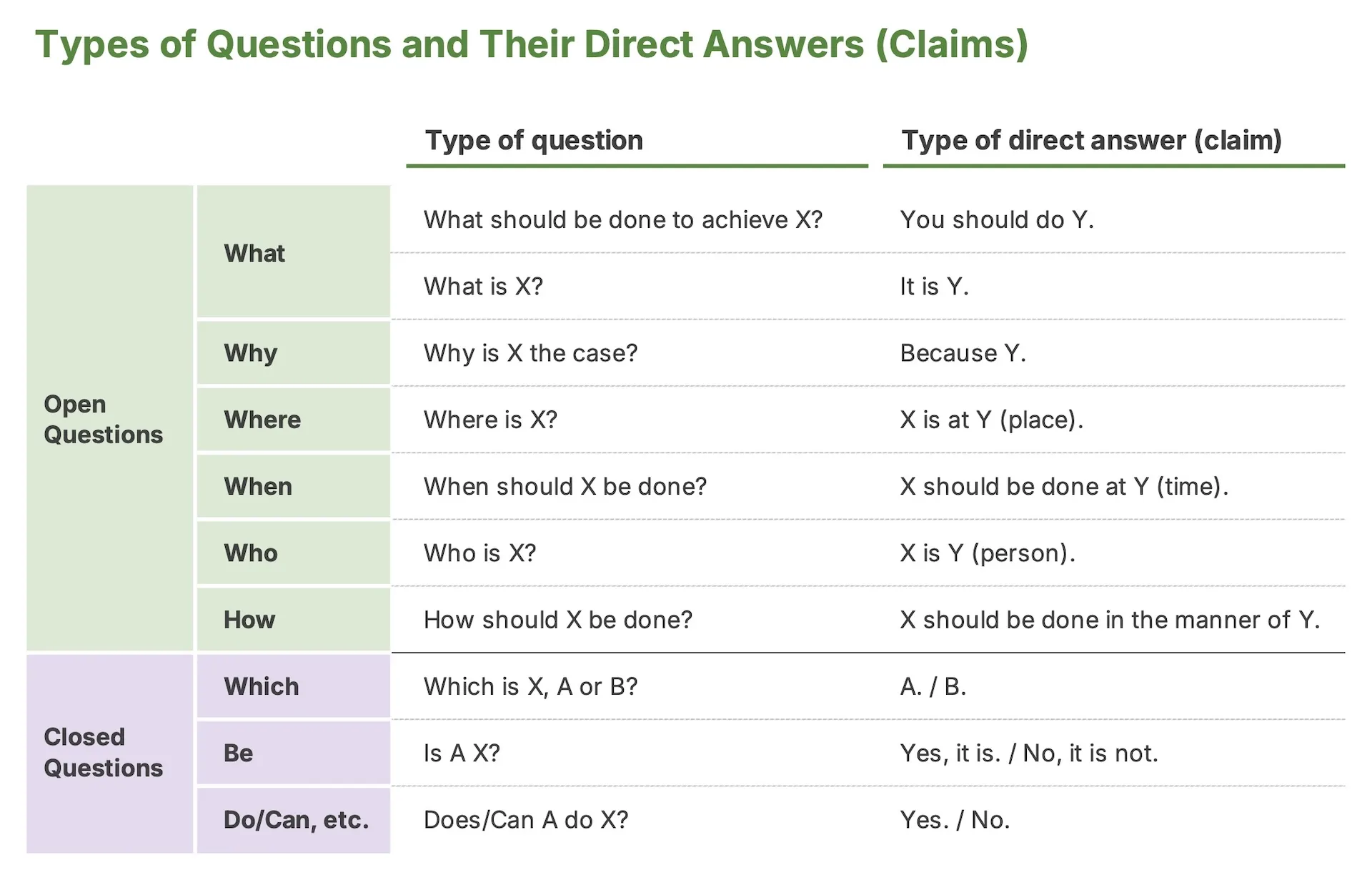
As shown, the type of statement that can serve as an answer is determined by the type of question. In other words, you can infer the type of question from the answer (what someone is saying), and use this to check whether question drift has occurred. You’re working from the right side of the table back to the left.
In the earlier example, the four-column format makes this correspondence visible. Take another look:
The bear’s side is a straightforward “infer the question from the answer” analysis. The panda’s side requires reading between the lines of what was actually said — a slightly more advanced analysis.
This four-column format lets you rigorously evaluate whether question drift has occurred, so I recommend using it until you get the hang of it.
That said, most real-world question drift happens in spoken conversation, where you need to perform this evaluation quickly and instinctively2. Don’t lose sight of that practical reality.
Cause #2: Different Ideas of What’s “Relevant”
The second cause is that participants have different ideas of what counts as “relevant” to the question. This is less a cause of question drift than a different angle on it.
What do I mean? Let’s continue the earlier exchange:
Pointing out the drift didn’t work. Panda’s reasoning, on its surface, even sounds somewhat plausible. For Panda, “whether you could say it to the families of accident victims” is relevant to “are cars necessary for society?”
Of course, it isn’t actually relevant. Bear could have responded differently from the start:
However, even if Bear responded this way, you can imagine Panda would follow up with something like, “You’re a terrible person (bear).” This, too, is irrelevant, but for Panda it feels relevant — so the discussion will never converge.
Countermeasure #2: End the Discussion
The only countermeasure for this cause is to end the discussion (or not engage in the first place).
As far as I know, there is no established method for determining what counts as “relevant” to a question. Fields like logic teach you that “personality and delivery are not relevant to a question,” but no field teaches you, in a universal way, what content counts as relevant. This part inevitably comes down to vague things like common sense, knowledge, and intelligence.
If you point out the question drift and your counterpart doesn’t accept it, then those vague things differ between you and them. There’s probably no way to align them, and it’s certainly impossible to do so in a short conversation. Continuing the discussion is a waste of time.
Cause #3: One Participant’s Position Is Fixed
Finally, discussions with someone whose position is fixed tend to suffer from question drift.
The reason is simple: that person has no intention of changing their position. When the discussion turns in a direction inconvenient for them, they’ll try to deflect it however they can. That’s where question drift happens (though it’s still hard to determine whether it’s “deliberate”).
Try reading the earlier exchange again, assuming Panda has no intention of giving up the position that “cars are not necessary for society.” Panda’s behavior starts to look like it has a kind of internal logic.
The countermeasure for this is also to end the discussion. “Having a fixed position” is the same as “not being open to discussion.” Engaging is just a waste of time.
Exercise
Analyze the following exchange and explain how the question has drifted.
Write your answer in the form below before checking the sample answer.
Bear’s question is “Is this action legal?” while Panda’s question is “Are many people doing this action?” The questions are different — the question has drifted.
Just because everyone is doing something doesn’t mean it’s legal.
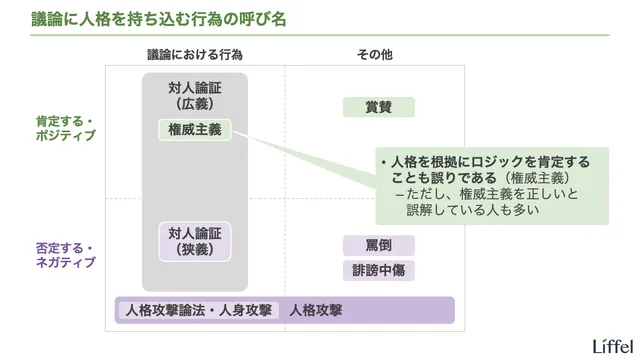
That’s it for question drift. Next, let’s look at one specific form of question drift: the ad hominem fallacy. Read the entry below.
You can also find a full list of fallacy types (logical fallacies and cognitive biases) in the entry below.
Footnotes
-
My guess is that the Latin “ignoratio elenchi” has been somewhat mistranslated in popular usage. The original term doesn’t carry a “deliberate” nuance — it simply means “not knowing how to argue” or “missing the point of the discussion.” ↩
-
Personally, I suspect this ability — “instantly grasping the relationship between question and answer” — is at the core of what’s called “language skills” or “communication ability.” ↩