This entry explains the error of making delivery the issue in a discussion.
The best-known example is what is called “tone policing,” but the error is not limited to tone policing: any act of making delivery the issue is wrong. Let us look at the whole picture.
toc
What Is Tone Policing?
First, let us look at tone policing, the most typical example of making delivery the issue.
Tone policing is making the way an argument is delivered (its tone or manner of expression) the target of debate, rather than the argument itself. It “polices” the “tone,” hence the name.
Let us look at an example.

It’s drizzling. Should I use an umbrella?

You should. Getting wet puts you at risk of catching a cold.
Ugh, the way you said that was so condescending. I’m not using an umbrella.
What Bear is doing here is tone policing. Let us analyze the exchange.
The question is “Should I use an umbrella?” Each animal’s argument breaks down as follows.
| Speaker | Claim | Premises |
|---|---|---|
| Panda | Use one. | Because getting wet puts you at risk of catching a cold. |
| Bear | Do not use one. | Because the way Panda said “getting wet puts you at risk of catching a cold” was unpleasant. |
As you can see, Bear is making Panda’s delivery the issue. This kind of move, and this kind of argument, is what we call tone policing.
Tone policing: rejecting the other person or their argument by making their delivery the issue
Tone Policing in the Strict Sense
In the strict sense, the term “tone policing” seems to be used not for “making delivery the issue” in general, but only when the following two conditions are met.
- Someone has spoken up about a social issue (and made an argument), and
- their tone or manner of expression is made the issue in order to reject them (and their argument)
That said, this is probably not a matter of definition. Rather, when tone policing actually happens, these two conditions tend to be met. If you agree with an argument, you have no reason to take issue with how it was delivered. And because social issues affect many people, more people end up making their case in an inappropriate way.
Because its definition varies somewhat, be careful when you use the term “tone policing.”
Argument from Rhetoric
However, making delivery the issue in a discussion is always wrong, regardless of the question. It also makes no difference whether the argument is being affirmed or rejected.
Since there is no widely used name for this act of “making delivery the issue in a discussion,” I will call it an “argument from rhetoric” (my own coinage).
Argument from rhetoric: any act of putting delivery on the table in a discussion (my own coinage)
Incidentally, if I had to name an everyday term that comes close, it would be “nitpicking.” However, nitpicking suggests fussing over trivial details rather than objecting to delivery itself, so it does not quite fit.
What Is Rhetoric?
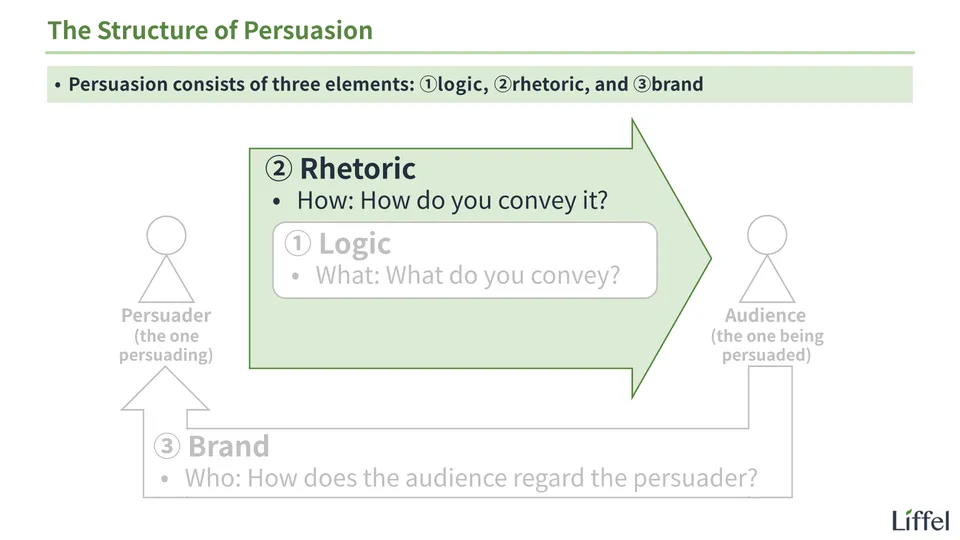
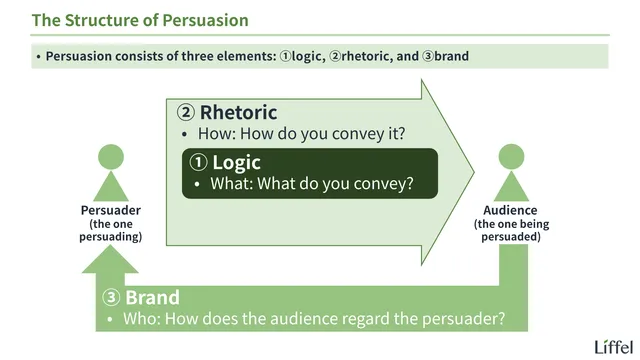
Back to the main topic. What exactly is “rhetoric”? Take a look at the following slides.
These slides break down the “delivery (rhetoric)” of a discussion in detail. In other words, the moment you put anything shown on these slides on the table in a discussion, you are reasoning in a wrong (irrational) way.
Here are some concrete examples.
- Objecting that someone phoned instead of coming in person (and therefore rejecting their argument)
- Rejecting every document that is not set in Arial
- Turning down a proposal because the presentation used a color you dislike
All of these make the rhetoric (delivery), not the argument (content), the issue. Acts like these are arguments from rhetoric.
This entry does not go into the slides in detail. To learn more, read the following entry.

Why the Argument from Rhetoric Is Wrong
Why is the argument from rhetoric wrong (irrational)?
Simply put, because delivery and content are unrelated. Examining things that are irrelevant does nothing to make a decision more rational.
For example, here is the previous paragraph rewritten in a blunter tone:
Simple: delivery and content are unrelated. Examining irrelevant things won’t make a decision any more rational.
What it says has not changed at all. If you find it “condescending and annoying (so I won’t accept the argument)” as soon as the tone turns blunt, that is clearly irrational.
To put it another way: the question “Is the delivery appropriate?” has drifted away from the question the argument is trying to answer. To think straight about the question, focus on the content alone.
When Delivery Has to Be the Issue
Even though the argument from rhetoric is wrong, in reality there are cases where you cannot help but make delivery the issue. The three most common are probably these:
- The delivery is so bad that you cannot understand the content
- The delivery is so unpleasant that the content does not sink in
- The delivery is so problematic that you cannot trust the person
In each case, problems with the delivery keep you from reaching the stage of evaluating the content.
In cases like these, the only option is to end the discussion (or not engage in the first place). You do not have to discuss things with everyone in the world. You can simply ignore them.
Although this may look like an argument from rhetoric itself, the two should be distinguished as follows.
- Ending the discussion: neither affirming nor rejecting the other person’s argument
- Argument from rhetoric: affirming or rejecting an argument on the basis of its delivery, after accepting the other person as someone to discuss with
In other words, taking issue with delivery is justified when deciding whether to let someone into the ring, but taking issue with the delivery of someone you have already let in is not fair. Once someone is in the ring, consider only the content.
That said, if you are too strict about whom you let into the ring, you end up doing the same thing as an argument from rhetoric. As a rule, the healthy attitude is to “overlook problems with delivery as much as possible and make an effort to understand the content.”
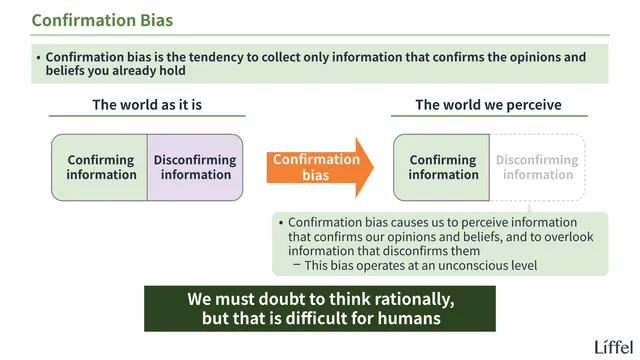
That concludes our discussion of the argument from rhetoric. Next, let us learn about confirmation bias, a typical cognitive bias. Please continue to the following entry.
A full list of fallacies (including logical fallacies and cognitive biases) is available in the entry below. Feel free to use it as a reference.