In this entry, let us learn what confirmation bias is and how to deal with it.
Whatever you are thinking about, confirmation bias is your greatest enemy. Unless you recognize that confirmation bias exists and understand how to deal with it, you cannot think correctly. Let us consider how to live with the “inner yes-man” we all carry around.
toc
What Is Confirmation Bias?
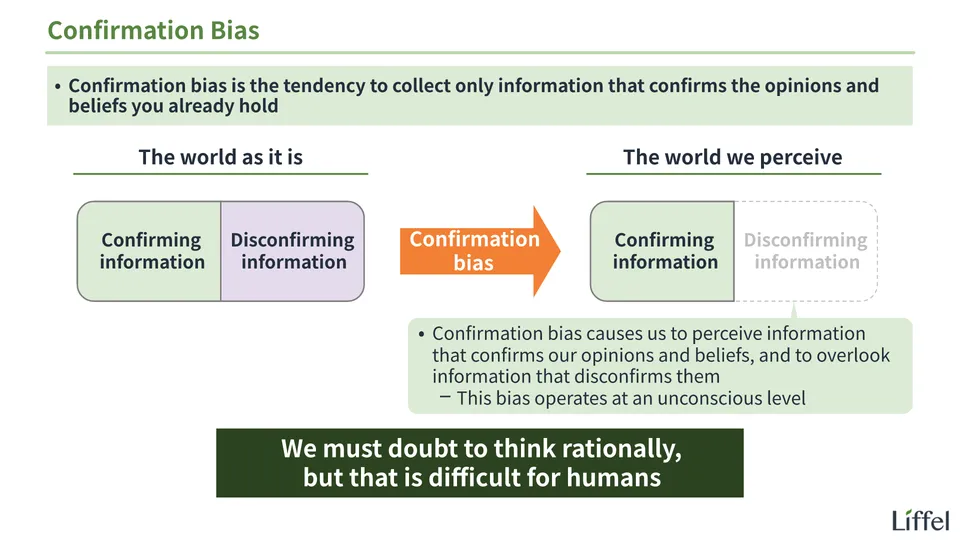
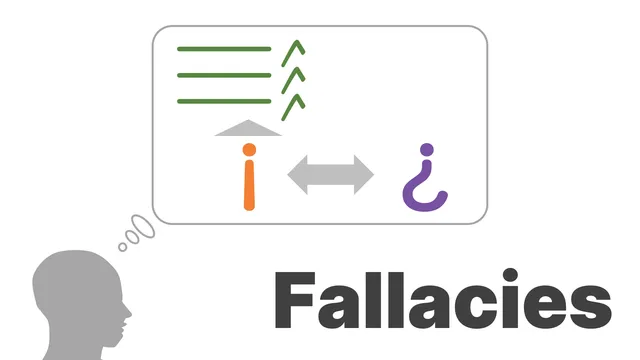
Let us get straight to it. The following slide summarizes confirmation bias.
As shown, confirmation bias is the tendency to seek out only information that affirms the opinions and beliefs you already hold. Put another way, confirmation bias keeps us from seeking out information that contradicts our existing opinions and beliefs.
Think of it this way: there is a yes-man inside your head who keeps repeating “You’re right!” That yes-man is confirmation bias.
Confirmation bias: the tendency to seek out only information that affirms the opinions and beliefs you already hold
Example: The Wason Selection Task
Let us see confirmation bias in action with a famous puzzle known as the “Wason selection task.”
Cards are laid out as shown below. Each card has a number on one side and a color on the other. Now consider the following hypothesis: “If one side of a card shows an even number, the other side is red.” Which card(s) should you flip over to test this hypothesis? (You may select more than one.)
Go ahead and jot down the answer that first pops into your mind in the box below. You are welcome to think it through carefully afterward, but for understanding confirmation bias, it is important to note whatever answer came to you first.
The correct answer is the 6 card and the blue card. For the hypothesis to hold, the other side of the 6 card must be red, and the other side of the blue card must not be an even number.
In more detail: the hypothesis “if one side is even, the other side is red” is disproved only when a card exists that has an even number on one side and a non-red color on the other. Therefore, the cards you need to check are the one showing an even number and the one showing a non-red color.
Most likely, the answer that first popped into your mind was the 6 card and the red card. At the very least, experiments show that this is the mistake most people make.
However, this is wrong. Even if the other side of the red card turns out to be odd or a decimal, that does not contradict the hypothesis “if one side is even, the other side is red.”
So why did you feel the urge to check the red card? Because “if the other side of the red card is even, the hypothesis is confirmed.” Or rather, you probably felt the urge to check the red card without even being conscious of this reasoning. That is confirmation bias.
Is Confirmation Bias Universal to All Humans?
Since some of you may have gotten the right answer straight away, let us consider whether confirmation bias is truly universal among humans.
My conclusion is that it is safe to assume that every human has confirmation bias.
There are three reasons.
First, the existence of confirmation bias appears to be taken for granted among psychologists1. I have yet to find a single psychologist who questions its existence. Every psychology textbook I have at hand includes confirmation bias, and Thinking, Fast and Slow by Daniel Kahneman, the psychologist who won the Nobel Prize in Economics, contains the following observation.
The operations of associative memory contribute to a general confirmation bias. If you are asked “Is Sam friendly?” you will think of Sam’s behaviors and traits in a way that favors a positive answer. In contrast, if you are asked “Is Sam unfriendly?” you will selectively retrieve instances of unfriendly behaviors.
Second—and this is only my hypothesis—confirmation bias seems explainable from the perspective of evolutionary psychology.
Even by a generous estimate, humans acquired the skill of “thinking (= doubting)” only around 3,000 years ago (Descartes was born in 1596, and Aristotle in 384 BCE).
For the tens of thousands of years before that, there may have been selective pressure favoring individuals with a strong ability to “believe.” Individuals who could “believe” in invisible things like family bonds formed communities (groups) and won wars against those who could not. Confirmation bias fits neatly as the foundation of this ability to “believe.”
Third, in my observation, no one is free of confirmation bias. I myself know about the Wason selection task and know that “the first answer that comes to mind is wrong,” yet for some reason I still want to flip the red card. Judging from scandals involving scientists and arguments on social media, everyone appears to be in the grip of confirmation bias regardless of their level of intelligence2.
At the root of it, I think humans are simply pulled toward whatever they perceive (what they see, hear, and put into words). In the Wason selection task, the word “red” appears in the hypothesis, and that is what pulls us in. Perhaps the law of gravity operates at the level of abstract concepts as well.
Let us leave it here, as digging further into this will not produce a definitive answer. To move forward, I will proceed on the assumption that “every human has confirmation bias.” I hope you will accept this.
Every human has confirmation bias (and it is safe to assume so)
Why Confirmation Bias Is So Dangerous
At the beginning, I said that “whatever you are thinking about, confirmation bias is your greatest enemy.” Let us see why. Take another look at the slide from earlier.
The frightening part is that even if you are perceiving the world shown on the right, you can still call it “objective.” After all, you are still perceiving some information. No one who collects information from outside themselves, such as “here is some data” or “that person said so too,” thinks of themselves as subjective.
But are the claims derived from that kind of perception correct? Clearly not. You are seeing only what you want to see from the start. There may be objectivity, but there is clearly no universality.
For the terms “objective” and “universal,” please also see the following entries.
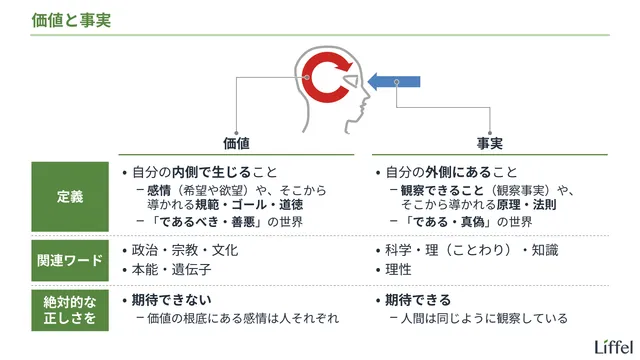

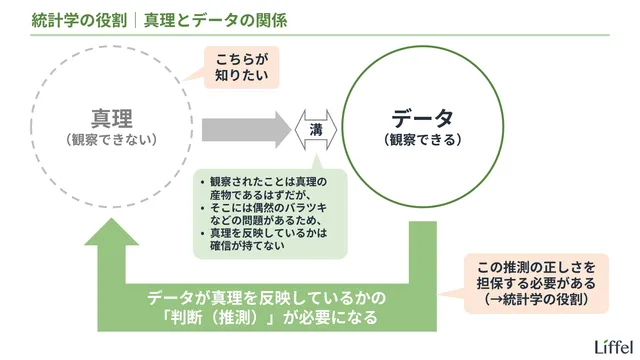
To sum up, unless you are aware that “I have confirmation bias,” you will arrive at a wrong claim while believing you have thought objectively.
If you are not aware of your confirmation bias, you will get things wrong while believing you have thought objectively
And as noted above, every human being comes with this pitfall built in.
In short, our eyes are clouded from the start. Unfortunately, we have no choice but to accept this.
Countermeasures Against Confirmation Bias
So let us think about how to live with our clouded eyes. There are two possible countermeasures against confirmation bias.
- Seek out opposing views
- Try it out
Let me explain each.
Countermeasure #1: Seek Out Opposing Views
The first countermeasure against confirmation bias is to actively seek out opposing views.
Our eyes are clouded, but we know how they are clouded. They are clouded in a way that makes us blind to information that contradicts the opinions and beliefs we already hold.
In that case, the only option is to make a deliberate effort to look at that blind spot. Specifically, seek out opinions that oppose your own. Be conscious of the existence of confirmation bias and actively pursue opposing views.
Here are some practical methods:
- Test your hypotheses through falsification, not confirmation
- Expose yourself to a variety of media
- Regularly read media you would not normally read
- On social media, connect only with people who hold different views from your own
- An anonymous account may be wise, to avoid misunderstandings
Through these actions, you can become more aware of your own confirmation bias and prejudices.
To be frank, however, I believe that seeking out opposing views on your own has its limits.
As I see it, confirmation bias is not that easy to beat. Its grip on us is about as firm as the urge to eat when we are hungry. It is probably best to accept that it is impossible for one person alone to look at both sides of something fairly.
The Devil’s Advocate
This is where the “devil’s advocate” comes in. A devil’s advocate is “someone who deliberately argues for the opposing view.” Originally, the term referred to the Promoter of the Faith in the Catholic Church’s canonization process (this person investigated the candidate’s shortcomings), and it later took on this meaning.
If one set of eyes is clouded, you can bring in another set of eyes that is clouded in a different place. That is the concept behind the devil’s advocate.
President Kennedy famously used devil’s advocates in his decision-making during the Cuban Missile Crisis.
After the failed invasion, President Kennedy reviewed his foreign policy decision-making process and made several important improvements.
(…)
Fifth, he gave his two closest confidants, his brother Robert Kennedy and Theodore Sorensen, the role of “devil’s advocates” in this decision-making process. Kennedy had them identify the weaknesses and risks of each proposal, uncover every important assumption, and analyze them thoroughly.
As this shows, for truly big decisions, it is safer not to trust your own judgment too much and to bring in a devil’s advocate.
Of course, since a devil’s advocate is costly, this approach cannot be used in every situation. In fact, in most cases it is probably unrealistic to go this far. Still, as a way to improve the accuracy of decision-making, it does not hurt to remember that this approach exists.
Countermeasure #2: Try It Out
The second countermeasure is to actually try it out. First, look at this example.

Starting today, I’m going on a fruit diet! This time I’m sure to lose weight!

Enough talk. Just try it. If you’ve lost weight in three months and you’re still healthy, then great.
(Three months later)
It didn’t work. Forget what I said.
In other words, stop thinking and take action. If the opinion or belief you hold is the kind that can be tested by acting, like “if I do X, it will work,” this lets you reach a clear conclusion.
Besides dieting, examples include the following.
- “That person must like me” → Actually confess your feelings and check the result
- “Study method X should raise my grades” → Actually study that way for a set period and check your test scores
- “Business X is sure to succeed” → Start the business and check its sales after a set period
As a rule, opinions and beliefs that can be tested by acting are best settled this way. It makes things black and white.
Strictly speaking, this may be better described not as a countermeasure against confirmation bias, but as “accepting the limits of thinking.” Please also see the following entry.

When using this countermeasure, however, keep the following three cautions in mind.
- Measure the results in numbers
- Bet small
- Do not overgeneralize
Let me explain each.
Caution #1: Measure the Results in Numbers
First, you should measure the results of your actions in numbers. For a diet, look at your weight; for a study method, look at your test scores.
The reason is simple: numbers do not lie. For example, if you have not lost even 1 kg after a reasonable amount of time, you have no choice but to admit that “my diet method is wrong.” If you deny even the numbers, you have gone beyond confirmation bias into the realm of the occult.
When measuring the numbers, you should decide, before you act, how you will judge whether the opinion or belief you held was correct. Specifically, think about the following before you act.
- Which numbers to look at
- When to look at them
- What value determines success or failure
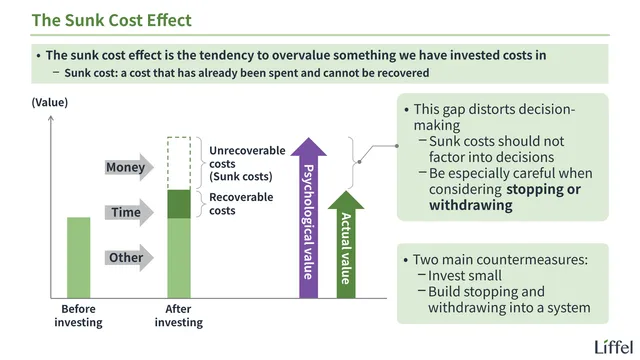
The reason for this is the sunk cost effect. Unfortunately, once you start acting, you are caught by another bias besides confirmation bias: the sunk cost effect. Biases everywhere.
The sunk cost effect is “the bias by which the costs you have invested raise the value of something in your own mind.” See the following slide.
Because of the sunk cost effect, our standards of judgment become lax after we act (a bias that justifies the action kicks in). To avoid this, it is best to decide your standards of judgment before you act.
For a detailed explanation of the sunk cost effect, see the following entry.
Caution #2: Bet Small (Ooch)
Next, you should keep the cost of your actions small. In other words, bet small.
Again, the reason is simple: if you bet big, you cannot back out.
The essence of the “try it out” countermeasure is: “It’s a waste of time to keep thinking about something you could find out by trying. Try it and settle it.” But if you bet so big that you cannot back out even when the result is bad, you are not really trying anything. Act only within a range from which you can withdraw if it turns out not to work.
In other words, the “try it out” countermeasure cannot be used for opinions and beliefs that can only be tested at enormous cost from the start. Corporate acquisitions (“if we acquire Company A, we can run it better”) are one example.
As an aside, testing your opinions and beliefs through small actions (experiments) is apparently called “ooching.”
Ooching means running small experiments to test your hypotheses.
However, I suspect that the word “ooching” has not caught on in Japan and never will. I will not explain why (let us just say it sounds a little funny in Japanese).
Caution #3: Do not Overgeneralize
Finally, even if trying it out works, you need to be careful about generalizing it.
Let us look at an example.
Starting today, I’m going on a fruit diet! This time I’m sure to lose weight!
Enough talk. Just try it. If you’ve lost weight in three months and you’re still healthy, then great.
(Three months later)
Thanks to the fruit diet, I lost 3 kg in three months. With this diet, anyone should be able to lose weight easily.
That’s going too far. All you have is one case where it worked for you.
As you can see, “it worked for me” is just a single success story. Since n is only 1 in statistical terms, deriving a general rule from it is a stretch.
In other words, your own success story does not have enough universality to derive a general rule from it. If you overlook this, overgeneralize from your own success, and publish the result to the world, you risk a backlash. Be careful.
Your own success story does not necessarily apply to everyone
That said, the idea that “you must not recommend things to others based on your own success” is too restrictive, and in reality the world is full of advice based on success stories. It is also true that some of it is useful.
In conclusion, my view is that as long as you exercise restraint, there is nothing wrong with sharing your success stories with others.
Here are some ways to do it.
- State up front: “This worked for me. I don’t know if it will work for you, but I wanted to share it anyway.”
- Personally, I think this is enough. The rest is the reader’s own responsibility
- Add other premises besides your success story, such as the mechanism or evidence
We live in an age when every statement is closely scrutinized on social media and elsewhere. Keep your success stories to yourself, or if you share them, keep the points above in mind.
That concludes our discussion of confirmation bias and how to counter it. This bias is the natural enemy of logical thinking. Recognize that it exists, and be careful not to fall into its trap.
A full list of fallacies (including logical fallacies and cognitive biases) is available in the entry below. Feel free to use it as a reference.
References
Websites
Books


Footnotes
-
That said, there are cases where a theory that was really just one individual’s hypothesis has become widespread as if it were an established truth, such as “Maslow’s hierarchy of needs.” So you should not simply trust whatever experts say. ↩
-
That said, it is also possible that this observation itself is the result of my own confirmation bias (since thinking this way leads to an endless loop, at some point you just have to accept it). ↩