In this entry, let’s study one of the angles for breaking down by addition: breaking down by categories (qualitative variables).
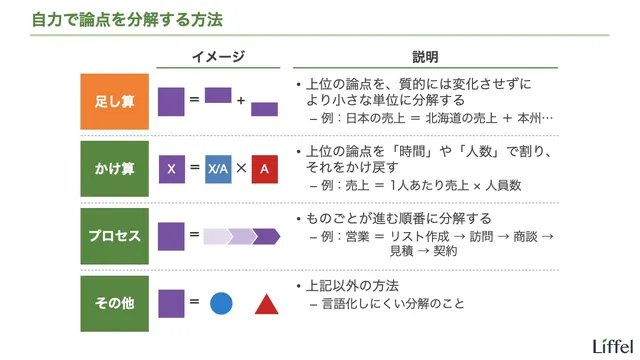
This entry is part of a series on breaking down by addition. If you get lost along the way, read the series in order, starting from the entry below.

Let’s begin.
toc
- Angle 2 for Addition: Categories (Qualitative Variables)
- Common Category Angles
- Key Point for Breaking Down by Categories: Ensure Exhaustiveness
Angle 2 for Addition: Categories (Qualitative Variables)
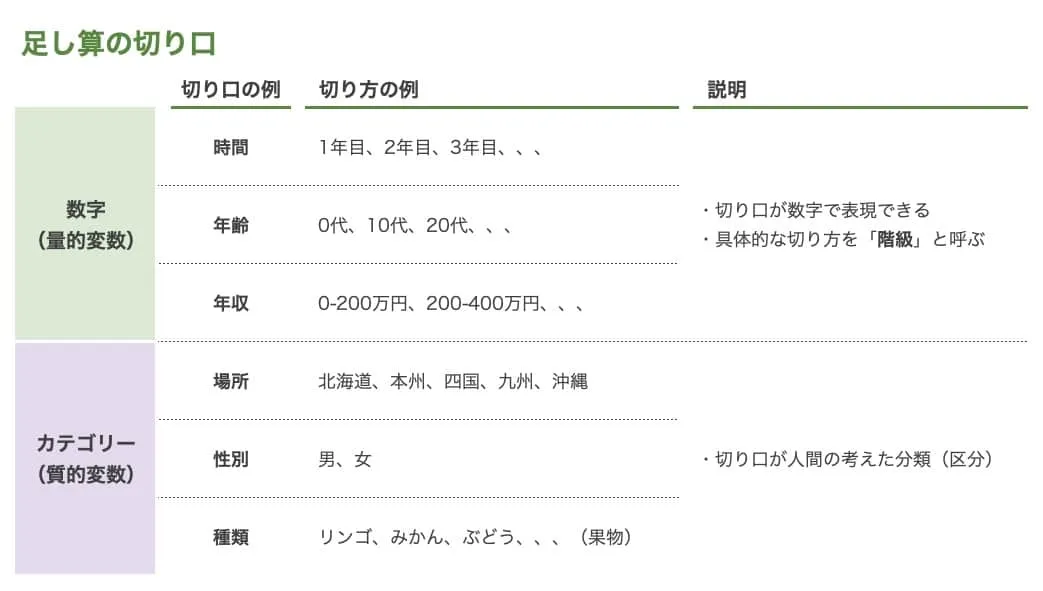
The second angle for breaking down by addition is categories. This time, it’s the lower part of the table. The technical term is qualitative variables. Keep that in the back of your mind too.
What Are Categories (Qualitative Variables)?
For what categories look like, check the table above.
While the upper part of the table (quantitative variables) divides things by numbers, the lower part (qualitative variables) doesn’t. Divisions like place or gender are all labels (classifications) that humans devised. Things like these are categories1.
Category: a label (classification) that humans devised
Note that although “category” generally doesn’t include proper nouns, “category” here includes them, since proper nouns are sometimes used as angles for breaking things down. Think of it this way: any angle that can’t be expressed in numbers is a category.
In fact, since proper nouns are labels themselves, thinking this way causes no problem at all. For example, our names are “labels for identifying us as individuals” (which sounds cold when put this way).
Examples
Let’s look at some examples. Here, let’s break down the question “What kind of people are buying this product?” from two angles.
First, let’s break it down by gender. It looks like this:
- What kind of people are buying this product?
- Men?
- Women?
Next, let’s break it down by region of residence (using the four US Census regions).
- What kind of people are buying this product?
- People in the Northeast?
- People in the Midwest?
- People in the South?
- People in the West?
Gender and region are labels humans devised and can’t be expressed in numbers. A breakdown like this is breaking down a question by categories.
Exercise
Let’s check what you’ve learned with an exercise.
Break down the following questions using the angle specified in parentheses.
What kinds of smartphones are popular? (Operating system)
Try writing your answer in the box below.
- What kinds of smartphones are popular?
- iOS (= iPhone)?
- Android?
What kinds of smartphones are popular? (Manufacturer)
- What kinds of smartphones are popular?
- Apple?
- Samsung?
- Google?
- Other manufacturers?
Common Category Angles
Let’s look at frequently used category angles. Here, I’ll introduce two:
- Place
- Players in the same market
Common Category Angle 1: Place
First, place is the most basic of the basics. Let’s look at a few concrete ways to divide it.
- World regions (continents): Asia, Europe, Africa, the Americas, Oceania
- Sometimes the Americas are split into North and South, or Antarctica is added
- Countries: the United Kingdom, France, Spain…
- Regions within a country: for the United States, for example, the four Census regions (Northeast, Midwest, South, West)
- These can be broken down further into states
- How regions are defined varies by country and source, so if you use regions, it may be better to use them as an intermediate level and break things down further into states, prefectures, provinces, and so on
These should all be familiar angles (classifications). Since we’ve been moving from place to place to live since we were apes, perhaps we find the difference between “here” and “there” intuitive. Place is the classic angle, so be sure to master it.
Common Category Angle 2: Players in the Same Market
Next, players in the same market is also an angle used often in business. If your company is in that market, this means your company and its competitors. Here are some examples:
- Your company’s market: your company, Competitor A, Competitor B…
- The automobile market: Toyota, Volkswagen, Hyundai, Ford…
- The US wireless carrier market: Verizon, AT&T, T-Mobile…
- More if you include MVNOs
Comparing things like product quality and price across these is the basics of market analysis.
Key Point for Breaking Down by Categories: Ensure Exhaustiveness
When breaking down by categories, ensuring exhaustiveness is important. In other words, you have to break things down so that nothing is left out.
This is easier to see by comparison with numbers. When breaking down by numbers, gaps hardly ever occur, since everyone knows that “numbers range from 0 to infinity” (include negative numbers if you break down by something like “temperature”). For example, if you use “age” or “income” as the angle, start from 0, set classes without overlaps, and make the top class “X or more,” and exhaustiveness is ensured.
By comparison, ensuring exhaustiveness with category angles isn’t easy. With category angles, there’s often no way to say “this is completely exhaustive.” Look at the table again.
For example, when breaking down fruit by “type” (at the very bottom), it’s impossible to ensure exhaustiveness the usual way. There are countless fruits in the world, so something will always be left out.
Also, classifying things too finely makes them hard to follow. The goal is always “to answer the higher-level question,” not “to break things down (classify them) correctly.” You need to keep the number of divisions to a level where we can grasp the differences.
Although how many that is is debatable, personally I think you should keep it to five or six at most. Since categories, unlike numbers, have no continuity, they’re not as easy to follow as numerical divisions. It’s safer to keep the divisions few.
When breaking down by categories, you need to keep the number of divisions manageable while ensuring exhaustiveness
The Secret Weapon for Ensuring Exhaustiveness: “Other”
So what do you do? Add “other” at the end. That ensures exhaustiveness.
Let’s actually add “other” to the fruit breakdown.
- Fruit
- Apples
- Mandarin oranges
- Grapes
- Other
That alone makes the breakdown exhaustive. As you know, the word “other” means “everything in a set not yet listed.”
In other words, “other” is a true magic word that automatically ensures exhaustiveness. When breaking down by categories, unless you’re 100 percent sure it’s exhaustive, it’s safe to add “other” at the end.
When breaking down by categories, add “other” at the end unless you’re 100 percent sure it’s exhaustive
A Variant of “Other”: Not A
Incidentally, when you divide into two in total including “other,” that is, when there’s only one specific category, it’s clearer to write “other” as “Not A (where A is the category name).” It’s what mathematics calls the “complement.” Look at an example.
- Fruit
- Sweet fruit (A)
- Fruit that isn’t sweet (Not A)
As an aside, this kind of either-or phrasing often appears in novels and movies. Let me introduce one I like.
Do. Or do not. There is no try.
Handling “Other”
Although “other” is a handy tool like this, it needs careful handling. Since you can’t think concretely about the concept of “other,” if you mistakenly throw an important element into the “other” box, the breakdown fails then and there. Use it only at the very end, after you’ve listed all the main elements.
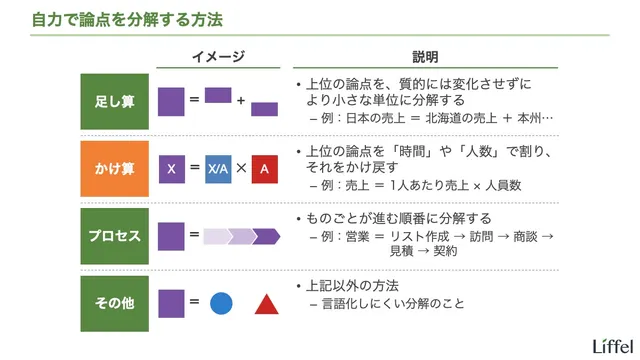
That covers category angles. This completes breaking down by addition. Next, let’s learn breaking down by multiplication. Continue to the entry below.
Entries related to critical thinking are collected on the page below. Feel free to use them as a reference.

Footnotes
-
Strictly speaking, quantitative variables are also categories devised by humans. They’re simply the categories that happen to be expressible in numbers, treated separately. ↩