In this entry, you’ll learn how to examine the validity of premises. At the same time, you’ll understand what critique is.
Critical thinking in the narrow sense could be described as “how to build valid premises (premises that get a claim accepted as right).” Although this site takes a somewhat broader view of critical thinking, building valid premises is still essential.
You can’t build valid premises without knowing how their validity is examined. Since this is the first step, make sure you understand it well.
toc
- How a Claim Gets Accepted
- What It Means to Examine the Validity of Premises
- What Are Valid Premises?
How a Claim Gets Accepted
First, let’s sort out where premises stand in critical thinking. It comes down to two points:
- When there’s a question, what we want to decide is whether the claim is right
- To judge whether the claim is right, we examine the validity of the premises
Let’s check with an example.

Should I buy a house or rent one?

I think you should rent.
There are three reasons. First, buying property in Japan right now means you’re likely overpaying. Japan’s population will keep declining, so there will only be more and more surplus housing. In other words, as rents are likely to fall, it makes more sense to keep switching rentals to match.
Second… (omitted)
In critical thinking, jumping on the claim “you should rent” is forbidden. Examine the premises presented with the claim, and decide whether to accept the claim based on their validity.
In critical thinking, you decide whether a claim is right by examining the validity of its premises
What It Means to Examine the Validity of Premises
So what exactly do you do to examine the validity of premises?
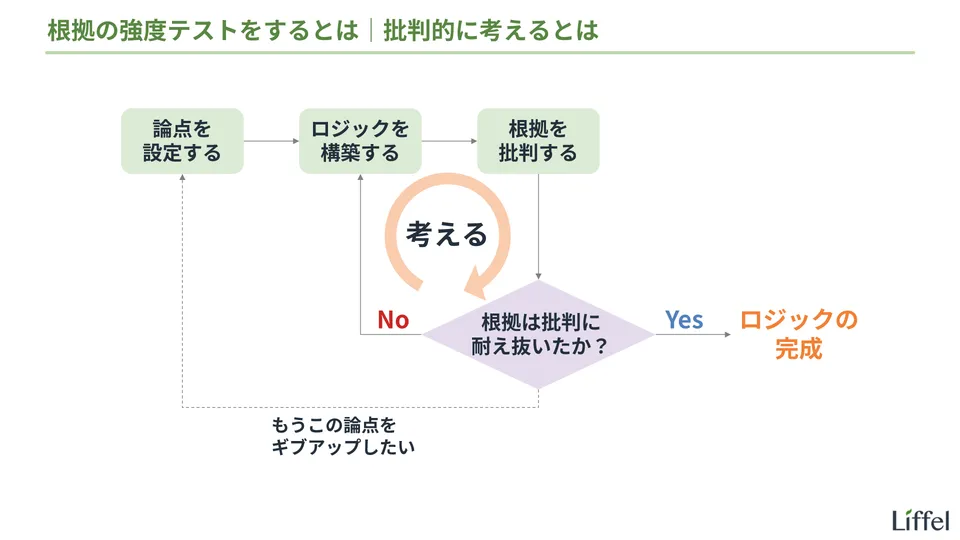
First, get a rough picture. Examining the validity of premises means stress-testing a building. The slide below sums it up.
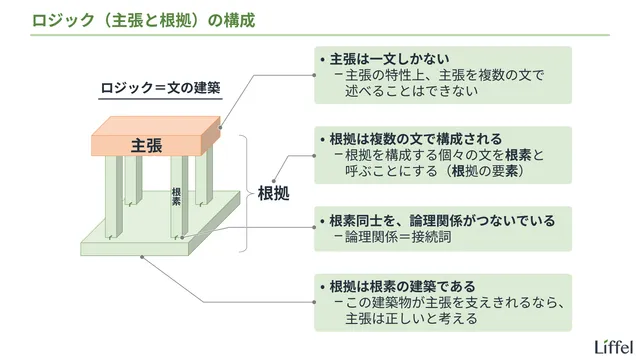
As shown, an argument can be seen as a building made of sentences (statements and concepts).
Examining the validity of premises means stress-testing the green part of this building (the premises). You hit the pillars with a hammer, or even fire a bazooka at them. If the foundation still stands and the roof (the claim) remains, the claim is right.
The slide above is explained in detail in another entry. If what I’ve said so far doesn’t click, read the entry below before going further.

Stress-Testing = Critiquing
Of course, when you actually examine the validity of premises, you can’t use a hammer or a bazooka. Instead, you critique the premises.
To examine the validity of premises, critique them
To critique is to examine for yourself whether the premises presented are really right. Instead of accepting the premises blindly, you think for yourself about whether you can accept them. In short, you doubt the premises.
Let’s check with the earlier example.
Should I buy a house or rent one?
I think you should rent.
There are three reasons. First, buying property in Japan right now means you’re likely overpaying. Japan’s population will keep declining, so there will only be more and more surplus housing. In other words, as rents are likely to fall, it makes more sense to keep switching rentals to match.
Second… (omitted)
Since Panda is the one presenting the argument, let’s have Bear critique the premises.
Will Japan’s population really keep declining?
Is the assumption that a declining population leads to lower property prices and rents actually right?
Switching rentals means paying deposits and other fees. Is renting still cheaper even when you factor those in?
For example, even if “a declining population lowers property prices” is true in general, the population doesn’t decline uniformly across every region of Japan. Cities and rural areas lose population at different rates. So saying “Japanese property will fall in value” without narrowing down the region may be going too far.
Since we’re not actually trying to settle the question “Should I buy a house or rent one?”, let’s leave it at that.
What I want you to take away is the image of what it means to critique. Picture tapping the pillars with a hammer. By doubting each element of the premises in turn, you’re examining their rightness (stress-testing the premises).
To critique: to examine for yourself whether the premises presented are really right
You Critique Even When Thinking Alone
Although the example above used two people in a discussion to make it easy to follow, the same applies when you’re thinking alone. Once you have an argument ready, have another version of yourself critique the premises.
If the premises withstand your own critique, you can share the argument with others. If they can’t, you either (1) change the claim, or (2) look for different premises. Going back and forth between claim and premises like this is what it means to think critically.
As an aside, this is exactly why the skill is called “critical thinking”1. Rather than accepting premises unconditionally, you always examine them critically yourself. By repeating this, you try to build more valid premises.
Critique in Its Original Sense Isn’t Negative
Note that “critique” here carries no negative meaning at all. Critique is indispensable for practicing critical thinking. It isn’t something you do out of negative feelings like “I don’t like that guy, so I’ll tear his argument apart.”
In other words, critiquing premises is a natural act. The only way to reach more valid premises (and the claims that come with them) is to critique premises.
In critical thinking, critique is simply a matter of proper method, or better yet, something driven by pure intellectual curiosity. Just because someone critiques your premises doesn’t mean they like or dislike you.
Some people misunderstand this. For them, “someone who critiques my premises (and ends up denying my claim) = an enemy.” Perhaps because of this, the everyday sense of “criticism” has come to mean almost the same thing as “slander,” at least in my impression. That’s truly unfortunate.
With that mindset, thinking with anyone becomes impossible. If you can’t critique premises, all you can do is affirm or deny claims. Whether to affirm or deny a claim is a matter of decision, unrelated to thinking. To think together with others, you need to critique premises and accept being critiqued as a matter of course.
In critical thinking, critiquing premises is a natural act and carries no implication of personal attack
Of course, in reality, some people will critique your argument with the intent of a personal attack. And there’s no question that critiquing everything indiscriminately will strain your relationships. There are many situations where it’s better to stop critiquing and simply affirm (= empathize with) someone’s claim unconditionally.
Don’t forget to choose the people and situations where critique will lead to a constructive discussion.
What Are Valid Premises?
Let’s move on. As explained so far, premises are always exposed to critical scrutiny. If the premises presented withstand the critique “Can these premises really support the claim?”, the claim is accepted. If not, it isn’t.
This reveals what it means for premises to be valid. Valid premises are premises that withstand critique. If they withstand critique, the premises can support the claim. In other words, they were valid.
Valid premises are premises that withstand critique
That means to build valid premises, you need to know how premises are critiqued. If you know what kind of attack is coming, you can prepare for it in advance. To build pillars that won’t break when hit with a hammer, learn how to use the hammer.
That covers how to examine the validity of premises. Next time, let’s learn specific ways to critique.

Entries related to critical thinking are collected on the page below. Feel free to use them as a reference.
Footnotes
-
In Japan, the same skill is usually called “logical thinking.” Perhaps that’s because the Japanese translation of “critical” carries a strongly negative image. That said, some people in Japan treat “logical thinking” and “critical thinking” as separate skills. ↩