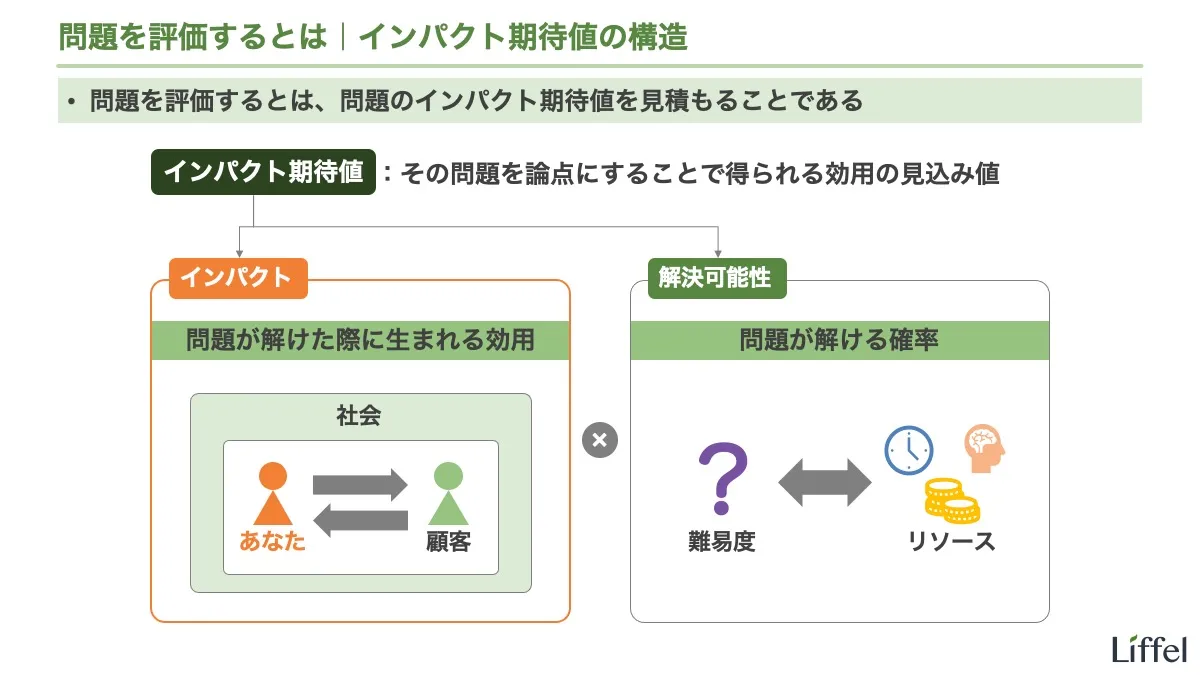
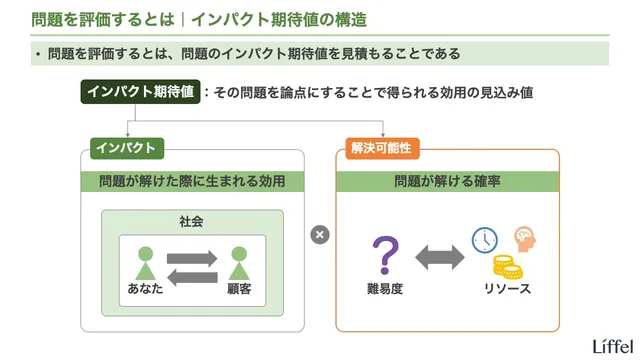
Let’s keep thinking about the impact of a question. What remains are the impact on clients and the impact on society.
This entry is part of a series on evaluating questions. Read the series in order, starting from the entry below.

Let’s begin.
toc
Impact 2: Impact on Clients
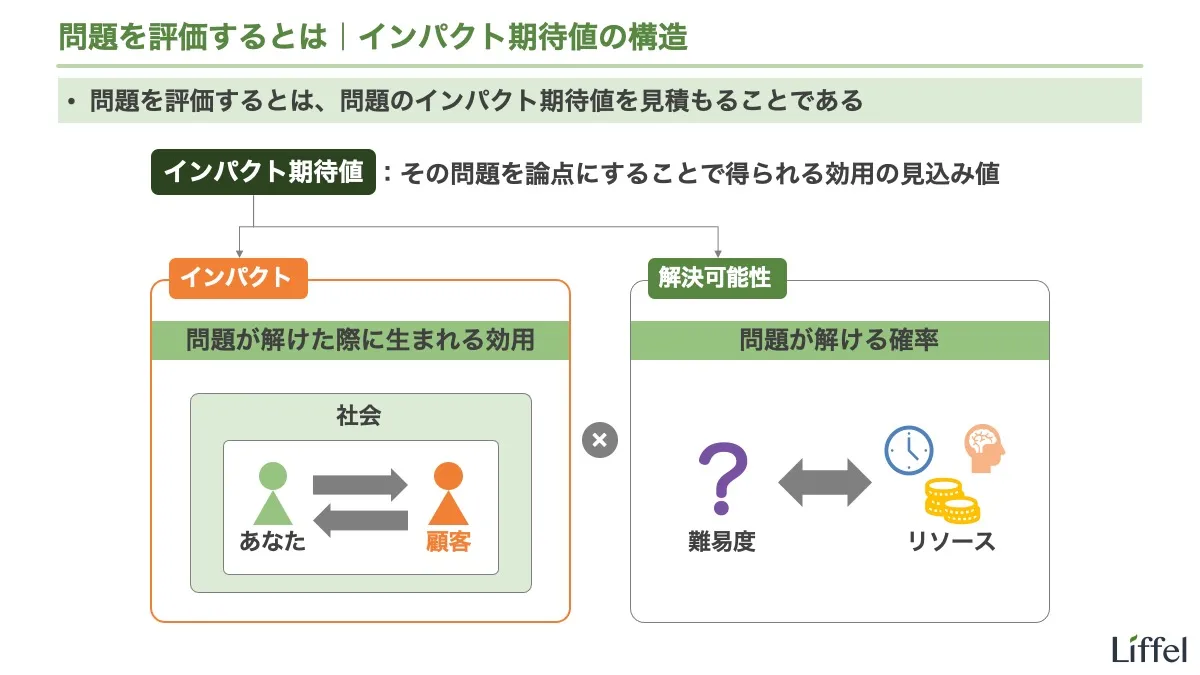
The second element of impact is the impact on clients. What impact does your solving some question have on your clients?
Since this gets complicated, let’s look at it by the route through which you identified the question. Reading the entry below first will make it easier to follow.
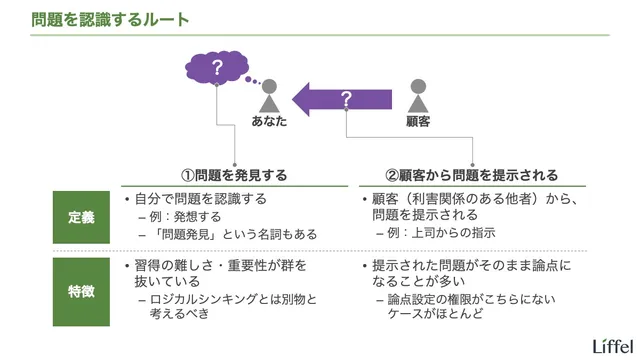
Impact on Clients 1: When You Discovered the Question
First, let’s consider the route where you discover the question yourself.
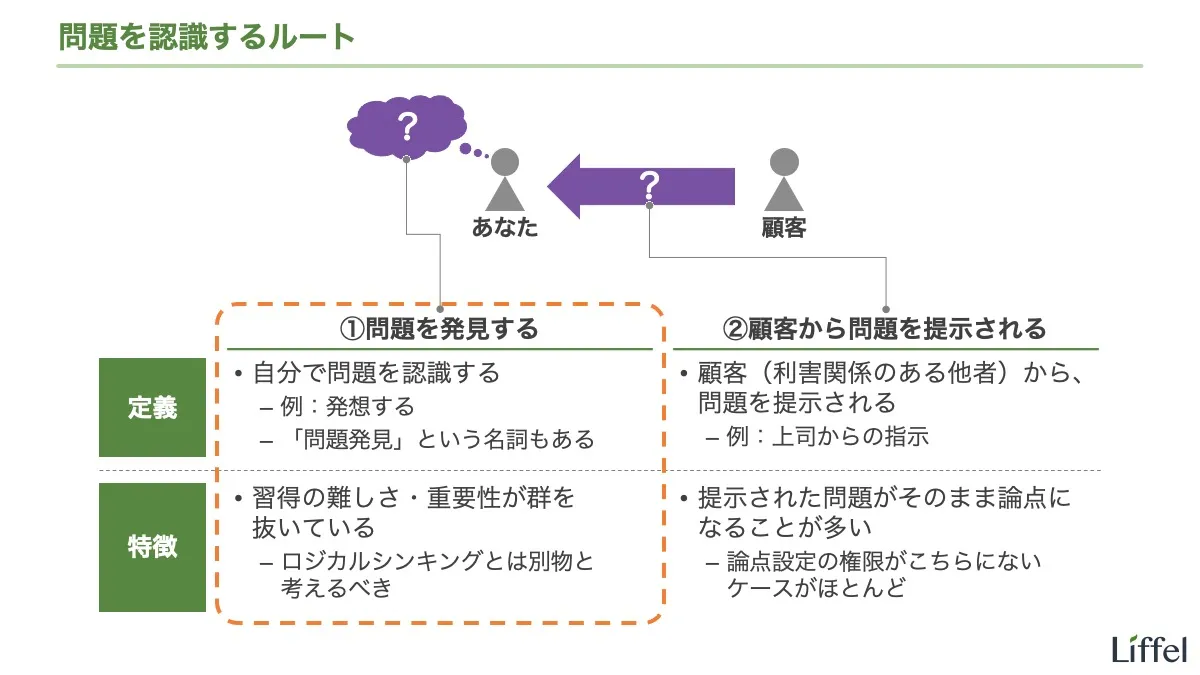
In this case, the impact on clients can be considered equal to your financial reward1.
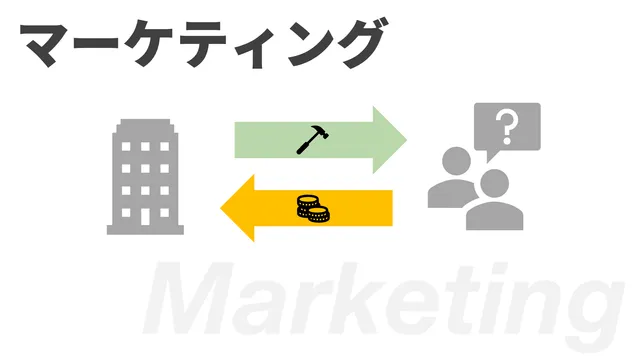
The reason is that clients are the ones who pay your financial reward. This doesn’t change even if you’re thinking about a question you discovered yourself. Since no one pays for something they don’t see value in, if the question you discovered has no impact on any client, your financial reward should be zero.
Specifically, you estimate your financial reward (= the impact on clients) by thinking about questions like these:
- Who are the clients? (What kind of people would be glad to know the answer to this question?)
- How many such clients are there?
- How much value do clients see in the answer to this question? (what’s called “needs”)
In reality, the path from your thinking creating impact for clients to it becoming financial reward (what’s called a business model) is more complex, so you need to consider many things.
Since what follows is entirely a marketing topic, this entry stops here. If you want to dig deeper, see the entry below.
Impact on Clients 2: When a Client Presented the Question
Next is the route where a client presents the question.
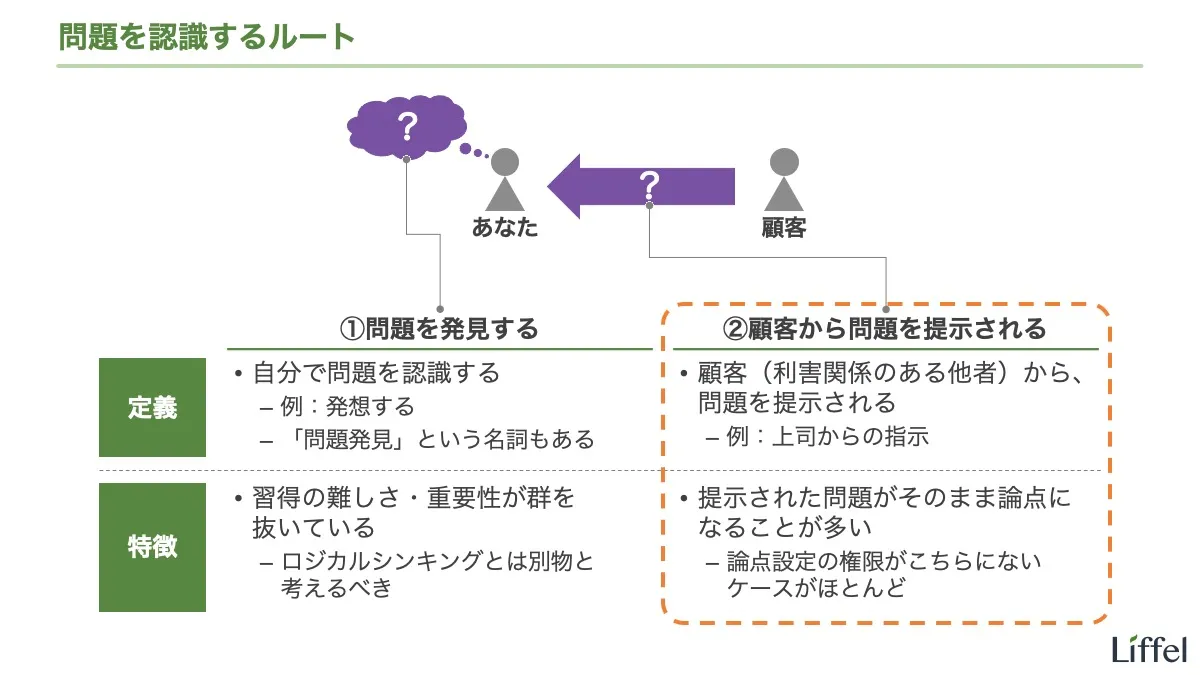
When you use critical thinking in the real world, you should consider this the basic route. You think about the question your client (including not just actual clients but also managers and others) specifies, and receive financial reward in return.
In this case, as a rule, you don’t need to think about the impact on clients. You can assume that clients present you with questions that have impact for them. So you can ignore this element altogether. Naturally, you don’t evaluate it or weight it either.
An example makes this easier to see. Let’s say Bear is extremely wealthy and Panda is a professional private investigator.

Find out, thoroughly, whether pop idol X has a romantic partner. You have three months. The fee is one million dollars.

Certainly! (What on earth is this guy thinking…)
In this case, Bear can’t stop wondering about the question “Does pop idol X have a romantic partner?” That’s why Bear is paying Panda a million dollars to investigate. In other words, the question “Does pop idol X have a romantic partner?” has a big impact on Bear.
Inwardly, Panda is appalled, since Panda can’t imagine the question “Does pop idol X have a romantic partner?” having enough impact to be worth a million dollars. But that doesn’t matter, does it? Panda gets a million dollars for doing what’s asked, so Panda just does it.
Incidentally, if you replace Bear with “the general public” and lower Panda’s fee, you get exactly the setup that sustains tabloid magazines and gossip shows. Not everyone who does that kind of work is interested in celebrities’ love lives (this is just my guess, since I don’t know anyone in the business). It’s simply that the demand exists, so money flows there and it works as a business.
The General Rule
Let’s generalize. When a client presents the question, you should keep two points in mind:
- The impact of a question is extremely subjective
- It’s safe to assume that “the client has evaluated the question’s impact themselves and is having you think about a question with impact”
This is easy to understand from the client’s point of view. When you pay someone to do something, would you have them do something that has no value to you? Of course not.
In short, when a client presents the question, the impact on the client is the client’s call. It’s not something for you to worry about, since what questions people see impact in varies from person to person.
When a client presents the question, you don’t need to evaluate the impact on the client
There Are Exceptions
However, jobs generally called “doctor” or “teacher,” or jobs that strongly demand professionalism, are exceptions to this rule. People in such jobs often don’t treat the question the client presents as absolute, and instead define the question themselves or propose redefining it.
The clearest example is doctors. Doctors don’t take the symptoms we describe as absolute. They always examine us and make their own diagnosis. In other words, in medical care, the client (patient) merely brings a vague problem (e.g., “I feel sick”), and it’s the doctor who decides the concrete problem and its impact (e.g., “It’s cancer, and if left untreated, you’ll die”).
In another example, consultants often make proposals like “There’s no point unless we think about this other question before that one.” They’re trying to redefine the client’s question. Naturally, since they don’t have a doctor’s authority, it comes down to discussion with the client.
However, even in these exceptional jobs, clients evaluate the impact themselves in the medium to long term. For example, if your health doesn’t improve after following a doctor’s diagnosis and prescription, you’d look for another doctor, or even sue in some cases. It’s impossible for clients never to evaluate the impact themselves.
In the end, as a rule, you won’t go wrong remembering that “the client is always right.” You wouldn’t want others deciding what you find valuable either, would you? That applies to everyone.
You Don’t Need to Evaluate It, but You Should Understand It
Although you don’t need to evaluate the impact on clients, you should understand why your client sees impact in the question. There are two reasons:
- It helps you contribute more to your client
- In the real world, you may be made to think about questions that have no impact on anyone
(1) is obvious. If you’re thinking for someone, it’s best to understand them well.
The problem is (2). In the real world, there are cases like the following where the assumption that “the client correctly evaluates the impact of the question” doesn’t hold:
- A game of telephone happens within the organization, and the question the real client (such as the CEO) wants you to think about reaches you distorted
- A manager (especially a middle manager) doesn’t realize that having subordinates think costs money, and assigns pointless questions to keep subordinates busy
If you unfortunately find yourself in such a situation, unless you can push back with your manager at the level of “whom does thinking about this question benefit, and how?”, you’ll be made to think about questions that have no impact on anyone. That’s tough.
Unlike the occupational or positional characteristics described above, this is simply organizational dysfunction. Frankly, it’s not your responsibility. So it’s fine to respond by “thinking about (or pretending to think about) questions with no impact without complaint, as long as you get paid.”
But if that keeps happening, it’ll wear you down. I recommend pushing back as much as you can.
Impact 3: Impact on Society
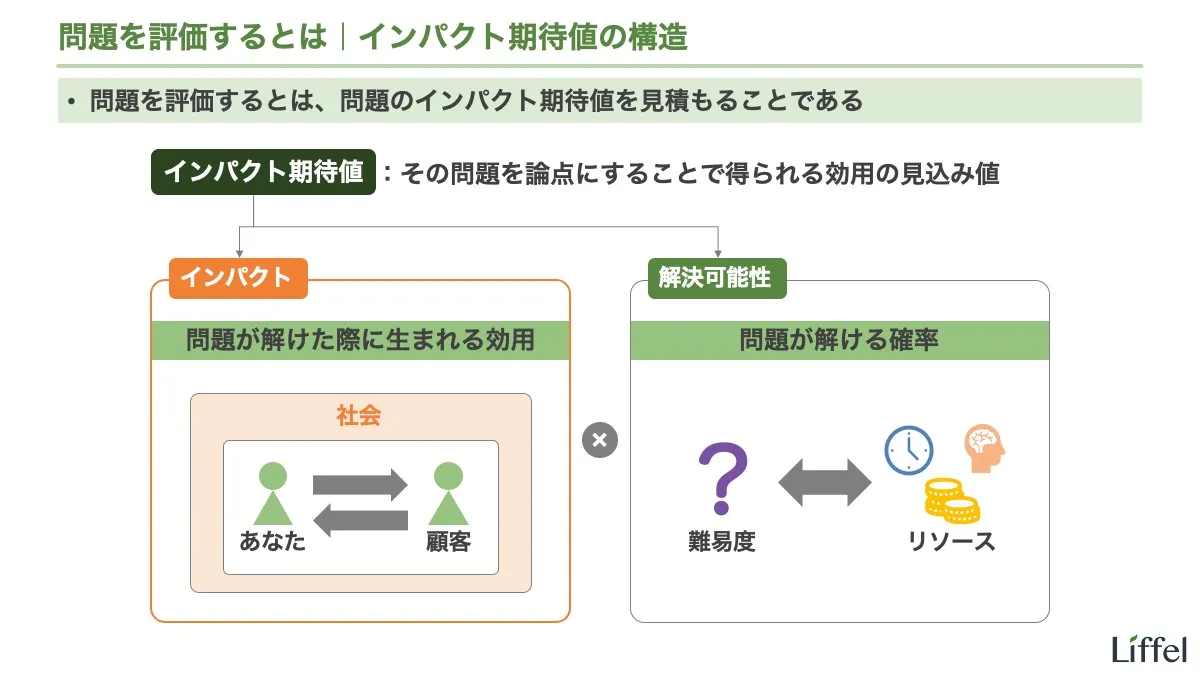
Finally, there’s the impact on society. Many people probably think, “If I’m going to use my head, I want to think about questions that have an impact on society.” Let’s think about what this means.
What Is “Society”?
First, let’s start by thinking about what “impact on society” is.
As mentioned in the previous entry, in the context of expected impact, “society” is defined as “everything other than you and your clients.”
Society: everything other than you and your clients
In short, it’s “everything else.” To think about impact exhaustively, every person and thing other than the concrete parties of you and your clients is thrown into the box called “society.”
What Is “Impact on Society”?
What concretely does impact on “society,” defined this way, mean?
To give the conclusion first, it’s impossible for an ordinary individual to concretely define “impact on society.” In other words, I won’t say “Impact on society concretely means this,” and I don’t recommend that you try to figure it out either.
The reason is simple: since the world is full of all sorts of people, there’s no way to decide what has an impact on society as a whole.
For example, if I decide “my favorite food,” no one will complain (I’d be in trouble if they did), but if I decide “society’s favorite food,” people will say, “Hey, who are you to decide that?” It’s the same thing.
When an ordinary individual thinks about “impact on society,” there’s no legitimacy to it
How Things Work in Reality
However, “there’s no legitimacy to an ordinary individual deciding ‘impact on society’” doesn’t mean “there are no questions with an impact on society.” Social problems (= problems with an impact on society) do exist, so someone needs to decide what counts as a social problem so that society can work toward solving it. How should that work?
As you know, modern democracies use “elections” to decide social problems. Through elections, we choose politicians (representatives of society), and politicians (and the civil servants under them) decide on social problems and work to solve them.
In other words, the “impact on society” that politicians think about is the most legitimate “impact on society.”
Of course, since we’re the ones who choose politicians, in essence we (by majority vote) are deciding which questions have an impact on society. It’s well designed, isn’t it?
How to Evaluate “Impact on Society”
Now that we’re ready, let’s get back to evaluating impact. Given the assumptions above, how should you evaluate “impact on society”?
Here, let’s divide it into two cases:
- When the client (the one paying the financial reward) is a public institution
- All other cases
Case 1: The Client (the One Paying the Financial Reward) Is a Public Institution
First, if the client (the one paying the financial reward) for a question is a public institution, you can consider the question to have an impact on society. Typical examples are thinking about something as a civil servant, or research funded by public research grants such as Japan’s KAKENHI (Grants-in-Aid for Scientific Research). For reference, here’s the description of KAKENHI.
Grants-in-Aid for Scientific Research (KAKENHI) are “competitive research funds” intended to dramatically advance all “academic research” (research based on researchers’ free ideas), from basic to applied, in every field from the humanities and social sciences to the natural sciences. Through peer review, they provide funding for original, pioneering research.
The reason questions from public institutions can be considered to have an impact on society is that that’s how the system is set up.
As mentioned, only politicians can effectively define impact on society. This holds true in the realm of thinking as well. In other words, politicians (and civil servants) decide which questions have an impact on society, and public money is paid to people who think about such questions.
So questions for which public money is paid as a reward can be considered to have an impact on society. The size of the impact can only be evaluated by the amount of the financial reward. There’s no other practical way.
Case 2: All Other Cases
What about other cases? Specifically, thinking about (1) questions with no client, or (2) questions whose client isn’t a public institution.
First, let’s set aside questions with no client, since they’re just self-indulgence.
Don’t get me wrong: I don’t think thinking about something for self-satisfaction is bad. It’s simply that it’s a stretch to say a question “has an impact on society” if you can’t convince anyone in the world that it’s worth paying someone to think about it, or worth paying for the result.
What remains is “(2) questions whose client isn’t a public institution.”
To give the conclusion first, in this case, there’s no point in thinking about “impact on society.” To repeat, there’s no legitimacy to anyone but politicians thinking about impact on society. In other words, “impact on society” falls outside what you evaluate.
And that’s no problem at all. So far, we’ve defined “society” as “everything other than you and your clients,” but that’s just a convenient way of organizing things to think about impact exhaustively.
In reality, you and your clients are also part of society. In other words, if there are clients who pay, the activity is creating an impact on society.
Many people may resist this idea. In fact, I can think of several “legal economic activities that clearly harm society” (since that’s my subjective judgment, I won’t give specific examples). You can probably think of some too.
But it’s beyond dispute that “since modernization, the world has developed under capitalist economies.” And what private companies, the protagonists of capitalism, pursue is not impact on the abstract entity of “society,” but impact on concrete “clients” who pay them. No matter how much impact a business has on society, it can’t survive without concrete clients.
In short, business (economic activity) has a positive impact on society.
Activities with paying clients create an impact on society
Summary
To sum up, both the impact on clients and the impact on society ultimately come down to your financial reward. Compared with the abstract notion of impact on others, the money you receive has the overwhelming advantage of being easy to measure. I recommend starting by using financial reward as a proxy for impact on clients and society.
Saying this may get me called a money-grubber. But there’s no helping it, since that’s the definition of money.
Money is a medium for exchanging value (impact)2. That means if you bring value to someone other than yourself (clients or society), money flows to you. Of course, this principle often malfunctions, but on the whole, I think there’s no debate that it holds. In other words, in the realm of thinking about questions too, you should consider questions that bring you money to be creating impact on clients or society.
Many people may think this is obvious. But when I was in college, I didn’t understand it at all. For some reason, I saw “making money” and “having an impact on society” as opposites, and I think it held me back. I wrote this entry hoping it would reach people like that. That’s why it leans a bit toward the money-grubbing view.
Summary of Impact as a Whole
To sum up this entry and the last, in my view, the impact of a question ultimately comes down to the balance between “thinking about what you want to think about (intellectual curiosity)” and “thinking about what creates value for someone (financial reward).”
When the two align (others see value in what you want to think about), things are simple. When they’re in conflict (others see no value in what you want to think about), it’s hard.
Personally, I think you come to find any question interesting as you think about it. So rather than treating your current intellectual curiosity as absolute, I think it’s better to look, among questions with a reasonably large financial reward, for ones you can get interested in (money-grubbing, I know). You can think about the questions you truly want to think about once you’ve saved some money.
The rest is up to you.
That concludes the explanation of the impact of a question. Next, let’s think about solvability.
Entries related to critical thinking are collected on the page below. Feel free to use them as a reference.
Footnotes
-
In reality, the impact on clients doesn’t correlate with financial reward in every case. But since there’s no realistic way to measure the impact on clients other than through financial reward, I’ve put it this way. ↩
-
Money also has other aspects, such as being a store of value, and what money is, taken as a whole, is open to debate. At least in today’s society, however, there’s no doubt that money is used as a medium for exchanging value. ↩