Starting with this entry, let’s learn about breaking down the question.
This entry begins by explaining what it means to break down the question, and what it means for a breakdown to be “right.”
Let’s begin.
toc
- Process #2: Breaking Down the Question
- What Makes a Breakdown “Right”?
Process #2: Breaking Down the Question
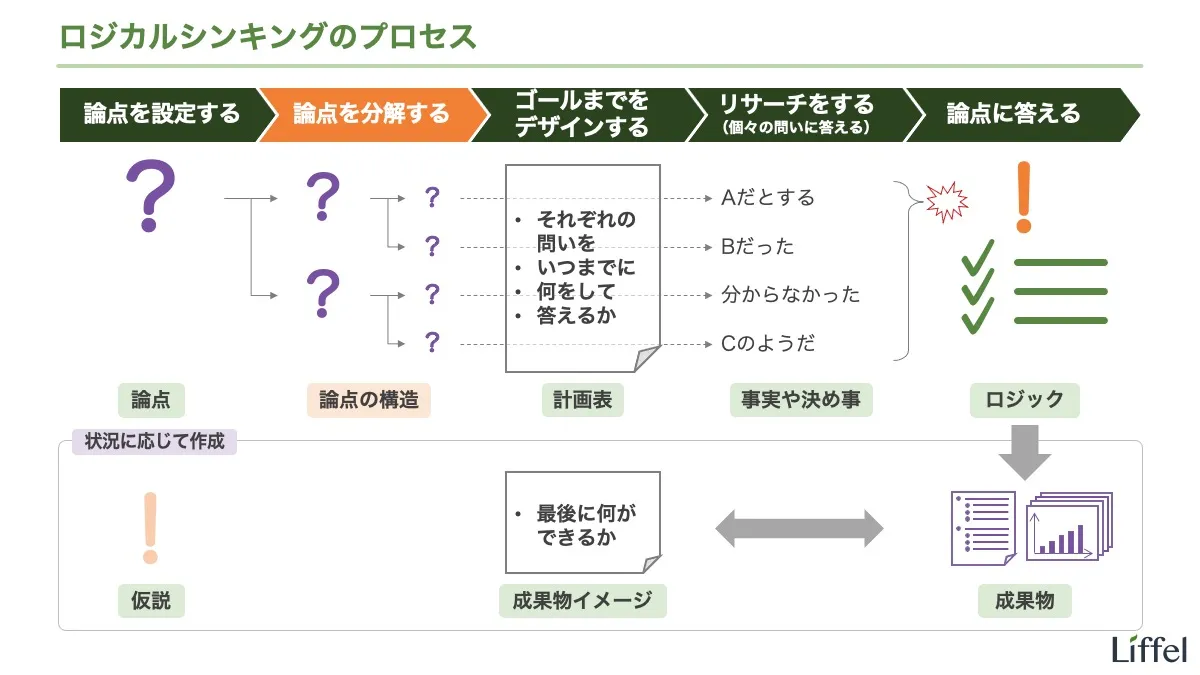
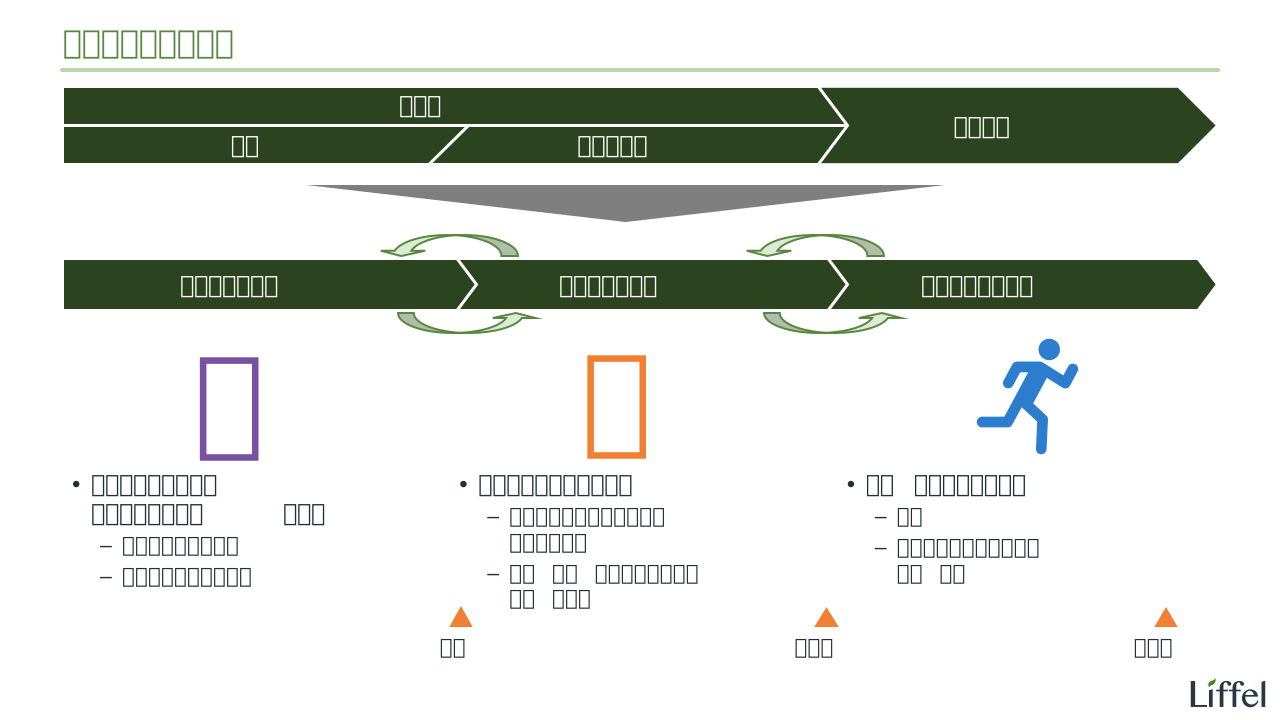
The second process in rational thinking is breaking down the question.
The question you set in the first process is almost always too large (as a concept) to answer directly. You need to make it smaller — down to a manageable level. This operation is what we call “breaking down” the question.
The overall picture is explained in detail in a separate entry. If the explanation above was not enough, read the following entry before continuing.
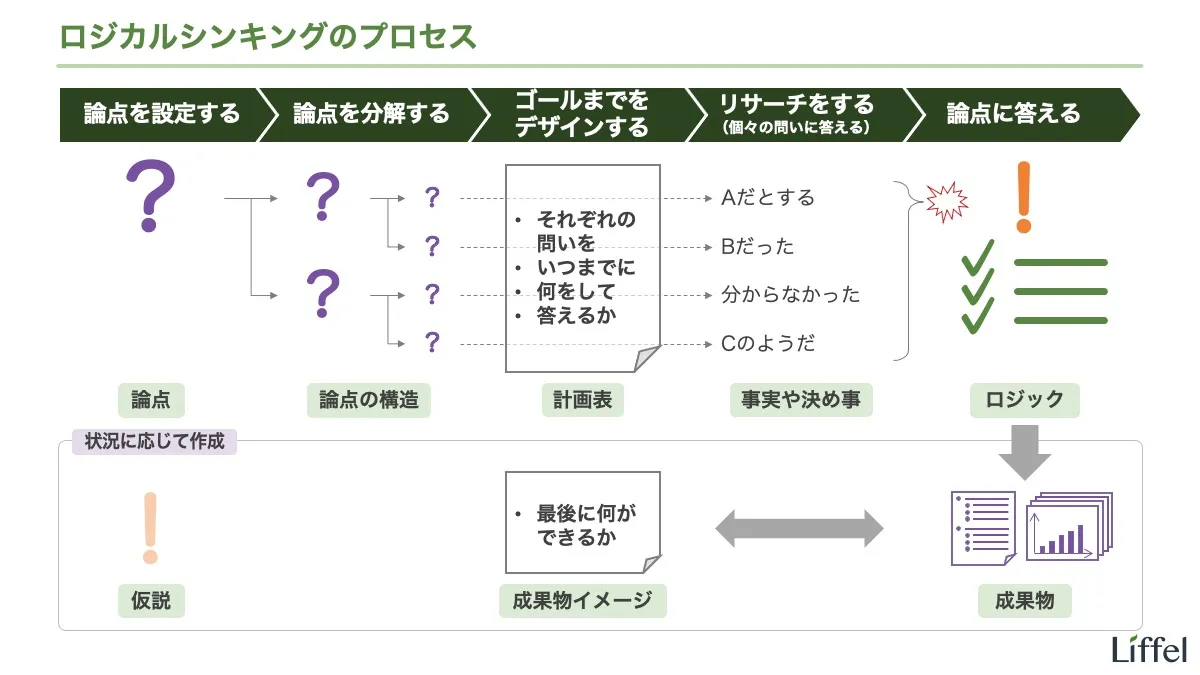

The Deliverable and the Goal of This Process
The deliverable of this process is the question structure (a set of broken-down sub-questions). As an example, here is the question structure for the question “How should I study to score 100 on the TOEFL in one year?”
- How should I study to score 100 on the TOEFL in one year?
- How many hours a day will I likely need to study?
- What score should I aim for in each of the four sections (Reading, Writing, Listening, Speaking)?
- What is my current level in each of the four sections?
- How much study is likely needed to close the gap?
- How should I secure the necessary study time?
- When and where should I study?
- Which section should I start with?
- Should I work on all four sections equally, or are there sections I should prioritize?
- How should I study each section?
- What materials should I use?
- What study methods are effective?
- How should I track my progress (whether I am getting closer to the goal)?
- How often should I take the TOEFL?
- Are there other low-cost ways to track progress?
- How many hours a day will I likely need to study?
Notice that the top-level question (the main question) has been turned into a set of smaller, more manageable sub-questions. You could call this a “question tree.” Once you have built something like this, the process is complete.
Naturally, this breakdown needs to be right. The goal of this process is to break down the question correctly(ここrightのほうがいいとおもうけど、rightって副詞として使える?). What it means for a breakdown to be “right” will be explained later. For now, just keep in mind that this is the goal.
The goal of the breakdown process: break down the question correctly
What Makes a Breakdown “Right”?
Let us get to the main topic. What kind of breakdown counts as “right”?
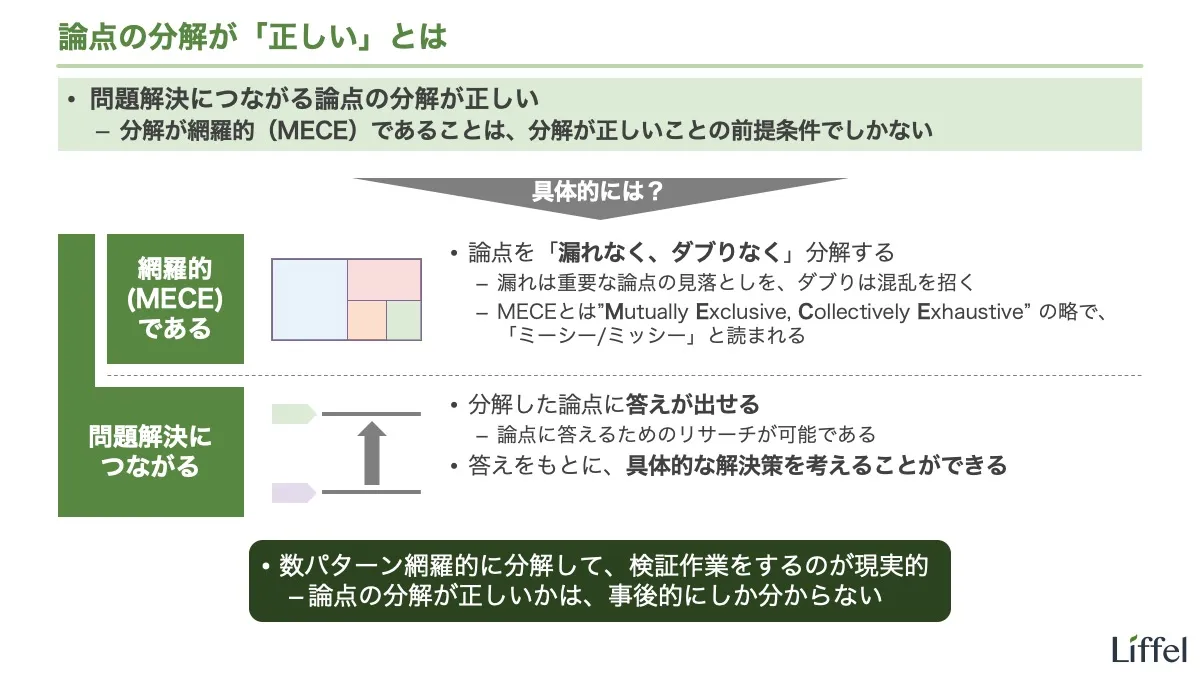
Start by looking at the conclusion. I have summarized it in the following slide.
A breakdown that leads to problem-solving is a right breakdown of the question.
Here are the key points:
- A breakdown that leads to problem-solving is a right breakdown
- Being exhaustive (MECE) is merely a precondition; an exhaustive breakdown is not automatically a right one
- For a breakdown to lead to problem-solving, the broken-down sub-questions need to have the following properties:
- You can arrive at answers to the sub-questions
- Those answers let you develop concrete solutions
I will explain each of these in order. If you are unfamiliar with the concept of “problem-solving,” read the following entry first. It explains the relationship between problem-solving and rational thinking.
Condition for a Right Breakdown #1: Being Exhaustive (MECE)
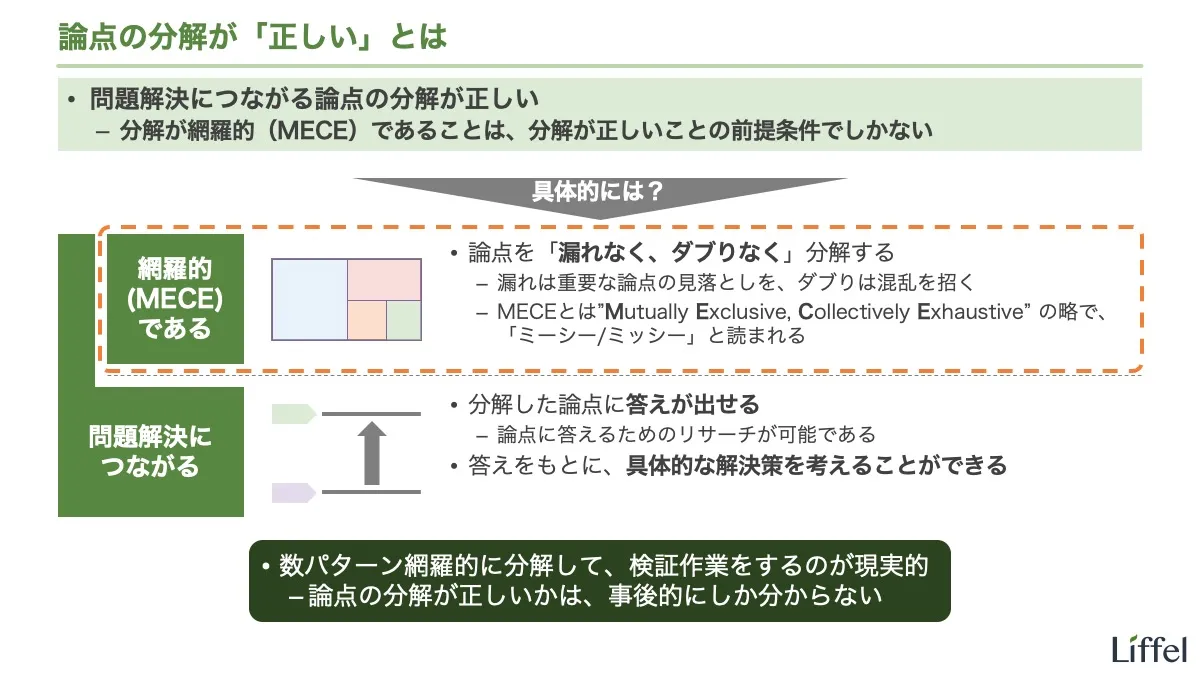
The first condition for a right breakdown is being exhaustive (MECE). If the breakdown is not exhaustive, your premises will not be exhaustive either, and as a result they will lack validity — meaning your claim will not be right.
This has already been explained in the following entry, so I will skip the details here.
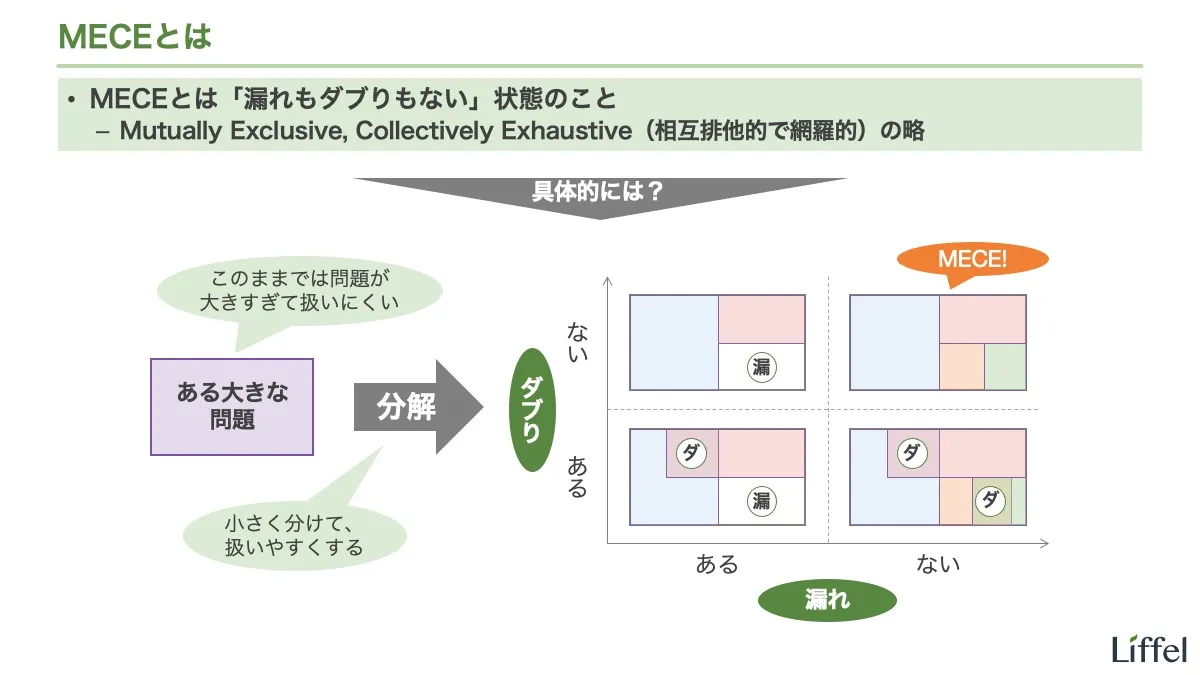
The entry above broke down a concept (a noun). Let us also confirm what it looks like to break down a question (an interrogative sentence). For example, the question “What are our sales in Japan?” can be broken down exhaustively by region as follows:
- What are our sales worldwide?(この分解でいいかな?ロシアが漏れている?)
- What are our sales in North-America?
- What are our sales in South-America?
- What are our sales in Europe?
- What are our sales in Africa?
- What are our sales in Asia and Middle East?
As you can see, the first requirement is to ensure that the breakdown is exhaustive.
Exhaustiveness Is Not a Sufficient Condition
What I actually want you to remember is the opposite. Just because you broke down the question exhaustively does not mean the breakdown is right. Even if the breakdown is exhaustive, it is meaningless if it fails to meet the condition of “leading to problem-solving.”
Put differently, exhaustiveness is a necessary condition for a right breakdown — a precondition — not a sufficient condition.
In my experience teaching rational thinking, I have seen several people who turned “breaking things down exhaustively” into an end in itself. They kept repeating exhaustive breakdowns that were clearly unproductive — unlikely to solve anything.
This is probably because typical books on rational thinking emphasize “be MECE” above all else. People end up mistaking MECE for the ultimate goal.
As I will explain in more detail later, what matters most when breaking down the question is “will this breakdown solve the problem?” — not “is this breakdown exhaustive (MECE)?”
To be sure, a breakdown should be exhaustive (MECE). However, if you get trapped by this and keep repeating wrong breakdowns, you are putting the cart before the horse. What counts as exhaustive is also a subjective judgment, and aiming for perfect exhaustiveness is not realistic. If you have studied rational thinking elsewhere, do not let the term “MECE” distract you.
An exhaustive breakdown is not automatically a right breakdown.
Condition for a Right Breakdown #2: Leading to Problem-Solving
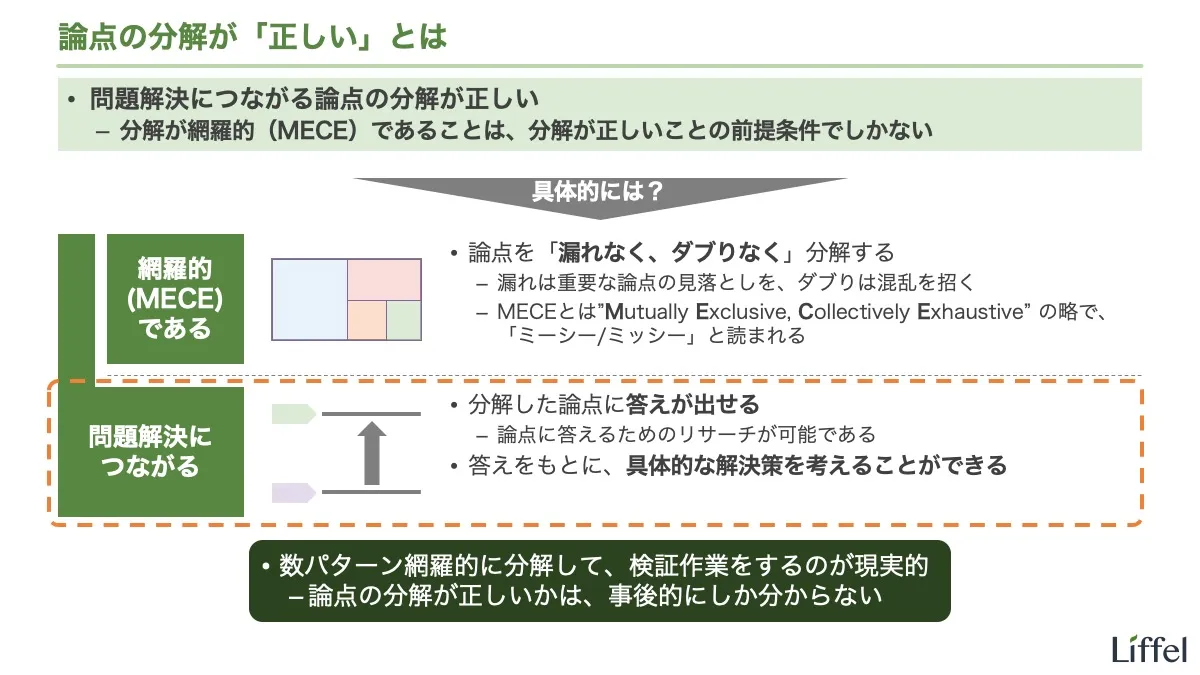
This brings us to the main point. A right breakdown leads to problem-solving.
Problem-Solving and Rational Thinking
You should break down the question in a way that leads to problem-solving. Why does this condition need to be met?
The short answer: in most cases, the reason you use rational thinking is to solve problems. Breaking down the question is part of rational thinking, so it too needs to lead to problem-solving.
Let me explain concretely. Compare the following two questions:
- What was the average life expectancy of people in the Jomon period (roughly 14,000–300 BCE)?
- Why are our sales declining?
These two questions have fundamentally different purposes.
The purpose of thinking about question #1 boils down to “I want to know the right answer.” It is hard to imagine the answer to this question affecting anything beyond our intellectual curiosity. Incidentally, a search turns up the figure “around 15 years” (though the accuracy of this is uncertain). Surprisingly short.
What about the purpose of thinking about question #2? At a shallow level, it is also “I want to know the right answer.” However, the real purpose behind this question is “to recover our sales.”
This means that for question #2, finding the right answer is not enough. You need to change your actions based on that answer and change the current situation (in this case, sales). When the situation actually improves (sales recover), we call that “problem-solving.”
The point is this: when thinking about questions like #2, achieving the goal of rational thinking — “finding the right answer” — is not sufficient on its own. If the results of rational thinking do not lead to problem-solving, they are meaningless. Rational thinking is nothing more than a means for problem-solving.
Unless you belong to the world of specialized researchers, you will rarely think seriously about questions like #1. In the vast majority of cases where you use rational thinking, you must break down the question in a way that leads to problem-solving.
Rational thinking is a means for problem-solving, so the answers it produces need to contribute to problem-solving.
What Does a Breakdown That Leads to Problem-Solving Look Like?
How should you break down the question so that it leads to problem-solving?
This is easier to understand by looking at “a breakdown that is exhaustive but does not lead to problem-solving.” Consider the following situation:
- The question: Why are our sales declining?
- Additional context: The company sells detached houses (high-priced products costing upwards of 100,000 dollars)
Suppose you broke down the question as follows. Is this breakdown right?
- Why are our sales declining?
- Are morning sales declining? If so, why?
- Are afternoon sales declining? If so, why?
Breaking down sales into morning and afternoon has no gaps and no overlaps. In other words, this breakdown is exhaustive. However, this breakdown is not right. Breaking the question down this way will not lead to problem-solving.
Reason This Breakdown Fails #1: It Cannot Be Verified
First, the broken-down sub-questions cannot be verified.
Unless you have data on what time each sale was made, you cannot verify this. Such data does not exist unless you are in a retail business (say, a convenience store) with a POS system that tracks what sold when. For products like houses — purchased by signing a contract — the best data you can get is the date. Without data, you cannot verify the sub-questions.
Reason This Breakdown Fails #2: Verification Would Be Meaningless
Furthermore, there is no point in verifying the broken-down sub-questions.
For the sake of argument, suppose you had data on the exact time each deal closed — say the contract had a field for the time of signing. I have never seen such a contract, but let us suppose it exists.
Even if you ran an analysis on this data, it would not yield a meaningful insight.
Deciding whether to buy a high-priced product like a house is a lengthy process. It is not something you can decide on impulse, the way you might grab a snack at a convenience store. The time at which a customer signed the contract is therefore meaningless.
Given that sales are in fact declining, an analysis would show that either morning or afternoon sales have dropped. However, thinking about “why morning (or afternoon) sales declined” will not produce any meaningful insight.
By the time customers sign a contract, they have already decided to buy. The information we actually want — “why did they stop buying from us?” and “what would make them buy from us again?” — is not contained in that data.
Reason This Breakdown Fails #3: There Is No Viable Solution
On top of all that, even if some insight emerged, there would be no viable solution.
Stretch the imagination enormously and suppose the analysis yielded something like this: “For such-and-such reasons, deals set in the afternoon are more likely to fall through. You should schedule meetings in the morning and get the contract signed there.”
This solution is not feasible because meetings are scheduled at the buyer’s convenience.
To solve a problem, you need a solution that concretely describes the who, what, when, where, and how. That solution also needs to be something you can actually carry through. A solution that fails to meet these two conditions will either never be executed or will not last.
In the end, for the detached-house case, breaking down “Why are our sales declining?” by time of day did not lead to problem-solving. The sub-questions could not be verified; even if they could, verification would have been meaningless; and even if it were meaningful, no viable solution could have been produced.
This breakdown, in other words, was exhaustive but not right.
Conditions for a Breakdown That Leads to Problem-Solving: Summary
If we flip the discussion so far, we can see the conditions for a breakdown that leads to problem-solving:
- You can arrive at answers to the broken-down sub-questions
- Verification through research (observation or data analysis) is possible
- Those answers let you develop concrete solutions
In practice, however, it is almost never the case that every broken-down sub-question meets the conditions above. If even one of the sub-questions meets them, you can consider the breakdown right. This is the concrete meaning of “leads to problem-solving.” Take another look at the slide.
Incidentally, you often cannot tell in advance whether a breakdown will lead to problem-solving. The example I used earlier was an obviously wrong one. In reality, breakdowns that seemed promising often turn out not to work. Since it is not unusual to find no data or to get only uninteresting results from an analysis, do not be too discouraged.
Whether a breakdown was right can only be determined after the fact. You break it down, do the verification work, and only then find out whether it was a hit or a miss. Developing an eye for breakdowns that are more likely to succeed beforehand is important, of course. However, rather than agonizing over the breakdown or spending too much time on it, you are better off moving quickly to verification — especially as a beginner. Sometimes all you can do is generate several exhaustive breakdowns and try them one by one.
That concludes the explanation of breaking down the question. Starting next time, we will learn concrete methods for breaking down the question.
Entries related to rational thinking are collected on the following page. Please refer to it as well.