This entry explains how to spot useless frameworks. Since the world is full of frameworks that are no use at all, let’s learn to judge for yourself which frameworks to use.
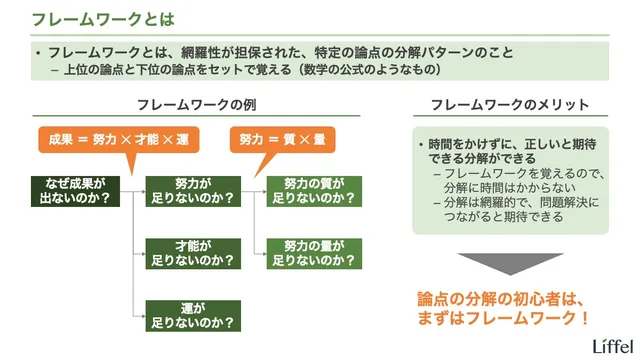
This entry doesn’t explain the word “framework” itself. If you’re unsure about it, read the entry below first.

Let’s begin.
toc
- Fake Frameworks
- Characteristic 1: The Main Question Is Unclear
- Characteristic 2: They Aren’t Exhaustive
- A Classic Fake Framework: SWOT
- References
Fake Frameworks
As you know, the word “framework” is everywhere. Perhaps that’s because it sounds like jargon, with an air of a secret weapon about it.
As a result, the world is full of so-called “frameworks” that look impressive at first glance but are actually useless. Let’s call these “fake frameworks.”
Fake framework: something commonly called a “framework” that’s actually useless
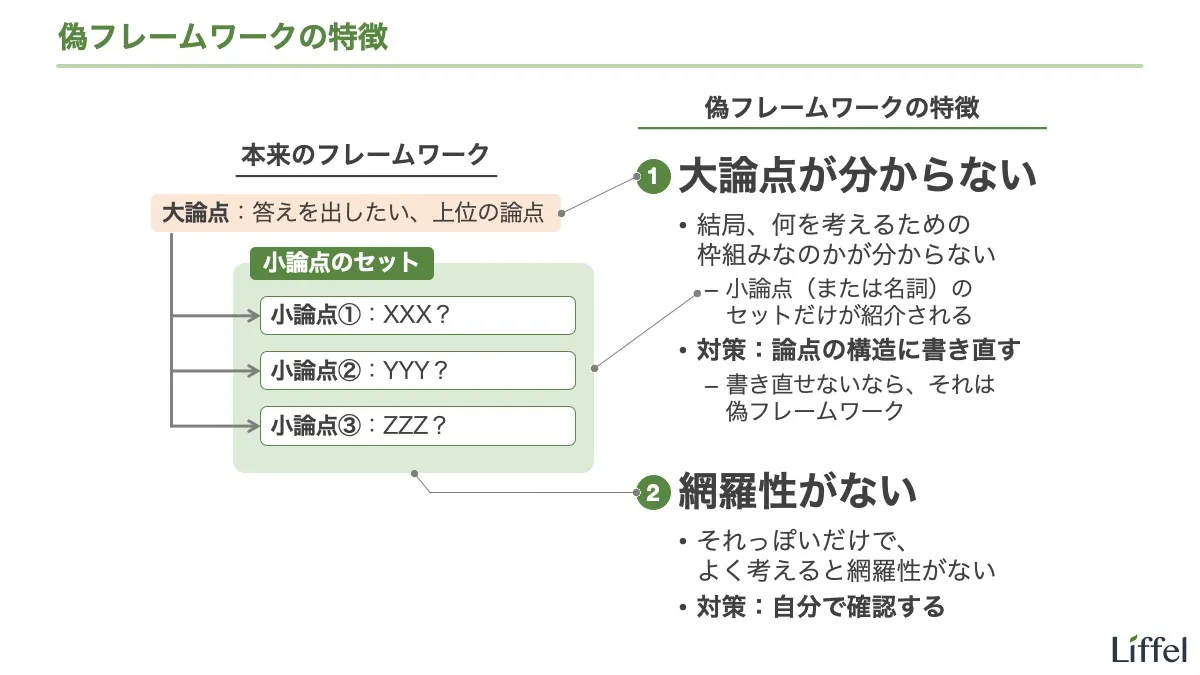
The slide below summarizes the characteristics of fake frameworks.
As shown, fake frameworks have the following characteristics:
- The main question (higher-level question) is unclear
- They aren’t exhaustive in the first place
Let me explain each in turn.
Characteristic 1: The Main Question Is Unclear
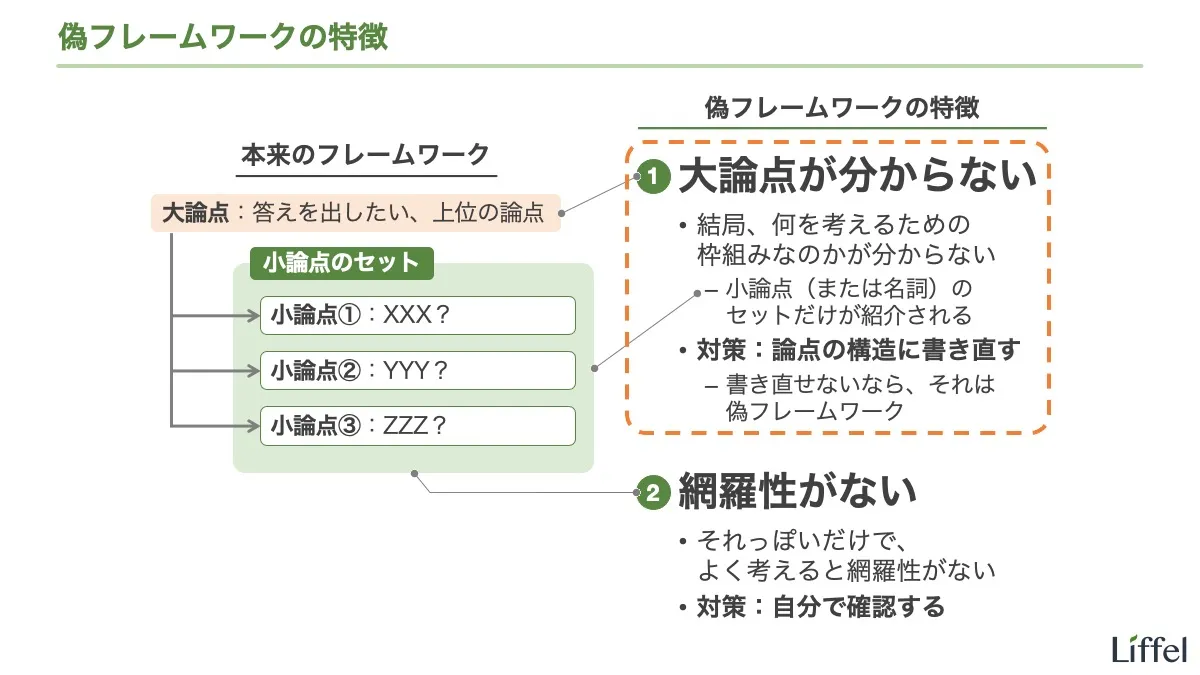
The first characteristic of fake frameworks is that the main question is unclear. You’re shown three or four neatly organized categories (sometimes more), but it’s unclear what question they’re meant to answer.
A framework is just one way of breaking down a question, and the purpose of breaking down a question is to answer the higher-level question. In other words, a framework with an unclear main question can’t be used. This is a typical characteristic of fake frameworks.
Fake Framework Example 1: The 3Cs
Let me explain with a concrete example. A classic fake framework with no main question is the “3Cs.”
The 3Cs combine Company, Competitor, and Customer, and are said to be a framework for looking at markets. They appear in almost every book with “framework” or “marketing” in the title, so you may have heard of them.
As a bulleted list, they look like this:
- Market
- Company
- Competitors
- Customers
The 3Cs are completely useless. Analyzing a market with the 3Cs doesn’t yield any insightful message. And if a framework yields no message, it’s useless. Since “the 3Cs” has become common knowledge among businesspeople, it doesn’t hurt to know the term. But you should never use it at work.
The fatal flaw of the 3Cs is that there’s no concrete interrogative sentence you want to answer. As mentioned, there’s no main question.
It’s true that a market consists of the company, competitors, and customers, with no gaps or overlaps. In other words, the 3Cs break down a market exhaustively (depending on how you define “market”1).
And that’s all. The 3Cs offer nothing beyond that. “Market” is just a noun, a concept. The 3Cs don’t tell you what question about the market you can answer by looking at the three elements of company, competitors, and customers.
In other words, the 3Cs can’t be rewritten as a question structure (a breakdown in the form of interrogative sentences). As you learned in the previous entry, a question structure looks like this:
- Why am I not getting results in XX?
- Am I putting in enough effort?
- Do I have enough talent?
- Do I have enough luck?
Can the 3Cs Be Turned into a Question Structure?
Try rewriting the 3Cs as a question structure yourself.
Rewrite the “3Cs” as a question structure.
How did it go? For the main question, you can probably only write a vague interrogative sentence like “What’s going on in the market?” The same goes for the sub-questions (lower-level questions).
Conversely, if you set a concrete main question like “Should we enter this market?”, there’s no good reason to break it down into “company, competitors, and customers” to answer it. For this main question, breaking it down as follows is better for reaching an answer:
- Should we enter this market?
- Market potential: How will needs for the value this market provides change over the medium to long term?
- Chance of winning: Do we have a chance of winning in this market?
- Motivation: Do we want to enter this market?
If a business seems likely to have needs going forward, you have a chance of winning, and it’s something you want to do, you should probably do it. The same goes for individual careers2.
To sum up, if something merely breaks down a noun neatly and can’t produce a set of concrete interrogative sentences, it’s a fake framework. Be careful not to be fooled.
How to Judge a Framework 1
Turning what we’ve covered on its head reveals a way to tell real frameworks from fake ones.
You can tell whether something called a “framework” is real by whether it can be rewritten as a question structure.
Both frameworks and fake frameworks are expressed using only nouns. Otherwise they wouldn’t be catchy. In the previous entry, I too expressed frameworks with nouns: “Results = Effort × Talent × Luck” and “Effort = Quality × Quantity.”
But usable frameworks can always be rewritten as question structures. Problem solving ultimately means answering questions (interrogative sentences) and acting. A framework that can’t break down interrogative sentences is useless.
How to judge a framework 1: check whether it can be rewritten as a question structure
To repeat, be aware of what the main question is. Most “frameworks” in circulation don’t state this. They only show the result of the breakdown.
That leaves you not knowing what the framework is ultimately for, and you tend to end up “knowing the framework but never having used it.” When you come across a new framework, start by writing out its question structure.
Characteristic 2: They Aren’t Exhaustive
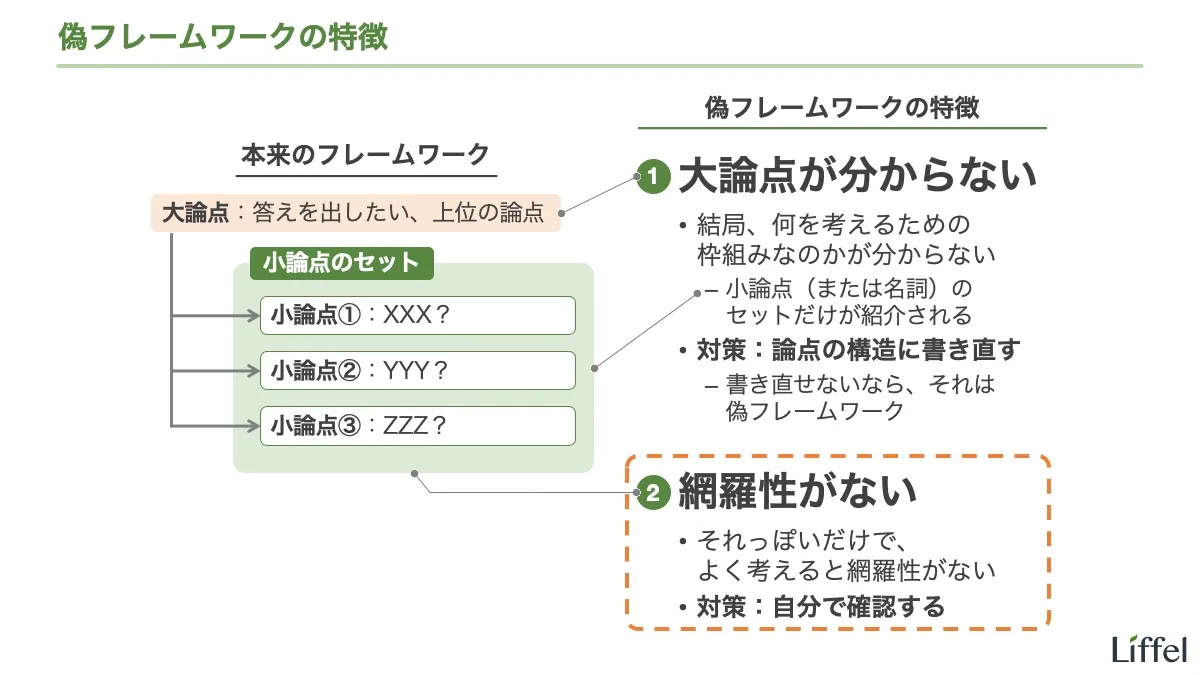
The second characteristic of fake frameworks is that they aren’t exhaustive in the first place. Some classification is presented as if it were exhaustive, but on closer inspection, it isn’t.
For most people, frameworks come from authoritative sources such as business books and corporate training. Normally, you wouldn’t expect such authorities to present frameworks that aren’t exhaustive. That’s why it’s easy to pick up useless frameworks. Be careful.
Fake Framework Example 2: Michael Porter’s Three Generic Strategies
A classic example of a framework that isn’t exhaustive is “Michael Porter’s three generic strategies.” Although it’s a somewhat old example, let me introduce it.
It broadly divides the strategies a company can take into three:
- Cost leadership (selling more cheaply than others)
- Differentiation (delivering value others can’t)
- Focus (narrowing the area where you invest resources)
I’ll skip further explanation here. If you want to know more, search for “Michael Porter generic strategies.” You’ll find any number of sites explaining them. As I’ll explain, however, this framework is wrong, so there’s no point in memorizing it.
Are Porter’s Three Strategies Exhaustive?
Let me explain this framework’s problem concretely.
In Competitive Strategy, which is even called the businessperson’s bible, Porter writes that there are three potentially successful generic strategies for outperforming other firms in coping with the five competitive forces: cost leadership, differentiation, and focus. He adds that a firm can occasionally pursue more than one successfully as its primary target, but that this is rarely possible.
In short, Porter is saying that “these three strategies are exhaustive and work as a framework”3. The only answers to “How can we outperform other firms?” are these three, and you can only pick one. Is that really true?
To give the conclusion first: no. Unfortunately, the businessperson’s bible contains a fake framework.
Let me explain concretely.
First, in any market, you can’t gain an advantage unless you (1) gain a cost advantage or (2) differentiate. This is obvious if you think about it the other way around. Would you want to buy a product that’s no better in product value, promotion (including brand), or ease of purchase, and is also more expensive? Of course not.
Yet Porter’s strategies include a third option. Porter says that focus, that is, (3) narrowing the market segment you target, lets you gain an advantage in the market.
That means narrowing the market segment you target (3) automatically achieves either a cost advantage (1) or differentiation (2) (or both).
By what mechanism could that possibly happen? Porter explains that the focus strategy rests on the premise that a firm can serve its narrow strategic target more effectively or efficiently than competitors who compete more broadly.
Note the bold part. The focus strategy is built on this premise that Porter set.
And this premise is wrong, because it leaves out the concept of management resources. Porter’s premise holds when your company and all your competitors have equal management resources, but not otherwise. In reality, the amount of management resources companies have varies enormously.
Or rather, the size and number of market segments a company can target is a constraint determined by the management resources it has. For example, it’s clearly unreasonable for a company with $100,000 in capital to run ten businesses4. In any market, you can’t achieve either a cost advantage or differentiation without investing a certain level of management resources. In other words, it’s fair to say that targeting market segments (in size and number) beyond your means will definitely fail.
Put the other way, surviving companies are always focused to some degree. In other words, being focused (narrowing market segments appropriately to match your management resources) is a necessary condition for gaining an advantage in the market, not a sufficient one. It’s not a matter of “focus and you’ll win.”
What’s more, in an environment where the management resources of companies vary enormously, it’s impossible to judge concretely whether a company is “focused.” For example, which is more “focused”: a company with $1 million in capital running a single business, or a company with $100 million in capital running three?
I’ll stop here, but in any case, don’t blindly trust a classification just because it was devised by someone said to be brilliant.
How to Judge a Framework 2
So the discussion so far reveals the second way to judge a framework.
When you encounter a new framework, check critically whether it’s really exhaustive.
The way to check critically is simply to think concretely. In the case of Porter’s generic strategies, think about whether you can name a specific company that “(1) isn’t cheaper,” “(2) isn’t differentiated,” but “(3) achieved high profits by narrowing its target segment.”
How to judge a framework 2: check critically whether it’s really exhaustive
Note, however, that you don’t need to examine this point as strictly as whether there’s a higher-level question.
This site defines a framework as “a specific breakdown of a question that is established to be exhaustive (MECE),” but exhaustiveness is decided subjectively to begin with, and one could also take the view that “even if it’s not exhaustive, it’s fine as long as the main sub-questions are covered.” Since frameworks are just aids to thinking, if you find one useful, use it.
A Classic Fake Framework: SWOT
Finally, let me introduce SWOT as a classic fake framework. Because it’s so well known, it’s a fake framework that calls for particular caution.
SWOT
SWOT combines the initials of Strengths, Weaknesses, Opportunities, and Threats.
Expressed as a question structure, SWOT looks like this:
- ???
- Strengths: What are our strengths?
- Weaknesses: What are our weaknesses?
- Opportunities: What are our opportunities?
- Threats: What are our threats?
So with this framework, the main question is unclear. It’s not clear what it’s meant to help you think about.
Strictly speaking, it’s not so much that the main question is unclear as that all sorts of things are described as SWOT’s main question. In what I researched alone, the following were given as SWOT’s purpose or main question:
- Formulating strategy (What strategy should we take?)
- Analyzing the current situation (What situation are we in?)
- Deciding how to achieve a goal (What should we do to achieve goal X?)
That alone makes it clear this framework is useless. These three questions are clearly different. Different main questions can’t be answered with the same set of sub-questions.
Furthermore, the sub-questions don’t seem exhaustive either. Although “strengths and weaknesses” and “opportunities and threats” each feel exhaustive, why would considering these four be exhaustive for the main question (when the main question isn’t even clear)?
In fact, when I tried breaking down several concrete main questions with SWOT, I couldn’t derive a convincing conclusion from these four sub-questions. The logical connection between the conclusion and the sub-questions breaks down.
Saying this, you may think, “Then why does SWOT appear in almost every business book?” Honestly, since I’ve never seen or used SWOT at work, I’m puzzled too about why SWOT is so famous.
For what it’s worth, my hypothesis is that doing a SWOT analysis makes you feel as if you’ve thought things through and reached a conclusion.
A SWOT analysis produces a table as its output, and it’s easy to make. Everyone knows their company’s strengths and the opportunities in their industry. On top of that, you can then do a cross-SWOT analysis.
Through activities like these, perhaps it’s easy to get the sense that “this conclusion isn’t arbitrary, but the result of thinking backed by premises.”
These days, some say “SWOT is outdated,” but in my view SWOT isn’t outdated. It was wrong from the start. I’ll stop here, but in any case, I recommend not using SWOT.
That said, since this is only my opinion, check it critically for yourself too.
Bonus Characteristic of Fake Frameworks: Making a Table Doesn’t Produce an Answer
Summing up the discussion so far, another characteristic of fake frameworks seems to be that “they can produce a table as output, but it’s unclear what the table answers.” That goes without saying for SWOT, and also for the 3Cs above. PEST analysis is another example (details below).
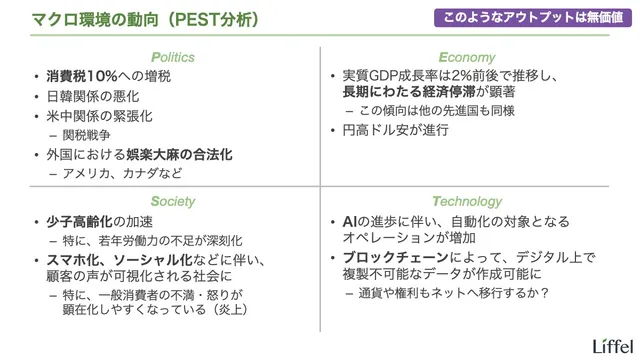
This is really just another way of saying “the main question is unclear,” but it may be an easier criterion to use. Be careful not to be satisfied just by making a table.
That covers how to spot useless frameworks. In reality, there’s an oversupply of frameworks. Don’t trust them blindly. Keep the attitude of choosing for yourself the frameworks that are truly usable.
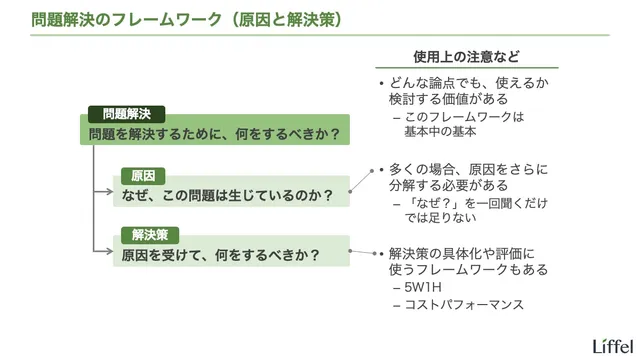
From the next entry, let’s learn specific frameworks, starting with the problem-solving framework. Of course, critique these frameworks for yourself too.
Entries related to critical thinking are collected on the page below. Feel free to use them as a reference.
References

Footnotes
-
If you define “market” as “the set of sellers and buyers of a given value,” the 3Cs break it down exhaustively, since sellers are the company and its competitors, and buyers are the customers. But if you define the market more broadly, things change. For example, if you define a “market” as “everything that affects a given exchange of value,” the government and customers’ families are definitely part of it, and possibly even a butterfly flapping its wings in South America, since it’s unclear what affects an exchange of value. ↩
-
However, when using this breakdown for an individual career strategy, it’s better to break “chance of winning” down further into “the chance of the company you’re joining winning in its market” and “your chance of winning within that company.” If the company goes under, your promotion won’t matter, and conversely, even if the company is thriving, being sidelined is no fun. ↩
-
Strictly speaking, Porter’s generic strategies go a step further than a framework. They’re a list of solutions, not a list of broken-down questions. ↩
-
Strictly speaking, capital doesn’t reflect the amount of management resources, but I’ve described it this way for clarity. ↩